
Why Christian reconciliation ministries focus on repentance is not a preference for harshness; it is a commitment to reality. Without repentance, reconciliation collapses into conflict management, reputation repair, or a temporary truce. Christian donors who care about lasting peace should expect ministries to name sin truthfully, pursue justice carefully, and aim for restored communion without bypassing the cross.
That expectation also raises hard questions. Repentance language has been misused to pressure victims into silence, to force premature “forgiveness,” or to maintain institutional stability at the expense of truth. Mature Christian peacemaking refuses those distortions. It insists that repentance is first a spiritual turning to God and only then a rebuilding of human trust, often through costly, verifiable change.
Repentance is the theological doorway to genuine peace
Reconciliation is not a substitute for the gospel
In Scripture, reconciliation begins with God’s action toward us: “while we were enemies we were reconciled to God by the death of his Son” (Romans 5:10). The New Testament does not present reconciliation as a technique for smoothing relationships. It presents reconciliation as the fruit of atonement, received by faith, and expressed through a changed life. Repentance is the human response that corresponds to that gift: a turning from sin toward God, not merely an apology for consequences.
That is why ministries serious about Christian peacemaking are reluctant to replace repentance with softer language such as “taking responsibility” or “moving forward.” Those phrases can describe real progress, but they can also function as moral fog. Repentance names the problem as sin before God, not only harm between people. It clarifies that reconciliation is not achieved by personality alignment or negotiated compromise alone.
Repentance protects reconciliation from sentimentality
Christian donors often carry fatigue from seeing public reconciliations that dissolve within months. The reason is rarely a lack of goodwill. It is the absence of transformation. John the Baptist’s counsel remains a bracing standard: “Bear fruits in keeping with repentance” (Luke 3:8). Repentance is not an interior feeling; it produces observable fruit over time.
When reconciliation ministries foreground repentance, they are often protecting the process from becoming sentimental theater. “Peace” without repentance tends to reward the more powerful party, who can dictate what counts as closure. Repentance re-centers the moral order: God is holy, sin is real, and peace is not purchased by denying either.

Repentance is a safeguard for truth, especially when power is involved
Scripture’s model of confession is concrete
Christian reconciliation work lives in the tension between mercy and truth. “Love… rejoices with the truth” (1 Corinthians 13:6). In practice, that means repentance must move beyond generalities. Where wrongdoing has been done, confession should name what occurred, acknowledge impact, and refuse self-justifying narratives.
In our review of ministries that serve churches, families, and community institutions, the most credible programs resist the temptation to treat conflict as symmetrical. Some conflicts are mutual misunderstandings. Others involve clear moral harm. Repentance language helps ministries avoid reducing every situation to “both sides need to own their part,” which can be deeply unjust when one party has abused authority.
Reconciliation can become coercive without repentance
Christians genuinely disagree about how quickly restored relationship should follow confession, and different traditions emphasize different pastoral instincts. But the field has had to reckon with a sobering reality: calls for “unity” can become a spiritualized demand that vulnerable people absorb harm for the sake of the group’s peace.
Repentance, rightly practiced, pushes in the opposite direction. It requires the wrongdoer to come into the light and accept costly consequences. It also creates moral space for the wounded to tell the truth without being blamed for “division.” In that sense, repentance is not the enemy of compassion; it is one of compassion’s protections.
What repentance requires in practice
Not every apology is repentance
Donors sometimes ask what they should look for when evaluating a reconciliation ministry’s approach. Repentance is not measured by intensity of emotion or religious vocabulary. It is measured by clarity, humility, and durable change. Zacchaeus’s response to Jesus included restitution and a new pattern of life, not only remorse (Luke 19:8).
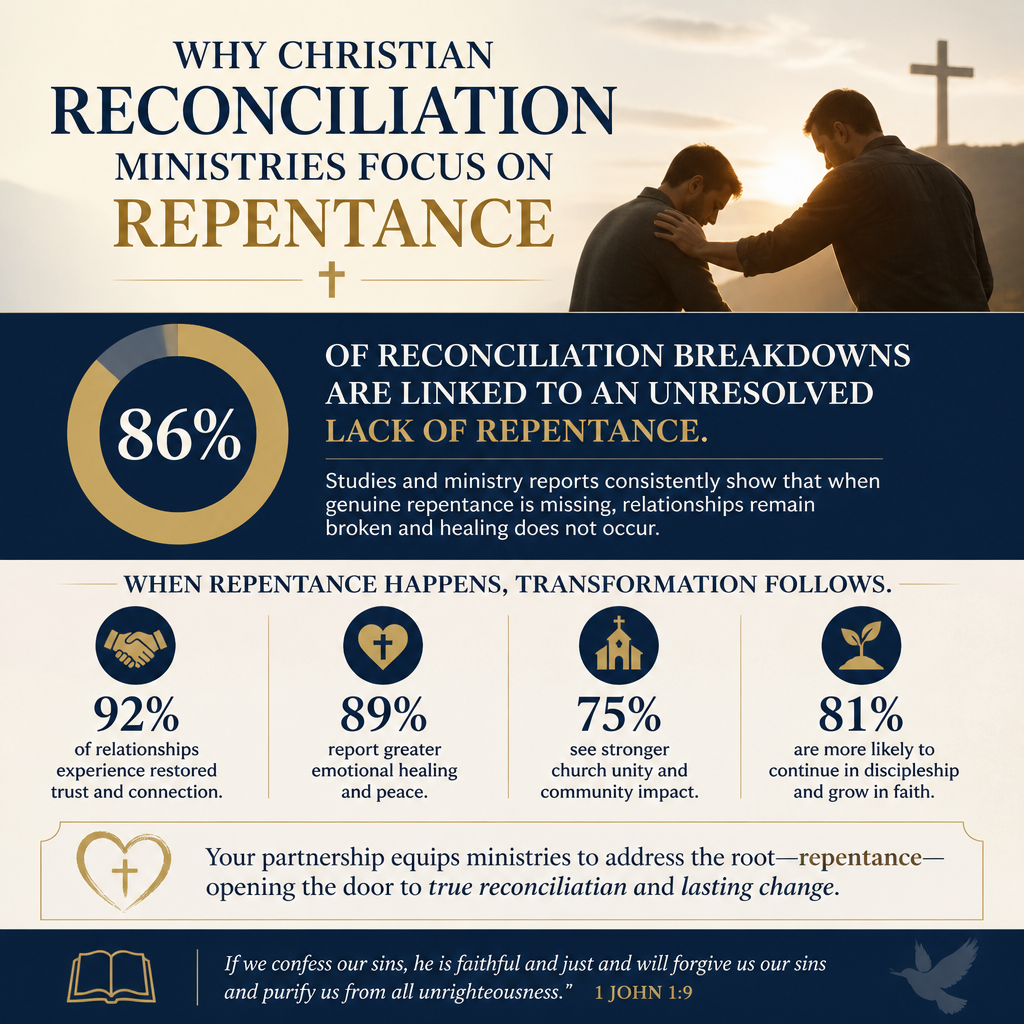
What this means in practice is that strong reconciliation ministries teach a thicker moral vocabulary than “say you’re sorry.” They train people to distinguish between regret, remorse, confession, and repentance. They also make room for the time it takes to rebuild trust. Forgiveness can be offered without immediate restoration of access.
Healthy ministries insist on fruit over time
A concise way to describe repentance in reconciliation work is that it includes truth, ownership, and repair. Different settings require different forms of repair, but the category itself matters because it shifts the focus from managing optics to pursuing righteousness.
- Truth-telling: naming what happened without euphemism or blame-shifting
- Ownership: accepting responsibility without demanding quick absolution
- Restitution: making repair where repair is possible, including financial repair when appropriate
- Boundaries: honoring safeguards that protect the harmed, even when inconvenient
- Accountability: submitting to leaders or structures that can verify change
For donors, that list is not a checklist for judging private souls. It is a framework for discerning whether a ministry’s reconciliation outcomes are credible and whether its methods align with Scripture’s moral seriousness.
Repentance, forgiveness, and justice are related but not identical
Forgiveness does not erase consequences
In Christian teaching, forgiveness is commanded for believers, and it is grounded in God’s forgiveness of us (Matthew 6:12). But Scripture does not present forgiveness as the cancellation of all consequences. David is forgiven after his sin with Bathsheba, yet consequences still unfold within his house (2 Samuel 12). The difference matters for donors evaluating reconciliation programs, especially those that operate in contexts involving criminal harm, financial misconduct, or abuse of authority.
Repentance includes willingness to accept appropriate consequences and to seek repair. That stance strengthens, rather than weakens, a Christian witness. It demonstrates confidence that God’s mercy is not threatened by truth. Ministries that teach forgiveness while minimizing justice often damage credibility and can retraumatize the harmed.
Some reconciliations require external authorities
The harder question is how reconciliation ministries relate to civil authorities when wrongdoing may be criminal. Churches have sometimes treated state involvement as a betrayal of Christian peacemaking. Yet Romans 13 describes governing authorities as God’s servants to restrain evil. A ministry’s fidelity to repentance is tested when repentance includes reporting, cooperating, and relinquishing control of outcomes.
Donors should expect careful, legally informed practices, particularly in cases involving minors or financial fraud. When a reconciliation ministry partners with qualified counselors, trauma-informed advocates, or legal professionals, that is not a compromise of Christian conviction. It can be an expression of it.
What donors should examine when funding reconciliation ministries
Repentance must be embedded in governance, not just teaching
Christian donors often support reconciliation work because they have seen the cost of unresolved conflict: divided churches, broken families, and exhausted leaders. The ministries doing this work operate in spiritually charged environments where loyalty and charisma can obscure accountability. For that reason, a ministry’s stance on repentance must be visible not only in its curriculum but in its organizational life.
Across our verification work at Most Trusted, we observe that credible ministries tend to treat repentance as a corporate discipline as well as an individual one. They are willing to correct leaders publicly when appropriate, to revise policies after failures, and to invite external scrutiny. They also communicate clearly about what reconciliation can and cannot promise.
Donors who want to understand the broader landscape of practice and standards can begin with Christian Conflict Resolution Ministries, where the central questions of theology, accountability, and outcomes come into view.
Evidence of integrity is especially important in emotionally charged work
Reconciliation work often involves confidential details and pastoral discretion, which can make it harder for donors to assess outcomes. That reality does not excuse opacity. It increases the responsibility to demonstrate integrity through clear policies, independent oversight, and transparent financial reporting.
Most Trusted evaluates ministries against The Most Trusted Standard, a 15-criteria framework spanning Faith Foundation, Financial Integrity, Governance and Leadership, and Transparency and Effectiveness. A reconciliation ministry may be theologically serious and still be administratively fragile. Donors should look for audited or professionally reviewed financials when appropriate, meaningful board governance, and public-facing clarity about safeguarding and reporting practices.
The category context matters as well, because reconciliation ministries vary widely in their models—from church-based mediation to restorative justice initiatives to post-conflict community rebuilding. The wider frame of The Mission and Impact of Christian Peacemaking Ministries helps donors compare approaches without flattening the theological distinctives that make Christian peacemaking what it is.
FAQs for Why Christian reconciliation ministries focus on repentance
Does focusing on repentance pressure victims to reconcile before they are ready?
It can, and that is a legitimate concern. A biblically faithful approach distinguishes forgiveness from restored relationship and distinguishes reconciliation from immediate access. Repentance, properly understood, places the weight of moral action on the wrongdoer: truth-telling, ownership, repair, and acceptance of boundaries. When a ministry uses “repentance” language to silence the harmed or to accelerate reunification, it is not practicing repentance as Scripture defines it.
How can donors tell whether a ministry uses repentance language responsibly?
Donors can look for concrete indicators: clear safeguarding and reporting policies; a non-defensive posture toward outside accountability; teaching that includes restitution, consequences, and boundaries; and governance structures that can address leader misconduct. The strongest ministries do not treat repentance as a private transaction between two people. They treat it as a moral reality before God that produces fruit over time and can be evaluated without violating appropriate confidentiality.
Repentance is the path to peace that can endure
Christian reconciliation ministries focus on repentance because they are trying to build peace that is truthful, just, and spiritually credible. The cross does not offer a shortcut around sin; it names sin, bears its cost, and creates a new way of life. Donors who fund reconciliation work should expect ministries to honor that order: repentance first, then the long, careful work of rebuilding trust where trust can be rebuilt.



