
Why donors use donor-advised funds for Bible study ministries is ultimately a question of stewardship: how to give with both conviction and clarity when the need is urgent and the landscape is crowded. For Christian donors who want Scripture to shape not only what they support but also how they give, a donor-advised fund can function as a disciplined channel for generosity rather than a detached financial tool.
That said, donor-advised funds raise real questions. Some Christians worry that DAFs can become a form of delayed obedience, with funds parked while ministry needs remain immediate. Others see DAFs as a wise way to simplify giving, involve family, and sustain long-term commitments to the work of the Word. Mature stewardship requires facing both possibilities without caricature.
Donor-advised funds fit the rhythm of serious Christian stewardship
They separate the tax moment from the ministry moment
One reason donors use donor-advised funds for Bible study ministries is straightforward: a DAF allows a donor to make a charitable contribution in a high-income year and then recommend grants over time. For donors whose income is irregular—business owners, those with large one-time gains, or families doing major asset sales—this separation can prevent generosity from being driven by tax deadlines rather than prayerful discernment.
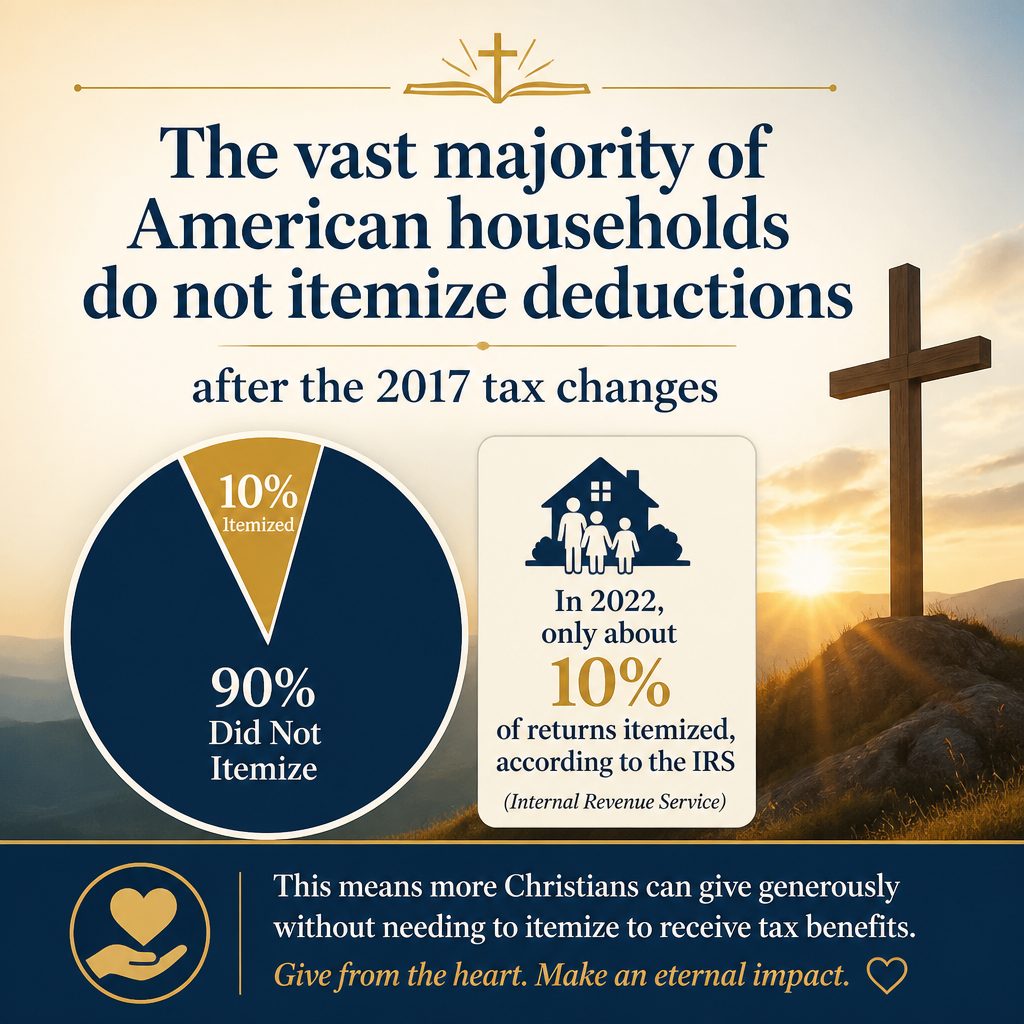
National giving patterns show why this matters. The vast majority of American households do not itemize deductions after the 2017 tax changes; in 2022, only about 10% of returns itemized, according to the IRS (Internal Revenue Service). For donors near the itemizing threshold, “bunching” giving into a DAF in certain years can increase the tax efficiency of giving without reducing the actual ministry support over time.
They help donors give from assets rather than only from cash
Bible study and engagement ministries often benefit when donors can give appreciated assets—publicly traded securities, and sometimes more complex assets—rather than only writing checks. DAF sponsors commonly accept appreciated securities, which can allow a donor to avoid capital gains tax while still giving the full fair market value. The result is often more capital directed toward ministry than would be feasible through cash giving alone.
Not every donor needs this, and not every ministry needs DAF gifts. But for donors with significant appreciated assets, a DAF can align financial stewardship with a theological instinct: “Honor the Lord with your wealth and with the firstfruits of all your produce” (Proverbs 3:9). The principle is not financial sophistication for its own sake; it is the desire to direct more resources toward the Word’s work.

DAFs can stabilize support for Scripture-centered work
They reduce volatility when markets and life circumstances shift
Bible study ministries often operate on relatively modest budgets compared to major institutions, even when their influence is extensive. In that setting, volatility is not an abstraction; it is payroll, curriculum production, translation timelines, and the ability to keep facilitators trained and resourced. A donor-advised fund can create a reservoir that helps a donor keep giving through personal transitions—retirement, a business downturn, a family medical crisis—without forcing sudden changes in support.
This stability matters because Christian giving is meaningfully cyclical. The Giving USA report has documented that charitable giving tends to rise and fall with broader economic conditions, even while generosity is also shaped by formation, discipleship, and local church teaching (Giving USA). Donors who want Scripture engagement work to be less exposed to year-to-year shocks often see a DAF as a way to sustain promises already made.
They make multi-year commitments realistic
Many Bible study and engagement ministries do their best work over years, not months: developing theological curriculum, training leaders, building translation pipelines, or strengthening local-church-based disciple-making systems. A DAF can support multi-year funding because it allows donors to set aside resources when they are available and then issue grants in a measured way.
What this means in practice is that a donor can fund the unglamorous but essential work—editorial review, theological oversight, safeguarding processes, evaluation—without needing a new emotional appeal each year. For donors who want to resist the impulse-driven giving that social media can encourage, the DAF can function as a commitment device.
DAFs can strengthen accountability and verification when used carefully
They can encourage deliberate selection of ministries
Bible teaching ministries range from deeply church-anchored work to celebrity-driven platforms with limited accountability. Donors who use DAFs often become more deliberate, not less, because recommending a grant typically requires selecting an organization, confirming its legal status, and often reviewing basic governance and financial materials. The process is not sufficient for discernment, but it can slow down impulsive giving and create space for wise evaluation.
At Most Trusted, we see this as one of the quiet strengths of DAF-based giving when donors use it with spiritual seriousness. The ministries that meet The Most Trusted Standard tend to show a pattern of clarity: about doctrine and ecclesial relationships, about audited or review-level financial discipline when scale warrants it, about board governance, and about reporting outcomes without exaggeration. Many donors use a DAF precisely because they want repeatable, defensible processes for giving, not simply good intentions.
They can reduce pressure on ministries to chase restricted funds
DAF donors can grant in ways that support general operations, not only highly restricted projects. For Bible study ministries, unrestricted support often funds the connective tissue: pastoral care for volunteers, training systems, curriculum updates, technology maintenance, and the administrative compliance that protects the ministry and those it serves.
Here donors should be candid about the trade-off. A DAF can make it easier to give thoughtfully, but it can also make it easier to give at a distance. Wise donors counteract that distance by requesting clear reporting, asking about doctrinal accountability, and paying attention to whether the ministry’s claims match its public disclosures.
DAFs help families integrate generosity, discipleship, and legacy
They provide a forum for intergenerational formation
Many Christian donors do not only want to fund Bible study work; they want their children and grandchildren to learn a theology of stewardship. A donor-advised fund can function as a structured environment for family conversations: what kinds of Scripture engagement are faithful, what sorts of ministries are accountable, and how to discern between charisma and character.
This is not sentimental. Scripture assumes that worship and instruction are handed down across generations (Deuteronomy 6:6–7). For many donors, a DAF becomes one of the practical mechanisms through which that instruction happens: not simply “give,” but “give wisely,” with the fear of the Lord and with love for the church.
They can support planned giving goals without complex administration for every gift
In the broader world of Legacy and Planned Giving for Bible Study and Engagement Ministries, donors often face a tension between intention and execution. They may want to include Scripture-centered work in a long-range plan, but not create administrative burdens for themselves or for the ministry. A DAF can simplify ongoing giving and coordinate with other planned giving tools, depending on the sponsor’s policies and the donor’s broader estate planning counsel.
Christians genuinely disagree about how much complexity is prudent in giving. Complexity can become an excuse for control, or it can be an expression of faithful order. The difference is often revealed by posture: whether the donor is seeking to serve the mission and the church, or to keep every outcome within personal command.
What wise DAF giving to Bible study ministries requires from donors
DAFs are a tool, not a moral status
The central ethical question around donor-advised funds is not whether they are legitimate; they are widely used and legally established. The harder question is whether the donor’s use of a DAF reflects timely generosity and honest accountability. Some critics have argued that DAFs can delay money from reaching operating nonprofits, while others note that DAFs can increase overall giving and provide reliable grantmaking. A donor should treat this as a stewardship question, not as a partisan one.
For Christian donors focused on Scripture engagement, the discipline is simple to state and demanding to practice: set a giving plan that moves resources outward with intention. In that spirit, donors who use DAFs well often adopt practices like these:
- Establish a written grantmaking cadence that prevents indefinite delay.
- Prioritize ministries with clear doctrinal accountability and healthy governance.
- Fund general operations where the ministry demonstrates financial discipline and truthful reporting.
- Request outcome reporting that is specific but not performative.
- Revisit commitments annually in prayer and with attention to new information.
Verification matters because Scripture work attracts both faithfulness and opportunism
The work of Bible teaching and discipleship draws sincere servants—and, at times, leaders who are unprepared for power or tempted toward financial opacity. Donors should not be surprised by that; Scripture warns that teachers are judged with greater strictness (James 3:1). The point is not suspicion as a posture, but sobriety.
Across our verification work at Most Trusted, we encourage donors to connect passion with evidence. It is wise to ask whether the ministry’s theology is clear, whether its financials are responsibly managed, whether its board provides real oversight, and whether its communications avoid inflated claims. Donors who want to go deeper into how Bible-centered organizations operate can also consult Bible Study and Engagement Ministries as a broader context for discernment.
FAQs for Why donors use donor-advised funds for Bible study ministries
Are donor-advised funds appropriate for explicitly Christian Bible study ministries?
Yes, a donor-advised fund can support explicitly Christian Bible study and engagement ministries, provided the recipient is a qualified charitable organization under U.S. law and the DAF sponsor approves the grant. The more important question is stewardship: whether the donor uses the DAF to give faithfully, promptly, and with appropriate due diligence regarding doctrine, governance, and financial integrity.
Does giving through a DAF reduce a donor’s ability to ensure the ministry uses funds well?
A DAF does not remove the need for accountability; it can heighten it. Because DAF grants are typically irrevocable once contributed to the fund, donors should evaluate recipient ministries carefully before making large commitments. Practices such as reviewing governance structures, requesting clear reporting, and relying on independent verification against a framework such as The Most Trusted Standard can strengthen accountability without turning giving into control.
A disciplined channel for generosity toward the Word
Donors use donor-advised funds for Bible study ministries because DAFs can help align generosity with the realities of modern finance while keeping the focus on Scripture’s enduring work. The tool is not the point; faithfulness is. When a DAF is paired with timely grantmaking, careful ministry selection, and verifiable accountability, it can serve the church by sustaining serious, Scripture-centered formation for years rather than for a single season.



