
How Christian adoption ministries follow international adoption law is not a peripheral compliance question. It is part of whether Christian compassion is expressed with truthfulness, restraint, and a fierce commitment to the child’s good, even when that requires slower timelines and fewer “success stories.” For donors, the legal framework is not an obstacle to mission; it is one of the ways we test whether a ministry’s zeal is governed by love of neighbor rather than outcomes.
International adoption sits at the intersection of children’s vulnerability, governmental authority, and cross-border inequality. The field has had to reckon with real failures: documented cases of coercion, document fraud, and child trafficking occurred in multiple countries during earlier decades of expansion, prompting reforms and closures. A sober donor posture does not assume guilt, but it also does not outsource moral responsibility to enthusiasm. Scripture’s repeated insistence on honest scales and truthful speech applies as directly to dossiers and consents as it does to offerings and budgets (Prov. 11:1).
International adoption law exists to protect children before it protects outcomes
The Hague Convention sets the baseline for ethical practice
The most consequential instrument in modern intercountry adoption is the 1993 Hague Convention on Protection of Children and Co-operation in Respect of Intercountry Adoption. Its governing logic is subsidiarity: whenever possible, children should be cared for in safe family settings in their country of origin before intercountry adoption is considered. In practice, that means a legitimate process must include careful determinations about adoptability, family preservation efforts where appropriate, and verified relinquishment or termination of parental rights. The text and purpose of the Convention are publicly available through the Hague Conference on Private International Law.
For a Christian ministry, this is not merely procedural. The Hague framework is a moral constraint against turning children into the means of fulfilling adult desires, even good desires. It forces difficult questions about whether poverty is being misread as orphanhood, whether local kinship care has been exhausted, and whether the child’s story is being documented truthfully. Christians genuinely disagree about policy details, but few disagree that the child must not be purchased, pressured, or processed.
Domestic law and international law are both in play
Compliance is rarely a single checklist. Ministries must respect the laws of the sending country, the receiving country, and any bilateral agreements or requirements attached to particular programs. In the United States, intercountry adoption is administered through multiple federal channels, including the U.S. Department of State’s intercountry adoption oversight and the U.S. Citizenship and Immigration Services process for the child’s immigration eligibility. Donors can confirm these structures through the U.S. Department of State and USCIS.
What this means in practice is that even a well-intentioned ministry can cause harm if it treats legal compliance as paperwork rather than protection. A flawed relinquishment, an unverifiable birth record, or an unlicensed facilitator is not a “delay.” It is a warning that a child’s identity and family ties may be at risk of being violated.

What compliant Christian adoption ministries do before an adoption ever begins
They insist on child-centered documentation and verification
Because intercountry adoption is vulnerable to misrepresentation, compliant ministries build their earliest work around verifiability: who the child is, what happened to the parents, what efforts were made toward reunification or kinship placement, and whether consent was free, informed, and documented. The Hague system requires central authorities and accredited bodies to act as safeguards, but ethical ministries do not treat those safeguards as someone else’s job. They press for complete files, translated records, and consistent narratives that can be audited.
In our verification work at Most Trusted, ministries that consistently meet The Most Trusted Standard tend to regard documentation as a ministry to the child: protecting the child’s story, identity, and future access to truth. That posture is costly. It may lead a ministry to step away from a country program, decline a referral, or slow a pipeline that would otherwise generate more placements and more donor enthusiasm.
They avoid incentives that can create a market for children
The harder question is how money moves through an adoption system. Even when no one intends corruption, fee structures can create perverse incentives: a “per child” model can reward speed and volume, and unmonitored payments can become inducements. Compliant ministries work to separate legitimate, documented costs from any form of payment that could be construed as purchasing access to children.
Donors should understand that international adoption is expensive, and some costs are lawful and necessary (for example, regulated agency fees, government processing, required travel). Yet lawful does not automatically mean wise. A mature ministry can articulate why a cost exists, who receives it, how it is receipted, and how conflicts of interest are prevented. Where the sector has been wounded in the past, transparent financial pathways are part of repentance.
How ministries demonstrate legal compliance and ethical restraint to donors
Accreditation, licensing, and audits are not optional signals
In the United States, agencies providing adoption services in Hague cases must meet accreditation standards. Donors can and should ask whether a ministry is accredited and in good standing, and whether its partner agencies abroad are properly authorized. The State Department outlines the role of accreditation and approved adoption service providers through its intercountry adoption resources at travel.state.gov.
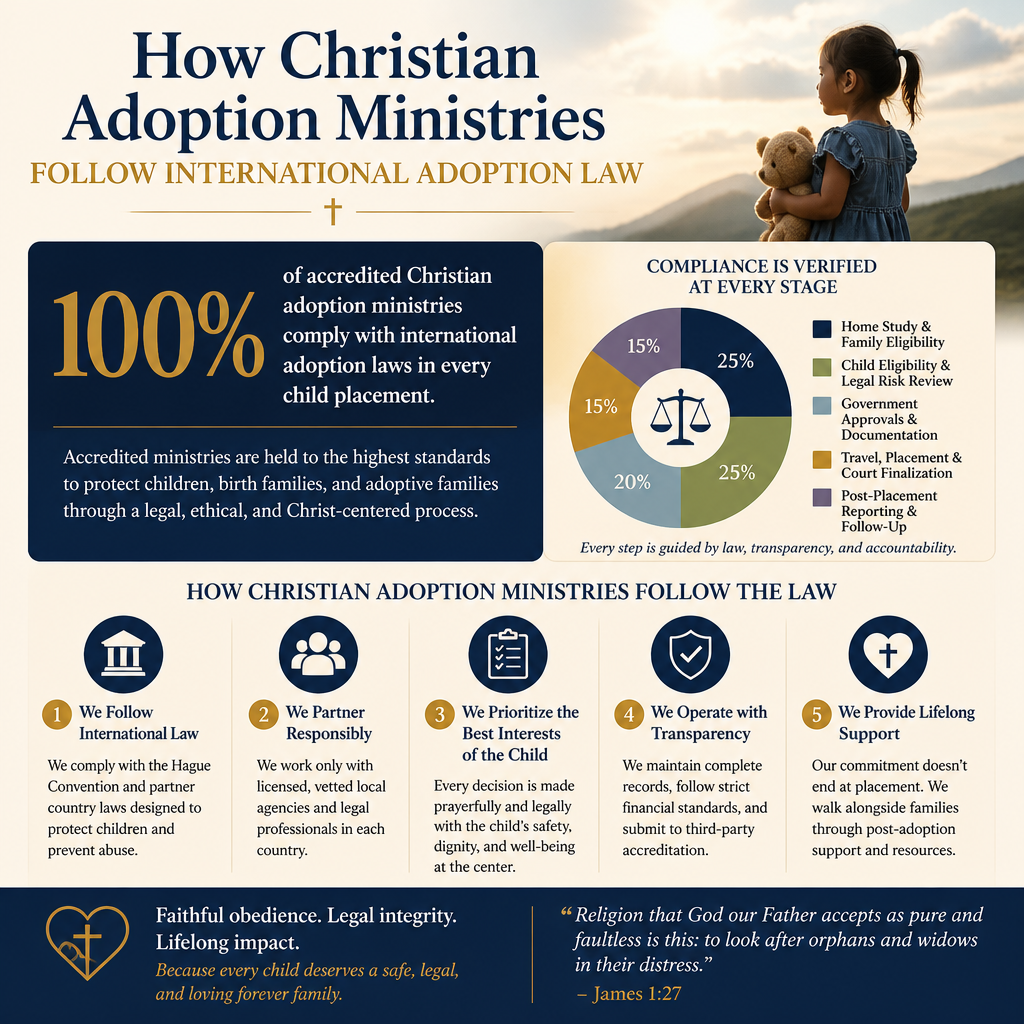
Serious ministries also welcome independent review. Financial audits, governance policies, conflict-of-interest disclosures, and documented procedures for allegations are not distractions from compassion. They are the structures that keep compassion from becoming reckless. This is one reason donors interested in the broader context of legal obligations often consult Legal and Regulatory Compliance in Christian Adoption Ministries as they evaluate organizations and programs.
They publish clear policies for consent, coercion, and complaints
Most donors will never read a case file, and they should not expect to. But donors can reasonably expect ministries to publish policies that answer concrete questions: How does the ministry ensure a birth parent’s consent is informed? What translation is provided? What safeguards exist against coercion by intermediaries? How are allegations reported and investigated? What is the ministry’s practice when records are incomplete or contradictory?
A credible ministry does not hide behind confidentiality to avoid accountability. It protects children’s identities while still making its process intelligible to supporters. That balance is part of ethical maturity.
Red flags donors should not ignore in international adoption work
Speed, secrecy, and certainty can indicate danger
International adoption necessarily involves grief, bureaucracy, and ambiguity. Ministries that promise fast timelines, unusually low costs, or guaranteed outcomes are not merely optimistic; they may be signaling that safeguards are being bypassed. Donors should also be wary of ministries that cannot describe their legal status, their accredited partners, or the oversight structures in the sending country.
Across the sector, some of the most destructive harm has occurred when Christian communities confused sincerity with credibility. Scripture warns against bearing false witness, even unintentionally. When an organization speaks with certainty where the facts are not established, it places the child and family at risk.
A short donor checklist for prudent support
- Ask whether the ministry or its service provider is properly accredited or licensed for the countries where it works.
- Request a plain-language explanation of how adoptability is determined and how family preservation and kinship placement are considered.
- Review how funds flow overseas and what documentation exists for partner payments and in-country fees.
- Look for published safeguarding policies, including how allegations are reported, investigated, and disclosed appropriately.
- Confirm whether the ministry can explain how it complies with both U.S. requirements and the sending country’s legal process.
These questions do not imply suspicion toward faithful ministries. They reflect a sober recognition that children bear the consequences when adults are careless. Mature generosity asks for evidence commensurate with the stakes.
Compliance is part of Christian witness and part of donor stewardship
Lawful does not always mean faithful, but faithfulness is never lawless
Christians sometimes worry that legal frameworks can crowd out compassion. That concern is understandable in a world where bureaucracy can be impersonal. Yet the Christian tradition also teaches that governing authorities have a real, if limited, role in restraining evil and ordering public life (Rom. 13:1–7). In intercountry adoption, law is one of the primary tools societies use to prevent children from being commodified.
Faithfulness, then, is not measured by whether we can “get it done.” It is measured by whether we refuse to do good ends through compromised means. Ministries that accept stricter oversight, slower pace, and fewer placements may be giving donors a more credible form of fruitfulness: integrity under pressure.
Verification helps donors give with confidence
Donors are not called to become international adoption attorneys. But donors are called to steward resources wisely and to support ministries whose practices withstand scrutiny. Most Trusted exists to help meet that need by evaluating Christian nonprofits against The Most Trusted Standard, examining evidence across faith commitments, financial integrity, governance, and transparency and effectiveness. In adoption work, that evaluation intersects directly with compliance: whether an organization’s stated commitments are matched by documented controls and accountable leadership.
For donors seeking a wider view of the ministry landscape, Christian Adoption Ministries provides additional context on how organizations differ in models, safeguards, and theological framing.
FAQs for How Christian adoption ministries follow international adoption law
Does compliance with the Hague Convention guarantee an adoption is ethical?
No. The Hague Convention provides an essential framework and a set of required safeguards, but ethics also depend on how those safeguards are implemented in real cases. Donors should look for ministries that can demonstrate verifiable documentation, transparent financial practices, and credible processes for investigating concerns, not only formal participation in a Hague system.
What should donors ask if a ministry works in a non-Hague country?
Donors should ask what legal regime governs the work, how adoptability is determined, who authorizes placements, and what safeguards function in place of Hague central authority processes. The absence of Hague structures increases the importance of clear documentation, reputable local partnerships, and independent oversight.
A faithful posture toward international adoption law
International adoption can be a means of profound mercy, but it is mercy that must be disciplined by truth. Ministries that follow international adoption law well are not merely avoiding liability; they are protecting children, honoring families, and refusing the temptations that arise when money, emotion, and urgency converge. Donors best serve that mission when support is directed toward organizations whose compassion is demonstrably accountable.



