

How Christian adoption ministries handle donor tax receipts is not a clerical afterthought. For donors, receipts are the documentary line between generosity offered to God and stewardship practiced before God, the kind of “honorable” administration Paul insisted upon when churches handled funds for the poor (2 Corinthians 8:20–21 esv.org). Adoption work carries uncommon emotional weight; that is precisely why the paper trail must be unusually disciplined.
The harder question is not whether a receipt exists, but whether it is accurate, timely, and aligned with IRS rules that protect both the donor and the ministry. When receipts are late, vague, or padded with language that implies a quid pro quo, faithful donors can lose legitimate deductions and ministries can accumulate avoidable compliance risk. Both outcomes erode trust in a field that depends on it.
What a compliant donation receipt must contain
The legal baseline donors should expect
For U.S. donors, the IRS draws clear lines. A donor generally needs a bank record or written communication from the charity for any charitable contribution (with a higher documentation threshold as gifts grow), and for contributions of $250 or more, the donor must have a contemporaneous written acknowledgment that states whether any goods or services were provided in exchange for the gift (and, if so, a good-faith estimate of their value). These are not optional best practices; they are the rules that make a deduction defensible. The IRS lays out these substantiation requirements in Publication 526 and related guidance (irs.gov).
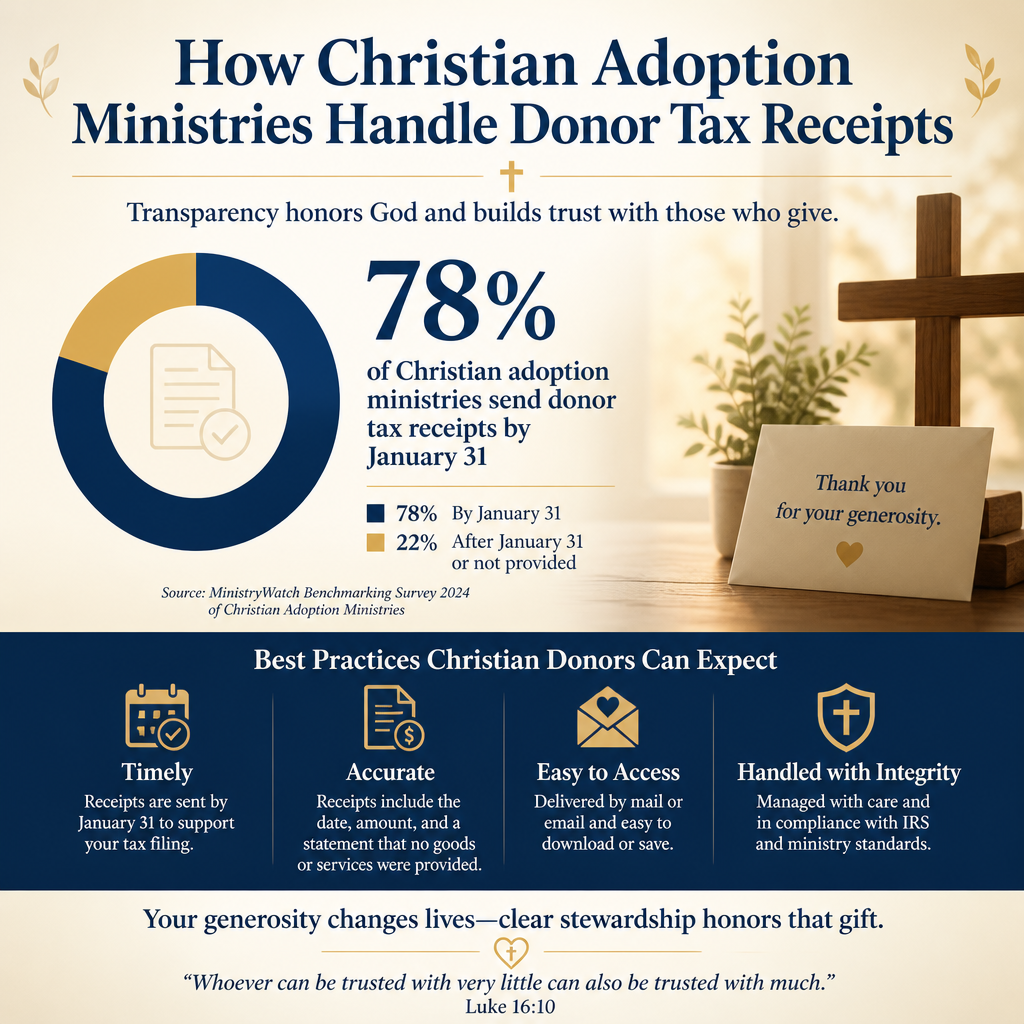
In practice, a sound receipt includes: the ministry’s legal name, the date and amount of the contribution (or a description for noncash gifts), a statement about goods or services provided, and language that does not overpromise tax deductibility in complex situations. Ministries sometimes add pastoral warmth, but warmth never substitutes for precision.
Where adoption ministry receipts frequently go wrong
Adoption ministries are uniquely exposed to receipt mistakes because donors often want to fund specific families, placements, or travel costs, and because ministries sometimes operate multiple programs under one umbrella. Confusion tends to cluster around earmarking and benefits: the donor wants specificity, but the receipt must not imply that the donor purchased something or received a personal benefit.
Across our verification work at Most Trusted, the ministries that meet The Most Trusted Standard tend to produce receipts that are both human and exact: they thank the donor, but they also state the facts cleanly, avoiding euphemisms that create tax ambiguity.

Designated gifts, restricted gifts, and the donor control problem
Why wording and control matter as much as intent
Many donors want to “adopt a family,” not merely “support a ministry.” Christian compassion naturally moves toward faces and names. Yet for a gift to be treated as a charitable contribution to the organization, the organization must retain discretion and control over the funds. If the donor controls the funds in substance—even if routed through a charity—the IRS may view the payment as a gift to an individual, not a charitable contribution.
This is why careful ministries use language such as “preference” rather than “direction,” and why they maintain written gift acceptance policies that clarify when and how they will honor designations. They also train staff to avoid promising, verbally or in writing, that funds will be applied exactly as a donor demands. The distinction can feel bureaucratic, but it is a guardrail that keeps mercy from becoming mischaracterized as a private benefit.
How mature ministries communicate restrictions without misleading donors
There is a legitimate place for restricted giving: donors may restrict gifts to a program (for example, domestic adoption services, birth mother support, or post-adoption counseling) while still giving to the organization. Ministries that handle this well disclose their ability to redirect funds if a restricted purpose cannot be met and ensure board-approved processes for releasing or modifying restrictions.
What this means in practice is that a receipt may confirm the amount and date of the contribution while the ministry’s separate donor communication explains how the gift will be applied within the organization’s discretion. That separation protects integrity: the receipt is legal documentation; program updates are relational communication.
Quid pro quo risks in adoption fundraising
Events, banquets, and benefits donors may overlook
Adoption ministries often raise funds through dinners, galas, golf tournaments, or benefit concerts. Donors sometimes treat the ticket price as fully deductible, but IRS rules do not. When goods or services are provided in exchange for a payment, only the portion exceeding the fair market value of what was received is deductible, and the charity must provide a disclosure statement for quid pro quo contributions over a threshold. The IRS explains these disclosure expectations and the underlying rules in its guidance on charitable contributions and substantiation (irs.gov).
For donors who want to give cleanly, the practical counsel is straightforward: treat event tickets as partially nondeductible unless the ministry explicitly states otherwise with a fair market value calculation. Ministries that respect donors do not bury this in fine print.
Adoption-related services and the temptation to blur categories
Some ministries provide adoption home studies, counseling, training, or other services. Donors may also be service recipients. A receipt must never imply that fees paid for services are charitable contributions if they are, in substance, payment for services rendered. Christians genuinely disagree about the best models for funding adoption services, but tax law is not negotiated by good intentions.
When ministries pursue hybrid models—fees plus philanthropy—clarity becomes a form of truth-telling. A donor should be able to see, on paper, what is a fee, what is a gift, and what (if any) benefit was received. Where those lines are blurred, we recommend donors ask for written clarification before year-end, not after.
Timing, delivery, and year-end accuracy
Contemporaneous means more than prompt
Receipts must be “contemporaneous,” which in practice means the donor has it by the time they file their tax return or by the due date of the return, whichever comes first. Ministries that treat receipting as a spiritual obligation typically aim earlier—especially for December gifts—because donors often need documentation for planning and for their own accountability within families and churches.
Electronic receipting is common and often reliable, but it introduces failure points: spam filters, outdated email addresses, and donor portals with incomplete histories. Strong ministries maintain systems that can reproduce receipts on request, and they test the donor experience the way they test other mission-critical workflows.
What donors should verify before filing
Adoption ministries may process gifts through third-party platforms, donor-advised funds, or employer matching portals. Each channel can shift who issues the receipt and what information appears on it. A donor should confirm whether the receipt comes from the platform, the ministry, or the donor-advised fund sponsor, and whether the documentation matches the donor’s actual payment method and date.
For donors who want a disciplined year-end process, the following checkpoints tend to prevent avoidable confusion:
- Confirm the receipt states the correct legal entity name and date received.
- For gifts of $250 or more, confirm the goods-and-services statement is included.
- If you attended an event, confirm fair market value disclosures are stated clearly.
- If you designated a program, confirm the ministry did not promise donor control.
- Keep bank records and confirmations alongside the receipt.
How serious ministries operationalize receipting as stewardship
Receipts sit inside governance, not just accounting
Receipting failures are often symptoms of deeper governance and internal control weaknesses: unclear authority over gift coding, poor separation of duties, inconsistent donor records, or under-resourced finance teams. Donors usually see only the receipt, but boards and executives should treat receipting as part of a larger integrity system that protects the mission from avoidable scandal.
This is one reason donors benefit from reading beyond marketing claims and toward verifiable practices. On our side, Most Trusted assesses ministries against The Most Trusted Standard with attention to financial integrity, governance discipline, and transparency practices that can be documented rather than merely asserted. A clean receipt is not sufficient evidence of a healthy organization, but repeated sloppiness is rarely an isolated problem.
What to look for when evaluating an adoption ministry
Adoption is a ministry of truth as well as mercy. The best ministries do not treat donor questions as adversarial; they treat them as part of the trust they are called to keep. Donors can reasonably ask for policies and examples, not only assurances.
Within the broader landscape of Christian Adoption Ministries, we recommend watching for organizations that publish clear giving guidance, maintain accessible documentation, and demonstrate that compliance is not delegated to the margins. And within Legal and Regulatory Compliance in Christian Adoption Ministries, donor receipting is one of the simplest areas to verify quickly, precisely because the expectations are so concrete.
FAQs for How Christian adoption ministries handle donor tax receipts
If we give to help a specific adopting family, will our receipt make the gift deductible?
Not automatically. For a contribution to be deductible as a charitable gift to a ministry, the ministry must retain discretion and control over how funds are used, and the payment cannot be earmarked in a way that functions as a gift to a particular individual. A receipt may document that a payment was made, but deductibility turns on the underlying facts and the organization’s control, not on the donor’s intent alone. When the situation is close, we recommend asking the ministry for its written policy on designated gifts and consulting a qualified tax advisor.
What should a receipt say about goods or services, and why does it matter?
For contributions of $250 or more, the written acknowledgment should state whether the donor received any goods or services in exchange for the gift; if so, it should include a good-faith estimate of their value. This matters because only the portion of a payment that exceeds the value of benefits received is deductible. The IRS’s substantiation rules are clear on this point, and ministries that serve donors well treat this disclosure as a basic act of accuracy, not an inconvenience (irs.gov).
Receipts as a test of truthfulness
Donor tax receipts are mundane documents with moral weight. They reveal whether an organization is willing to be exact where precision is required, even when ambiguity might raise more money in the short term. For Christian adoption ministries, that discipline is part of bearing faithful witness: truth in small things, ordered stewardship in public things, and care for donors whose giving is meant to be an act of worship offered “in the light” rather than in the shadows (John 3:21 esv.org).



