
What warning signs donors should watch for in Christian adoption ministries are not merely administrative details. They are moral signals about whether a ministry is treating children as image-bearers to be protected or as instruments to sustain an organization’s revenue, reputation, or sense of mission.
Scripture binds Christian compassion to Christian truthfulness. The God who commands care for the vulnerable also condemns dishonest scales and self-serving leadership. Donors who support adoption work are participating in a field where the stakes are unusually high: legal compliance, trauma-informed care, family preservation, and irreversible decisions affecting a child’s identity and belonging. Wise giving therefore requires more than sympathy; it requires scrutiny shaped by love of neighbor.
1. Programs that bypass safeguards and treat speed as a virtue
Rushed timelines and spiritualized urgency
Adoption is often described with theological language—redemption, welcome, family. Those themes are legitimate in Christian imagination, but they can also be misused. A common warning sign is when a ministry treats speed as proof of faithfulness: “doors opening,” “God is moving,” “don’t miss this child.” When urgency becomes a fundraising tool, it can pressure donors and families to accept risk that should instead be slowed down and examined.
The Hague Adoption Convention and its implementing standards exist precisely because intercountry adoption can attract corruption where documents, incentives, and desperation converge. The harder question is whether a ministry’s internal culture welcomes delay when a case is unclear. Healthy organizations do not shame caution; they require it.
Weak case documentation and unclear chain of custody for records
Donors should be concerned when a ministry cannot articulate how it verifies a child’s legal status, birth family circumstances, or relinquishment documentation. In intercountry settings, especially, record integrity is one of the most important child-protection issues. Ministries that meet The Most Trusted Standard typically can explain, in plain terms, who collects records, how they are validated, and what triggers an independent review when information conflicts.
International adoption has declined significantly over the past two decades, in part due to tightened safeguards and country closures tied to abuse and irregularities. The U.S. government tracks this decline through annual statistics, which also reflect the sector’s ongoing legal and ethical complexity (U.S. Department of State).

2. Money arrangements that create perverse incentives
Fees and funding structures that reward child movement
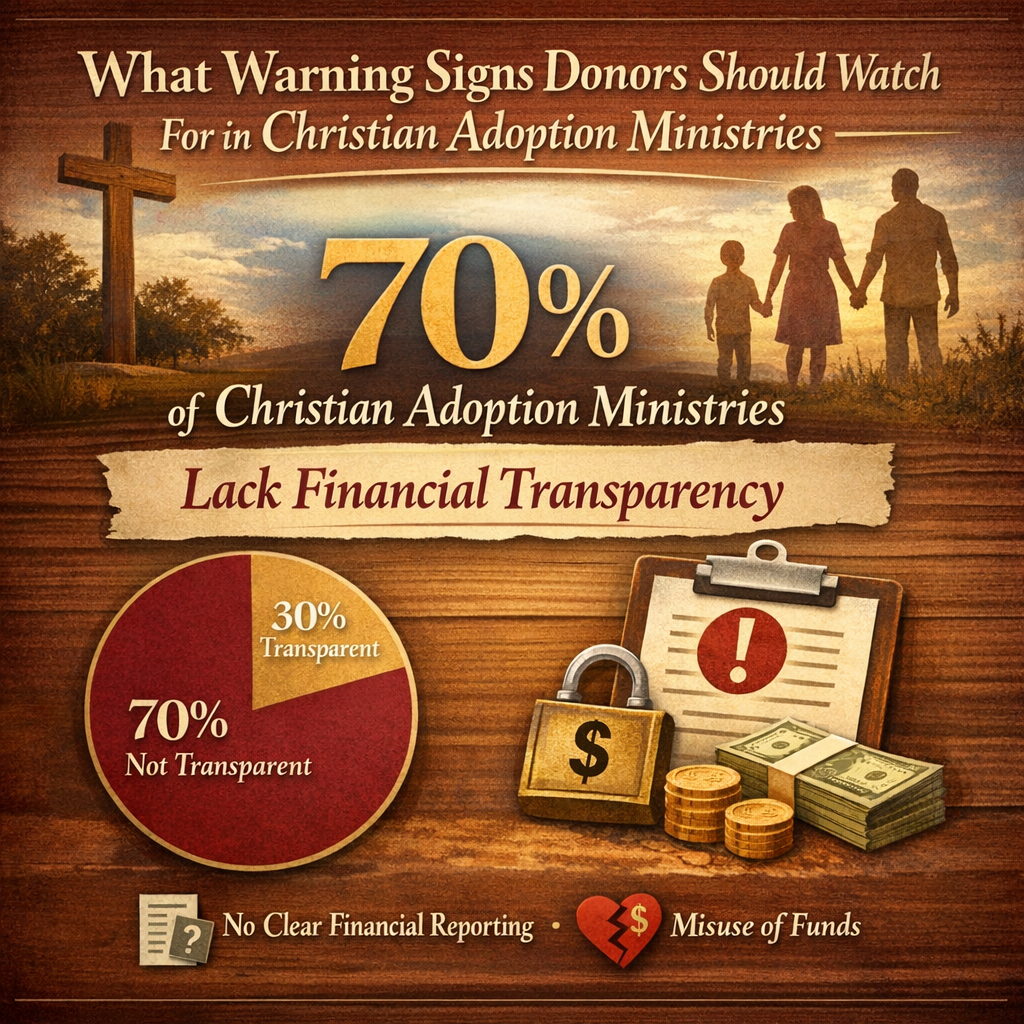
Any ministry operating in adoption-related work must confront an uncomfortable reality: where significant money flows, incentives form. Donors should pay careful attention to how funds are raised and disbursed. Warning signs include payments that appear contingent on a child being matched or moved, “success fees,” or opaque transfers to overseas partners without clear contractual safeguards and auditability.
This does not mean Christian adoption ministries should be suspicious by default. It means donors should insist on structures that reduce incentives for coercion: documented budgets, restricted-fund controls, separation of duties, and transparent descriptions of how foreign partners are vetted and monitored.
Emotion-first fundraising that crowds out accountability
Some ministries rely on donor emotion to carry the work, and emotion is not wrong. The danger is when emotional storytelling becomes the substitute for verifiable reporting. If the primary evidence offered is heart-tugging narrative—especially about a specific child—without clear explanations of legal steps, child-safety protocols, and outcomes, donors are being trained to give without asking necessary questions.
Many donors have also absorbed the mistaken idea that low overhead is the clearest proof of virtue. In child protection work, under-investing in compliance, qualified staff, and independent oversight can be a direct risk factor. The philanthropic sector has publicly warned against simplistic overhead ratios, urging donors to evaluate governance and outcomes rather than chasing minimal administration (Charity Navigator).
- Vague accounting for partner payments, travel, and in-country “facilitation” costs
- Fundraising tied to a specific child without clear privacy safeguards and consent
- Pressure to give immediately framed as “faith” rather than stewardship
- No explanation of refund policies, restricted fund handling, or fee-setting process
- Unclear conflict-of-interest policies for founders, board members, and vendors
3. Governance that concentrates power and suppresses questions
Founder control without meaningful board oversight
In adoption ministry, concentrated authority can become dangerous quickly. A warning sign is a founder-led organization where the board functions primarily as supporters, donors, or friends rather than as independent overseers with the authority to challenge leadership. Donors should look for documented board governance: regular meetings, minutes, independent members, and explicit conflict-of-interest disclosures.
Across our verification work at Most Trusted, we find that the strongest ministries treat governance as part of discipleship—an embodied commitment to truth-telling, restraint, and accountability. Where leadership cannot be questioned, the vulnerable are rarely protected for long.
Retaliation against whistleblowers or critics
A ministry’s response to criticism is often more revealing than the criticism itself. Donors should pay attention to patterns: former staff who describe retaliation, families who report being dismissed rather than heard, or public communications that attack questioners as “anti-adoption” or “against the Kingdom.” Christians genuinely disagree about adoption policy and practice, but ad hominem responses are a governance smell. A humble ministry can name trade-offs, acknowledge failures, and demonstrate corrective action without theatrics.
For donors assessing the broader landscape, our topic page on Christian Adoption Ministries situates these issues within the wider set of ministry models and common accountability questions.
4. Child protection practices that are thin, improvised, or unreported
Privacy violations and identity exploitation
Children in adoption pathways are not fundraising assets. Donors should be cautious when ministries publicly share identifying details—full names, medical diagnoses, abandonment narratives, or images that expose a child to future stigma. Ethical practice requires more than good intentions. It requires a doctrine of human dignity applied to communications, data handling, and donor engagement.
This area is particularly complex because many supporters want specificity: “Who are we helping?” Yet the more identifiable the story, the greater the privacy risk. A responsible ministry can report transparently without turning a child’s trauma into marketing copy.
Minimal training, weak screening, and unclear safeguarding policies
Adoption-related work intersects with trauma, cross-cultural dynamics, and power differentials. Donors should ask whether staff and volunteers receive training in trauma-informed care, mandatory reporting where applicable, and child-safety protocols. If a ministry cannot provide written safeguarding policies—or treats them as optional—donors should assume those safeguards are not operationalized.
Church-based movements have learned, painfully, that safeguarding must be more than moral aspiration. It must be a system. When donors evaluate ministries through Ethics and Child Protection in Christian Adoption Ministries, the aim is not suspicion; it is practical love that refuses to expose children to preventable harm.
5. Outcomes that are asserted rather than demonstrated
Counting adoptions without measuring wellbeing
Adoption ministries often report outputs: matches made, dossiers completed, families supported, or placements facilitated. Outputs matter, but they are not the same as outcomes. A warning sign is a ministry that treats the number of adoptions as the primary measure of faithfulness without evidence of long-term support, ethical compliance, and child and family wellbeing.
Research and practice in child welfare increasingly emphasize family-based care and the risks of institutionalization. Global policy statements have moved toward strengthening families and prioritizing family-based alternatives over long-term residential care (UNICEF). Donors should expect adoption-related ministries to be conversant with this direction, even when their model is not identical to government policy.
Absence of independent evaluation and unwillingness to name limits
Some adoption-related work is difficult to measure, particularly when privacy constraints are properly respected. Still, a ministry should be able to show more than internal affirmation. Donors should look for independent financial review, documented compliance processes, and credible reporting about what did not work as well as what did. If every story is a victory, the reporting is likely curated rather than transparent.
The ministries that meet The Most Trusted Standard tend to speak with sobriety about what adoption can and cannot repair. Adoption can be a gift of belonging. It is not a guaranteed cure for trauma, and it should never be framed as the solution to poverty in ways that ignore family preservation, kinship care, or local child welfare realities.
FAQs for What warning signs donors should watch for in Christian adoption ministries
Is it unchristian to ask detailed questions about an adoption ministry’s practices?
No. Christian charity is not opposed to due diligence; it depends on it. Scripture consistently binds righteousness to honesty, justice, and protection of the vulnerable. For donors, careful questions about governance, finances, legal safeguards, and child protection are a form of love—love for children, birth families, adoptive families, and for the ministry itself.
What should donors ask first when evaluating a Christian adoption ministry?
We recommend starting with three questions: How does the ministry verify a child’s legal adoptability and protect against coercion? How are funds handled and audited, especially in cross-border partnerships? What written child-safeguarding and privacy policies govern communications and volunteer involvement? Clear, specific answers are not a guarantee of integrity, but evasive answers are a reliable warning sign.
Stewardship that protects children and honors the truth
Christian donors often come to adoption ministry with profound hope: that the Church can reflect God’s fatherly care for the vulnerable. That hope is not naïve, but it must be disciplined by accountability. Warning signs in Christian adoption ministries usually appear first as small distortions—urgency that cannot be questioned, stories that override safeguards, leadership that cannot be challenged, or money that is not traceable.
Giving with confidence requires verifiable evidence that a ministry has ordered its compassion through truth. Most Trusted exists to help donors make that judgment with clarity, using The Most Trusted Standard to distinguish admirable intention from demonstrated faithfulness.



