
Legal and regulatory compliance in Christian adoption ministries is not a secondary administrative concern. It is part of the ministry’s moral authority, because adoption work touches children with trauma histories, vulnerable families, multiple jurisdictions, and large sums of donor-funded support. When compliance is treated as a spiritual discipline—an extension of “giving honor to whom honor is owed” (Romans 13:7)—the ministry is better positioned to serve without coercion, confusion, or preventable scandal.
Donors often feel the tension. The biblical mandate to care for the fatherless is unmistakable, yet the modern adoption landscape has had to reckon with serious failures: unethical child sourcing, mishandled fees, and opaque intermediaries. Christian donors rightly want to fund sacrificial love, not underwrite shortcuts. Compliance does not guarantee righteousness, but disregard for law and accountable governance reliably produces harm.
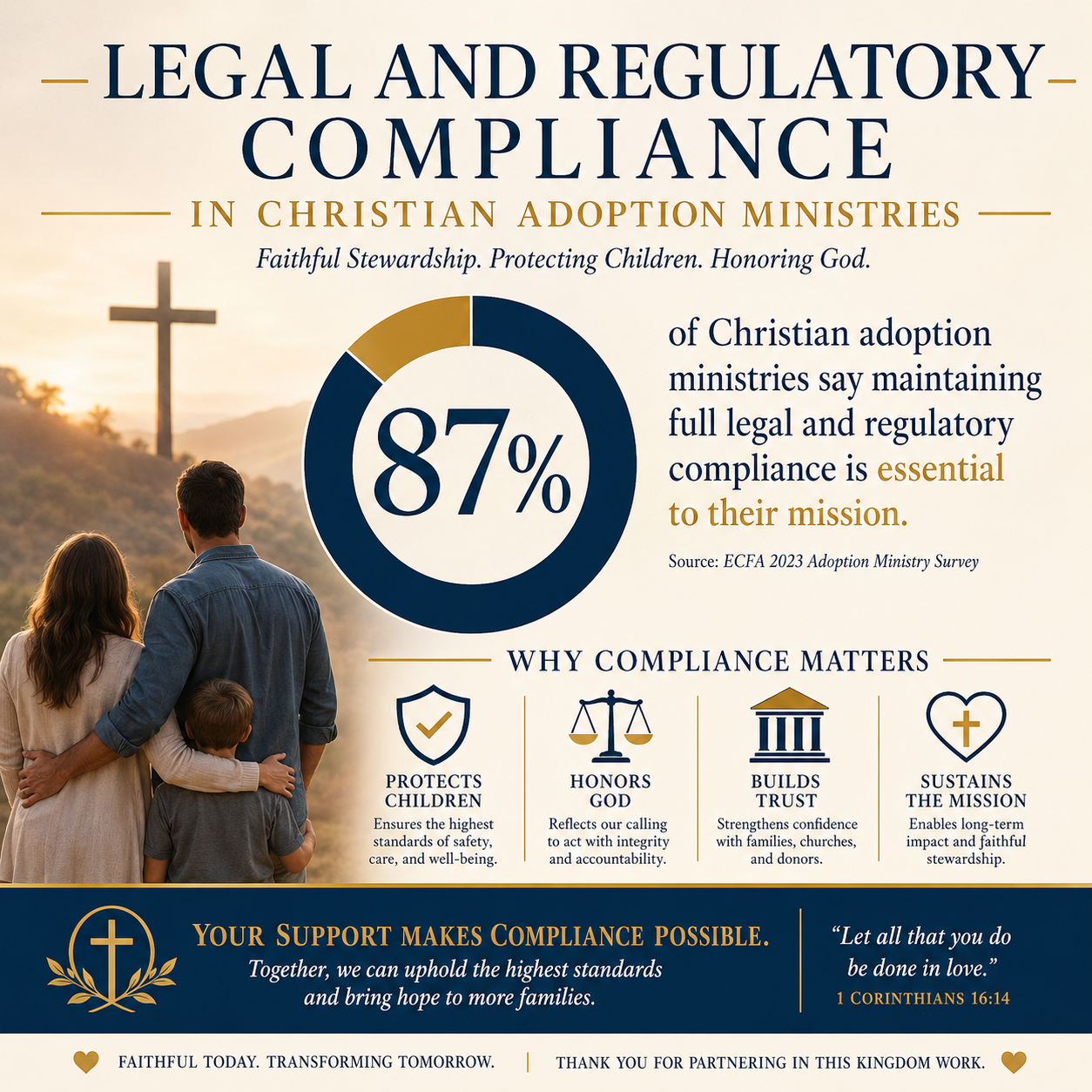
Compliance is a protection for children, families, and the witness of the church
Adoption is both pastoral and legal. Ministries may provide counseling, home study support, travel coordination, post-adoption services, or care for expectant mothers. Yet the moment a ministry participates in any activity that affects custody, consent, placement, or cross-border movement, the work becomes heavily regulated—and for good reason. Children cannot meaningfully consent. Birth parents can be pressured. Prospective adoptive parents can be misled. Regulators exist because the stakes are that high.
What this means in practice is that Christian donors should expect mature ministries to welcome oversight. In the New Testament, integrity is not merely internal sincerity; it is demonstrable conduct “honorable not only in the Lord’s sight but also in the sight of man” (2 Corinthians 8:21). A ministry that treats compliance as an adversary often ends up treating hard questions the same way.
Domestic and international adoption are governed by different legal regimes
In the United States, adoption is primarily state law. Licensing requirements, home study rules, advertising restrictions, birth parent counseling requirements, and consent timelines vary significantly by state. A ministry operating across state lines has to manage those differences carefully rather than assume a single set of “Christian best practices” covers the field.
International adoption adds another layer. The Hague Adoption Convention creates a framework intended to prevent abduction, sale, and trafficking by setting standards for intercountry adoption and requiring central authorities and accredited providers. The U.S. State Department’s intercountry adoption resources outline these requirements and the role of accreditation in Hague cases (U.S. Department of State).
Regulation is not a substitute for ethics, but it does set enforceable boundaries
Christians genuinely disagree about how much weight to place on institutional safeguards versus personal trust in leaders and relationships. The harder question is that adoption systems include incentives—fees, timelines, donor urgency, and emotional narratives—that can distort judgment. Enforceable standards help restrain those incentives. A ministry can have sincere intentions and still create pressure that undermines informed consent or truthful representation.
Donors should not confuse speed with faithfulness
Adoption is often time-sensitive for families, and waiting can feel like needless bureaucracy. Yet “slow” is frequently the mark of due process: proper counseling, independent legal advice, verified relinquishment, and child-centered casework. Ministries that promise unusually fast placements or that minimize the seriousness of legal requirements are often signaling risk, not competence.

What donors should verify in a ministry’s legal posture and operating model
Donors are rarely positioned to audit a ministry directly. Still, a donor can assess whether a ministry operates with verifiable controls, licensed partners, and a governance culture that takes accountability seriously. Across our verification work at Most Trusted, the ministries that meet The Most Trusted Standard tend to show consistency: they can explain their legal model in plain language, and their documentation matches their public claims.
Clarity about the ministry’s role and limits
Some organizations are licensed child-placing agencies; others are advocacy and support ministries that do not facilitate placements. Both can be legitimate, but they must be clear about what they do and do not do. Donors should look for precise language: “We provide post-adoption counseling” is different from “We match children with families.” Vague descriptions can mask unauthorized practice, improper referrals, or prohibited fee structures.
A sound ministry will also name its legal relationships: which services are delivered in-house, which are delivered through licensed agencies, and how families are referred. This is not mere administrative detail. It determines who holds legal responsibility if something goes wrong.
Licensing, accreditation, and professional boundaries
Where licensing or accreditation applies, donors should expect the ministry to disclose it without defensiveness. In international adoption, Hague accreditation and compliance structures matter because they are tied to child protection safeguards. In domestic settings, state licensing for child-placing work often includes training requirements, background checks, recordkeeping, and external inspections.
Professional boundaries matter as well. Ministries may employ social workers, counselors, or attorneys, but they must be careful about the scope of practice and conflicts of interest. Donors can look for evidence that the ministry encourages independent counsel for birth parents and adoptive families rather than positioning itself as the sole trusted advisor.
Written policies that anticipate predictable risks
Strong ministries do not improvise under pressure. They build written policies for conflicts of interest, fee transparency, safeguarding, privacy, and complaint handling. These policies should be more than a binder on a shelf. They should be referenced in staff training, reflected in board oversight, and visible in how the ministry responds when a case becomes difficult or contested.
Financial and documentation compliance are ministry issues, not just accounting tasks
Donors often focus on “where the money goes,” but adoption-related work can be financially complex. Some support is donor-funded; some is fee-for-service; some is restricted for specific families or programs. Missteps here are rarely victimless. They can create inequitable access, hidden subsidies, or financial pressure that distorts decision-making.
Donation receipting and donor intent
Many donors give toward specific adoptive families or designated funds. The legal and ethical standard is straightforward: ministries must honor donor intent while also disclosing any discretion they retain. In the U.S., charitable contribution substantiation rules and quid pro quo disclosures are part of responsible receipting. The IRS outlines donor substantiation requirements for charitable gifts (Internal Revenue Service).
Donors should be cautious when an organization implies that a gift is “for your friend’s adoption” but reserves broad discretion without clearly stating it. Mature ministries handle this with careful language and clean accounting, because ambiguity erodes trust and can expose donors and the ministry to avoidable problems.
Restricted funds and family support require unusually careful controls
Adoption ministries sometimes manage grants, travel assistance, counseling subsidies, or crisis support for expectant mothers. These programs can be deeply compassionate, and they can also create compliance risks if eligibility is unclear, approvals are undocumented, or disbursements look like private benefit. Donors should look for the hallmarks of disciplined programs: written eligibility criteria, documented approvals, and financial reporting that distinguishes restricted and unrestricted activity.
Records, confidentiality, and safeguarding
Adoption work generates sensitive records: counseling notes, case files, medical information, immigration documentation, and identifying details for birth families and adoptees. Laws and professional ethics vary by context, but the principle is consistent: confidentiality is part of neighbor-love. Donors should expect clear privacy practices, secure record storage, limited access controls, and a serious posture toward safeguarding and reporting obligations.
Governance and legal counsel are the difference between aspiration and accountability
Many compliance failures in adoption are not technical mistakes. They are governance failures: boards that do not understand the ministry’s legal exposure, leaders who resist scrutiny, and cultures that treat urgency as a justification for opacity. A credible ministry does not rely on a charismatic founder’s integrity; it builds accountable systems that can endure leadership transitions.
Board oversight that matches the risk profile
Adoption work warrants a board that understands regulated services, child welfare ethics, and cross-cultural complexity. Donors can look for signs that the board is active rather than ceremonial: conflict-of-interest disclosures, independent members, and evidence that the board reviews compliance issues and not merely program stories. The healthiest ministries treat adverse events, complaints, and regulatory interactions as matters for board-level visibility.
Competent legal counsel and the humility to use it
Christian organizations sometimes hesitate to spend on attorneys, fearing it signals misplaced priorities. The reality is that legal counsel is often a form of protection for the vulnerable. Counsel helps ministries structure fee practices appropriately, draft truthful agreements, manage cross-border risks, and respond to allegations with discipline rather than panic. Donors should not punish ministries for seeking competent counsel; donors should be concerned when ministries treat counsel as unnecessary.
Transparency that does not trade on sacred language
Adoption ministries can unintentionally use spiritual vocabulary to soften scrutiny: calling questions “lack of faith,” treating complexity as “spiritual attack,” or implying that donors should trust because the work is holy. That pattern is spiritually dangerous. Scripture does not ask the church to suspend discernment; it calls us to test what is true (1 Thessalonians 5:21). Donors should expect clear answers about governance, fees, partners, and complaint processes.
For donors seeking broader context on how adoption work is structured and evaluated across the field, engagement with Christian Adoption Ministries can clarify what responsible practice looks like in both support-based and placement-based models.
A faithful adoption ministry can be measured by its accountability
Legal and regulatory compliance in Christian adoption ministries is not a distraction from compassion; it is one of the ways compassion becomes credible. Children deserve more than good intentions. Birth families deserve more than pressure disguised as persuasion. Adoptive families deserve more than assurances that everything is “handled” without verifiable safeguards.
At Most Trusted, we evaluate ministries against The Most Trusted Standard because donors need more than inspiring narratives. They need evidence of faith-shaped governance, financial integrity, and transparent effectiveness. In adoption work, those qualities are not ancillary. They are part of what it means to do justice, love mercy, and walk humbly before God (Micah 6:8).



