

How rescue missions share the Gospel with guests is not a marketing question. It is a discipleship question shaped by real trauma, public scrutiny, and the moral weight of meeting immediate needs. Christian donors rightly want to know whether a mission’s evangelism is faithful to Scripture, respectful of guests made in God’s image, and integrated with tangible care rather than tacked on as a condition for help.
The field has also had to reckon with a tension that does not go away: a rescue mission can drift into mere social service and lose its Christian distinctiveness, or it can speak about Christ in ways that feel coercive to guests who need a bed and a meal. The most credible ministries refuse the false choice. They aim for what the New Testament models: word and deed, truth and mercy, proclamation and patient presence.
1 The Gospel is proclaimed as good news not as a transaction
Guests are not projects and the meal is not the price of admission
When the church serves the poor, Scripture does not depict mercy as leverage. Jesus fed the hungry crowds and also preached the kingdom; he did not present bread as payment for attention, and he did not reduce preaching to a technique for increasing compliance. Rescue missions that share the Gospel with integrity are careful about transactional dynamics. A warm meal and a safe bed are offered because Christians believe every person bears God’s image, not because the guest has first agreed to a religious activity.
Christians genuinely disagree about the exact line between “expectations appropriate to a faith-based program” and “coercion,” especially in residential settings. What we can say with confidence is that missions earn trust when they articulate clear guest rights, clear program expectations, and clear alternatives. If chapel is required for a specific discipleship track, guests should know that up front, and emergency services should not be quietly withheld from those who decline.
A credible mission makes space for real consent
Most rescue missions operate with limited beds and high demand, which makes even well-intended requirements feel weightier. Donors should look for written policies that protect guests from pressure, including the ability to ask questions, step out of a service, or request prayer without signing up for a program. These practices reflect a theology of the person: faith is not extracted; it is received, often over time, as the Spirit works through the Word in the context of love.

2 The Gospel is embedded in the mission’s culture not outsourced to a weekly service
The message is carried by people formed by the message
Many guests who arrive at a rescue mission carry histories of betrayal, addiction, and institutional disappointment. In that context, the credibility of the Gospel is often tested first through the character of staff and volunteers. A mission may have an eloquent preacher, but if the intake desk is harsh or arbitrary, guests will learn to hear “good news” as one more form of control.
Rescue missions that share the Gospel well invest in formation: staff training in trauma awareness, clear standards for respectful communication, and spiritual care that is not performative. Donors can ask whether the mission has chaplains who are accountable, whether volunteers are trained rather than simply welcomed, and whether leadership models humility under pressure.
Local church partnership shapes spiritual credibility
A mission is not a substitute church, and most healthy missions say this plainly. They see themselves as an extension of the local church’s mercy and evangelism, not an independent spiritual ecosystem. That posture matters for donors because it creates accountability and relational pathways for guests who profess faith. Baptism, church membership, and long-term discipleship belong in congregational life.
What this means in practice is that a mission’s Gospel ministry should have visible ties to churches: pastors involved, referral pathways to congregations, and a willingness to celebrate when guests move on and become part of ordinary church life. For donors evaluating ministries in this space, broader context on the field is available through Rescue Missions and Homeless Outreach.
3 The Gospel is spoken in a way that accounts for trauma and power
Trauma-informed care can serve evangelism without diluting it
Some Christians worry that “trauma-informed” language can become a secular substitute for repentance and faith. Others worry that direct evangelism ignores the psychological realities that shape how people receive communication. The better missions hold these concerns together. They do not surrender the scandal of the cross, but they do learn to speak it to people whose nervous systems have been trained by violence, instability, and loss.
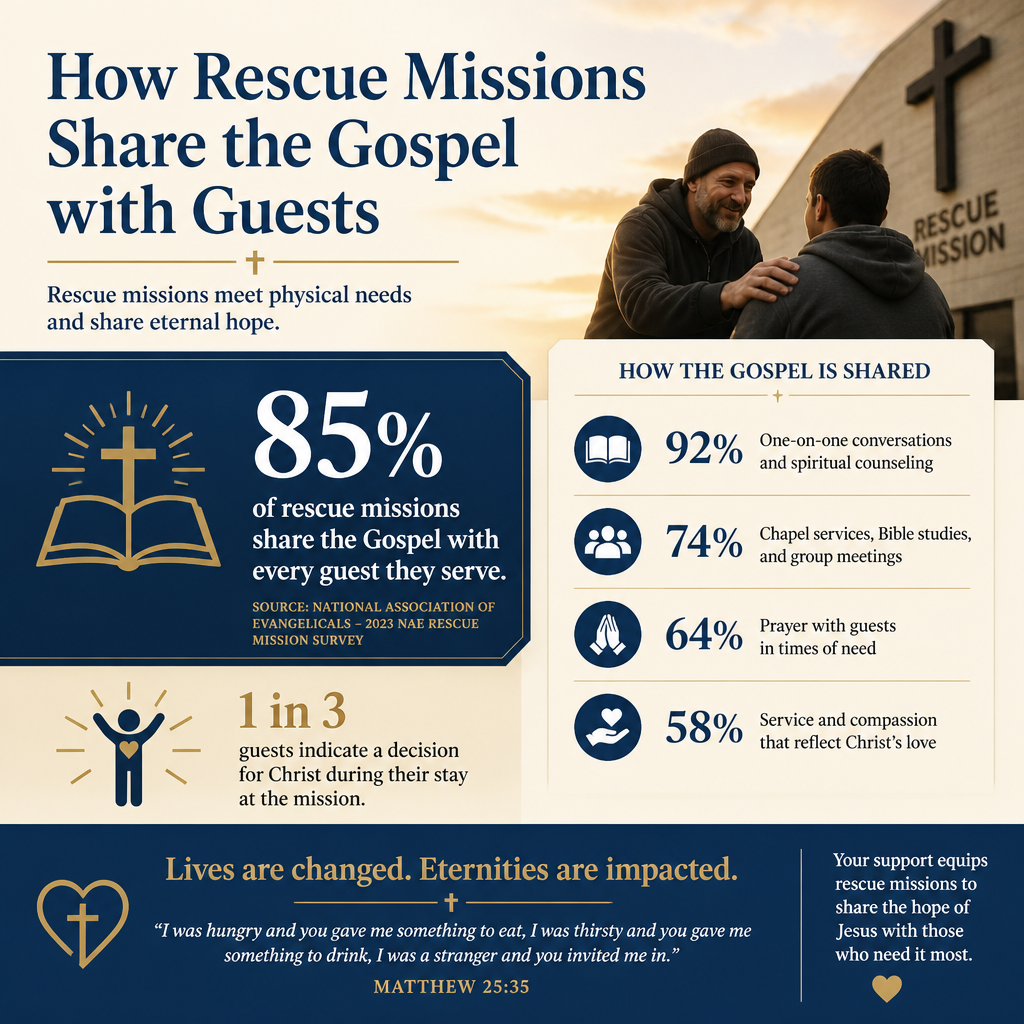
In practice, this often includes predictable routines, clear boundaries, and calm de-escalation—so that guests are not forced into spiritual conversations while in acute distress. It also includes a commitment to speak about sin and grace in ways that do not re-enact shame or manipulate vulnerability. The Gospel is not “you are worthless, so accept Jesus.” It is “you are made in God’s image, you are a sinner like all of us, Christ died and rose, and in him there is forgiveness and a new life.”
The harder question is how missions handle relapse and failure
Rescue missions frequently serve people in active addiction or early recovery, where relapse is common. Research has long documented that substance use disorders often involve cycles of remission and recurrence rather than linear progress; the National Institute on Drug Abuse describes addiction as a chronic condition in which relapse can occur, even after periods of abstinence (National Institute on Drug Abuse).
Donors should pay attention to how a mission frames relapse theologically and programmatically. A mission that treats relapse only as moral failure may produce superficial conformity. A mission that treats relapse only as clinical inevitability may undercut moral agency. More credible ministries keep both truths in view: people are responsible before God, and people also need structured support, counseling, and community to walk in repentance.
4 The Gospel is paired with measurable stewardship and transparent outcomes
Spiritual claims should not be immune from accountability
Many rescue missions report spiritual outcomes—professions of faith, baptisms, church connections. Donors should appreciate the difficulty of measuring spiritual reality without turning it into a scorecard. At the same time, donors should not accept vagueness as a substitute for integrity. Missions can track meaningful indicators without claiming to quantify the work of the Spirit.
Practical examples include documenting how many guests attend Bible studies voluntarily, how many are connected to a local church, and how many complete a residential program, alongside care outcomes such as housing placements, employment steps, and recovery supports. When missions publish definitions, timeframes, and methodology, donors can interpret reports with appropriate caution rather than cynicism.
Donors should expect clarity on finances and governance
Generous Christians want their giving to be faithful stewardship. That means governance, financial controls, and clear reporting matter as much as heartfelt stories. The broader nonprofit sector has repeatedly emphasized that simplistic “overhead ratios” are a poor proxy for effectiveness; the Overhead Myth letter argued that donors should focus on transparency, governance, and results rather than minimizing administrative costs (Charity Navigator).
At Most Trusted, we evaluate Christian nonprofits against The Most Trusted Standard, including criteria related to faith commitments, financial integrity, leadership accountability, and transparent reporting. For rescue missions, this kind of verification can help donors discern whether a ministry’s Gospel emphasis is matched by sober stewardship and credible oversight.
5 The Gospel is shared through a coherent pathway from crisis to community
A bed is an urgent intervention but not a full answer
Emergency shelter is often the first act of mercy, but missions that share the Gospel well rarely treat crisis care as the end of the story. They see a pathway: stabilization, assessment, discipleship, and long-term community. This is where donors can look past moving testimonies and ask whether the mission has a defined model, clear program distinctions, and realistic capacity.
The reality on the ground is complex. Some guests need only brief assistance and a safe discharge plan. Others need long-term residential recovery and mental health supports. Still others will cycle through shelters for years, and the mission’s faithfulness may look like patient presence rather than “success” in the usual sense. Donors serve the mission well when they fund what the mission can actually deliver, not what a brochure implies.
Signs of a healthy Gospel-centered model
Across our verification work, the ministries that meet The Most Trusted Standard tend to share several patterns when it comes to evangelism and care. Donors can use questions like these to guide discernment:
- Are emergency services offered without requiring participation in religious activities, with program expectations clearly disclosed?
- Is spiritual care led by accountable pastoral leadership, with trained volunteers and safeguards for guests?
- Does the mission partner with local churches for discipleship, baptism, and long-term community?
- Are outcomes reported with definitions and timeframes, avoiding inflated spiritual claims?
- Are finances, leadership, and policies transparent enough for public accountability?
For donors who want to focus specifically on how missions integrate faith and mercy, our coverage of Gospel-Centered Care in Rescue Missions addresses common models, common failure points, and the governance practices that tend to protect both guests and donors.
FAQs for How rescue missions share the Gospel with guests
Is it coercive for a rescue mission to require chapel or Bible study?
It depends on what is being required, for whom, and with what alternatives. Many missions distinguish between emergency services and longer-term residential programs. Donors should look for clear written policies that disclose expectations up front, protect guest dignity, and ensure that urgent shelter, food, and basic safety are not quietly conditioned on religious participation.
What should donors ask for when a mission reports many professions of faith?
Donors can ask for definitions and evidence of follow-through rather than skepticism or naïve acceptance. Helpful questions include: How is a “profession of faith” counted? Over what period? How many guests were connected to a local church? How many entered ongoing discipleship? Mature missions will describe spiritual fruit with reverence and restraint, and they will be transparent about what they can and cannot verify.
Conclusion
Rescue missions share the Gospel with guests most faithfully when proclamation is joined to mercy, when guests are treated as image-bearers rather than problems to manage, and when spiritual care is practiced without manipulation. Donors do not need perfection to give with confidence, but we do need clarity: clear theology, clear safeguards, and clear stewardship. When those elements align, a rescue mission’s evangelism can be both unmistakably Christian and demonstrably trustworthy.



