
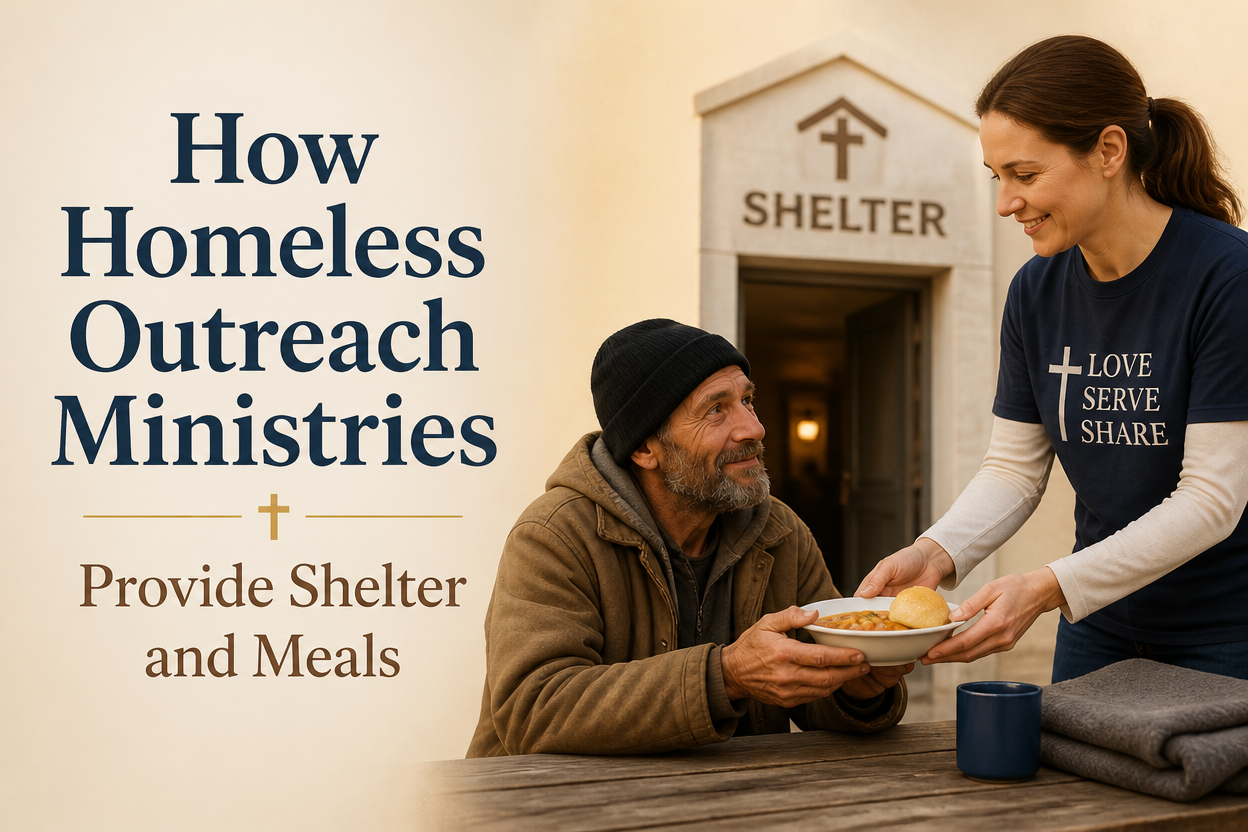
How homeless outreach ministries provide shelter and meals is never only a question of logistics. It is a question of what Christians believe about human dignity, spiritual agency, and the kind of mercy Scripture commends: mercy that relieves suffering without denying personhood.
Donors tend to encounter homelessness through the most visible edges of crisis: a cold night, an empty stomach, a family suddenly displaced. Outreach ministries meet those moments with beds, hot food, and triage-level care. Yet the harder work is sustaining that mercy in ways that remain safe, accountable, and oriented toward restoration rather than mere throughput.
Emergency shelter and meals as works of mercy and moral responsibility
What Scripture requires and what crisis demands
When Jesus identifies himself with “the least of these,” he does not limit the church’s obligations to spiritual counsel alone. He names feeding the hungry and welcoming the stranger as concrete tests of discipleship (Matthew 25:35–40). That moral clarity matters because donor fatigue is real, and the suffering on the streets can feel endless. The Christian tradition has consistently treated bread and shelter not as distractions from the gospel, but as expressions of neighbor-love that must be practiced with wisdom.
In most American communities, emergency shelter is also a safety function. Unsheltered exposure raises risk of injury, exploitation, and avoidable death. Public systems do not reliably provide humane capacity, and the demand regularly outstrips supply. The U.S. Department of Housing and Urban Development’s annual point-in-time count reported more than 650,000 people experiencing homelessness on a single night in 2023, with increases driven in part by unsheltered homelessness and rising family homelessness in some regions. HUD
Why many ministries begin with basic needs
Christian outreach often starts with meals and shelter for a pragmatic reason: these are immediate, measurable needs that can be met tonight. A meal service can be stood up quickly with volunteers, donated food, and a modest facility. An overnight shelter is more complex, but it still addresses a clear crisis threshold: indoors versus outdoors.
What this means in practice is that donors should not treat “basic needs” programming as inherently shallow. In well-governed ministries, basic needs become the front door to assessment, pastoral care, referrals, and longer-term pathways that require trust. Our work at Most Trusted consistently shows that mature rescue missions hold both truths together: immediate relief and patient restoration.
How shelter is actually provided and what makes it safe
Models of shelter ministries commonly use
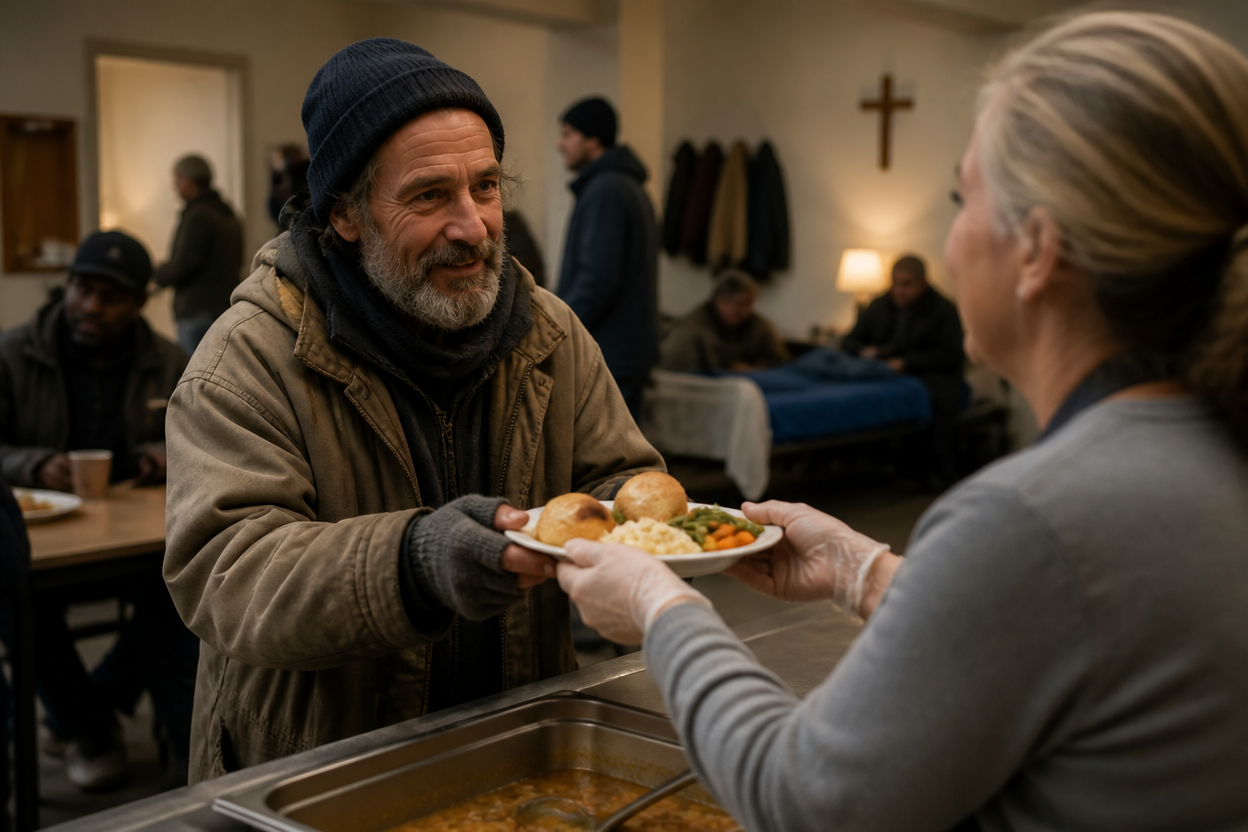
Emergency shelter can mean several different operational models, each with distinct costs and risk profiles. Some ministries run a night-by-night dormitory with a strict curfew and morning exit. Others operate longer-stay transitional housing with case management. Some partner with churches to host rotating shelters in fellowship halls. Others provide family units or domestic violence-adjacent safe shelter with tighter confidentiality requirements.
Christians genuinely disagree about the best model in a given city. “Low barrier” shelters emphasize immediate access with fewer entry requirements, which can reduce unsheltered exposure but can also increase on-site behavioral complexity. “Higher structure” programs emphasize sobriety requirements and participation expectations, which can strengthen communal safety but can also exclude people who are still unstable. Donors serve the work best by asking ministries to articulate why their model fits their local realities.
Safety, trauma, and the non-negotiables
Shelter is not only a bed; it is an environment that can either stabilize trauma or compound it. Ministries that do this well invest in trained staff, clear policies, and predictable rhythms. They also separate spaces appropriately when possible: single men, single women, families, and survivors of exploitation have different safety needs.
In our verification work, the ministries that meet The Most Trusted Standard tend to demonstrate a consistent pattern: safety is governed, not improvised. Boards approve policies. Leadership tracks incident data. Staff are trained in de-escalation and mandatory reporting. The presence of prayer and pastoral care does not replace sound safeguarding; it heightens the responsibility to protect those who are vulnerable.
How meal programs work and why dignity matters
Feeding programs as both service and relationship
Meals in homeless outreach often take the form of soup kitchens, mobile feeding routes, pantry distribution, or partnerships with local grocers and food banks. Many ministries provide breakfast after an overnight shelter, a midday meal that draws in unsheltered neighbors, and dinner linked to a chapel service or optional discipleship time.
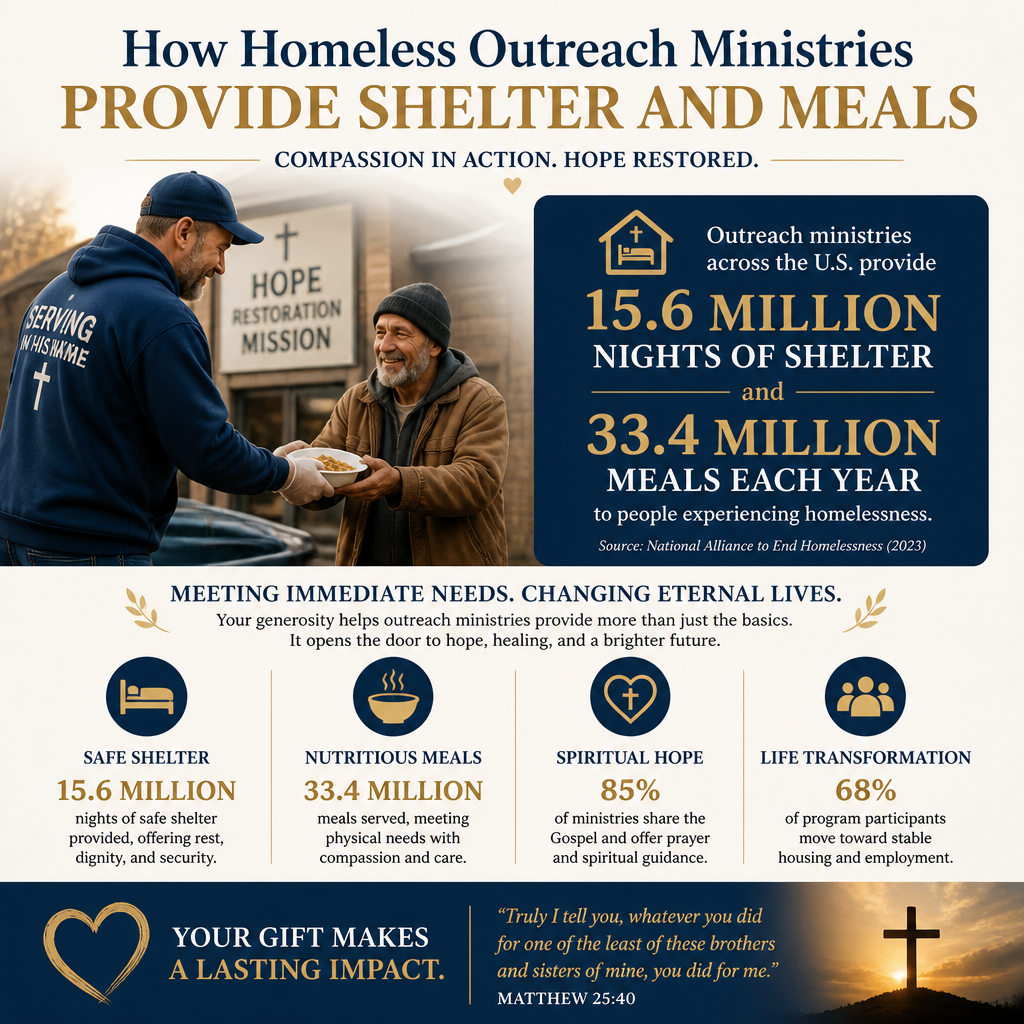
Donors sometimes ask whether meal programs “enable dependency.” The concern is understandable; Scripture condemns exploitation and commends work. Yet in homelessness, hunger is commonly intertwined with mental illness, disability, domestic violence, and job loss. A meal is rarely the root of the crisis. It is often the first stable touchpoint from which someone can begin telling the truth about what happened.
Quality, nutrition, and the ethics of how food is given
There is a moral difference between feeding people and disposing of leftovers. Mature ministries treat food safety, nutritional adequacy, and hospitality as part of Christian witness. That includes appropriate storage, allergy awareness, and a refusal to serve what volunteers would not eat themselves.
Many ministries also coordinate with the federal nutrition ecosystem. For example, food banks and partner agencies are often connected to the Feeding America network, which reports distributing billions of meals annually through a national partner system. Feeding America
Coordination matters because it can reduce waste, diversify supply, and keep donor dollars focused on what only a ministry can do well: relational engagement, pastoral care, and wraparound support.
From relief to restoration without coercion or sentimentality
What “rescue mission” can mean at its best
Rescue missions and outreach ministries have historically offered more than shelter and meals: they have offered a structured community in which sobriety, work readiness, counseling, and discipleship can take root. But the field has also had to reckon with failures—poor governance, weak safeguarding, spiritual coercion, or pressure to produce conversions as a metric.
Faithful Christian ministry does not treat conversion as a fundraising deliverable. It also does not hide its Christian identity. The more credible posture is clarity: services are given freely; spiritual care is offered openly; participation in religious activities is not the price of safety. When that line is honored, ministries can maintain theological integrity and public trust.
Evidence-informed care and the tension donors must accept
Many ministries have learned from the broader relief-and-development conversation, including the “When Helping Hurts” framework articulated by Steve Corbett and Brian Fikkert, which warns that aid can unintentionally reinforce shame, dependency, and paternalism when it replaces rather than restores agency. When Helping Hurts
What this means for shelter and meals is not that relief is wrong. It means relief must be paired with clear pathways toward stability, and those pathways must be realistic given the client population. For some neighbors, restoration will look like rapid rehousing and a return to work. For others, it will look like supported housing, disability services, or long-term clinical care. Donors should be wary of ministries that promise uniformly quick outcomes in a population defined by complex barriers.
- Clear intake and assessment that distinguishes immediate crisis from longer-term needs
- Case management or navigation connected to local housing and benefit systems
- Clinical partnerships for mental health, substance use disorder, and primary care
- Work and life-skills programming that respects differing capacities
- Discipleship offered with integrity as invitation, not transaction
Donors looking for deeper context on the wider landscape of this work can engage our coverage of Rescue Missions and Homeless Outreach as they discern where to give and what questions to ask.
What Christian donors should verify before funding shelter and meal ministries
The stewardship questions that protect both guests and givers
Emergency services are emotionally compelling, and ministries sometimes receive gifts primarily on the strength of moving stories. That is precisely why verification matters. Christian stewardship is not suspicion; it is love expressed through due diligence. A ministry that handles people in crisis should be able to show donors how it handles money, authority, and truth.
At Most Trusted, we evaluate nonprofits against The Most Trusted Standard, a 15-criteria framework spanning Faith Foundation, Financial Integrity, Governance and Leadership, and Transparency and Effectiveness. In practice, donors can translate that into a set of verifiable questions.
Concrete signs of a ministry worth sustained support
We recommend looking for evidence in five areas.
- Governance: an active board, conflict-of-interest policies, and documented oversight of safeguarding
- Financial clarity: current financial statements, an accountable budget, and consistent external reporting
- Program integrity: clear eligibility rules, incident procedures, and referral relationships with local systems
- Truthful communication: outcomes reported with definitions and limits, not inflated claims
- Christian identity with ethical boundaries: transparent faith commitments without coercive practices
The nonprofit sector has also had to correct simplistic thinking about overhead. Charity Navigator, Candid, and the BBB Wise Giving Alliance jointly warned against judging charities primarily by overhead ratios, because underinvestment in administration can weaken effectiveness and accountability. Charity Navigator
Donors seeking ministries where theology and operational excellence are held together should also review the broader field of Faith-Based Programs in Homeless Outreach and compare how different organizations define success, measure safety, and report results.
FAQs for How homeless outreach ministries provide shelter and meals
Do shelter and meal programs reduce homelessness or only manage it?
They can do both, depending on what the ministry is built to do and what the local housing system can absorb. Emergency shelter and meals manage immediate harm by reducing exposure, hunger, and victimization. Reduction in homelessness typically requires pathways into stable housing, income, and clinical care for those who need it. Strong ministries can contribute meaningfully to exits from homelessness when they integrate navigation, case management, and partnerships rather than operating as a stand-alone service.
Should Christian donors prioritize overt evangelism or basic-needs services?
Scripture does not force a choice between word and deed; it calls the church to both. Donors can support ministries that offer shelter and meals freely while providing pastoral care and discipleship as an open invitation. The ethical line is clear: basic safety and food should not be conditioned on religious participation. Ministries that hold this line tend to preserve credibility with guests, civic partners, and donors while remaining unapologetically Christian.
Mercy that is immediate, accountable, and aimed at restoration
Shelter and meals are not the whole answer to homelessness, but they are often the first faithful answer on a freezing night or an exhausted morning. Christian donors serve this work best when generosity is paired with verification: asking whether a ministry is safe, truthful, and governed well enough to bear the weight of vulnerable lives. When those foundations are present, a bed and a meal become more than services; they become the beginning of stability, and sometimes the beginning of hope.



