
How Christian outreach programs support long-term stability depends on whether outreach is defined as a moment of relief or as the first step in a disciplined pathway toward restoration. Mature Christian donors are often willing to fund the hard, slow work that stability requires, but they also expect moral clarity: what is a ministry actually promising, and what evidence suggests it can keep that promise?
In homelessness ministry, good intentions are common. Effective long-term outcomes are harder. People living unsheltered are not simply short of cash or a bed for the night; many are navigating untreated mental illness, substance use disorders, traumatic brain injury, domestic violence, family fracture, and a labor market that punishes gaps in work history. Christian outreach is strongest when it refuses reductionism and insists that the person in front of us bears God’s image, even when their life is profoundly disordered.
Outreach is not the opposite of discipleship
Mercy is immediate, but it is not shallow
Scripture does not permit a tidy division between “spiritual” ministry and “material” care. The prophets repeatedly connect worship with justice for the poor. James is unsparing: “If a brother or sister is poorly clothed and lacking in daily food… what good is that?” Christian outreach programs at their best treat immediate aid as a truthful act of neighbor love and as the beginning of trust.
What this means in practice is that outreach can be both low-barrier and spiritually serious. A hot meal, a street-level medical check, or a hygiene kit is not a full theory of change. It is, however, a morally coherent first move: a declaration that a person’s body matters to God and to us. That first move becomes stability only when ministries can sustain relationships and offer concrete next steps.
The tension donors must face
Christians genuinely disagree about conditionality. Some ministries require participation in chapel, counseling, or recovery programming to remain in shelter; others separate shelter access from spiritual programming to reduce barriers. Both approaches can be principled. Both can also fail: strict requirements can exclude the most fragile; no requirements can devolve into unmanaged chaos that harms residents and staff.
For donors, the question is not whether a ministry is “strict” or “permissive,” but whether its approach is coherent, communicated plainly, and implemented with integrity. Ministries should be able to explain how rules protect people, how discipline is administered without humiliation, and how spiritual care avoids coercion while remaining explicit about Christ.

Stability is built through sequenced, not scattered, services
From crisis contact to a pathway
Outreach becomes long-term stability when it functions as the front door to a sequenced set of services: safe shelter, case management, recovery support, employment readiness, and ultimately housing. The housing field often describes this as “systems” work. Donors can think of it more plainly: a person should not have to restart their story at every handoff.
For many rescue missions, the outreach team is the first point of contact, but the mission’s deeper asset is continuity. When outreach, shelter, and longer-term programming are aligned under one accountable leadership structure, it becomes more plausible to move someone from a sidewalk to a stable lease without losing them in referrals.
Housing is not merely a unit count
Evidence from the broader homelessness sector has helped clarify what “works,” even as debates continue about the best mix of models. The U.S. Interagency Council on Homelessness summarizes a strong research base for permanent supportive housing for people experiencing chronic homelessness, particularly when paired with services that address disabling conditions U.S. Interagency Council on Homelessness. Christian ministries that collaborate with supportive housing providers, community mental health, and Medicaid-funded services often strengthen their long-term outcomes without surrendering their spiritual identity.
At the same time, Christian donors should resist simplistic metrics. A ministry can place someone into housing and still fail if it cannot support tenancy stability, sobriety, or reunification where appropriate. Conversely, a program may report fewer “placements” while doing the necessary work of stabilization that makes placements durable.
Donors evaluating programs in Rescue Missions and Homeless Outreach should look for coherent pathways, not a menu of unrelated activities. A pathway does not require a large budget; it requires disciplined leadership, clear partnerships, and consistent follow-up.
Work and community are not optional for lasting change
Employment is formation, not only income
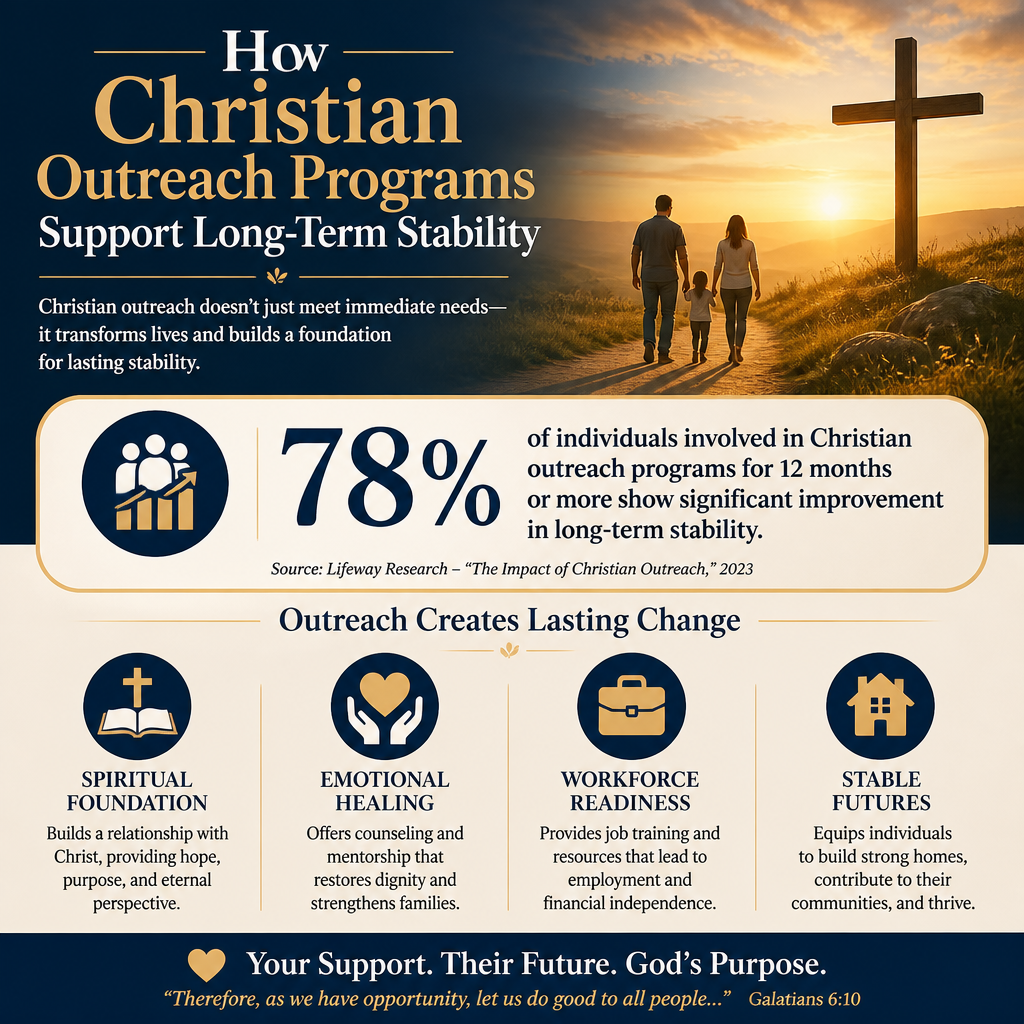
Long-term stability usually requires earned income. Theologically, work is not a punishment; it is part of humanity’s created purpose, later disordered by sin but not emptied of dignity. In practice, employment is often where people rebuild rhythm, accountability, and self-respect. Many missions use transitional work programs, social enterprises, or partnerships with local employers to create a bridge back into the labor market.
The harder question is how a ministry navigates the reality that many participants face legal barriers, poor credit, gaps in employment, or untreated health conditions. A serious program does not shame these barriers away. It assesses them, makes a plan, and stays with the person through setbacks.
Community is protective, but it must be safe
Isolation is a common feature of homelessness, and community is a common feature of recovery. Christian outreach programs often provide community through chapel services, small groups, mentorship, and local church connections. This can be profoundly stabilizing when it is well-led, trauma-informed, and oriented toward healthy belonging.
Community can also be unsafe if boundaries are unclear or if the program tolerates predatory behavior among participants. Donors should not assume that “faith-based” automatically means “safe.” Ministries need explicit policies, trained staff, and a willingness to remove those who threaten others, even when the offender’s needs are real.
Wise compassion requires accountability and measured outcomes
What donors should ask for without demanding the impossible
Homelessness programs operate in complex environments and serve people whose lives have often been shaped by years of trauma and instability. Donors should not demand false certainty. They should, however, expect ministries to track meaningful indicators and to speak candidly about limitations.
Across our verification work at Most Trusted, we observe that ministries capable of sustained stability tend to do a few ordinary things with unusual consistency: they document policies, separate duties so finances are not controlled by one person, measure outcomes they can define responsibly, and communicate with donors in plain language. The ministries that meet The Most Trusted Standard usually treat accountability as a form of love, not as a concession to skepticism.
- Clear program model and eligibility criteria, stated publicly and applied consistently
- Documented safeguarding practices for residents, volunteers, and staff
- Case management approach that includes coordinated referrals and follow-through
- Outcome reporting that distinguishes short-term relief from longer-term stability
- Financial statements and governance practices that prevent conflicts of interest
What to do with the overhead debate
Christian donors sometimes hesitate to fund “administration,” preferring visible front-line services. The sector has had to correct this instinct. Charity Navigator, Candid, and the BBB Wise Giving Alliance jointly warned against judging nonprofits by overhead ratios alone, arguing that such pressure can undermine effectiveness and transparency Charity Navigator. A mission that cannot pay for competent case managers, secure data systems, or clinical partnerships is less likely to support long-term stability, even if its meal service is exemplary.
Donors can still insist on discipline. The point is not to excuse bloat; it is to fund the actual costs of doing the work well and safely.
Long-term stability often depends on collaboration beyond the ministry
Government and healthcare systems are not competitors to the Church
Many of the interventions that support stability are embedded in public systems: mental health treatment, addiction medicine, disability benefits, and housing vouchers. Christian outreach programs that refuse all partnership can unintentionally confine participants to a smaller universe of help than they need. Collaboration does not require theological compromise. It requires clarity about mission and competence in navigating systems.
The U.S. Department of Housing and Urban Development’s Annual Homeless Assessment Report is one reason the field increasingly emphasizes data, coordinated entry, and housing-focused strategies U.S. Department of Housing and Urban Development. Rescue missions do not need to imitate every secular model, but they do need to understand the ecosystem in which their participants will seek housing and services.
Church partnership is a spiritual and practical multiplier
Local churches provide what institutions rarely can: long-term relational presence, moral formation, and ordinary community life. When missions can place participants into healthy congregations with trained mentors, the support outlasts the program timeline. This is one reason donors should care about how a ministry equips volunteers and churches, not only what it does on its own campus.
For donors interested in Faith-Based Programs in Homeless Outreach, collaboration is one of the clearest markers of maturity. The ministry that can name its partners, describe shared responsibilities, and report what happens after a referral is usually the ministry that understands stability as a long horizon.
FAQs for How Christian outreach programs support long-term stability
Do Christian outreach programs work better than secular programs?
It depends on what “better” means and which population is being served. Some faith-based programs are unusually strong at sustained relationship, recovery community, and moral formation. Some secular programs are unusually strong at clinical integration and housing navigation. The most reliable predictor of long-term stability is not whether a program is faith-based, but whether it is well-governed, clear about its model, competent in partnerships, and honest in outcome reporting.
What outcomes should donors look for if they care about long-term stability?
Donors should look for outcomes that match the program model and that are reported with clarity: length of stay, program completion where completion is meaningful, employment or income gains, housing placements paired with follow-up, and indicators of tenancy retention when the ministry tracks it. Donors should also ask what happens to participants who do not complete the program, since drop-off is often where the most vulnerable people disappear from view.
A stable life is usually the fruit of sustained, accountable love
Christian outreach programs support long-term stability when they treat emergency relief as the beginning of a pathway, not the end of the story. They combine mercy with discipline, spiritual care with competent services, and compassion with accountability. Donors who fund that kind of work are not paying for a moment; they are underwriting the slow reconstruction of a life before God and neighbor.



