
What faith-based programs support juvenile justice reform is not a question of charity alone. It is a question of discipleship and public justice: what it means to seek the good of children who have harmed and been harmed, and how Christian donors can fund change that is both morally serious and operationally credible.
Youth justice sits at a difficult intersection. Communities want safety. Victims deserve truth-telling and repair, not sentimentality. And many court-involved young people carry layered histories of trauma, family breakdown, foster care involvement, addiction, and educational exclusion. Christian giving at its best refuses the false choice between accountability and mercy because Scripture refuses it. God’s justice is not indifferent to harm, and God’s mercy is not indifferent to the sinner.
Faith-based juvenile justice reform begins with a Christian view of the child
Image-bearing, accountable, and redeemable
Christian programs in the juvenile system are strongest when they start with theological clarity rather than a generic humanitarian impulse. Young people in confinement are image-bearers, capable of agency and therefore accountable; they are also minors whose judgment, impulse control, and risk assessment are still developing. Donors should not require ministries to minimize wrongdoing in order to emphasize grace. The Cross does not treat sin lightly; it treats it truthfully and bears its cost.
This theological starting point matters because juvenile justice reform is contested terrain. Christians genuinely disagree about what reforms protect communities and what reforms simply lower consequences. The work is further complicated by the fact that “juvenile justice” includes very different populations: detained youth awaiting hearings, youth committed to long-term placement, youth on probation in the community, and young adults aging out of juvenile systems.
What the system is designed to do and what it often does
Most state systems formally emphasize rehabilitation, yet practice can drift toward containment. Donors do not need to become technical experts, but they should understand the stakes: the juvenile system shapes education pathways, family stability, mental health trajectories, and long-term employability. A ministry can preach faithfully and still ignore the practical conditions that make flourishing difficult; a ministry can also pursue program outcomes while hollowing out the distinctly Christian center. Reform-minded, faith-based programs aim for both: moral formation and tangible reintegration.
Across our verification work at Most Trusted, we observe that the ministries most worth funding tend to be explicit about their theology, sober about risk, and disciplined about partnerships with schools, courts, and families. They treat “transformation” as more than a moment and less than a guarantee.

Program models that reliably support reform rather than mere relief
Inside-the-facility discipleship tied to reentry planning
Chaplains and volunteer Bible studies matter, but durable reform requires continuity. Strong programs connect spiritual formation inside facilities with practical reentry planning that begins well before release. This includes coordinated documentation, schooling, family engagement, and clear handoffs to community mentors and churches. Donors should ask whether a program has formal access agreements, consistent volunteer training, and realistic release-to-community pathways.
Community-based alternatives that keep youth connected to family and school
Many reform efforts prioritize keeping appropriate cases out of confinement through structured supervision and restorative approaches. Faith-based organizations may provide mentoring, counseling, substance-use support, tutoring, and family stabilization as part of diversion or probation support. When these programs work, they reduce the “detention as default” reflex while retaining meaningful accountability.
The research community has documented how confinement can increase educational disruption and weaken prosocial ties. Donors should look for programs that work closely with schools and caregivers, not merely with the youth. The U.S. Department of Justice has noted that confinement can be associated with higher recidivism compared to certain community-based responses for some youth populations, depending on risk level and program quality. Office of Juvenile Justice and Delinquency Prevention
When donors want broader context for how ministries operate across incarceration and reentry, we encourage engagement with Prison and Post-Prison Ministries, where the field’s program patterns and accountability questions become clearer.
The reform agenda faith-based programs can advance without drifting from the gospel
Restorative justice that honors victims and demands truth
Restorative justice is often misunderstood as a softer form of discipline. At its best, it is morally bracing: it requires the offender to name harm, accept responsibility, and participate in repair where appropriate and safe. Faith-based programs are particularly well positioned here because confession, repentance, restitution, and reconciliation are not novel Christian ideas. They are biblical ones.
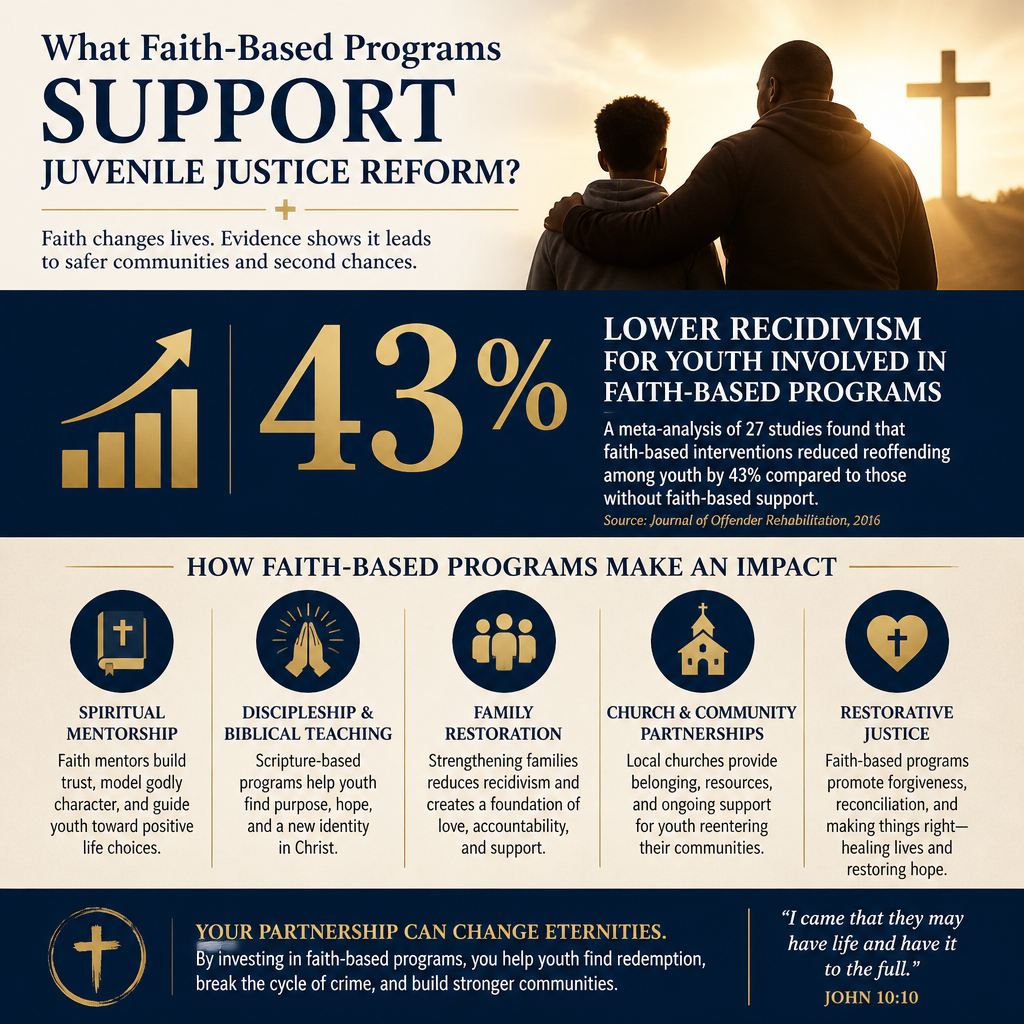
Still, donors should resist romantic narratives. Not every case is appropriate for direct victim-offender dialogue. Some victims want distance, not contact, and that preference should be respected. Strong restorative programs have professional protocols, trauma-informed facilitation, and clear safeguards that prioritize victim agency.
Family strengthening and church integration as reentry infrastructure
Reform is not only about what happens to a youth; it is also about what happens around a youth. Courts can order conditions, but communities must supply belonging. Faith-based programs that support juvenile justice reform often work through family systems: parenting support, mediated family contact, transportation for visitation, and coordinated planning with caregivers. Churches can participate without becoming quasi-probation departments by offering stable relationships, supervised activities, tutoring, and practical help that reduces chaos in the home.
The Annie E. Casey Foundation has documented that youth of color are overrepresented at many points in the juvenile justice system, a reality that places additional moral responsibility on donors to fund credible, community-embedded solutions rather than performative concern. Annie E. Casey Foundation
How donors can evaluate ministries working in juvenile justice
Questions that separate mature reform work from impressive storytelling
Juvenile justice ministries often operate in emotionally charged environments: children in restraints, families in crisis, staff under strain, victims seeking answers. The stories are real, and the need is real. But donors serve the cause best when they evaluate with discipline. Most Trusted exists for precisely this reason: we help donors give with confidence by evaluating Christian nonprofits against The Most Trusted Standard, a 15-criteria framework addressing faith foundation, financial integrity, governance and leadership, and transparency and effectiveness.
In practice, donors should look for a ministry that can describe its model clearly, name its limits, and document its safeguards. The strongest leaders do not promise outcomes they cannot control, and they do not hide behind spiritual language when operational questions are asked.
- Access and legitimacy: Are there formal agreements with facilities, courts, or schools where required, and are boundaries clear for volunteers?
- Safeguarding: Are background checks, two-adult rules, and mandatory reporting training standard and documented?
- Continuity of care: Is there a credible plan from custody to community, including mentoring handoffs and family involvement?
- Accountability to victims and community safety: How does the program address harm, restitution, and risk management?
- Evidence and learning: Does the ministry track participation, retention, and reentry engagement, and improve based on results?
Financial integrity and the ethics of restricted funding
Juvenile justice work is staff-intensive. Donors sometimes prefer to fund direct programming while leaving training, compliance, and evaluation unfunded. That preference can unintentionally erode safety and quality. The “Overhead Myth” letter, signed by leading charity evaluators, warned donors against simplistic overhead ratios and urged attention to outcomes, transparency, and governance. Candid GuideStar
What this means for juvenile justice is straightforward: a ministry that cannot fund professional supervision, volunteer training, data systems, and legal compliance is a ministry that will eventually drift toward avoidable failure. Restricting gifts too narrowly can become a form of under-resourcing disguised as prudence.
Donors who want to compare programs serving detained youth, probation youth, and reentry youth can situate their giving within Prison Ministry for Youth and Juvenile Justice, where the practical distinctions between models tend to surface.
Programs and partnerships donors should look for in the field
Chaplains and faith-based mentoring networks with rigorous training
Some of the most effective faith-based initiatives are not the most publicized. They are consistent chaplaincy partnerships and mentoring networks that insist on training, supervision, and long-term presence. The best mentoring programs do not recruit volunteers primarily on enthusiasm. They recruit on steadiness, maturity, and adherence to boundaries, with clear expectations about frequency of contact and crisis escalation.
Donors should ask whether volunteers receive training on adolescent development, trauma exposure, de-escalation, and mandatory reporting. A ministry can be doctrinally faithful and still be negligent if it treats youth protection as optional.
Reentry education and workforce pathways aligned with local employers and schools
Education disruption is one of the system’s quiet drivers of long-term harm. Credible programs support school re-enrollment, credit recovery, GED pathways where appropriate, and vocational training connected to real local demand. Partnerships with community colleges, employers willing to hire justice-involved youth, and legal aid for record-related barriers can materially change outcomes.
The harder question is whether a ministry’s workforce claims are verifiable. Donors should expect clarity: how many participants completed training, how many obtained employment, and what “employment” means in practice. Vague success stories are common in this field; disciplined reporting is less common and more valuable.
At their best, faith-based programs connect these practical pathways to spiritual formation without confusing the two. Work is not salvation. But work is often one of the ordinary means by which stability, responsibility, and renewed identity are sustained.
FAQs for What faith-based programs support juvenile justice reform
Do faith-based juvenile justice programs have to be explicitly evangelistic to count as Christian?
Christian donors will weigh this differently, but clarity matters. Some programs are explicitly evangelistic; others are faith-motivated, offering mentoring, counseling, or restorative practices shaped by Christian convictions while serving youth in settings where proselytizing is restricted. We recommend supporting ministries that are transparent about what they do, what they are permitted to do in government settings, and how they sustain a clear Christian identity without coercion.
What outcomes should donors expect a credible juvenile justice ministry to measure?
Recidivism is often requested, but it is not always feasible for a nonprofit to track reliably without agency data-sharing agreements. Credible ministries typically measure what they control: participation and retention, mentor contact frequency, school re-enrollment, completion of programs, family engagement, and successful handoffs to churches or community supports. Where they cite recidivism, donors should ask for definitions, timeframes, and data sources rather than accepting generalized claims.
Giving that strengthens justice rather than sentiment
Faith-based programs support juvenile justice reform when they combine spiritual seriousness with operational discipline: accountability that names harm, mercy that refuses to discard a child, and practical pathways that make change plausible after release. For Christian donors, the central task is not to find a perfect program in an imperfect system. It is to fund ministries whose theology is clear, whose safeguards are real, and whose claims can be tested—so that compassion becomes durable rather than episodic.



