

How prison ministry supports youth after release is not primarily a question of programs; it is a question of whether the Church will meet young people at the most predictable point of abandonment. Release is often treated as the end of a sentence, yet for many youth it is the beginning of a high-risk return to the same social pressures, family instability, and economic scarcity that contributed to incarceration in the first place.
Christian donors recognize the theological stakes. Jesus named prison visitation among the concrete works of mercy by which his disciples are known (Matthew 25:36). The harder question for funders is what faithful, effective post-release support actually entails for youth, where the developmental realities of adolescence and the legal realities of supervision collide.
Release is a transition, not a finish line
The predictable vulnerabilities of adolescence
Ministries serving youth after incarceration work in a distinct moral and developmental landscape. Adolescents are still forming impulse control, identity, and belonging. A youth returning home from detention typically re-enters school, family, and neighborhood dynamics with heightened scrutiny and fewer safe relationships. Many carry trauma, and some return to homes strained by addiction, housing instability, or domestic conflict. A purely compliance-driven approach can keep a young person out of immediate trouble while leaving the deeper drivers untouched.
What this means in practice is that “support” must include more than a ride from the facility. It often involves structured relationships, school re-entry advocacy, mental health referrals, and patient work with families whose trust has been eroded by years of crisis. Theologically, Christian ministry is not surprised by the complexity: Scripture speaks of the heart, the community, and the powers that deform human life, not merely the behavior we can measure quickly.
Supervision can create pressure that ministries must understand
Youth on probation face technical requirements that adults with stable homes and transportation would find difficult. Missed appointments, curfew violations, and school absences can escalate rapidly. Donors should expect credible ministries to understand local juvenile justice systems, maintain professional boundaries with probation, and build collaboration without becoming an extension of enforcement.
The field has had to reckon with a basic tension: partnerships with the system can expand access and continuity of care, but they can also compromise trust if youth perceive the ministry as a surveillance arm. Sophisticated ministries name this tension openly and design policies that protect the pastoral relationship while cooperating appropriately with mandated reporting and safety requirements.

Relational discipleship is the core intervention
Consistency is the rarest resource
Many youth leaving detention have learned, repeatedly, that adults disappear. A faithful post-release prison ministry offers a consistent presence that is neither sentimental nor transactional. Mentoring becomes a form of embodied discipleship: a mature Christian shows up, tells the truth, keeps promises, and refuses to reduce a young person to a case file.
Research across youth development consistently underscores the power of stable, supportive relationships. The U.S. Office of Juvenile Justice and Delinquency Prevention highlights protective factors that include strong connections to family and other supportive adults, which are associated with reduced delinquency risk and better outcomes (Office of Juvenile Justice and Delinquency Prevention).
Spiritual formation without coercion
Christian donors should be alert to two opposite errors. One is a thin “services only” posture that avoids naming Christ, treating spiritual formation as an optional accessory. The other is coercive spiritual pressure that uses a youth’s need for housing, food, or rides as leverage for religious compliance. Faithful ministry refuses both. It offers the gospel clearly, grounds discipleship in the local church where possible, and protects the dignity of the young person even when he or she is not ready to believe.

Across our verification work at Most Trusted, we observe that ministries meeting The Most Trusted Standard tend to define success in moral and pastoral terms that are still verifiable: participation consistency, connection to a church community, educational engagement, employment readiness, and reduced re-contact with the justice system where tracking is feasible and lawful. They do not promise outcomes that no one can guarantee, especially in environments shaped by poverty and violence.
Practical supports matter because scarcity constrains choices
Education and work are often contested terrain
Post-release youth commonly face school disruptions, credit deficits, and disciplinary stigma. Even where policies support re-entry, implementation varies. Some youth need advocacy to obtain records, re-enroll, or access alternative education. Others need tutoring and structured routines to re-learn how to function in classrooms after confinement.
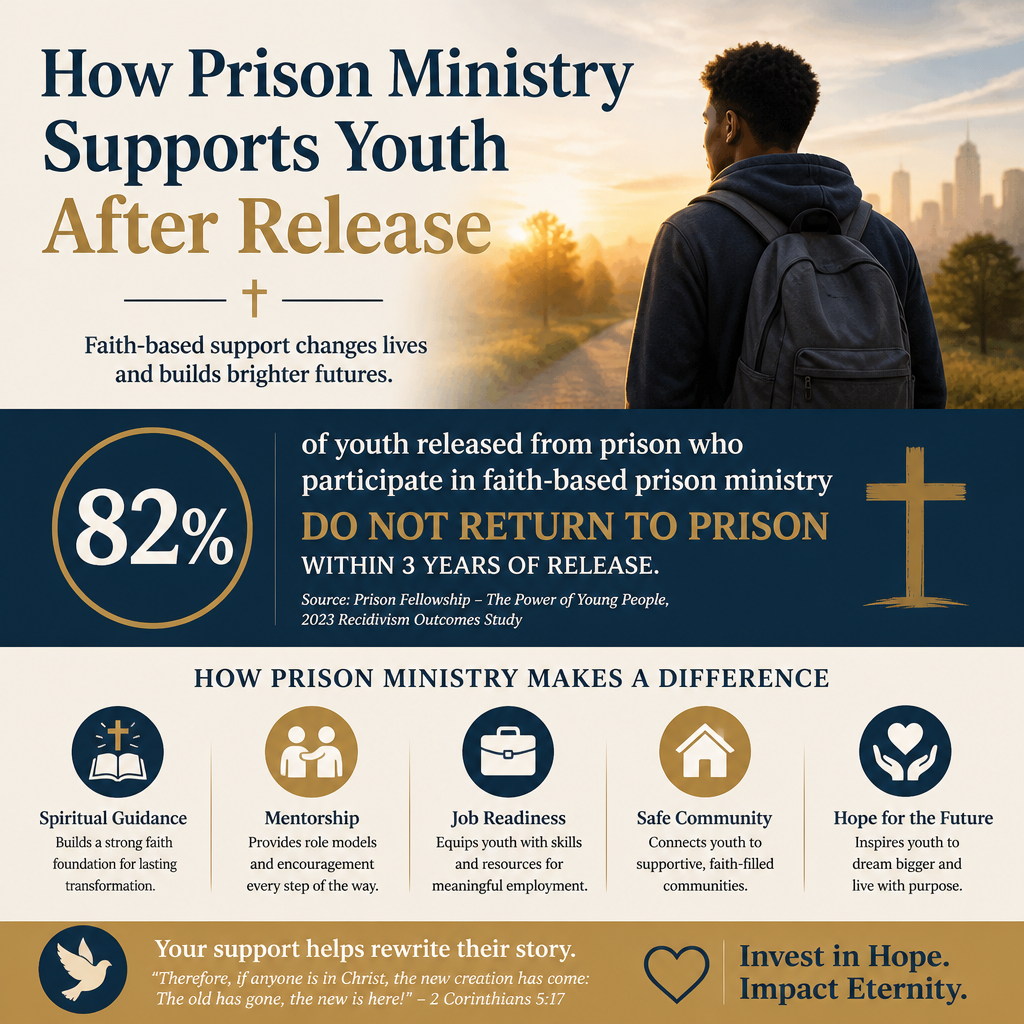
Employment is similarly complex. A young person may be legally employable yet practically blocked by transportation, lack of identification, unstable housing, or a labor market that does not readily take chances. Ministries that support youth after release often build employer relationships, provide job readiness coaching, and help youth obtain basic documents. These are not peripheral tasks; they are the scaffolding that enables a youth to choose the good when temptation and scarcity narrow the field of perceived options.
Housing and family stability are decisive
Many donors underestimate how fragile housing can be for justice-involved youth, especially when a young person returns to a home already under strain. The U.S. Department of Housing and Urban Development has documented the strong association between youth homelessness and involvement with juvenile justice systems (U.S. Department of Housing and Urban Development). When shelter is uncertain, discipleship conversations about long-term choices can become abstract. Stability is not salvation, but it is often a precondition for sustained change.
Family reunification is also morally and practically complicated. Not every home is safe, and not every biological relationship is healthy. A responsible ministry does not romanticize reunification; it assesses risk, collaborates with appropriate professionals, and seeks the most protective arrangement possible, including kinship placement where available and safe.
Effective ministries build a continuum from incarceration to community
Pre-release engagement prevents the post-release gap
The most preventable failure is the “warm handoff” that never happens. Youth are discharged with minimal planning, returning to familiar pressures within hours. Ministries that support youth well typically begin while the youth is still incarcerated: establishing rapport, coordinating with chaplains and case managers, and creating a plan that includes the first week after release, not merely the first meeting.
For donors evaluating programs, the question is whether the ministry has access, permissions, and operational discipline to work across the boundary line of the facility gate. This is where continuity becomes measurable: consistent contact pre-release, documented follow-up attempts post-release, and clear escalation pathways when youth disengage.
Local church integration is both vital and difficult
Many churches want to welcome returning youth but are unsure how to do so safely and wisely. Youth may arrive with gang affiliations, unresolved conflict, or patterns that alarm volunteers. Churches also carry legitimate concerns about safeguarding policies and the well-being of other youth.
Strong ministries train churches to respond with both mercy and prudence: clear youth protection protocols, careful volunteer screening, and structured roles that do not place new volunteers in high-risk situations. For donors wanting a broader view of how incarceration and re-entry ministries are structured, our coverage of Prison and Post-Prison Ministries offers context on the common models and the accountability questions that follow them.
How Christian donors can fund youth re-entry with integrity
What to ask before giving
Generous donors often want the simplest possible assurance: “Does this work?” With youth re-entry, the more faithful question is whether the ministry is positioned to pursue the right outcomes with the right means, over an appropriate time horizon. Recidivism is a relevant indicator, but it is not the only one, and it is not always tracked consistently across jurisdictions.
We recommend that donors look for a ministry that can answer specific questions without defensiveness:
- How does the ministry maintain contact in the first 72 hours after release, when risk is high?
- What safeguards and boundaries govern mentor relationships, transportation, and communication?
- How does the ministry coordinate with probation, schools, and caregivers without compromising trust?
- What outcomes does the ministry track, and what data limitations does it acknowledge plainly?
- How is the gospel presented in a way that is clear, non-coercive, and connected to a church?
Why verification matters for this category
Youth justice work attracts understandable donor urgency. It also attracts risk: uneven governance, unclear financial controls, inflated claims about transformation, or charismatic leadership that outpaces accountability. This is precisely where independent verification serves the Church. Most Trusted evaluates Christian nonprofits against The Most Trusted Standard, examining faith commitments alongside financial integrity, governance and leadership practices, and transparency with evidence. Donors do not need perfection, but they do need ministries that can be trusted with young lives and donor resources.
Within youth-focused contexts, donors often ask about tutoring programs, diversion partnerships, and mentoring pipelines. Our work on Prison Ministry for Youth and Juvenile Justice reflects the recurring due diligence themes: safeguarding, data discipline, qualified staffing, and a theology of restoration that does not minimize harm.
FAQs for How prison ministry supports youth after release
Does youth re-entry ministry reduce recidivism?
The evidence is mixed across programs because “re-entry ministry” can mean very different interventions, and juvenile justice systems measure outcomes differently. What donors can reasonably expect is that well-run ministries will track concrete indicators they can influence—consistent mentoring contact, school engagement, job readiness steps, stable housing connections, and participation in church community—while also monitoring re-contact with the justice system where possible. Ministries that speak with integrity will not treat a single metric as definitive proof of spiritual or social renewal.
What distinguishes a faithful ministry from a well-meaning but risky one?
Faithfulness shows up in doctrine, but also in operational discipline. Credible ministries protect youth through safeguarding policies, maintain clear mentor boundaries, and collaborate with qualified professionals for mental health and trauma care. They communicate honestly about setbacks, avoid coercive practices, and demonstrate accountable governance and transparent finances. In our view, the best signal is whether the ministry can be examined without fear—because it has built structures worthy of the work it claims to do.
What donors make possible after the gate opens
When prison ministry supports youth after release, it makes visible a Christian conviction that society often denies: a young person is more than his or her worst decision, and grace is not naïve about consequences. The work is slow, relational, and frequently interrupted by relapse and re-arrest. Yet it is also one of the Church’s clearest opportunities to practice mercy with prudence and to fund restoration that is both spiritually serious and operationally accountable.



