

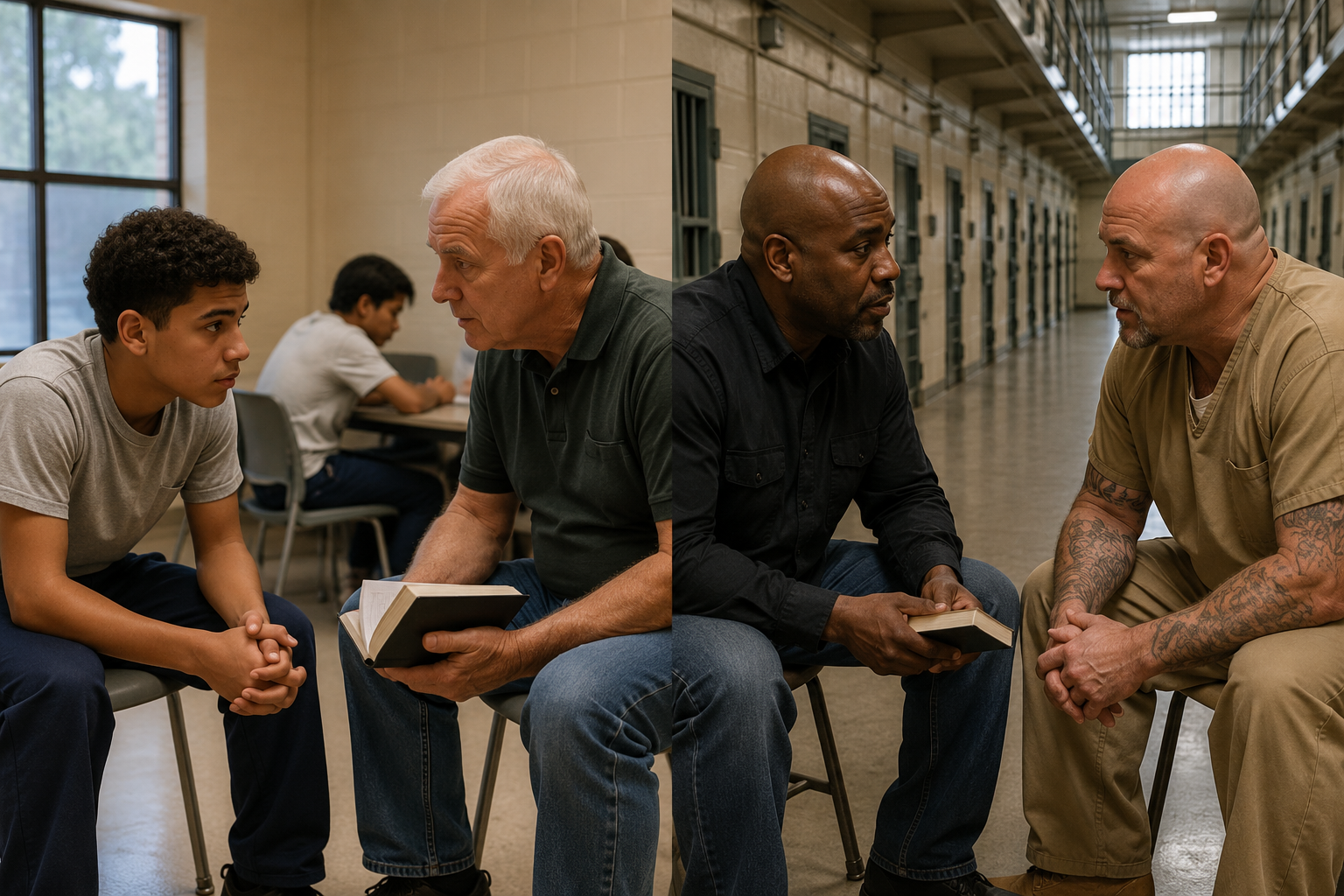
How juvenile detention ministry differs from prison ministry is not primarily a question of venue. It is a question of moral responsibility, developmental reality, and legal constraint. Adult prison ministry often meets people whose lives are already set in hardened patterns; juvenile detention ministry meets minors whose brains, identity, and attachments are still forming, and whose outcomes can still bend—toward restoration or toward deepened entrenchment.
For Christian donors, the distinction matters because the opportunities for durable impact are real, and so are the risks of unintended harm. The work sits at the intersection of trauma, family fracture, public systems, and spiritual formation. Faithful compassion is necessary, but it is not sufficient; ministries serving detained youth must also be precise, supervised, and accountable in ways that look different from adult facilities.
1 The people are different because adolescence is different
Development changes the pastoral task
Juvenile detention centers hold children and teenagers. That single fact changes what wise ministry must look like. Adolescents are still developing executive function, impulse control, and long-term planning. The U.S. Supreme Court has repeatedly recognized these developmental differences in cases addressing juvenile sentencing, noting that youth have diminished culpability and greater capacity for change; see U.S. Supreme Court.
In adult prisons, discipleship often begins with rebuilding a moral imagination that has been long neglected, sometimes across decades. In juvenile detention, ministry often begins with stabilization: helping a young person name what happened to them, what they have done, and what is possible next. That does not reduce sin to psychology, nor does it excuse harm. It does acknowledge that sanctification and maturity are not identical, and that God’s call to repentance lands in a different developmental context for a sixteen-year-old than for a forty-six-year-old.
Trauma and attachment are more central with minors
The field has had to reckon with how frequently detained youth carry significant trauma histories. In many jurisdictions, youth are detained for offenses that sit alongside deep family instability, educational disruption, and exposure to violence. The most careful ministries do not medicalize the gospel, but they do take trauma seriously as part of the pastoral environment, especially because youth are still forming basic expectations about adults, authority, and trust.
This is one reason volunteer selection and supervision must be tighter with minors than with adults. A warm, personable volunteer presence can be a gift; it can also re-trigger abandonment and attachment wounds when relationships begin and then disappear. Churches are often eager to “show up.” Juvenile settings require the discipline to show up consistently, under supervision, with clear boundaries.
2 The institutions are different because the law is different
Juvenile justice is officially rehabilitative but operationally complex
Adult corrections systems are often oriented toward punishment and public safety. Juvenile justice systems, at least in stated purpose, emphasize rehabilitation. But Christian donors should not assume that “rehabilitation” is automatically humane or effective. Practice varies widely by state, facility leadership, staffing ratios, and local culture.
Federal law also frames the environment. The Office of Juvenile Justice and Delinquency Prevention outlines core protections and compliance expectations for states under the Juvenile Justice and Delinquency Prevention Act; see OJJDP. What this means in practice is that access, programming, and the role of outside volunteers can be more constrained and more variable than in many adult facilities.
Consent, confidentiality, and mandatory reporting are not optional
Ministry to minors is never merely “a smaller version” of adult ministry. A detained youth may be in state custody, in a county facility, or under court supervision with complex parental rights questions. That makes consent, information-sharing, and pastoral confidentiality unusually delicate. Mandatory reporting obligations also carry higher frequency because youth more often disclose active abuse, exploitation, or threats of self-harm.

For donors, this should shape what questions are asked. A serious juvenile detention ministry can name its screening protocols, supervision rules, training on boundaries, and coordination with facility staff. When a ministry cannot answer these clearly, the risk profile rises quickly.
3 The ministry aims are different because the time horizons are different
Detention is brief and disrupted
Many juvenile detentions are short stays, with frequent movement between facilities, court dates, and placements. Adult prison sentences can allow for long-term programming, a stable cohort, and multi-year discipleship inside a facility. Juvenile detention ministry often works in fragments: a few weeks of access, then a transfer, then release, then a new charge, then a new placement.
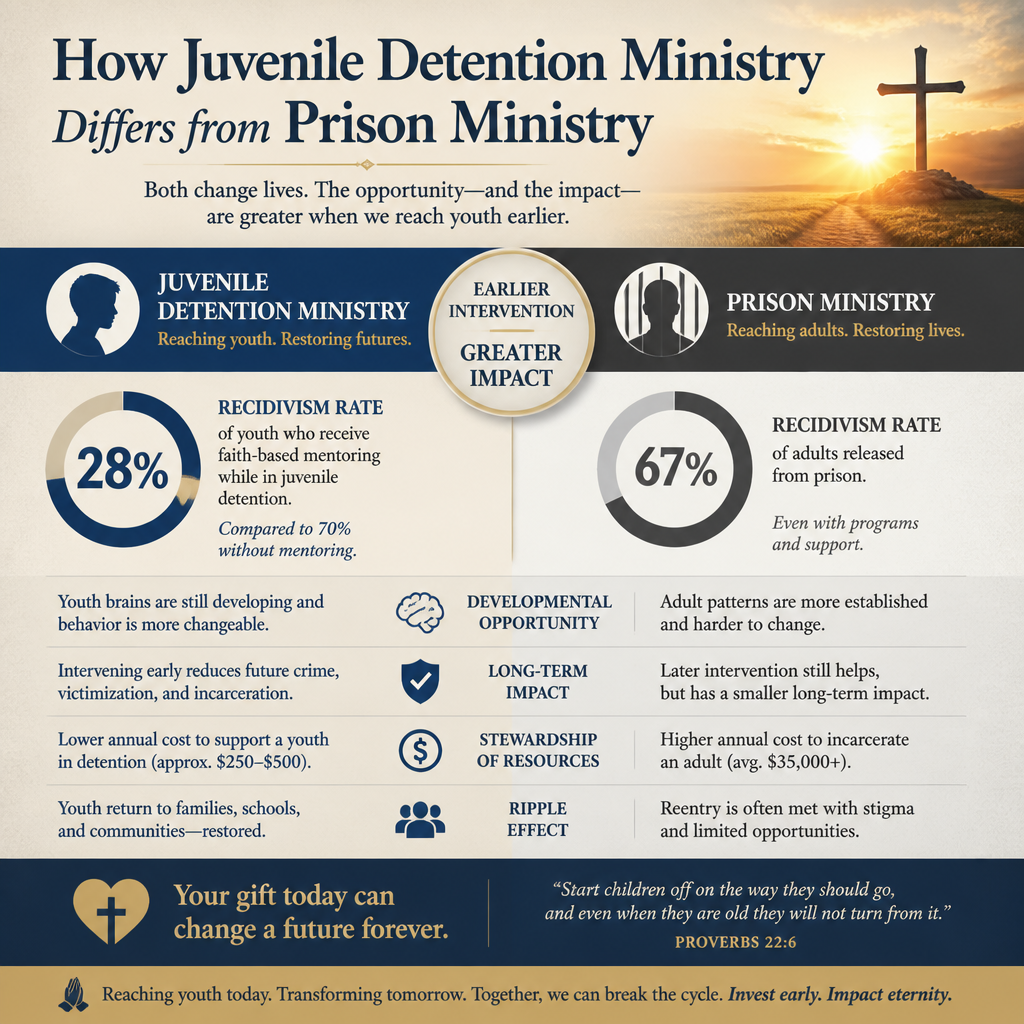
The donor implication is sobering: the ministry’s effectiveness depends heavily on transitions. A strong program inside a detention center can be undone if there is no handoff to community support. Conversely, a modest spiritual intervention inside can become a turning point if the youth is met immediately with credible aftercare, school reintegration support, and a church community trained for complexity.
Family systems are part of the mission, whether desired or not
Adult prison ministry frequently includes family support, but it is not always central to the incarcerated person’s daily plan. With minors, family systems are often inescapable. Even when home is unsafe, the youth’s story is still entangled with parents, siblings, guardians, and the child welfare system.
This is where Christian donors can look for uncommon wisdom. The strongest juvenile ministries avoid simplistic family narratives. Some families are heroic under pressure. Others are deeply compromised. Many are both. Wise programs build pathways that may include family reconciliation where appropriate, alternative placements when necessary, and durable mentoring relationships that do not compete with parental authority but do provide moral and spiritual stability.
4 The safeguards are different because the vulnerabilities are different
Power imbalances require stricter boundaries
Ministry in any locked facility involves power dynamics. With youth, the imbalance intensifies: minors are more impressionable, more easily coerced, and more likely to interpret spiritual authority as personal authority. This is why juvenile detention ministries require stricter policies around one-on-one contact, communication after release, transportation, gifts, and social media.
Donors sometimes worry that safeguards will “chill” compassion. In practice, safeguards protect compassion from becoming self-serving or unsafe. The posture of Matthew 25 does not suspend prudence; it demands it, because we are dealing with image-bearers in high-risk conditions.
Indicators of a ministry built for youth protection
Across our verification work at Most Trusted, we observe that ministries serving detained youth responsibly tend to make their safety architecture visible, not hidden. Donors can reasonably expect clarity in several areas:
- Volunteer screening, including background checks and reference processes aligned with youth-serving best practices
- Documented training on boundaries, trauma awareness, and mandatory reporting
- Clear supervision rules inside facilities, including restrictions on private meetings
- Written policies for post-release contact and mentoring, including church-based accountability
- Coordination protocols with facility staff and, when relevant, probation or caseworkers
These are not bureaucratic add-ons. They are part of neighbor-love ordered by wisdom. When a ministry presents them as an afterthought, donors should pause.
5 Donor due diligence differs because outcomes differ and are harder to measure
Recidivism is not the only measure, and it is often misused
Christians genuinely disagree about what “success” should mean in correctional ministry. Some emphasize conversions and church involvement. Others emphasize reduced reoffending. Many want both. For juvenile detention, the metrics problem becomes sharper: the youth’s environment is unstable, and long-term tracking is difficult.
Recidivism is commonly cited, but it can be misleading when definitions vary by jurisdiction and when a youth’s later system contact reflects policing patterns, school discipline practices, or probation technical violations. The more credible question is whether a ministry can articulate a coherent theory of change for youth and then show evidence that its programs are implemented faithfully, with appropriate partnerships for aftercare.
What accountability looks like under The Most Trusted Standard
Most Trusted exists to help donors give with confidence by evaluating Christian nonprofits against The Most Trusted Standard, a 15-criteria framework spanning Faith Foundation, Financial Integrity, Governance and Leadership, and Transparency and Effectiveness. The ministries that meet The Most Trusted Standard tend to treat youth detention as a distinct category, not merely an extension of adult prison work, and they document how their theology shapes their practice.
What this means for donors is straightforward: seek ministries that can describe their safeguards, their relationships with facility administrators, their volunteer management, and their aftercare partnerships in verifiable terms. For broader context on incarceration-focused giving, see Prison and Post-Prison Ministries.
It is also reasonable to compare programs within youth-specific work, because “juvenile justice ministry” can mean very different things: detention chaplaincy, court diversion partnerships, mentoring for youth on probation, family support, or trauma-informed discipleship groups. Donors evaluating this space may find it useful to review the range of approaches and risks within Prison Ministry for Youth and Juvenile Justice.
FAQs for How juvenile detention ministry differs from prison ministry
Is juvenile detention ministry mainly about preventing future crime?
Prevention matters, but Christian ministry cannot be reduced to crime control. The gospel addresses guilt, shame, reconciliation, truth-telling, and hope in Christ. For detained youth, those realities must be pursued with special attention to development, trauma, and family systems. Donors should support ministries that can describe both their spiritual commitments and their practical commitments to safety, consistency, and aftercare.
What should donors ask before funding a juvenile detention ministry?
Donors should ask how the ministry screens and supervises volunteers, how it handles mandatory reporting, what its policies are for communication with minors after release, and how it coordinates with facility staff and community partners. Donors should also ask what evidence the ministry has that its programs are delivered consistently and responsibly, and whether it can describe outcomes beyond anecdotes without overstating what can be measured.
Conclusion
Juvenile detention ministry differs from prison ministry because minors are not simply younger adults, and detention is not simply a smaller prison. The work demands a tighter integration of pastoral care, child protection, institutional cooperation, and long-term aftercare. Donors who fund this work well are not only extending mercy to those behind locked doors; they are investing in the possibility that a young person’s life can be redirected before patterns become permanent.



