

How churches can start juvenile detention ministry is not first a question of access or enthusiasm; it is a question of spiritual formation expressed through disciplined presence. When Jesus identifies visiting “those in prison” as service rendered to him, he does not reduce it to sentiment (Matthew 25:36). Juvenile detention adds complexity—developmental vulnerability, legal safeguards, and layered trauma—but it does not dilute the church’s responsibility to show up with humility, patience, and truth.
For Christian donors, the question is rarely whether young people in custody deserve care. The harder question is whether a proposed ministry model will protect youth, honor facility constraints, and produce fruit that can be responsibly described. The field has had to reckon with programs that were sincere but poorly governed—creating avoidable harm, broken relationships with detention staff, and disillusioned volunteers. Starting well is not a luxury; it is a moral requirement.
Begin with a theology of presence that can survive institutional reality
Matthew 25 is not romanticism
Juvenile detention ministry requires a church to carry two truths at once: every young person bears God’s image (Genesis 1:27), and every detention center is a tightly regulated environment shaped by safety, liability, and public accountability. A ministry that assumes it will “disrupt the system” will usually be removed from the system. A ministry that assumes the institution is morally neutral will become naïve about power, coercion, and the spiritual stakes of confinement.
What this means in practice is that the first spiritual discipline is fidelity. Detained youth encounter adults who make promises and disappear. Churches can unintentionally repeat that pattern with short volunteer bursts that create attachment and then sever it. The aim is not a moving story for supporters; it is a steady, predictable ministry that honors youth as persons rather than projects.
Clarify what ministry can and cannot do
Christians genuinely disagree about the best mix of evangelism, mentoring, and social support in carceral settings. Some programs emphasize Bible teaching; others prioritize relational mentoring, restorative practices, or family reconciliation. In reality, detention center rules, staffing, and the legal status of youth will shape what is possible. A church that begins with clear aims—spiritual care, consistent mentoring, reentry support, or family engagement—will make better decisions about training, volunteer selection, and accountability.
We recommend churches and donors hold a sober definition of success. In juvenile justice, “success” often looks like sustained contact, increased school engagement, stabilized family relationships, and reduced recidivism risk over time. Not every benefit is measurable immediately, but neither should ministries hide behind vagueness.

Build the ministry around the facility, not around the church calendar
Start with the chaplain and administration
Juvenile facilities are not open campuses; they are secure environments with strict protocols. A church must begin by listening: the facility chaplain (where present), program director, or volunteer coordinator will describe what is permitted, what is needed, and what has failed in the past. This is where credibility is built. A detention center’s first question is typically not theological; it is whether volunteers will follow procedures, respect confidentiality, and contribute to safety.
A practical early step is a memorandum of understanding that clarifies purpose, roles, scheduling, supervision, prohibited conduct, reporting obligations, and termination of volunteer access. Some churches resist formal documents as “too institutional.” In juvenile detention, formality is a form of care because it reduces ambiguity for youth and protects everyone involved.
Understand the youth population and constraints
The population in juvenile detention varies widely: pre-adjudication youth awaiting hearings, youth serving short commitments, and in some jurisdictions youth held for probation violations. Many carry serious trauma histories and co-occurring needs. Research consistently shows high rates of mental health disorders among justice-involved youth; a 2013 National Academies report notes substantial mental health needs in this population and emphasizes that many systems are not well designed to meet them National Academies. A church does not need to become a clinical provider to minister faithfully, but it does need to internalize that the environment is shaped by trauma, not merely by poor choices.
Facility constraints will also shape ministry design: group sizes, allowable materials, volunteer-to-youth ratios, banned items, dress codes, and communication restrictions. Churches that treat these rules as obstacles to “real ministry” will create conflict. Churches that treat them as boundaries inside which love must operate will earn trust over time.
Choose a model that matches your church capacity and the youth’s risk profile
Four common entry points
Most churches begin with one of several models. None is universally best; the best fit depends on facility openness, volunteer maturity, and the church’s ability to sustain consistency. Programs often expand only after a long period of dependable service.
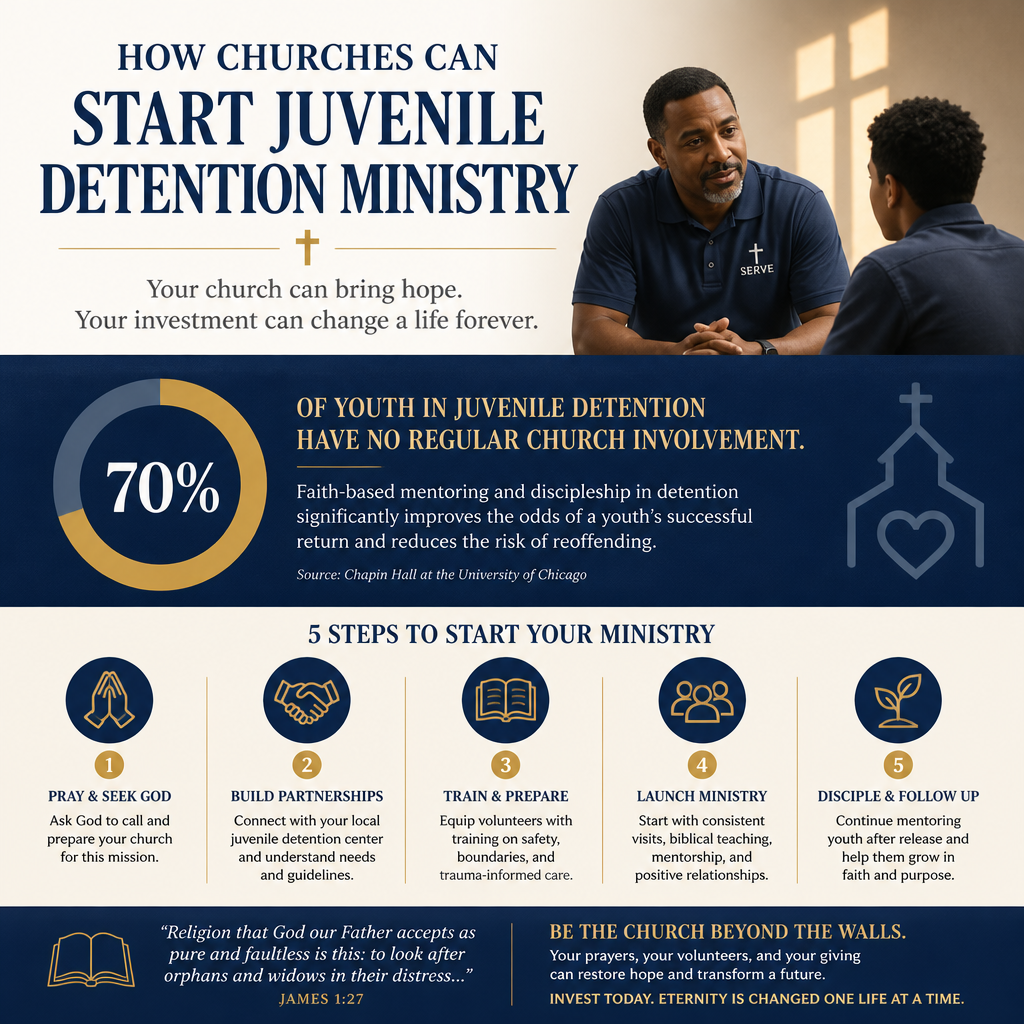
- Group Bible study or worship services led with facility approval and clear behavioral expectations
- Mentoring with vetted volunteers and tightly supervised contact
- Life skills and discipleship classes focused on habits, identity, and practical competencies
- Family support such as caregiver encouragement, transportation coordination where legal, or parenting resources through approved channels
- Reentry bridge connecting youth to a local church, tutoring, employment readiness, and ongoing mentoring post-release
A common donor temptation is to fund only the “front-of-house” programming. In juvenile detention, the hidden work—training, background checks, ongoing supervision, and data protection—often determines whether the ministry is viable.
Account for the reentry gap
Detention is episodic; reentry is where the pressures accumulate. Youth return to schools that may not receive them well, families under strain, and peer networks that often pull them back toward the behaviors that led to detention. Any church hoping for durable discipleship should plan for a handoff from detention-based ministry to community-based support.
The U.S. Department of Justice has emphasized the importance of coordinated reentry planning across systems and community partners, noting that fragmented services weaken outcomes Office of Justice Programs. Churches cannot control the whole ecosystem, but they can refuse to be episodic. The most credible ministries build continuity: one set of safe adults across detention and post-release, with clear boundaries and documented follow-through.
Governance and safeguards are not secondary ministries
Volunteer screening and training must be rigorous
Juvenile detention ministry places volunteers near minors in a high-risk context. A church that “moves fast” here is not being courageous; it is being careless. At minimum, a church should require background checks consistent with local policy, reference checks, written codes of conduct, training on mandated reporting, and supervision expectations. Youth protection policies should align with recognized child safety practices, and volunteers should be trained to avoid grooming dynamics, secrecy, gifts, and private communication outside approved channels.
We also recommend training in trauma-informed engagement. Trauma-informed ministry is not therapy; it is an approach that recognizes how trauma shapes behavior and trust. Volunteers learn to avoid escalations, respect boundaries, and respond calmly to testing behaviors. This posture is compatible with serious proclamation of the gospel because it treats youth as morally responsible persons who may also be deeply wounded.
Financial integrity and reporting discipline protect the mission
Donors rightly ask what their giving accomplishes and whether funds are handled with integrity. For churches that operate the ministry directly, this means designated funds that are tracked, clear expense policies, and oversight that does not rest on a single charismatic leader. For donors supporting external partners, the burden is to verify that the ministry has accountable governance, transparent financial statements, and a track record of honoring facility requirements.
Across our verification work at Most Trusted, we observe that ministries serving vulnerable populations often fail less from lack of compassion than from weak controls: informal decision-making, undocumented policies, and opaque reporting. The ministries that meet The Most Trusted Standard tend to treat governance and child safety as spiritual obligations, not administrative burdens.
Donor diligence should strengthen churches, not replace them
What to look for before funding
Juvenile detention ministry is emotionally compelling, and that is precisely why donors should insist on clarity. Before funding a church initiative or a specialized nonprofit partner, it is reasonable to ask for written policies, a description of facility authorization, volunteer training outlines, and evidence of ongoing oversight. It is also reasonable to ask what the ministry will do when a volunteer violates policy, when a youth discloses abuse, or when the facility changes leadership and access is disrupted.
When donors want to ground their giving in careful verification, Most Trusted evaluates Christian nonprofits against The Most Trusted Standard, a 15-criteria framework spanning faith foundation, financial integrity, governance and leadership, and transparency and effectiveness. In youth and juvenile justice work, these criteria are not abstract. They map directly to whether a ministry can be trusted near minors, trusted with restricted information, and trusted to describe outcomes with honesty.
Give toward systems that last
Some donors prefer funding “direct ministry” rather than infrastructure. In detention contexts, infrastructure is often what keeps ministry from collapsing under predictable strain: staff turnover, volunteer fatigue, policy changes, and crisis events. Funding for training, supervision, secure data handling, and evaluation is not overhead in the pejorative sense; it is mission-critical capacity. The public conversation about nonprofit “overhead” has matured, including the widely circulated joint statement rejecting simplistic overhead ratios as a proxy for effectiveness Charity Navigator.
Donors also serve the church by funding collaboration rather than competition. Juvenile justice work touches schools, courts, probation, families, and mental health systems. Churches that insist on doing everything alone often burn out. Churches that partner wisely can remain faithful over the long term.
Those exploring this work within the broader landscape of incarceration ministry will find additional context in Prison and Post-Prison Ministries, where the theological mandate and practical realities of carceral engagement are addressed with greater scope.
And because juvenile detention ministry carries unique safeguards and development considerations, donors and church leaders should also familiarize themselves with the wider field of Prison Ministry for Youth and Juvenile Justice, where specialized approaches and vetted partners often matter as much as zeal.
FAQs for How churches can start juvenile detention ministry
Should a church start juvenile detention ministry on its own or partner with an established nonprofit?
Both models can be faithful, but the risk profiles differ. Starting internally can deepen congregational ownership, yet it requires mature governance, consistent training, and strong child protection controls from day one. Partnering with an established nonprofit can accelerate access and standardize safeguards, but donors should verify the partner’s oversight, facility authorization, and reporting discipline. In either case, the decisive factor is not branding; it is whether the ministry can sustain safe, compliant presence over time.
What outcomes are realistic to expect from juvenile detention ministry?
Realistic outcomes include consistent participation, improved trust in healthy adults, engagement with Scripture and prayer, connection to a local church post-release, and practical reentry support that reduces isolation. Some programs can also document improvements in school attendance, reductions in violations, or lower recidivism, but outcomes are influenced by factors outside the church’s control. The most credible ministries avoid inflated promises and instead report what they can verify, over an appropriate time horizon, with appropriate safeguards for youth privacy.
A faithful start is measured by trustworthiness over time
Juvenile detention ministry is one of the clearest tests of whether the church believes its own confession about human dignity, sin, and redemption. Churches begin well when they build around the institution’s constraints, invest in governance and safeguards, and commit to long obedience rather than short intensity. Donors serve that faithfulness when they fund what makes ministry durable: vetted leadership, documented policies, trained volunteers, and honest reporting that can withstand scrutiny.



