
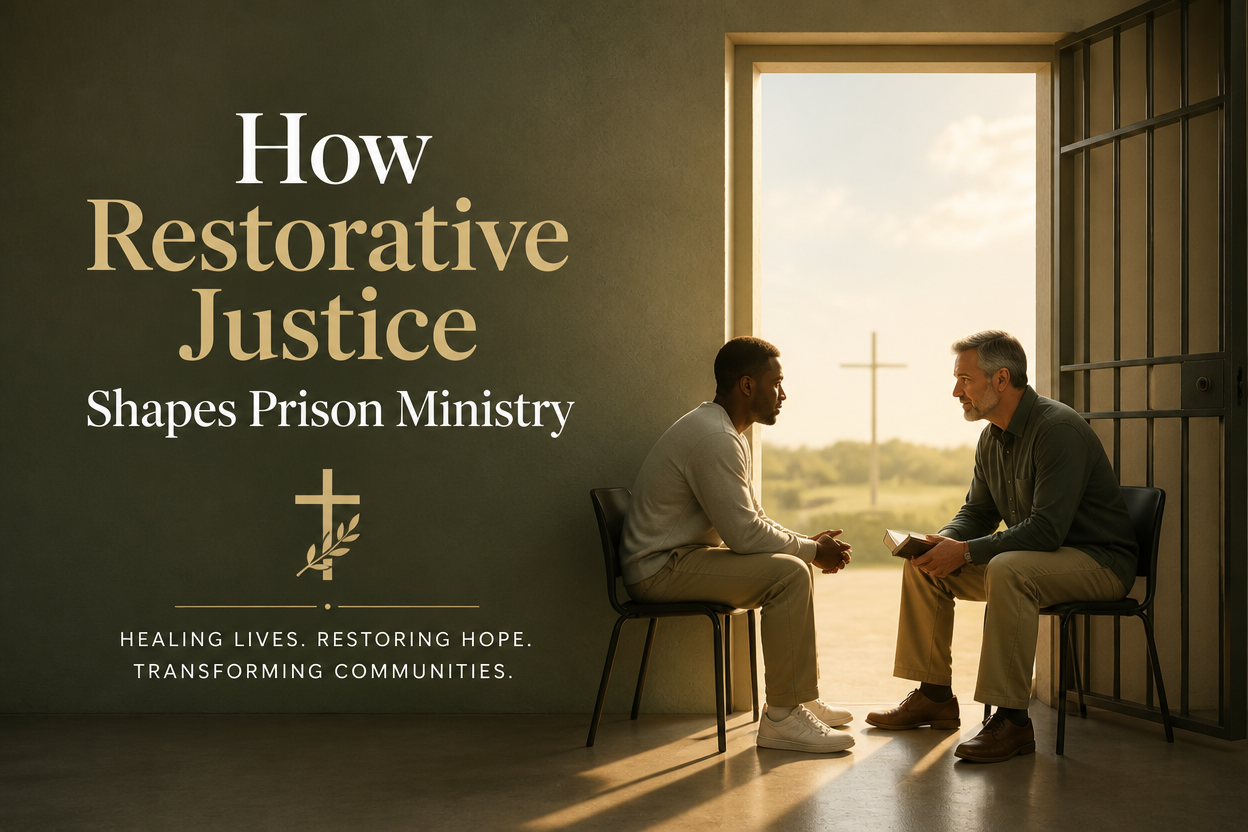
How restorative justice shapes prison ministry is not a question of branding or program design. It is a question of what we believe the cross accomplishes, and what we believe repentance, accountability, and repair should look like inside institutions built primarily for custody and control. When prison ministry embraces restorative justice carefully, it can become a tangible witness to the God who reconciles enemies without denying the reality of sin.
Donors often feel a legitimate tension at the outset. Christian compassion for incarcerated people can sound, to some ears, like indifference toward victims. Yet the New Testament vision is not sentimentality toward offenders; it is the costly pursuit of truth, confession, restitution where possible, and new life under the lordship of Christ. Restorative justice, at its best, is an attempt to name harm honestly and to seek repair without pretending that evil is merely a misunderstanding.
Restorative justice begins with a biblical account of harm and reconciliation
Sin is personal, social, and costly
Scripture refuses to treat wrongdoing as an abstract violation. Sin damages persons, families, and communities; it also offends the holiness of God. That is why biblical justice includes both accountability and restoration. Zacchaeus does not respond to grace with vague remorse; he commits to material repair, including restitution to those he defrauded (Luke 19). Restorative justice in prison ministry draws strength from that same moral clarity: harm must be named, responsibility must be taken, and repentance must produce fruit.
This is also why restorative approaches are not a substitute for legal accountability. Christians genuinely disagree about how criminal sentencing should work in a fallen world, and reasonable believers make different prudential judgments about public safety and proportional punishment. A credible prison ministry does not need to resolve every policy debate to practice a distinctly Christian ethic: the offender is still an image-bearer, and victims still deserve truth, dignity, and concrete care.
The cross anchors restoration without minimizing evil
Restorative justice becomes thin when it is detached from atonement. In the Christian frame, reconciliation is not achieved by mutual goodwill alone; it is purchased by Christ’s self-giving love, and it requires repentance and truth-telling. That theological grounding protects prison ministry from two distortions. The first is cheap grace that treats accountability as optional. The second is punitive despair that assumes people cannot change. The gospel confronts sin more seriously than any human court, and it offers a deeper hope than any human program.

What restorative practice looks like inside prison walls
Repair requires structure, not sentiment
In practice, restorative justice is a set of disciplined processes that seek accountability and repair for harm. Inside prison settings, those processes must respect safety constraints, trauma realities, and the limitations of incarcerated life. Many ministries support forms of facilitated dialogue, victim-awareness curricula, and reentry preparation that address the human consequences of crime. These are not theatrical “closure” moments; they are often slow, supervised, and emotionally demanding.
Because prison is an environment of scarcity and distrust, spiritual formation and restorative formation often reinforce one another. Confession becomes more than private sorrow; it becomes a willingness to name specific harms. Forgiveness is treated as morally serious and never coerced. When restorative work is healthy, it includes trained facilitation, clear boundaries, and pastoral care for participants who encounter grief, shame, and anger.
Victims must not be an afterthought
Restorative justice is frequently misunderstood as offender-centered. Properly practiced, it is victim-attentive. Many victims do not want contact with the offender, and ministries must respect that. Repair can include letters that are never sent, restitution planning, service to communities harmed by similar crimes, and support for victim-serving organizations. Some ministries partner with church-based victim care initiatives precisely because biblical justice refuses to neglect those who have been wounded.
For donors, this is a crucial point of discernment. A prison ministry can claim restorative language while rarely mentioning victims, trauma, or safeguarding. That is not restorative; it is imbalanced. The most credible ministries speak explicitly about victims’ dignity, choice, and safety, and they resist the subtle temptation to use victims as props for redemption narratives.

Why restorative justice can strengthen evangelism and discipleship
It moves discipleship from abstraction to repentance with substance
Prison ministries often serve men and women who have learned to survive by deflecting responsibility. Some have long histories of substance abuse, violence, or exploitation. Restorative justice, paired with biblical discipleship, presses against evasion. It asks: What was done? Who was harmed? What would repair require? What patterns of desire, anger, entitlement, or fear drove the offense? Those are deeply theological questions about the heart.
Where ministries incorporate restorative formation, we often see discipleship become more concrete. Participants are less able to hide behind religious vocabulary. They must practice confession, make amends where possible, and accept the reality that forgiveness from God does not erase earthly consequences. That combination can produce a more sober, durable faith—one that can withstand the pressures of both incarceration and reentry.
It clarifies the church’s public witness
Many donors care not only about individual conversions but also about the credibility of Christian witness in a polarized public square. Restorative justice can help the church speak with moral coherence: we can oppose crime and take victims seriously while also insisting that no person is beyond redemption. The field has had to reckon with real failures—ministries that under-screen volunteers, mishandle abuse disclosures, or promise outcomes they cannot deliver. A restorative posture does not excuse those failures; it demands truthful reckoning and reform.
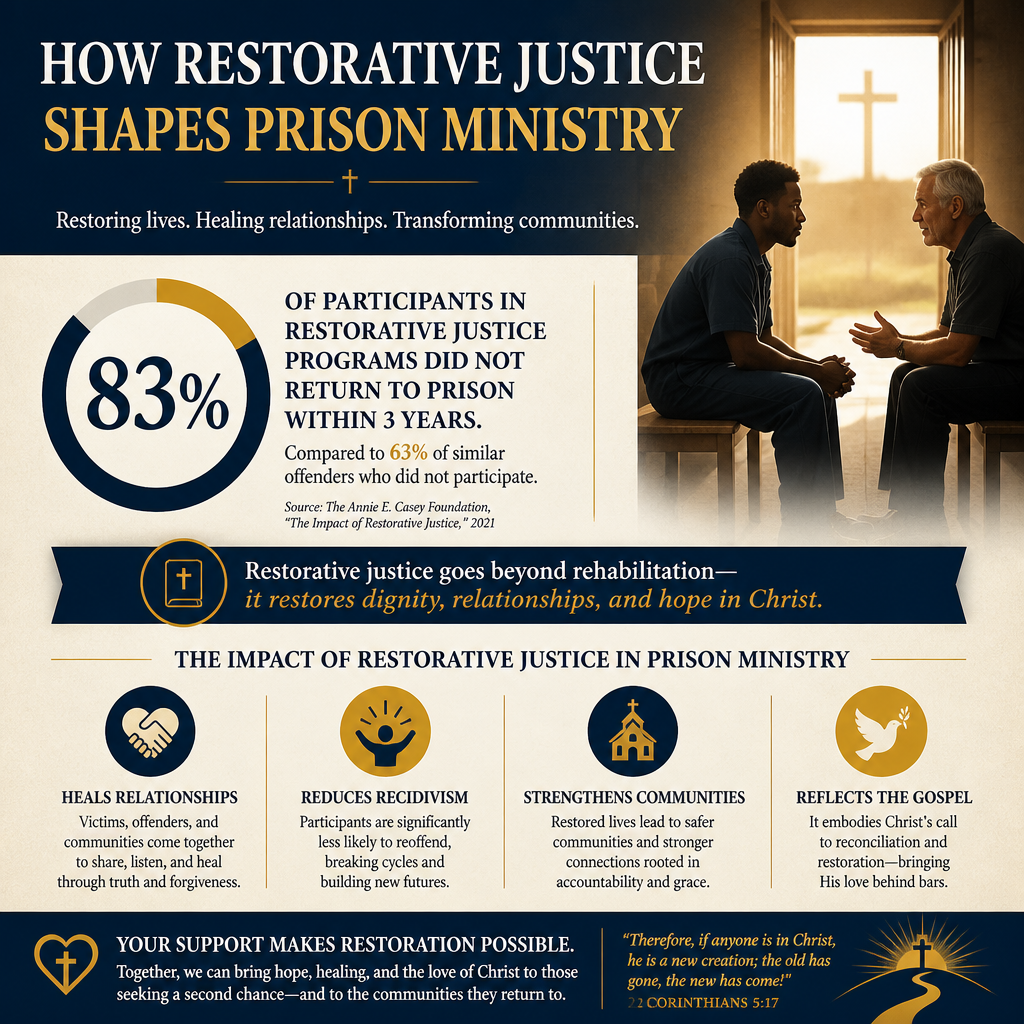
Donors who follow prison ministry closely may also appreciate the caution: restorative justice is not a guaranteed recidivism solution. Research on different restorative models is mixed and context-dependent, and program quality varies widely. When ministries present restoration as a simple technique that “works,” they are often overselling. Mature ministries speak in terms of faithfulness, formation, and measurable outputs they can actually verify.
What donors should look for in restorative prison ministry
Signs of integrity in programs that claim restoration
Restorative justice work is relational and therefore vulnerable to manipulation, boundary violations, and public-relations storytelling. Donors should expect ministries to demonstrate the kind of disciplined integrity that protects people. Across our verification work at Most Trusted, the ministries that meet The Most Trusted Standard tend to combine theological clarity with operational seriousness. They can explain their restorative practices without exaggeration, and they can show how they protect victims, participants, volunteers, and partnering institutions.
Practical due diligence does not signal suspicion; it signals stewardship. Jesus’ command to visit those in prison does not require donors to suspend discernment. It requires donors to give wisely so that ministry is sustainable, lawful, and faithful.
- Clear safeguarding practices for volunteers and participants, including training and supervision
- Formal relationships with correctional facilities and compliance with institutional rules
- Trauma-informed care and explicit respect for victims’ agency and privacy
- Program clarity about what “restoration” means and what outcomes are realistically measured
- Financial transparency that makes restricted giving and program costs understandable
Accountability and transparency matter more in high-trust narratives
Few ministry stories are more emotionally compelling than a person’s conversion in prison followed by reconciliation with family and community. Those stories can be true, and they can also become a temptation. Donors should ask whether the ministry’s governance and reporting are strong enough to withstand the pressure to publish only the best testimonies. Effective restorative work includes hard cases, relapses, and non-linear change. A ministry that only tells triumphant narratives may be curating perception rather than reporting reality.
For readers who are evaluating giving across this field, our broader editorial coverage of Prison and Post-Prison Ministries addresses the diversity of models—from evangelism-focused chaplaincy support to reentry housing and workforce development—along with common risks donors should understand.
Restorative justice does not eliminate punishment, but it can reframe it
Restoration and public safety are not enemies
Restorative justice is sometimes presented as an alternative to incarceration. In practice, prison ministry operates within existing sentences, and it must take institutional safety seriously. The question is not whether prisons should have rules; it is whether the moral goals of correction include repair, responsibility, and reintegration. A restorative framework can help ministries and institutions articulate why certain disciplines exist and how they might be oriented toward formation rather than humiliation.
Public safety concerns are not merely political talking points. Many incarcerated people have harmed others deeply, and some remain dangerous. Restorative prison ministry should never imply that spiritual language removes risk. Mature ministries coordinate with prison staff, follow policies, and avoid romanticizing transformation. Christian hope is not naïveté; it is confidence in God’s power alongside sober realism about human sin.
Reentry is where restoration is tested
Restoration ultimately faces the pressures of ordinary life: employment, housing, addiction recovery, family dynamics, and the stigma that follows a record. The U.S. Bureau of Justice Statistics has reported that a large share of people released from state prisons are arrested again within years of release, underscoring how difficult reentry can be even apart from spiritual questions Bureau of Justice Statistics. Restorative justice in prison ministry therefore cannot stop at in-prison programming. It must connect people to churches, mentors, practical supports, and accountable community.
Donors should also understand the scale of incarceration. The United States has a large correctional footprint that shapes families and congregations across regions, as documented by the Bureau of Justice Statistics’ reporting on correctional populations Bureau of Justice Statistics. That reality does not dictate a single policy conclusion, but it does frame why prison and post-prison ministry is not a marginal concern for the church.
Within our coverage of Faith-Based Prison Outreach and Evangelism, we pay close attention to how ministries connect proclamation with pastoral care, discipleship, and reentry supports—because restorative language without a community willing to receive returning neighbors often collapses under the weight of isolation.
FAQs for How restorative justice shapes prison ministry
Does restorative justice require victims to forgive or reconcile?
No. Christian forgiveness is morally serious, but it cannot be demanded, timed, or staged for someone else’s benefit. Restorative justice, when practiced responsibly, protects victims’ agency and does not pressure contact with offenders. Some restorative processes focus on acknowledgment of harm and accountability without any direct victim-offender engagement.
How can donors evaluate whether a prison ministry uses restorative justice responsibly?
Donors should look for clear definitions, trained facilitation, safeguarding protocols, and honest reporting about limits and outcomes. Ministries should show how they respect victims, coordinate with correctional authorities, and avoid exaggerating results. At Most Trusted, we encourage donors to prioritize ministries that can demonstrate alignment with The Most Trusted Standard across faith commitments, financial integrity, governance, and transparent communication.
A faithful restorative posture is measured in truth, repair, and endurance
Restorative justice shapes prison ministry most deeply when it is treated as a moral commitment rather than a slogan: the commitment to tell the truth about harm, to pursue repair where repair is possible, and to form people for accountable life in community. The church’s calling to go to those in prison is not an escape from justice. It is an invitation to practice the justice that flows from the cross—where mercy does not deny sin, and hope does not deny consequences.



