

Prison ministry for youth and juvenile justice work asks Christian donors to hold together two obligations that Scripture refuses to separate: mercy for the vulnerable and truth about moral responsibility. When the person behind the locked door is a teenager, the questions become sharper. Adolescents can cause real harm, and they are also still forming—neurologically, socially, and spiritually—in ways that make intervention both more promising and more perilous.
Matthew 25 places “I was in prison and you visited me” among the marks of those who recognize the King (Matthew 25:36). For donors, the issue is not whether incarcerated youth deserve ministry, but whether the ministries we fund actually serve young people with integrity, protect victims and communities, and pursue outcomes that withstand scrutiny. Juvenile justice is one of the most regulated environments in American social services, and it is also one of the most spiritually contested spaces, where shame, trauma, violence, and institutional failure often intersect.
What makes juvenile detention ministry morally urgent and operationally complex
Juvenile facilities are not simply “smaller prisons.” They are correctional institutions operating alongside child welfare systems, special education requirements, mental health care, and court supervision. Youth typically arrive with layered histories: adverse childhood experiences, unstable housing, school disruption, and exposure to violence. These realities do not excuse wrongdoing, but they do change what effective ministry must look like.
In practice, detention ministry becomes a careful form of presence: consistent, accountable, and bounded. Unlike many adult programs, youth work must account for developmental stage, mandatory reporting rules, and restrictions on contact. Ministries that ignore these constraints can do harm—especially when volunteers are untrained, boundaries are unclear, or spiritual authority is confused with institutional authority.
Adolescence changes the ministry math
Adolescence is a period of heightened susceptibility to peer influence and impulsivity, and it is also a season of rapid identity formation. The legal system recognizes this in limited ways; the Supreme Court has repeatedly noted developmental differences between juveniles and adults when evaluating sentencing practices. Donors should understand that the best youth ministries do not treat young people as fixed identities (“criminal,” “gang member,” “problem kid”) but as image-bearers capable of repentance, repair, and growth.
This is also where simplistic “conversion = transformation” claims deserve scrutiny. Real discipleship among justice-involved youth often proceeds in fits and starts. It involves relapse into old patterns, the slow rebuilding of trust, and the formation of new habits under constrained conditions. Wise ministries are candid about that reality and build programs that can sustain it.
Safety, consent, and trauma are not secondary concerns
Many justice-involved youth have experienced trauma. Trauma-informed practice is sometimes discussed as a secular import, but at its best it simply names what pastors and chaplains have long observed: fear and shame shape behavior, and care must be ordered toward truth, dignity, and safety. Donors should expect ministries to train volunteers in appropriate boundaries, mandatory reporting, and de-escalation. Spiritual care is not an exception to safeguarding; it should be a model for it.

How effective youth prison ministry reduces recidivism and deepens discipleship
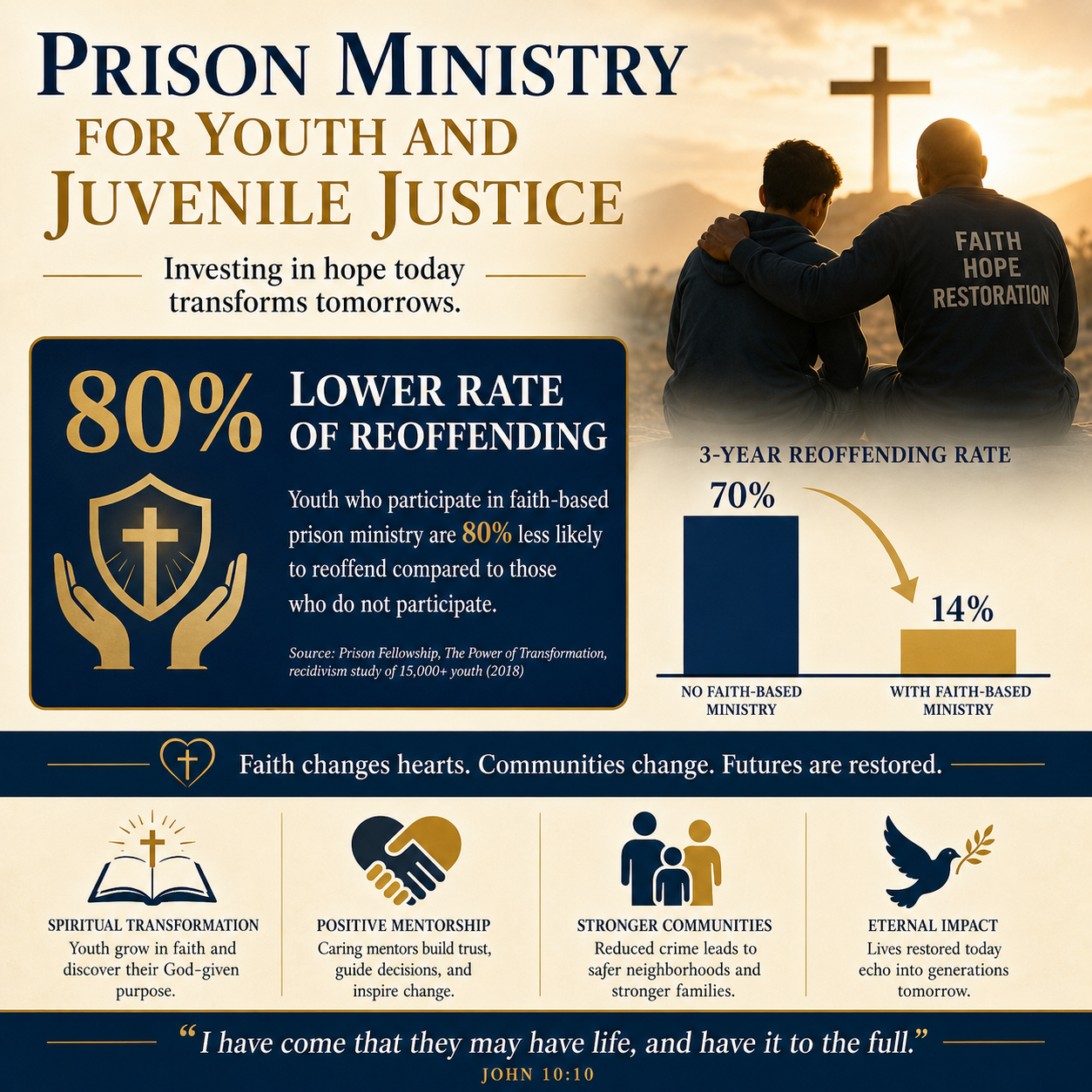
Christian donors often ask whether youth detention ministry “works.” That is a legitimate question, and it should be framed carefully. The goal is not merely lower reoffending, though public safety matters. The goal is a form of restoration consistent with Scripture: accountability, repair where possible, and the formation of a life ordered toward God and neighbor.
Verifiable evidence suggests that many justice-involved young people carry significant educational deficits and mental health needs, which shape what realistic change can look like after release. For example, the U.S. Department of Education has documented the educational disruptions common among youth involved in the justice system and the importance of reentry supports that reconnect them to school and services (U.S. Department of Education). Ministries that promise sweeping transformation while ignoring school re-enrollment, family instability, or untreated mental illness may inspire donors but often fail youth.
Detention ministry differs from prison ministry in structure and authority
Adult prison ministry often builds around chapel services, Bible studies, and post-release support networks. In juvenile facilities, programming is typically more tightly scheduled and supervised. Access may depend on compliance with facility policies, background checks, and approved curricula. Volunteers may have fewer opportunities for informal conversation and more scrutiny around contact and communication.
These constraints are not obstacles to ministry; they are the environment in which integrity is tested. The ministries that endure are those that cooperate with lawful authority without becoming indistinguishable from it. They respect facility rules, and they also maintain clear theological independence: the gospel is not a behavior management tool, and faith is never coerced.
Mentoring is vital because relationships are the intervention
Juvenile systems often cycle youth through multiple placements and adult decision-makers. A stable, trained mentor can become a rare source of consistent attention and moral formation. The strongest programs treat mentoring as a long-term commitment anchored in local churches, with careful screening and supervision.
Donors should ask whether mentors are selected for maturity rather than charisma, and whether the program provides ongoing coaching. Informal, unaccountable mentoring can create dependency, boundary violations, or disillusionment when volunteers disappear. A ministry that treats mentoring as a ministry of presence will also treat it as a ministry of governance.
Reentry support is where many youth either stabilize or unravel
Many juvenile programs show promise inside the facility but lose impact at the gate. After release, youth return to the pressures that shaped their earlier choices: strained family systems, neighborhood violence, school failure, and peer groups that reward risk. Effective ministries coordinate with probation, schools, and caregivers, and they help youth establish a daily rhythm that includes church community, education or work preparation, and accountable relationships.
Because donors cannot personally supervise reentry work, organizational transparency matters. Ministries should be able to describe what services they provide, how they coordinate with public systems, and what outcomes they track. The goal is not to reduce discipleship to metrics, but to ensure that claims are tethered to reality.
What faithful, fundable juvenile justice ministries tend to have in common
Across our verification work at Most Trusted, we find that the ministries most worthy of donor confidence pair pastoral seriousness with institutional maturity. They do not romanticize incarcerated youth, and they do not treat them as projects. They speak honestly about harm done, the needs of victims, and the long work of repair.
They also tend to show evidence of disciplined leadership: clear policies, accountable finances, and programming that can be described in concrete terms. These are not merely administrative virtues. In justice contexts, administrative weakness becomes spiritual harm because it exposes vulnerable youth to instability, confusion, and sometimes exploitation.
Faith foundation that is explicit and non-coercive
Donors should expect a ministry’s theological commitments to be clear: the authority of Scripture, the centrality of Christ, and a doctrine of salvation that does not collapse into self-improvement. At the same time, ministries working under government authority must avoid coercion. A youth in custody is not in a position of free choice in the same way a congregant is. Ethical ministry makes participation voluntary, respects religious liberty, and refuses to trade privileges for professions of faith.
This posture reflects the character of Christ, who calls, commands, and invites, yet does not manipulate. It also protects the credibility of the gospel in settings where young people are already wary of adults who promise care but deliver control.
Safeguarding and governance that match the risk environment
Juvenile ministry sits at the intersection of youth protection and corrections. Donors should ask whether the organization has written safeguarding policies, volunteer screening standards, training requirements, and clear procedures for reporting abuse. Good intentions are not a substitute for these safeguards. In many states, correctional and youth-serving organizations are required to follow specific protections; ministries should meet or exceed those expectations.
Governance matters because charismatic leadership without oversight can quickly become unsafe in environments that already feature power imbalances. A healthy board, conflict-of-interest controls, and documented decision-making are not bureaucratic hurdles; they are forms of neighbor love.
Financial integrity and transparency that invite scrutiny
Justice ministry is costly. Staff time, training, compliance, and travel add up, and outcomes are slower than many donors prefer. What donors can rightly demand is clarity: how funds are used, what programs exist, and what results are claimed. The philanthropic sector has learned that simplistic overhead ratios can mislead; the more faithful question is whether spending aligns with mission and whether the organization can justify its choices with evidence and candor (BBB Wise Giving Alliance).
Within The Most Trusted Standard, we examine ministries across faith foundation, financial integrity, governance and leadership, and transparency and effectiveness. This framework does not replace prayerful discernment, but it does help donors evaluate whether a juvenile justice ministry has the structure to steward gifts responsibly over time.
How donors can give with confidence without simplifying a hard field
Christians genuinely disagree about aspects of juvenile justice policy: the balance between accountability and rehabilitation, the role of incarceration, and the prudence of specific reforms. Donors can respect these disagreements while still pursuing faithful action. The question is not whether the field is complicated—it is—but whether a given ministry is honest about that complexity and built to serve within it.
What this means in practice is that donors should fund ministries that can name their boundaries and collaborations. Who is the program designed to serve: pre-adjudication youth, committed youth, or those on probation after release? What is the relationship with facility leadership? How does the ministry coordinate with schools, mental health providers, and families? These are not secondary details; they reveal whether the ministry understands the system it is entering.
Donors should also look for ministries that keep victims and community safety in view. A restoration framework that ignores harm is not biblical. Zacchaeus’s repentance included restitution (Luke 19:8). In juvenile contexts, restitution may look like accountability plans, family reconciliation where possible, or community service done with supervision. Ministries that speak only of grace without truth are rarely safe, and ministries that speak only of consequences without grace rarely endure.
Finally, donors should resist the temptation to fund only what feels immediately uplifting. Youth reentry is slow and often messy; family systems do not heal on a donor reporting schedule. Faithful ministries will show both patience and rigor: patience with a teenager’s uneven growth, and rigor in how programs are supervised, evaluated, and improved.
Those seeking broader context on incarceration ministry will often find it helpful to begin with Prison and Post-Prison Ministries, where the wider ecosystem of prison visitation, discipleship, and reentry support clarifies how juvenile work fits within the church’s calling.
A sober hope for youth behind locked doors
Prison ministry for youth and juvenile justice is neither sentimental nor despairing. It is sober about sin and systemic failure, and it is confident that Christ’s authority reaches into places the public prefers to forget. Donors serve this work best when we fund ministries that combine theological clarity with operational maturity—ministries that protect the vulnerable, tell the truth, and stay long enough to see whether hope has taken root.



