
How to volunteer at a pregnancy resource center is not primarily a question of availability; it is a question of vocation, formation, and trust. Pregnancy resource centers exist at a point of moral and emotional consequence, where truth-telling, practical support, and careful compassion must hold together without collapsing into sentimentality or ideology.
For Christian donors, the volunteer question often becomes a stewardship question. Many of us fund this work because we believe the Church should be present for women and families when fear, pressure, and material instability converge. Yet we also know that the sector is scrutinized—sometimes fairly, sometimes not—and that credibility is sustained through disciplined care, documented outcomes, and governance that can bear the weight of public attention.
Begin with the center’s mission and the kind of presence it requires
Pregnancy resource centers are not interchangeable. Some are explicitly evangelistic; others are cautious about spiritual language but partner closely with churches. Some focus on pregnancy testing and options counseling; others provide parenting education, material assistance, post-abortion support, or referrals for medical and social services. The first step in volunteering is discerning whether the center’s theological and practical approach matches the kind of witness we intend to offer.
Christians genuinely disagree about how a center should speak about abortion, contraception, and abortion-mindedness in the moment of crisis. Some emphasize direct moral clarity; others emphasize patient accompaniment and the slow rebuilding of trust. A serious center will not pretend these tensions are simple. It will train volunteers to hold conviction and compassion together, refusing both coercion and evasiveness.
Ask what the center means by care
In mature ministries, “care” is not a vague word. It includes informed consent, privacy practices, appropriate boundaries, and clear escalation pathways when abuse, trafficking, or suicidal ideation may be present. These are not optional features added for legal protection; they are expressions of the command to love our neighbor with truth and prudence.
Confirm how faith is integrated
Many donors assume “Christian” is self-defining, but centers vary widely in their statements of faith, spiritual practices with clients, and church relationships. Before committing, read the center’s doctrinal statement, volunteer covenant, and client-facing materials. If faith is central, it should be articulated with clarity and humility, not with pressure tactics. If faith is present but restrained, it should still be recognizable as a theological posture rather than a marketing strategy.

Understand the roles and choose one that matches your formation
The question is not only whether a volunteer is willing, but whether a volunteer is prepared for a role’s moral and emotional demands. Across our verification work at Most Trusted, we observe that effective ministries align role complexity with training intensity and supervision. Centers that place underprepared volunteers in high-stakes conversations tend to burn people out and create risk for clients.
Common volunteer roles and what they require
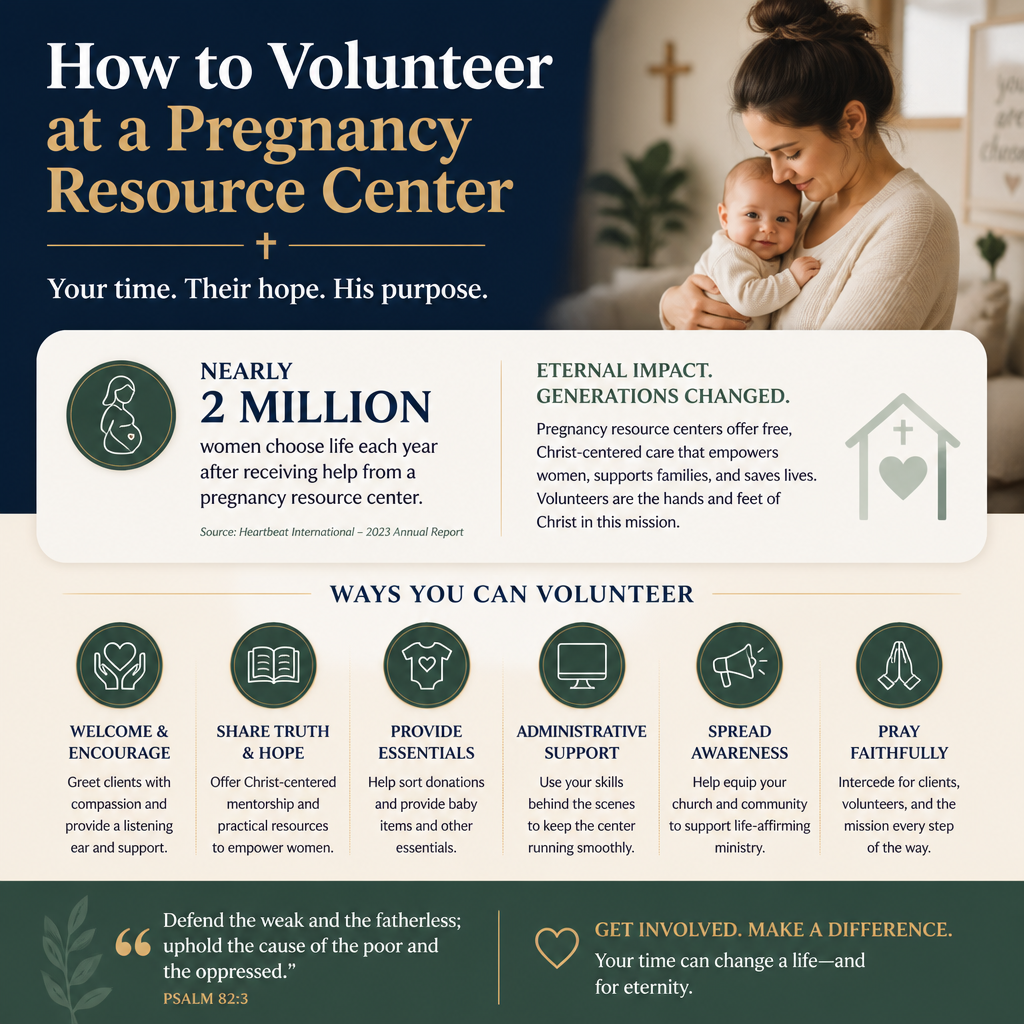
Centers typically distinguish between direct-client roles and support roles. Direct-client roles require stronger training, closer supervision, and higher emotional resilience. Support roles can be equally valuable and often sustain the center’s day-to-day stability.
- Client advocate: initial intake, listening, resource navigation, follow-up; requires strong boundaries and de-escalation skills.
- Peer mentor or parenting coach: ongoing relationship, curriculum-based teaching; requires consistency and humility.
- Medical support: licensed roles for ultrasound or nursing where applicable; requires credentials and clinical protocols.
- Reception and hospitality: first-contact environment, scheduling, calm presence; requires discretion and professionalism.
- Material assistance coordination: diaper and clothing programs, inventory, distribution; requires logistics discipline and fairness.
- Church liaison and prayer team: mobilization, reporting, intercession; requires spiritual maturity and confidentiality.
Choose the role that protects the client and strengthens the ministry
Many faithful volunteers should begin in a support role rather than a counseling-adjacent role. That is not a demotion; it is wise ordering. A center that values clients will not flatter volunteers into assignments that exceed their readiness. The goal is not to feel useful but to do good without harm, especially when clients have prior trauma, complicated relationship dynamics, or distrust of institutions.
Evaluate training, supervision, and safeguards before you commit
Trustworthy pregnancy resource centers operate with the sober awareness that good intentions are not a protection against harm. The work intersects with trauma, coercion, domestic violence, and medical questions. A volunteer culture that treats training as optional tends to become improvisational, and improvisation is costly when the stakes are high.
Training should be more than a doctrinal orientation
Expect training in active listening, trauma-informed care, mandated reporting where relevant, confidentiality, documentation, and referral protocols. Centers that use ultrasound or medical services should have clear clinical oversight and strict boundaries between medical facts and spiritual counsel. Volunteers should never be pressured to “wing it” with medical claims or legal advice.
Many centers also train volunteers in common coercion patterns: pressure from partners, family members, or traffickers; financial control; isolation; and intimidation. The U.S. Department of Health and Human Services notes that human trafficking can involve force, fraud, or coercion and includes both sex trafficking and labor trafficking, with vulnerability being a common factor in victimization.https://www.acf.hhs.gov/otip
Safeguards reveal whether the ministry understands power
Ask whether the center runs background checks, has written policies for child protection, and uses structured supervision. A trustworthy ministry can name how it handles conflicts of interest, how it documents client interactions, and how it protects client data. These practices are not secular intrusions into Christian ministry; they are a disciplined response to the reality of human sin and institutional vulnerability.
When donors consider where to invest time as well as money, we recommend reading the center’s policies and looking for signs of operational seriousness. This is one reason verification exists. Most Trusted evaluates Christian nonprofits against The Most Trusted Standard, which looks for evidence of faithfulness and competence together—clear faith foundation, financial integrity, governance and leadership, and transparency and effectiveness—so donors and volunteers can engage with warranted confidence.
Volunteer in a way that strengthens trust in the public square
Pregnancy resource centers operate under significant public skepticism. Some criticism is driven by philosophical disagreement about abortion. Other criticism raises practical concerns about advertising, informed consent, or the accuracy of medical information. Volunteers become part of the center’s public witness, and that witness must be anchored in truthfulness, not merely zeal.
Commit to accuracy and clear boundaries
We should be candid: centers have sometimes been tempted to overstate claims in order to persuade. That is not the Christian way. Scripture’s moral logic does not permit manipulation for a good end. The ninth commandment is not suspended in contested arenas, and credibility is fragile once lost.
Centers should distinguish clearly between what they know, what they believe, and what they cannot responsibly claim. For example, when discussing mental health outcomes after abortion, the research literature is contested, and simplistic statements tend to backfire. A volunteer’s role is not to win an argument; it is to serve a person made in the image of God with honesty and mercy.
Practice a donor’s form of stewardship as a volunteer
Christian donors often ask whether their giving produces durable fruit rather than short-term impressions. The same question applies to volunteering. A faithful volunteer is punctual, coachable, and accountable. A volunteer does not create dependency by becoming the client’s savior figure. The When Helping Hurts framework, articulated by Steve Corbett and Brian Fikkert, has helped many Christian ministries recognize how paternalism and unexamined power can undercut the dignity of those they intend to serve.https://whenhelpinghurts.org/
If your broader interest is understanding how these ministries are situated and evaluated, see Pregnancy Resource Centers in our coverage at Most Trusted.
Make your volunteering part of a coherent giving strategy
Many donors already support pregnancy resource centers financially but hesitate to volunteer because the work feels emotionally weighty or politically exposed. Both concerns are understandable. A coherent strategy treats volunteering as one form of participation alongside prayer, financial support, and church-based support structures for families.
Coordinate with your church rather than acting alone
Centers are stronger when churches provide wraparound support that a center cannot supply by itself: meals, baby supplies, transportation, job-network introductions, childcare, and ongoing discipleship. A volunteer who is embedded in a church community can offer referrals into stable relationships rather than into a single intense volunteer bond.
Where possible, encourage your church to develop a defined partnership with a specific center, including shared expectations, regular reporting, and a clear pastoral point of contact. This protects the center from being treated as a generic service provider and protects the church from episodic attention that fades after a moment of heightened concern.
Ask for measurable practices without demanding artificial metrics
Not everything that matters can be reduced to numbers, but mature ministries can still document their work. Ask what the center tracks: appointment follow-through, material assistance distribution, parenting class completion, referral outcomes, and client feedback. Beware of both extremes: ministries that offer no evidence of effectiveness, and ministries that promise neat results in a domain defined by human freedom and complex constraints.
For donors who want to understand the specific volunteer ecosystem and expectations across different centers, see Volunteering at Pregnancy Resource Centers.
FAQs for How to volunteer at a pregnancy resource center
Do pregnancy resource centers require volunteers to be Christians?
Many do, especially for client-facing roles, because the ministry’s identity includes spiritual counsel, prayer, or a defined Christian ethic. Others accept non-Christian volunteers in support roles but still require alignment with conduct standards and confidentiality policies. A serious center will state these requirements plainly and explain how they relate to its mission and care model.
What questions should donors ask before volunteering or encouraging others to volunteer?
We recommend asking about training length and content, supervision and escalation procedures, background checks, data privacy practices, and how the center ensures accuracy in client education. Donors should also ask about governance and financial transparency, because volunteer culture and organizational discipline often rise or fall together. When a center can answer these questions with written policies and consistent practices, volunteering becomes a form of stewardship rather than a leap of trust.
A mature volunteer posture
Volunteering at a pregnancy resource center is best approached as a disciplined ministry of presence: truthful, non-coercive, resilient, and accountable. The work deserves more than sympathy; it deserves competence shaped by Christian love. When donors and volunteers insist on both compassion and verifiable integrity, they strengthen the credibility of the Church’s care for women, children, and families at precisely the places where credibility is most tested.



