
Starting a church volunteer team for a pregnancy resource center is not primarily a recruitment problem; it is a shepherding and stewardship problem. The question is whether a congregation can offer embodied mercy to women and families in crisis without confusing compassion with control, or urgency with wisdom.
Pregnancy resource centers operate at the intersection of moral conviction, trauma-informed care, medical and legal boundaries, and public scrutiny. The work is explicitly pro-life, but it is also relational, confidential, and operationally complex. Donors often see the need clearly and want to help quickly. What this means in practice is that a volunteer team must be built to protect clients, serve the center’s mission, and preserve the church’s witness over time.
Begin with theological clarity and a defined purpose
Anchor the team in a biblical ethic of neighbor love
Christian mercy is never generic benevolence. Scripture binds care for vulnerable neighbors to truth-telling, personal holiness, and justice. When Jesus names the works of mercy in Matthew 25, he places concrete service alongside final accountability before God. The goal is not to “win” a cultural argument; it is to honor image-bearers with costly love.
For a pregnancy resource center, that love must be expressed in ways that respect agency and dignity. Christians genuinely disagree about the most effective public policy approaches to abortion, but the church’s obligation to care for women facing fear, abandonment, and material hardship is not contested. A volunteer team should be framed as a local expression of the church’s diaconal calling: present, competent, and accountable.
Write a purpose statement that limits as well as inspires
A clear purpose statement prevents mission drift and protects the center from becoming an extension of church politics or personalities. It should describe what the team will do and what it will not do. For example, a church team may provide client hospitality, material support logistics, parenting class assistance, facility maintenance, prayer support, and community referral research—but not clinical counseling unless properly credentialed and requested by the center.
We recommend making the center’s executive director the final authority on volunteer roles and boundaries. In healthy partnerships, the church brings people and resources; the center sets standards that protect clients and comply with licensure, insurance, and confidentiality requirements.

Choose the right partnership model with the center
Start with the center’s real capacity, not the church’s enthusiasm
Most pregnancy resource centers run lean. A sudden surge of volunteers can actually create administrative strain: background checks, scheduling, training, supervision, and documentation take staff time. The church’s job is to serve in a way that reduces burden rather than adding it.
Begin with a single liaison meeting between church leadership and center leadership. Agree on a pilot period, a small number of roles, and one primary point of contact on both sides. This protects the center from getting multiple informal “offers” that become expectations.
Clarify expectations around confidentiality and spiritual care
Many donors assume pregnancy centers function like church ministries. Some are explicitly faith-based; some operate with varying levels of spiritual integration depending on local law, funding sources, and organizational policy. Either way, client trust depends on confidentiality and consent. Volunteers should never assume the right to know client stories, share prayer requests with identifying details, or move conversations toward spiritual topics without the center’s guidance.
The partnership should codify expectations in writing: confidentiality rules, social media boundaries, mandatory reporting policies where applicable, and what happens if a volunteer violates standards. A church team that treats these guardrails as spiritual formation—not mere risk management—will serve the center well.
Many churches begin their broader learning through the wider ecosystem of Pregnancy Resource Centers, especially to understand differences in service models, credential requirements, and community partnerships.
Build a volunteer pipeline that prioritizes character and competence
Recruit for maturity, not just availability
Pregnancy-related crises often involve layered realities: coercion, domestic instability, prior abortions, poverty, immigration concerns, and mental health struggles. Volunteers do not need to be professionals to help, but they must be emotionally steady, teachable, and able to follow direction. This is a setting where zeal without discernment can harm.
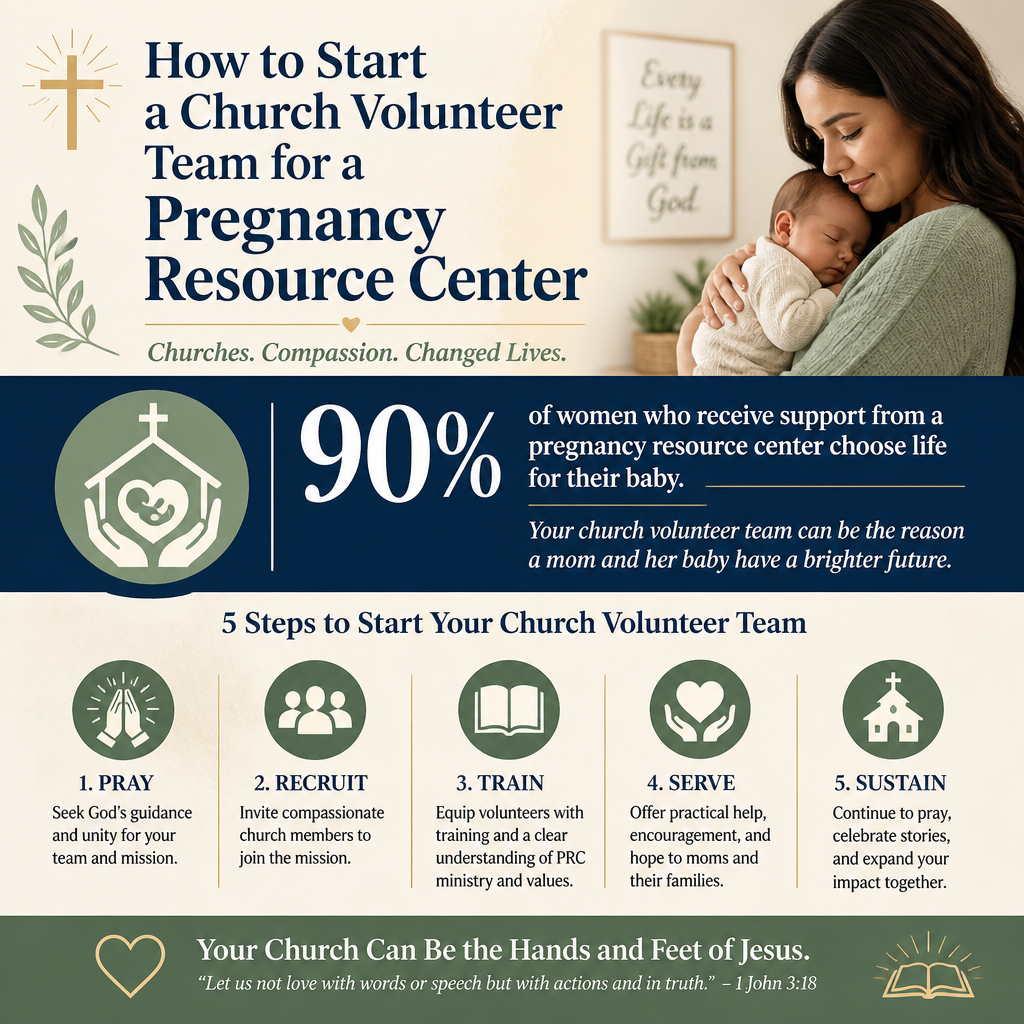
A practical way to recruit is to name specific roles and the qualities required. Churches tend to announce “We need volunteers” and receive a mix of people who are willing but not suited. Better is to recruit as one would for deacons: reputable, self-controlled, and capable of discretion.
Use a simple screening and training pathway
We recommend a consistent pathway for every volunteer, even for “behind the scenes” work. At minimum, include an application, a background check where the center requires it, a confidentiality agreement, and training that covers trauma awareness and appropriate boundaries. If the center already has training, the church should not replace it.
- Application and role fit: clear role description and time commitment
- Background checks: aligned with the center’s policies and insurance
- Confidentiality and communications: no client details in prayer chains or social media
- Trauma-informed posture: listening, consent, and de-escalation basics
- Supervision and feedback: a clear reporting line and regular check-ins
Volunteer screening is not a statement of distrust. It is an expression of love for clients, for staff, and for the volunteers themselves, who should not be placed in situations they are unprepared to handle.
Fund and govern the team with the same seriousness as any ministry
Set up financial support that is accountable and sustainable
Volunteer teams often fail because they are treated as episodic service projects rather than ongoing ministries with real costs. Even if the center does not ask the church for money, volunteers will incur expenses: supplies, training, mileage, childcare for volunteers, and sometimes facility improvements. Churches can either absorb these costs informally or plan for them transparently.
When donors give to pregnancy resource centers, many rightly ask whether contributions are handled with integrity and used for measurable outcomes. Our work at Most Trusted exists because Christian donors should not have to choose between compassion and due diligence. The ministries that meet The Most Trusted Standard tend to document how funds are governed, how leaders are held accountable, and how program claims are supported with verifiable reporting.
Address the overhead myth and real capacity constraints
Some donors still carry the assumption that “low overhead” equals faithfulness. The nonprofit sector has repeatedly challenged this simplification. The well-known Overhead Myth letter, signed by GuideStar, Charity Navigator, and the BBB Wise Giving Alliance, argues that focusing narrowly on overhead can pressure nonprofits to underinvest in systems that protect beneficiaries and ensure effectiveness https://www.guidestar.org/.
For a pregnancy resource center, underinvestment can mean weak volunteer supervision, poor data security, inadequate training, and burnout. A church volunteer team should expect to support the center’s capacity, not merely its visible client-facing work. That is part of what it means to love our neighbor with prudence.
For churches discerning where volunteer support fits among other commitments, the broader category of Volunteering at Pregnancy Resource Centers can help leaders compare common roles, expectations, and partnership approaches.
Protect the mission with communication discipline and measured expectations
Tell the truth about what volunteer teams can and cannot do
Pregnancy resource centers are often evaluated in public discourse with suspicion, and sometimes with unfair caricature. The most credible response is not defensiveness; it is disciplined truthfulness. Volunteers should not exaggerate outcomes, promise what the center does not offer, or speak for the center without authorization.
The harder question is how to communicate impact without violating confidentiality. Churches can celebrate faithfulness and service while keeping client stories anonymous and consent-driven. When stories are shared, they should be shared with explicit permission and with attention to power dynamics. Vulnerability is not a fundraising asset.
Set rhythms that prevent burnout and moral injury
This work can be spiritually and emotionally heavy. Volunteers may encounter grief, conflicted decisions, and complex family pressures. Churches should plan for pastoral care, debriefing, and prayer that does not treat outcomes as a scoreboard. Faithfulness includes endurance.
We recommend defining service terms (for example, three to six months) with planned rest, rather than open-ended commitments. Sustainable service honors the center, which depends on reliable volunteers, and it honors the volunteer, who should not be shaped by constant crisis exposure without support.
FAQs for How to start a church volunteer team for a pregnancy resource center
Should our church volunteer team focus on client-facing roles or support roles first?
Support roles are often the wisest starting point because they help the center immediately while allowing volunteers to learn the culture and standards. Client-facing roles require higher levels of training, supervision, and discernment. Many centers prefer that new church teams begin with hospitality, material resource organization, facility projects, or administrative support, then expand as trust and competence are established.
How can donors evaluate whether a pregnancy resource center is trustworthy before we mobilize volunteers?
Donors can begin with basic verifications: current financial statements, an independent board, clear leadership accountability, and transparent descriptions of services and outcomes. It is also reasonable to ask how the center handles confidentiality, staff training, and client consent. At Most Trusted, we evaluate ministries against The Most Trusted Standard so donors can give and serve with greater confidence, especially in areas where reputational and compliance risks are real.
A volunteer team that strengthens the church and serves the center
A church volunteer team for a pregnancy resource center should be built to last: theologically grounded, operationally disciplined, and governed with integrity. The aim is not to attach the center to a congregation’s identity, but to offer dependable service that honors women, protects families, and reinforces a credible Christian witness. When churches bring their people with humility and competence, pregnancy resource centers are better positioned to offer care that is both compassionate and trustworthy.



