
Why churches partner with pregnancy resource centers is ultimately a question of discipleship: how the local church embodies both truth and mercy for mothers, fathers, and children under pressure. For Christian donors, it is also a stewardship question, because these partnerships shape whether a community’s most vulnerable neighbors receive durable help or only momentary relief.
Partnerships between churches and pregnancy resource centers can be deeply fruitful, and they can also be misunderstood. The public conversation often collapses the work into politics or reduces it to a single service. The reality is more complex. A careful partnership asks what a center is actually doing, how it is governed, what outcomes it pursues, and whether it can sustain care beyond an initial crisis.
Churches partner because the gospel compels both mercy and moral clarity
Matthew 25 is not optional for the church
Jesus’ description of judgment in Matthew 25 does not treat works of mercy as a niche calling. Feeding the hungry, welcoming the stranger, and visiting those in need are presented as marks of fidelity to the King. Crisis pregnancy is not identical to hunger or imprisonment, but it is a moment when fear, isolation, and material constraint converge. Churches partner with pregnancy resource centers because they are trying to obey Christ in concrete, local ways rather than outsource compassion to impersonal systems.
That same obedience includes moral clarity. Historic Christian teaching has held that human life bears the image of God. Churches often partner with centers because they want a neighbor-serving response that is not merely reactive, but anchored in a coherent Christian anthropology that dignifies both mother and child.
Partnership can correct the church’s predictable weaknesses
Many churches are strong at proclamation and community but weaker at case management, referral networks, and trauma-informed care. Pregnancy resource centers, at their best, specialize in the practical disciplines that a congregation may not be equipped to staff consistently: structured client intake, risk assessment, ongoing coaching, and connections to medical and social-service providers.
At the same time, centers are not the church. Churches partner because the church can supply what a center cannot: long-term spiritual family, volunteers who accompany a woman through pregnancy and beyond, and a worshiping community where repentance, restoration, and hope are more than therapeutic categories.

Churches partner because pregnancy is a long arc, not a single appointment
Real needs extend past a positive test
Pregnancy decisions are rarely driven by a single factor. Housing instability, relational abandonment, economic fragility, and mental health concerns can all converge. When a church and a center coordinate well, they can address this complexity without pretending it is simple.
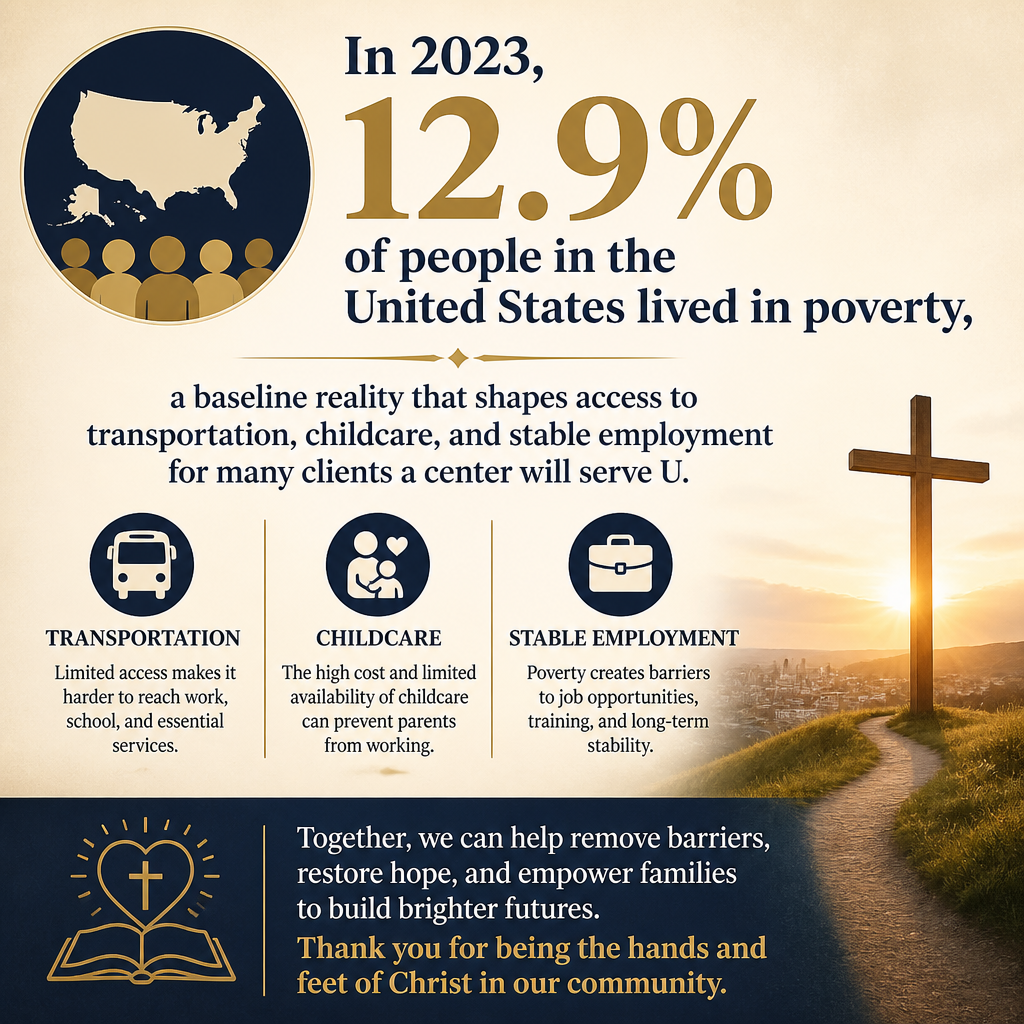
We also recognize that many women who are pregnant are navigating poverty. In 2023, 12.9% of people in the United States lived in poverty, a baseline reality that shapes access to transportation, childcare, and stable employment for many clients a center will serve U.S. Census Bureau.
Continuity of care is a theological and practical aim
A pregnancy resource center can provide a structured path: education, material assistance, coaching, and referrals. A church can provide continuity when systems are fragmented. Donors often underestimate how much stability matters: showing up at the same place each week, seeing the same faces, and being known by name over months. This is not sentimentality; it is neighbor love expressed through time and reliability.
Partnerships that endure also tend to clarify roles. Churches can be tempted to treat a center as a project; centers can be tempted to treat churches as donors only. Strong partnerships treat each other as collaborators in a shared moral and pastoral responsibility.
Churches partner because the work is contested and must be done with integrity
Public scrutiny is real, and donors should not resent it
Pregnancy resource centers operate in a highly scrutinized environment. Some criticisms are ideological. Others raise legitimate questions about medical claims, informed consent, and whether clients feel respected. Christian donors should not dismiss scrutiny as persecution by default. A ministry that serves vulnerable people should welcome clear standards and transparent practices.
Partnership is one way churches help insist on integrity. A church that supports a center is not only giving funds; it is lending credibility. That credibility should be conditioned on whether the center communicates honestly, protects client dignity, and maintains appropriate boundaries between spiritual care and clinical representation.
Healthy partnership requires governance, not just enthusiasm
Across our verification work at Most Trusted, we observe that ministries doing sensitive frontline care are strengthened by disciplined governance: clear oversight, written policies, and transparent reporting. Donors sometimes assume that sincerity is sufficient. It is not. Sincerity is compatible with error, and compassion without accountability can lead to avoidable harm.
For donors evaluating this space, the relevant question is not whether a center claims to be Christian, but whether it can demonstrate mature stewardship and ethical practice. The Most Trusted Standard is designed for this kind of evaluation, because it treats faith commitments, financial integrity, governance and leadership, and transparency and effectiveness as interconnected responsibilities rather than competing virtues.
Churches partner because donors are called to informed stewardship, not reactive giving
Giving should be discerning without becoming cynical
Christian donors often carry a tension: the desire to help quickly and the fear of funding something ineffective or manipulative. Both instincts can be spiritually significant. Quick help can be genuine mercy; caution can be wise stewardship. The donor’s task is not to eliminate the tension but to submit it to truth.
In practice, that means asking questions that go beyond marketing. What services are offered, and by whom? Are licensed professionals clearly distinguished from volunteers? Is there a clear policy on client privacy? Are financial statements available? Are board members independent and engaged?
What churches can ask before partnering
A church partnership often begins with a pastor’s relationship or a heartfelt presentation. Those can be good beginnings, but they are not due diligence. The church’s leaders and donors can ask for verifiable clarity. A short set of questions often reveals whether a center is prepared for mature partnership:
- Do we have written information on governance, leadership oversight, and complaint processes?
- Are program claims specific, and do they avoid medical overreach?
- Is there financial transparency appropriate to the organization’s size, including audited or reviewed statements when feasible?
- How does the center define success, and what evidence is used to assess it?
- How are volunteers trained for trauma, coercion screening, and client dignity?
When a center responds well to these questions, it usually indicates more than organizational competence. It indicates humility, and humility is not a secondary virtue in Christian ministry; it is a safeguard for those being served.
Churches partner because love of neighbor must be embodied in local networks
The local church can supply what institutions cannot
Many needs surrounding pregnancy are relational: a safe place to live, a ride to an appointment, someone to sit in the waiting room, childcare for an older sibling, a trusted mentor who will still answer the phone months later. Government programs and clinics can offer essential services, but they cannot substitute for covenantal community. Churches partner with pregnancy resource centers to build a network where practical care is personal and durable.
When churches do this well, they also reduce the risk of charity that inadvertently creates dependence or displaces local responsibility. The When Helping Hurts framework, articulated by Steve Corbett and Brian Fikkert, has helped many Christian ministries distinguish between relief, rehabilitation, and development, and to avoid forms of help that unintentionally harm dignity When Helping Hurts.
Partnership also protects against isolation and burnout
Frontline ministry in this area can be emotionally demanding. Staff and volunteers absorb stories of abandonment, coercion, and trauma. A church partnership can provide prayer, pastoral care, and a broader team so that care does not depend on a few exhausted individuals.
For donors, this is part of effectiveness. A ministry that cannot sustain its people cannot sustain its programs. Sustainable care requires the kind of institutional maturity that Christian philanthropy is increasingly insisting on, including clear leadership structures and honest reporting.
Church and center partnerships also sit within a wider ecosystem of Christian service. Donors who want broader context on how these ministries fit together can examine Pregnancy Resource Centers as a field, including the distinct roles of churches, medical providers, and community organizations.
FAQs for Why churches partner with pregnancy resource centers
Should a church only partner with a pregnancy resource center that offers medical services?
Not necessarily. Some centers are licensed medical clinics; others focus on education, material support, and referrals. What matters is truthful representation and appropriate boundaries. A non-medical center should not imply clinical authority, and a medical clinic should meet the standards and oversight required for its scope of practice. Donors and church leaders should ask for clarity on what is offered, who provides it, and how referrals are handled.
How can donors evaluate whether a center is both compassionate and credible?
Compassion shows up in client dignity, confidentiality, and continuity of care. Credibility shows up in governance, financial transparency, and accurate communication about services and outcomes. We encourage donors to favor ministries that can document policies, leadership oversight, and measurable program commitments rather than relying on emotion-driven appeals. This is also where independent verification can serve the church by reducing guesswork and rewarding ministries that meet consistent standards.
Where faithful partnership becomes credible witness
Why churches partner with pregnancy resource centers is not finally about institutional convenience. It is about whether the church will bear credible witness to the sanctity of life by caring for women and families in concrete, sustained, and truthful ways. Partnerships that honor client dignity, welcome scrutiny, and practice transparent stewardship become more than a programmatic arrangement; they become a local expression of neighbor love that can withstand both pressure and time.
In a contested space, the church serves best when its compassion is disciplined and its convictions are paired with verifiable integrity. That is the posture we encourage donors to seek and to fund, and it is the posture we examine through The Most Trusted Standard as we assess ministries working within The Faith-Based Mission of Pregnancy Resource Centers.



