
What Scripture grounds pregnancy resource center work is not a secondary question for Christian donors. If pregnancy resource centers are to be more than a social service with a religious veneer, their work must be anchored in the biblical account of human dignity, moral agency, mercy, and truth.
The field also sits in a contested public square. Christians genuinely disagree about what faithfulness requires in law, politics, and pastoral practice, and pregnancy decisions are often entangled with fear, coercion, abuse, poverty, and medical uncertainty. Scripture does not flatten those complexities. It clarifies what is non-negotiable: the image of God in mother and child, the obligation to protect the vulnerable, and the call to speak truth without manipulating those who are already in crisis.
Scripture begins with the image of God and therefore refuses reduction
Human life is bestowed, not manufactured
Pregnancy resource center ministry rests first on the doctrine of the imago Dei. Scripture’s opening claim is that human beings are made in God’s image (Genesis 1:26–27). That is not poetic encouragement; it is the foundation for Christian ethics. It means the pregnant woman is never a problem to manage, and the unborn child is never a mere concept or inconvenience. Both are bearers of dignity that precedes social usefulness, economic stability, or relational readiness.
This is why faithful centers insist on personal presence rather than abstract argument. The ministry is not an idea about life; it is care for actual persons, with names, families, histories, and moral weight. The biblical logic runs from creation to the law’s protection for the vulnerable and the prophets’ denunciation of exploitation. The question is not whether crisis pregnancy is complicated; it is whether our care honors the kind of creature a human being is.
God’s knowledge of the unborn shapes the church’s posture
Several passages show Scripture’s seriousness about life in the womb without turning biology into a simplistic slogan. David confesses that God knit him together and saw his unformed substance (Psalm 139:13–16). Jeremiah describes divine calling “before” birth (Jeremiah 1:5). Elizabeth’s pregnancy and John’s prenatal response to the presence of Christ make the unborn visible in the narrative of redemption (Luke 1:41–44). These texts are not clinical definitions; they are theological claims about God’s intimate relation to human life before birth.
What this means in practice is that a pregnancy resource center is not primarily a political outpost. It is a community expression of the church’s conviction that hidden lives are seen by God, and therefore should be treated with reverence by God’s people.

Scripture commands truthfulness and rejects coercion
Truth is a moral duty, not a strategy
When donors ask what Scripture grounds pregnancy resource center work, they often assume the answer will focus exclusively on defending life. That is essential, but the Bible’s concern for truth is just as central to a Christian ethic of care. “You shall not bear false witness” (Exodus 20:16) is not limited to the courtroom. Paul insists that Christians “speak the truth in love” (Ephesians 4:15), and that love “does not rejoice at wrongdoing, but rejoices with the truth” (1 Corinthians 13:6). Pregnancy counseling that manipulates, exaggerates medical claims, or withholds material information violates the very Scripture the center claims to honor.
This is a point of real credibility in a skeptical culture: centers must not confuse righteous ends with unrighteous means. Mature donors should want ministries that can be audited not only financially but morally—where medical referrals are responsible, informed consent is meaningful, and the vulnerable are not treated as instruments for a cause.
Agency and consent matter because persons matter
Scripture’s moral vision includes a sober respect for human agency. God does not treat people as props. Throughout the Gospels, Jesus asks direct questions, invites response, and refuses to crush bruised reeds (Isaiah 42:3; Matthew 12:20). That pattern does not eliminate moral exhortation, but it does shape the manner of exhortation. A pregnancy resource center can affirm the gravity of abortion and still treat a frightened woman with patience, candor, and honor.
The harder question is how a ministry responds when clients feel pressure from partners, parents, employers, or abusers. Scripture’s condemnation of oppression is unambiguous. “Learn to do good; seek justice, correct oppression” (Isaiah 1:17). When a center helps a woman name coercion, find safety, and make a decision without threats, it is acting in line with the Bible’s insistence that the vulnerable are not prey.
Scripture’s ethic of mercy obligates the church to practical care
The neighbor is not theoretical
The parable of the Good Samaritan makes neighbor-love concrete and expensive (Luke 10:25–37). The Samaritan does not offer only moral instruction; he offers time, risk, transportation, and money. In the same way, pregnancy resource center work is biblically credible when it couples conviction with costly help: material support, parenting education, housing referrals, employment coaching, and accompaniment through medical and legal complexity where appropriate.
James refuses to separate compassion from provision: if a brother or sister lacks clothing and daily food, “what good is that” to offer words without help (James 2:15–17). This is where donors often discern the difference between ministries that want outcomes and ministries that want people. A faithful center will not treat diapers as a marketing expense; it will treat them as a form of neighbor-love.
Mercy includes both mother and child
Some critics portray pregnancy centers as concerned with birth but indifferent afterward. Scripture will not allow that bifurcation. The God who commands protection of the vulnerable also commands ongoing care for families under strain. When Mary’s pregnancy became socially perilous, God provided protection through Joseph and through guidance that helped them flee danger (Matthew 1:18–25; Matthew 2:13–15). That narrative does not map neatly onto modern program design, but it does show that protecting a child often requires protecting the mother, and that obedience may involve relocation, provision, and community support.
Donors seeking a fuller theological account of how centers relate to the church’s wider vocation will find helpful context in The Faith-Based Mission of Pregnancy Resource Centers, where the moral and pastoral tensions can be considered without reducing the work to a single talking point.
Scripture’s warnings about partiality and exploitation set standards for integrity
Righteous ends do not excuse unrighteous administration
Pregnancy resource centers handle money, data, and vulnerable people. Scripture repeatedly warns that worship divorced from justice becomes hypocrisy (Isaiah 1:11–17; Amos 5:21–24). That prophetic critique applies not only to personal morality but to institutional conduct. Governance failures, opaque finances, or misleading fundraising do not become acceptable because the mission is emotionally compelling.
The New Testament’s concern for integrity in handling funds is explicit. Paul describes careful procedures for administering a collection so that no one can accuse the ministry of mishandling it, “for we aim at what is honorable not only in the Lord’s sight but also in the sight of man” (2 Corinthians 8:20–21). That is not a public-relations instinct; it is biblical ethics applied to administration.
Partiality undermines credibility and discipleship
James condemns favoritism toward the wealthy (James 2:1–9). In pregnancy ministry, partiality can appear in other forms: treating married clients differently than unmarried ones, implicitly punishing women with complicated histories, or reserving patience for those who seem likely to choose the outcome the counselor prefers. Scripture insists that the church’s care must not mirror the world’s status hierarchies.
At Most Trusted, our verification work repeatedly shows that donors are not merely asking whether a ministry’s theology is orthodox; they are asking whether its practices are ordered by that theology. The ministries that meet The Most Trusted Standard tend to document client care policies clearly, separate clinical claims from advocacy, and demonstrate governance structures that protect against mission drift and reputational shortcuts.
Scripture frames pregnancy ministry as witness under pressure
Faithfulness requires both conviction and restraint
Pregnancy resource centers often operate under suspicion. Some of that suspicion is ideological. Some of it is a reaction to genuine failures in the sector. Scripture prepares the church for ministry in contested spaces without granting permission for defensiveness. Peter calls believers to a posture that is both intellectually serious and morally gentle: “always being prepared to make a defense… yet do it with gentleness and respect” (1 Peter 3:15–16). Gentleness is not weakness; it is self-governed strength that refuses to win by humiliation or fear.
That posture matters for donor confidence. When a center can explain its services, limits, referral practices, and outcomes without evasion, it signals a ministry that expects scrutiny and can bear it.
Love of neighbor includes long obedience
Galatians calls the church not to grow weary in doing good (Galatians 6:9–10). Pregnancy resource center work is rarely resolved in a single appointment. Many clients return with new crises: unstable housing, postpartum depression, relationship collapse, job loss, immigration complications, childcare gaps. Scripture’s vision of love is durable, not performative. The local church’s calling is to form communities where burdens are shared (Galatians 6:2), and where practical support is an expression of belonging rather than a transactional incentive.
Donors evaluating this work should consider whether a center is integrated into a broader ecosystem of care—church partnerships, licensed medical providers where applicable, social service coordination, and clear pathways for ongoing discipleship without coercion. For a wider view of how pregnancy centers typically structure these relationships, see Pregnancy Resource Centers.
FAQs for What Scripture grounds pregnancy resource center work
Is pregnancy resource center work primarily grounded in a few pro-life proof texts?
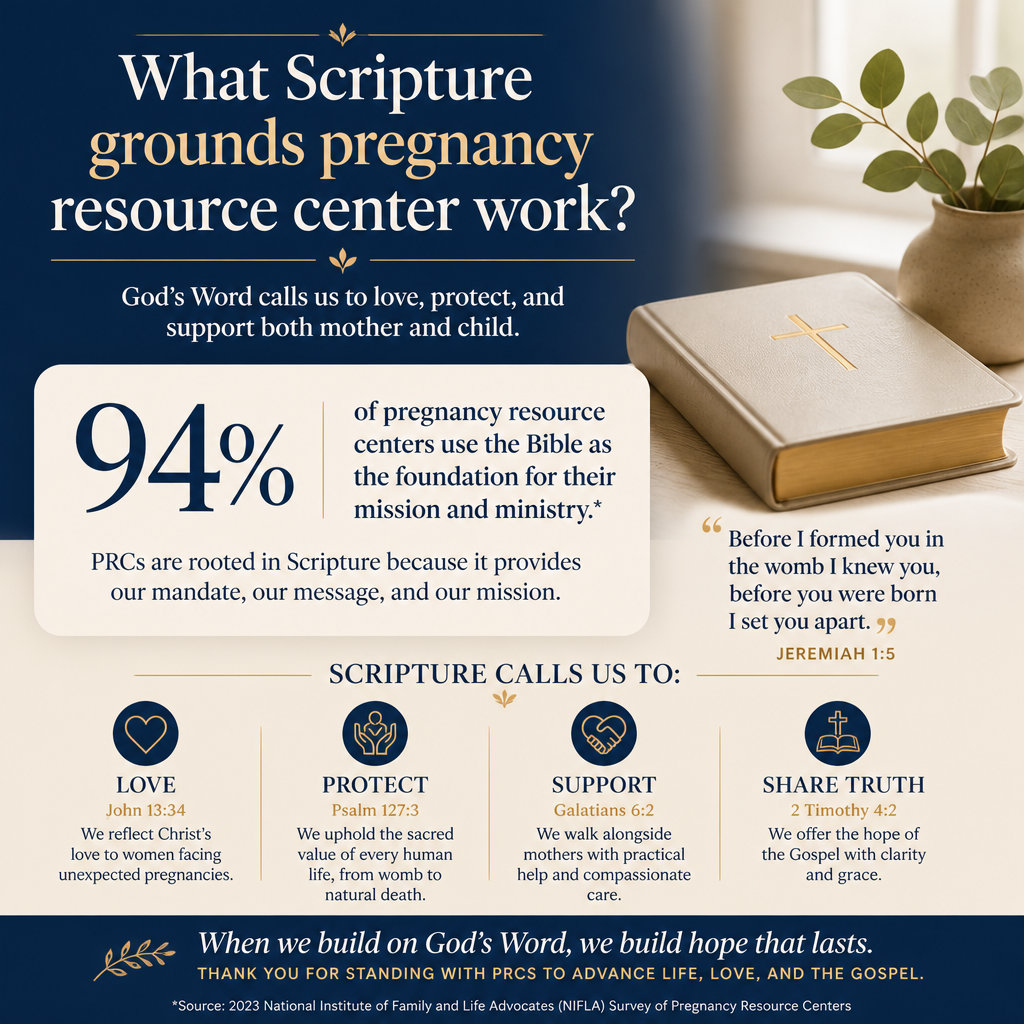
Scripture’s grounding is broader and deeper than a handful of verses. The imago Dei (Genesis 1:26–27), God’s knowledge of life before birth (Psalm 139:13–16), the commands against oppression (Isaiah 1:17), the call to neighbor-love with tangible provision (Luke 10:25–37; James 2:15–17), and the New Testament’s emphasis on honorable financial and institutional conduct (2 Corinthians 8:20–21) together form a coherent biblical rationale. A center that relies on slogans rather than this fuller framework is more vulnerable to ethical shortcuts and donor mistrust.
What should Christian donors look for to ensure a center reflects biblical ethics in practice?
Donors should look for evidence of truthfulness, non-coercive care, and accountable administration. Practically, that includes clear disclosures about services, responsible medical and social referrals, policies that protect client confidentiality, and governance that can withstand scrutiny. At Most Trusted, we evaluate ministries against The Most Trusted Standard so donors can distinguish between compelling rhetoric and verifiable integrity in faith, finances, leadership, and public accountability.
A scriptural foundation that donors can verify
Pregnancy resource center work is grounded in Scripture when it treats mother and child as image-bearers, binds truth to love, and expresses mercy in concrete provision over time. That theological foundation also requires institutional integrity—because Scripture holds ministries accountable not only for what they claim, but for what they do. Christian donors should not have to choose between compassion and credibility; the biblical vision insists on both.



