
When donors ask what parenting classes pregnancy resource centers offer, they are rarely asking about curriculum titles. They are asking whether a ministry is forming durable families, protecting children, and honoring mothers with practical help that can endure after the crisis appointment is over.
Pregnancy resource centers vary in size, theology, and program maturity. Some offer a structured sequence with measurable learning outcomes; others provide coaching built around mentoring relationships. The best centers understand that parenting formation is not only information transfer. It is discipleship-adjacent work: helping parents love with patience, practice self-control under stress, and order a home toward life, dignity, and responsibility.
Parenting classes at pregnancy resource centers are usually formation plus support
What most centers mean by parenting classes
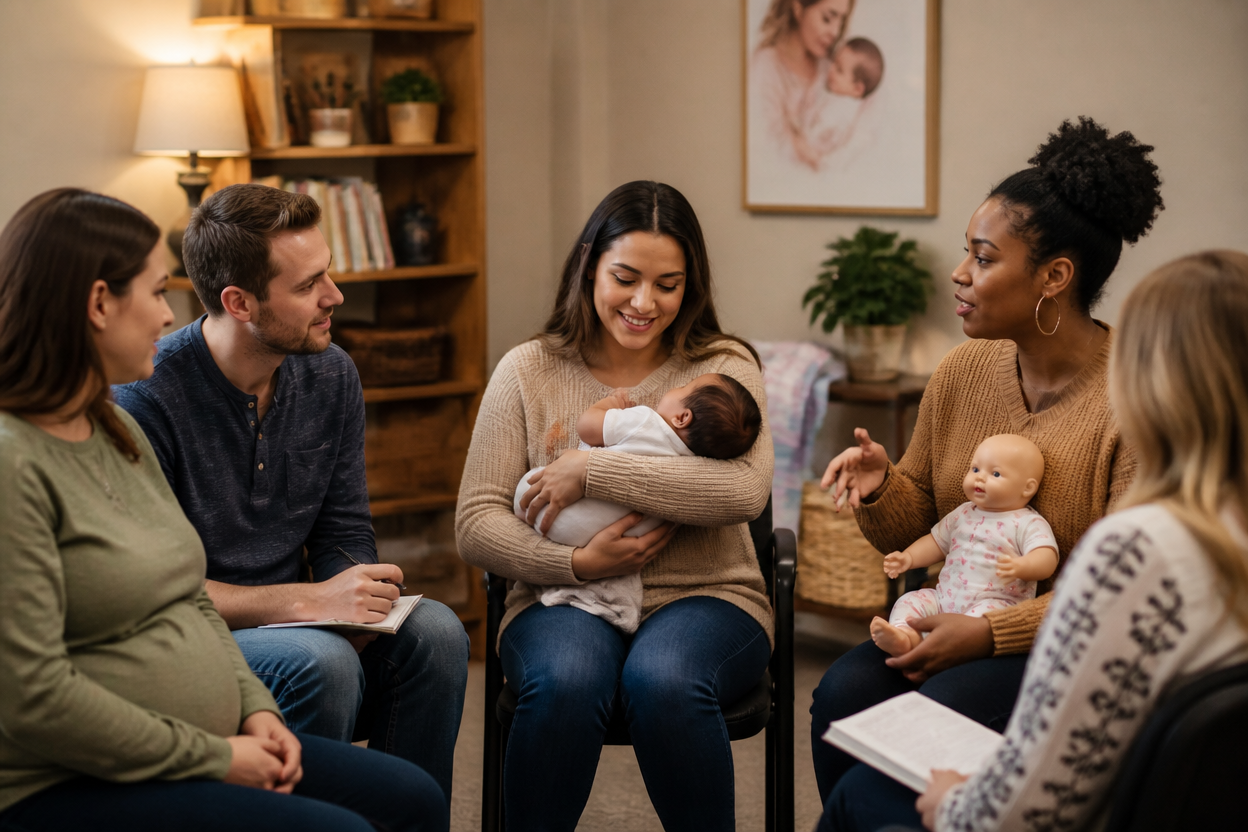
In practice, parenting classes at pregnancy resource centers tend to include a mix of lessons, coaching, and case-management style support. The format is often influenced by capacity. A small center might offer one-on-one classes in a private room with a trained advocate. A larger center may run group sessions, multi-week cohorts, or a “learn-and-earn” model tied to a material assistance boutique.
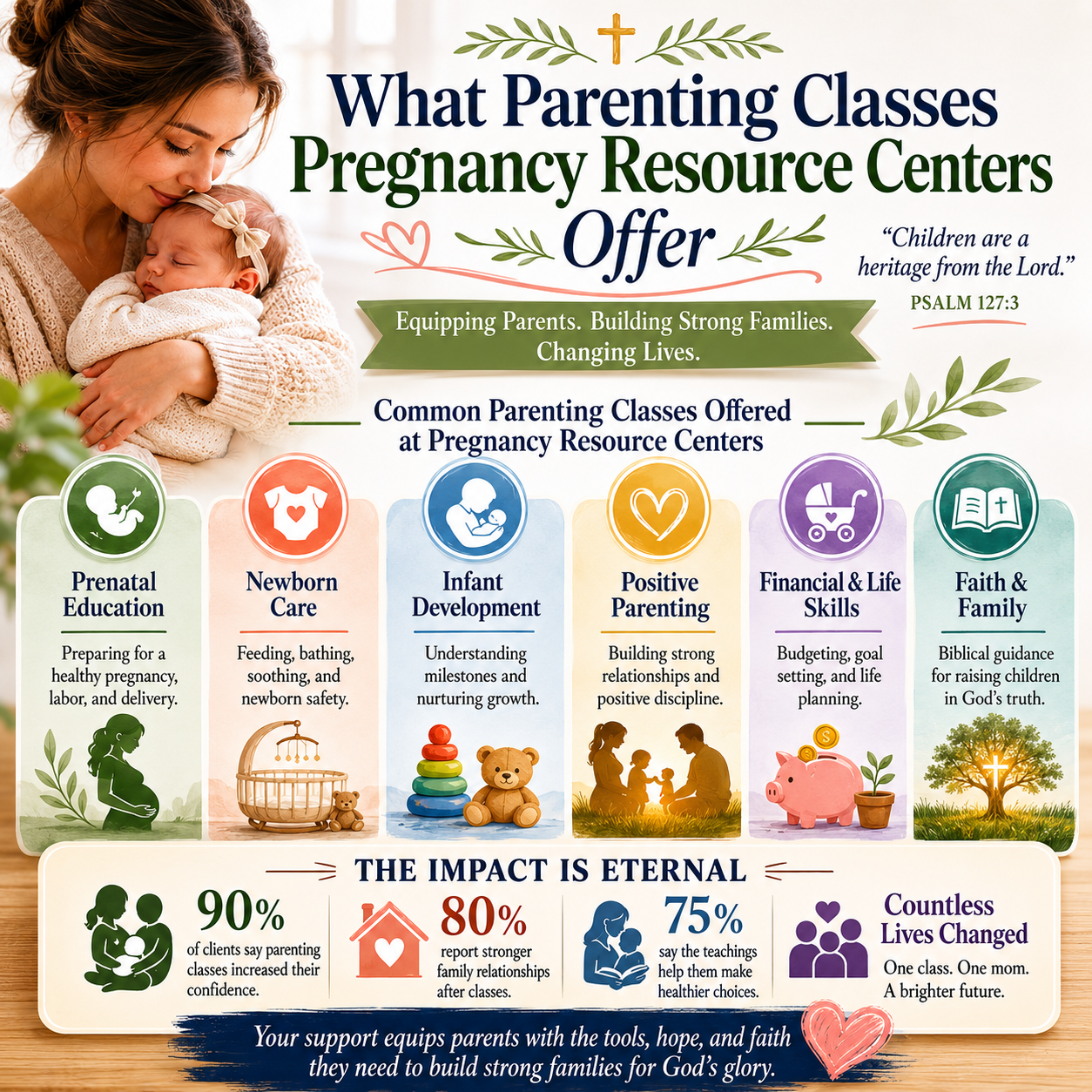
Content typically aims at immediate stability and child wellbeing: infant care, safe sleep, feeding, early bonding, postpartum mental health awareness, and realistic expectations for child development. As children grow, classes often expand to discipline strategies, routines, co-parenting communication, and navigating childcare and school systems.
Why a Christian donor should care about program design
Christian compassion is not sentimental; it is accountable love. Scripture joins mercy with truthfulness, and care with wise stewardship. A parenting program that is warm but incoherent may comfort without strengthening. A program that is structured but impersonal may convey information without building resilience. Donors should expect a center to articulate what change it is seeking and how it evaluates progress, without treating families as projects.
Across our verification work at Most Trusted, we find that ministries aligned with The Most Trusted Standard are more likely to document what is taught, how volunteers are trained, and how participant dignity is protected. Those are not administrative preferences. They are safeguards for mothers, fathers, and children who are often carrying heavy histories.
Common class topics and how they connect to long term family stability
Pregnancy and newborn care
Many centers begin with what a new parent must know in the first days and weeks: prenatal health basics, labor and delivery preparation, breastfeeding and formula feeding considerations, postpartum recovery, and newborn cues. Safe sleep education is frequently included because it is a high-impact, low-cost prevention measure. The American Academy of Pediatrics provides evidence-based safe sleep guidance that many centers reference directly American Academy of Pediatrics.
Some centers integrate car seat safety, basic first aid, and guidance on when to call a pediatrician. Donors should not assume medical instruction is being given in a clinical sense. The strongest centers are careful about scope, making clear what is educational, what is referral, and what requires a licensed provider.
Early childhood development and attachment
A growing number of centers teach age-appropriate developmental milestones and responsive caregiving. This is where parenting formation becomes especially consequential. Early adversity is associated with later health and social outcomes, yet supportive relationships can buffer stress in powerful ways. The Centers for Disease Control and Prevention summarizes the Adverse Childhood Experiences framework and related findings in accessible terms CDC.
Centers that handle this well avoid shaming language. They help parents understand what stress does to the body and how consistent, attuned care strengthens a child’s capacity to learn and relate. For a donor, this is one of the clearest bridges between pregnancy ministry and longer-term community renewal.
How pregnancy resource centers structure classes and why it matters
One on one coaching vs group learning
One-on-one formats can be more adaptable for parents facing complex circumstances: unstable housing, intimate partner violence, immigration pressures, addiction recovery, or severe anxiety. The trade-off is scale. Group formats can normalize common struggles, build peer support, and use staff time efficiently, but they require careful facilitation and confidentiality discipline.
Donors should ask what screening and safety protocols exist for group settings. A center can be spiritually faithful and still underprepared for the realities participants bring. Wise programs name that complexity and build guardrails rather than relying on goodwill alone.
Learn and earn models and material assistance
Many centers connect classes to the ability to “earn” baby items such as diapers, clothing, cribs, and car seats. This approach can be constructive when it reinforces agency and rewards perseverance. It can also be misused if it drifts into transactional thinking or if essentials are effectively withheld from families in genuine crisis.
Donors should look for clear principles that govern this model, including what is given immediately in emergencies and what is tied to participation. A credible center will be able to explain how it avoids coercion while still encouraging steady engagement.
- Clear learning objectives for each lesson
- Written policies for crisis exceptions and emergency needs
- Transparent sourcing and safety checks for donated items
- Trauma-aware volunteer training and supervision
- Referral pathways for medical, legal, and housing needs
Quality varies and donors should know what to ask and verify
Volunteer training, theology, and the dignity of clients
Pregnancy resource centers often rely heavily on volunteers. That can be a strength when volunteers are trained, supervised, and spiritually mature. It can become a liability when training is thin and boundaries are unclear. Parenting education touches intimacy, discipline practices, mental health, and family conflict. A center should be able to describe how it trains people to listen well, avoid judgment, and recognize mandated reporting scenarios where applicable.
Christians genuinely disagree about the best ways to integrate explicit spiritual content into parenting classes, especially when participants come from varied faith backgrounds. Some centers keep classes primarily practical and offer prayer and Bible study separately. Others integrate Scripture and prayer into every session. Donors should not treat either approach as automatically faithful or unfaithful. The more important question is whether the center is truthful about its approach and careful about consent, clarity, and pastoral responsibility.
What to evaluate beyond attendance numbers
Counting class attendance is easy. Measuring formation is harder. Still, credible signals exist: retention across multiple sessions, consistent mentor engagement, referrals completed, and documented learning progress. Where a center claims results, donors should expect modesty and specificity rather than inflated promises.
This is also where Most Trusted’s role is relevant. Our verification work evaluates ministries against The Most Trusted Standard across faith foundation, financial integrity, governance and leadership, and transparency and effectiveness. Donors do not need perfection; they need evidence that a ministry is accountable, honest about limits, and structurally able to care for people without creating dependency or avoidable harm.
How parenting classes fit into the wider ecosystem of pregnancy resource centers
Classes are rarely a stand alone intervention
Parenting classes are typically one component of a wider set of services: pregnancy testing, ultrasounds where offered and legally permitted, options counseling, material support, referrals, and sometimes ongoing mentoring. A donor who wants to understand parenting education should also ask how the center handles follow-up. Does it have a pathway for continued support after birth, when isolation and financial pressure often intensify?
Centers also differ in how they coordinate with churches and community partners. Some maintain close relationships with local congregations for baby showers, meal trains, and mentoring families. Others prioritize clinical privacy and keep church engagement more limited. Both can be prudent depending on context, but donors should expect intentionality rather than improvisation.
Where donors can study the broader work of these ministries
Parenting education sits within the larger calling of Pregnancy Resource Centers to protect life and uphold the dignity of mothers and fathers. For donors evaluating program depth, it can also help to compare how centers build wraparound care within Pregnancy Resource Center Programs for Mothers and Families, since parenting classes often function best when paired with mentoring, practical supports, and thoughtful referrals.
It is also wise to acknowledge a tension: some public narratives portray pregnancy centers as primarily political actors, while many centers understand themselves as mercy ministries responding to immediate need. Donors should not decide this question on rhetoric alone. The more reliable approach is to review what a center actually does, how it reports outcomes, how it handles medical claims, and whether it can withstand transparent scrutiny.
FAQs for What parenting classes pregnancy resource centers offer
Are parenting classes at pregnancy resource centers evidence based?
Some centers use established curricula with documented learning objectives; others develop internal lesson plans shaped by local needs. “Evidence-based” can be used loosely, so donors should ask what curriculum is used, how it is updated, and whether staff can point to specific sources for health and safety instruction. When centers teach on topics like safe sleep, referencing mainstream pediatric guidance is a strong sign of seriousness American Academy of Pediatrics.
Do centers require parents to attend classes to receive diapers and baby items?
Many centers use a learn-and-earn approach, but policies vary. A responsible ministry will have clear exceptions for emergency needs and will explain how it avoids coercion. Donors can ask for the written policy, how staff communicate it to clients, and how the center ensures that necessities are not used as leverage in moments of crisis.
What faithful donors should expect
Parenting classes at pregnancy resource centers are most credible when they combine practical instruction, consistent relationships, and accountable operations. Donors should look for programs that strengthen parental agency, protect child safety, and speak with moral clarity without exploiting vulnerability. When a center can explain its curriculum, demonstrate trained supervision, and show transparent stewardship, it becomes easier to give with confidence and to expect fruit that lasts beyond the immediate crisis.



