
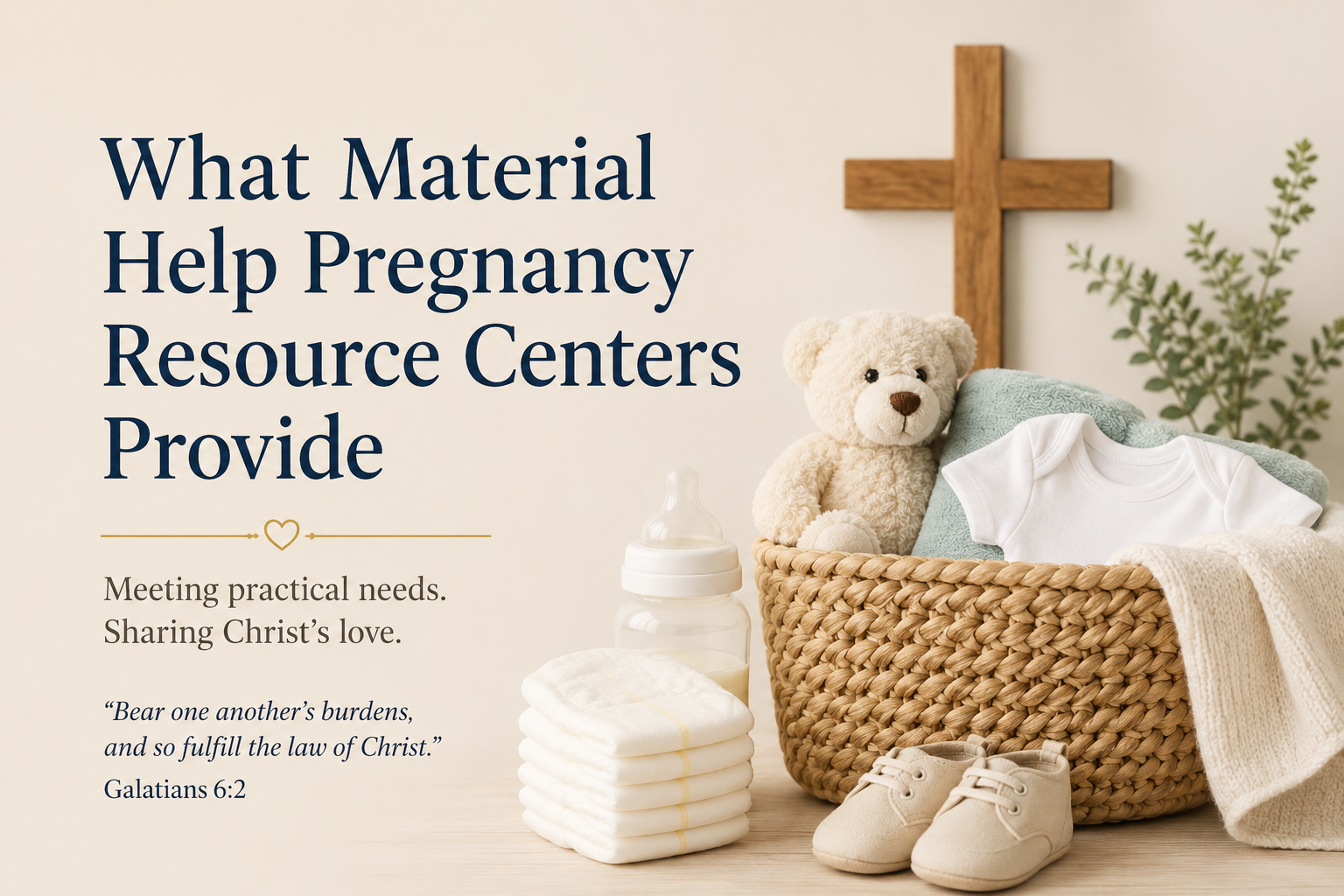
What material help pregnancy resource centers provide is often the most visible expression of their pro-life witness: tangible support that lowers the practical barriers a woman faces when she chooses life. For Christian donors, that visibility can be both an invitation and a risk, because material aid can either strengthen a mother’s agency and stability or, if poorly designed, create dependency, confusion, or even legal exposure for the ministry.
At their best, pregnancy resource centers treat material assistance as one part of a larger ethic of care—truthful counsel, respectful medical referrals where appropriate, relational support, and concrete resources delivered with clarity and dignity. The aim is not a transaction but a form of neighbor-love that keeps mother and child in view (Luke 10:33–37).
Material help is rarely the whole ministry but it is often the first door
Most pregnancy resource centers begin material support at the point of crisis: a missed period, a positive test, a strained relationship, an eviction notice, a job with no paid leave. Donors sometimes assume the primary “need” is a single item—a crib, diapers, or formula—but the presenting need is often a symptom of broader instability.
Across our verification work at Most Trusted, we observe that the ministries that handle material aid well are explicit about its purpose. They define it as short-term, targeted assistance tethered to longer-term goals: prenatal care, parenting readiness, stable housing, and a viable plan for work and childcare. That clarity becomes a form of protection for the mother and for the ministry.
Why material aid matters in a post-Dobbs landscape
Since Dobbs, state policy has shifted unevenly, and families experience the change unevenly. What has not changed is the financial pressure on low-income mothers in the earliest months of pregnancy and infancy. The USDA’s Thrifty Food Plan is the basis for SNAP allotments and reflects the reality that food costs are a central budget driver for families, especially when a pregnancy brings nausea, medical appointments, and reduced work hours. The policy mechanics are complex, but the pressure is simple: groceries, rent, and transportation compete with baby supplies and health costs. See the USDA overview of the Thrifty Food Plan at USDA.
What donors should watch for
Material aid becomes ethically compromised when it is offered as a covert quid pro quo: “supplies in exchange for a decision.” Mature centers refuse that logic. They serve mothers because each person bears God’s image, not because they can secure an outcome. Donors who want integrity should expect centers to state this explicitly in writing and to train volunteers accordingly.

The most common categories of material help centers provide
Pregnancy resource centers vary widely in size, staffing, and community context. Some operate large donation rooms and run weekly parenting classes; others focus on limited but consistent essentials. What follows is a realistic range of what many centers provide, with the understanding that scope must be matched to competence and oversight.
Essential infant supplies and layette items
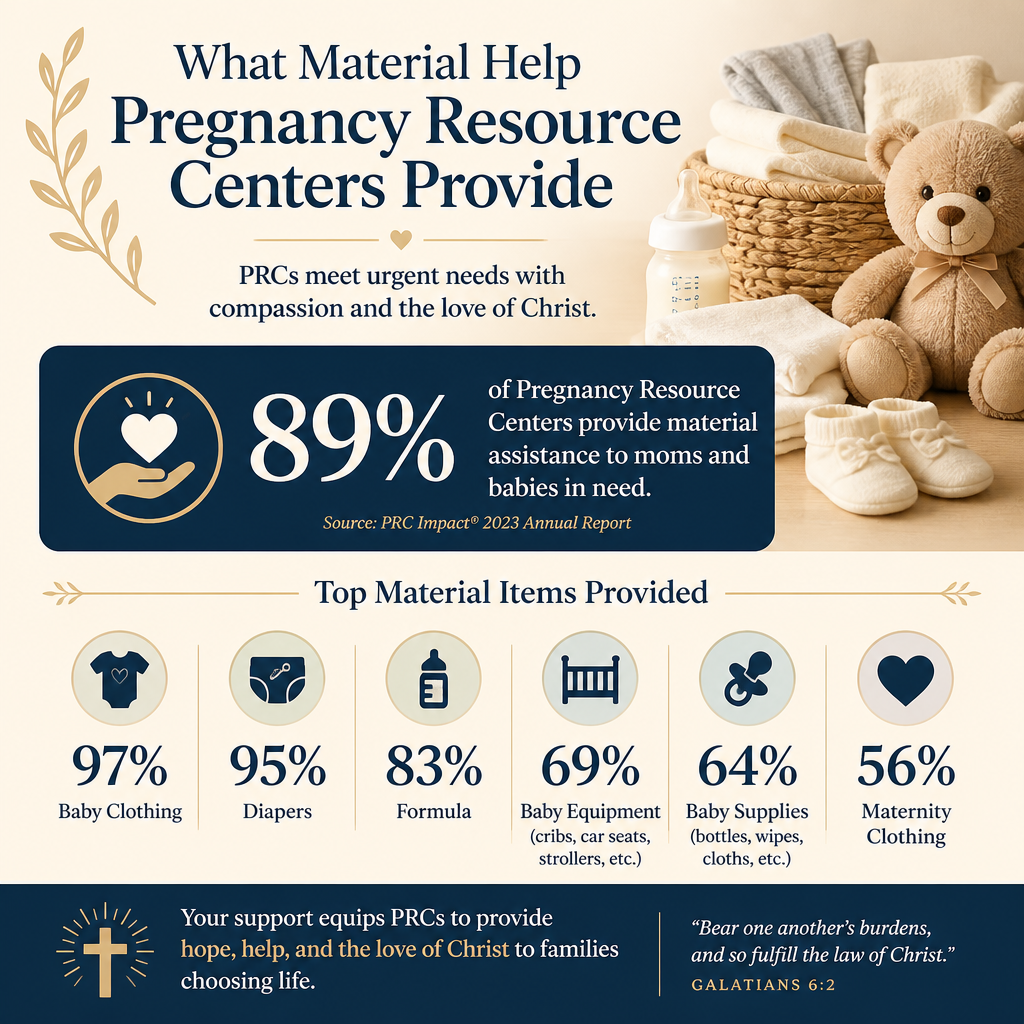
These are the items most donors recognize immediately, and for good reason: they are recurring costs that strain fragile budgets. In many communities, a center’s baby boutique or client store becomes a stabilizing presence, especially when tied to parenting education and case management.
- Diapers and wipes
- Infant clothing and blankets
- Car seats and pack-and-plays when available and safely sourced
- Cribs or bassinets, typically limited and often prioritized for unsafe sleep situations
- Basic postpartum care items for mothers
Even these basics require policies. Car seats, for example, carry safety and liability concerns if they are expired, recalled, or previously in an accident. Centers that meet high governance standards typically have written acceptance rules, date checks, and documentation practices for higher-risk items.
Pregnancy and parenting education tied to earned material support
Many centers use an “earned” model: clients attend parenting, prenatal, or life-skills classes and earn points to spend on baby items. Christians genuinely disagree about the wisdom of this approach. Some view it as dignifying and formative, pairing help with learning. Others worry it can feel paternalistic, especially if the mother faces barriers to attendance such as transportation, childcare, or work schedules.
The better programs acknowledge these tensions directly. They provide options for remote participation, make accommodations for work schedules, and keep the “earning” structure transparent and compassionate. When done well, the model resembles discipleship more than social control: a pathway toward competence and confidence, not a system of leverage.
Material help that addresses the deeper drivers of crisis
Diapers matter. But many pregnancies become “crisis pregnancies” because of housing instability, job insecurity, interpersonal violence, and lack of supportive relationships. Material support becomes most consequential when it addresses those drivers rather than only the visible needs.
Housing, utilities, and transportation partnerships
Pregnancy resource centers rarely function as housing agencies, and they should not pretend to be. Yet many build referral networks with churches, landlords willing to consider alternative documentation, local shelters, and community action agencies. Some centers maintain modest emergency funds for utilities, transportation vouchers, or one-time rent assistance, often with strict criteria and accountability.
When donors assess this kind of help, the key question is not merely compassion but controls. The field has learned through hard experience that cash assistance without clear policies can be diverted, mishandled, or distributed unevenly. Ministries that steward funds well document eligibility, avoid conflicts of interest, and track outcomes without reducing clients to numbers.
Health access and prenatal care navigation
Centers differ on the clinical services they offer. Some provide limited medical services under appropriate licensure and medical oversight; others focus on referrals. Either way, material support often includes practical help that enables prenatal care: bus passes, help scheduling appointments, and navigation of Medicaid or other coverage. The need is not theoretical. Medicaid covers a large share of births in the United States, which makes navigation of eligibility and enrollment a major practical concern for many mothers. For an overview of Medicaid and CHIP coverage, see Medicaid.gov.
Donors should expect centers to avoid practicing medicine without proper qualifications and to communicate clearly about what services are and are not provided. Transparency here is not merely a public-relations virtue; it is a matter of moral seriousness and legal prudence.
How wise centers prevent material aid from becoming harmful
Material help can unintentionally communicate that a woman is primarily a problem to be managed. Christian ministry must refuse that posture. The mother is a moral agent, not a project, and the center’s role is to serve and to tell the truth with gentleness. Scripture’s insistence on impartiality and honest dealings applies as much to charitable distribution as it does to business practice (Proverbs 11:1; James 2:1–4).
Applying the When Helping Hurts framework without losing compassion
The When Helping Hurts framework, articulated by Steve Corbett and Brian Fikkert, has reshaped how many Christian ministries think about poverty relief. It warns that unstructured handouts can undermine initiative and relationships, and it argues for assistance that restores dignity and agency. Pregnancy resource centers that internalize this framework tend to use material aid as a bridge into coaching, community, and long-term stability rather than as an end in itself. See the authors’ work through Chalmers Center.
This does not mean refusing urgent help. A mother leaving an abusive home may need immediate supplies and a safe place to sleep. The mature approach is both-and: urgent mercy now, and a pathway forward after the crisis night passes.
Safeguards donors should expect to see
In well-governed centers, material aid operates within a system of accountability. Staff and volunteers know what is permitted, what requires supervisor approval, and how decisions are documented. These safeguards are not signs of coldness; they are signs of stewardship.
In our work evaluating ministries against The Most Trusted Standard, we pay close attention to whether a center can show clear policies for in-kind gifts, client eligibility, privacy practices, and board oversight. Donors are not merely funding supplies; they are funding a trust relationship with vulnerable families.
How donors can evaluate material-help programs with confidence
Christian donors often ask a fair question: “If we give, will it truly help mothers, or will it simply move boxes?” The answer depends on whether the material program is integrated into a coherent mission with measurable practices and transparent reporting. A center can distribute a great volume of supplies and still fail to serve women well if it lacks ethical clarity, governance discipline, or truthful communication.
Questions that distinguish mature programs from well-intentioned ones
We recommend asking centers to describe their material-help model in plain terms: Who qualifies, what is provided, and what happens when needs exceed supply. Mature ministries can answer without defensiveness, and they can point to written policies rather than relying on informal practice.
It is also reasonable to ask how the center prevents material aid from becoming coercive or politicized. Pregnancy resource work sits at the intersection of moral conviction and contested public debate. The ministry’s credibility depends on being scrupulously truthful and consistently compassionate, especially with women who disagree with its convictions.
Where to learn more about the broader work of centers
Material help makes the ministry visible, but it is not the whole story. Many centers also provide mentoring, father engagement, post-abortion support, and connections to church communities that can sustain a family beyond the first months. Readers who want a wider view of the field can explore Pregnancy Resource Centers as a category of Christian ministry and the practical program mix they typically carry.
For donors specifically interested in family-facing services, our coverage of Pregnancy Resource Center Programs for Mothers and Families clarifies common program models and the governance signals that tend to accompany faithful effectiveness.
FAQs for What material help pregnancy resource centers provide
Do pregnancy resource centers give away free diapers and formula?
Many centers provide diapers and other infant supplies, often through a client store or baby boutique model. Formula support varies more widely because of cost, supply volatility, and safety concerns; some centers provide limited quantities, while others rely on referrals to WIC or community partners. Donors should expect clear policies that prioritize infant safety and equitable distribution.
Is material aid tied to attending classes or making a specific decision?
Some centers connect material support to participation in parenting or prenatal education, sometimes through an earned-points system. Ethically responsible centers do not condition material help on choosing a particular pregnancy outcome; they serve because care for vulnerable neighbors is a Christian obligation. When a center uses an earned model, donors should look for flexibility, transparency, and accommodations that keep the program from penalizing mothers with limited time, transportation, or childcare.
Material help as a form of truthful mercy
Material help pregnancy resource centers provide can be a concrete expression of Christian mercy when it is governed with clarity and delivered with dignity. The strongest centers treat supplies as a means, not a message: a way of strengthening a mother’s capacity to parent, to persevere, and to make wise decisions in a pressured moment. For donors who want their giving to honor both mother and child, the best signal is not the size of the donation room but the integrity of the ministry that stands behind it.



