
Pregnancy resource center programs for mothers and families are often described in the shorthand of “free ultrasounds” or “material assistance.” Serious Christian donors should understand them as something more demanding: a coordinated set of services meant to protect life, strengthen family stability, and offer durable discipleship-informed support in the midst of crisis. The question is not whether these programs are compassionate. The question is whether they are competent, truthful, and accountable—because pregnancy vulnerability is not a time for improvisation.
Christian support for pregnancy resource centers typically carries two convictions that can pull against each other if we are not attentive. First, every human life bears the image of God (Genesis 1:27), which makes care for a pregnant mother and her child a matter of reverence, not ideology. Second, Christian stewardship demands that compassion be disciplined by evidence and governance. A ministry can be sincere and still be ineffective, or even harmful, if it is poorly led, medically careless, or financially opaque.
What donors are actually funding when they fund programs
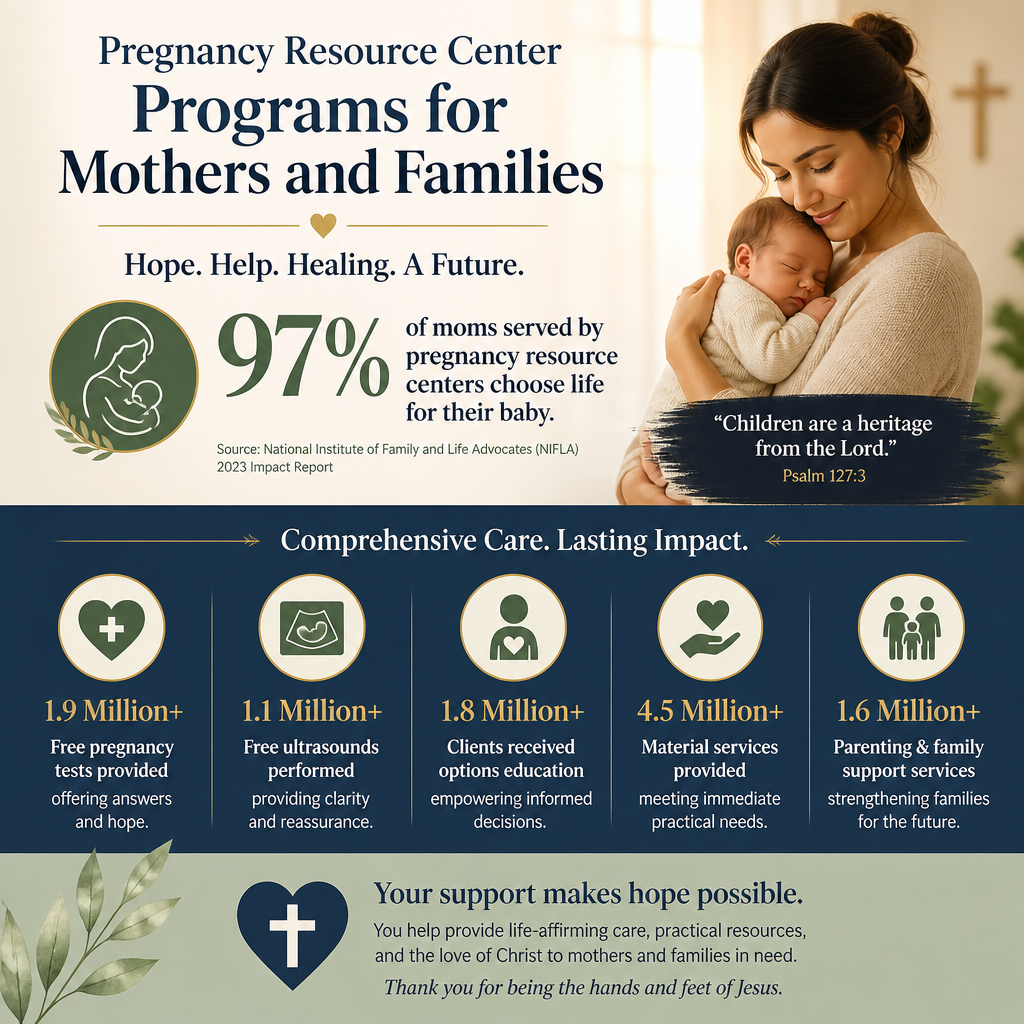
Most pregnancy resource centers build their work around a continuum: immediate triage in a moment of fear, practical support through pregnancy, and sustained care after birth. Donors often picture one discrete service. In reality, the most credible centers treat programs as mutually reinforcing. A pregnancy test without follow-up can function as a dead end. Material help without relational support can become transactional. Parenting education without community connection can become information without formation.
Intake, assessment, and the first 72 hours
The first contact is usually a pregnancy test, a conversation about options, and an assessment of safety. Strong centers use structured intake processes, clear privacy practices, and referral pathways for urgent needs: domestic violence, homelessness, mental health crises, and substance use. This is where donors should look for sober operational maturity. A center that cannot describe its safeguarding practices, mandated reporting training, and referral relationships is asking clients to trust a system that has not earned trust.
Many centers also provide ultrasound services. When these services are offered, donors should ask whether they are provided under appropriate medical oversight, whether staff are credentialed, and how the center distinguishes between “medical” and “non-medical” services in both practice and communications. The field has faced criticism when centers market in ways that blur those lines. The most responsible ministries do not treat regulation as an enemy; they treat it as part of loving their neighbor with competence.
Education programs that aim at stability, not merely information
Parenting classes are common, but their quality varies significantly. The best programs include infant care, child development, co-parenting, conflict de-escalation, budgeting for a new household, and connecting families to community resources. Donors should pay attention to whether classes are voluntary or tied to incentives, and whether centers can show basic outcome tracking (attendance completion, follow-up engagement, referral success). Education that never measures whether it is understood or applied is not neutral; it is unaccountable.
Material assistance as dignified support
Diapers, formula, car seats, maternity clothes, and cribs are not “extras.” For families with unstable housing or limited income, these needs can be immediate and destabilizing. Yet material help is also one of the easiest places for a well-meaning ministry to slip into paternalism or unhealthy dependency. The When Helping Hurts framework, articulated by Steve Corbett and Brian Fikkert, has helped many Christian ministries recognize that relief should be time-bound and targeted, and that sustainable change usually requires development built on agency, skills, and community.
Donors should not be suspicious of material programs; they should be discerning about how they are administered. The question is whether a center treats material aid as a bridge into long-term stability, or as a substitute for it.

Programs that extend beyond birth are where integrity is tested
A center’s credibility is often clearest after the baby arrives. If the mission is truly to support mothers and families, then post-birth care cannot be an afterthought. The time after delivery brings sleep deprivation, medical complications, postpartum depression and anxiety, relationship strain, and financial pressure. Christian charity that only responds to the crisis moment but withdraws from the long obedience of support is vulnerable to legitimate critique.
Postpartum support and mental health referral networks
Many centers offer mentoring, support groups, or peer communities for new parents. Some maintain referral relationships with licensed counselors, community mental health clinics, or Christian counseling networks. Donors should ask what the center does when a client discloses trauma, depression, or self-harm risk. Responsible centers do not attempt to provide clinical treatment without training. They build partnerships, maintain clear boundaries, and document referral follow-through when clients consent.
Postpartum depression is not rare, and donors should not treat it as a niche concern. The CDC reports that depression symptoms are common among postpartum women, and rates vary by state and population group Centers for Disease Control and Prevention. A credible pregnancy resource center will speak about postpartum mental health with neither alarmism nor denial, and will have practical steps to help mothers access care.
Fatherhood and co-parenting initiatives
Support for fathers is frequently contested terrain. Some donors assume pregnancy centers focus exclusively on mothers; others worry that father programming dilutes the mission. In practice, fatherhood engagement often strengthens child outcomes and reduces strain on mothers. Programs may include fatherhood classes, employment readiness referrals, and mediation support for co-parenting arrangements. Donors should ask whether a center has a coherent theological and practical rationale for engaging fathers while also prioritizing client safety in cases of abuse or coercion.
Centers that do this well are explicit: father engagement is never a demand placed on a mother, and reconciliation is not prescribed as a spiritual duty when safety is at risk. This kind of clarity signals mature pastoral judgment and responsible safeguarding.
Case management and public-benefit navigation
Many families need help navigating Medicaid, WIC, SNAP, housing waitlists, childcare subsidies, and local health systems. Even when donors prefer a strictly “private charity” posture, ignoring public benefits can be a moral and strategic mistake. A center can affirm the dignity of work and personal responsibility while still helping a family access lawful assistance during a vulnerable season. This is one place where donors can look for a ministry’s prudence: whether it can walk families through complex systems without politicizing their crisis.
For context on the role and scale of WIC in supporting mothers and young children, the USDA outlines program reach and purpose U.S. Department of Agriculture Food and Nutrition Service. Pregnancy resource centers that can competently connect families to nutrition and health resources often free their own charitable dollars for the kinds of relational support that only the church and local ministries can provide.
Medical-related services require exceptional clarity and accountability
Free ultrasounds and STI testing are among the most visible services offered by pregnancy resource centers, and also among the most scrutinized. For Christian donors who care about both truthfulness and life, scrutiny is not an annoyance; it is an opportunity to separate ministries that are operating with integrity from those that rely on ambiguity.
Ultrasound services and informed consent
When a center offers ultrasound services, donors should look for: medical director oversight, compliance with state requirements, staff credentials, equipment maintenance protocols, and clear informed consent processes. Ultrasound can be a meaningful service when it is integrated with appropriate medical referral and does not pretend to replace prenatal care. The client should leave with a clearer understanding of what the ultrasound can and cannot determine.
Because medical regulation differs by state, donors should ask state-specific questions rather than assuming a center’s model is transferable. The absence of uniformity is not necessarily malpractice; it does mean donors must press for documentation and clarity.
STI testing and treatment referral
Some centers provide limited STI testing, typically for common infections, and then refer for confirmatory testing and treatment. The ethical line here is straightforward: if a center offers testing, it must be accurate within the limits of the test type, communicated honestly, and connected to treatment pathways. A test result without a path to care is not a service; it is a risk.
Donors should also ask how centers handle partner notification guidance, confidentiality, and follow-up. These issues are not peripheral. They are the difference between well-intentioned support and medical negligence.
Truthfulness in communications
Pregnancy resource centers operate in a polarized environment where accusations are common and sometimes unfair. Yet the moral obligation remains: communications should be true, clear, and verifiable. Christian donors should not tolerate deceptive marketing simply because a ministry is aligned with their convictions. Scripture’s prohibition against false witness is not suspended for cause (Exodus 20:16).
Practically, this means asking whether a center’s website and intake materials clearly state what is and is not provided, what credentials staff hold, and what medical oversight exists. It also means examining whether the center’s fundraising claims match documented program reality.
What Most Trusted looks for when donors ask which programs are worthy of trust
Christian donors are not merely funding a set of services; they are entrusting a ministry with vulnerable people, difficult moral questions, and public witness. Across our verification work at Most Trusted, we find that the strongest pregnancy resource centers combine theological conviction with operational maturity. They can articulate what they do, how they do it, and how they know it is helping.
Signals of a center that deserves donor confidence
When a ministry is evaluated against The Most Trusted Standard, several patterns tend to correlate with trustworthy programs:
- Faith foundation with restraint: an explicit Christian identity expressed through compassion, not coercion. Clients should not be manipulated by spiritual pressure in exchange for help.
- Financial integrity: clean, timely financial reporting; appropriate controls; and fundraising claims that can be substantiated.
- Governance and leadership: an active, competent board; clear policies; and leadership that is accountable rather than personality-driven.
- Transparency and effectiveness: basic outcome measurement, clear program descriptions, and a willingness to name limitations and refer out.
Donors sometimes ask for a single metric: cost per client, number of ultrasounds, number of class sessions. Those numbers can be useful, but they are not sufficient. The harder question is whether the ministry is treating people as neighbors rather than projects, and whether its leaders are willing to be examined.
Common gaps donors should address before giving
Several weaknesses appear repeatedly in centers that are earnest but not yet mature:
- Overpromising and under-documenting: dramatic claims without clear program data or defined terms.
- Thin safeguarding practices: unclear policies for abuse disclosure, confidentiality, and volunteer oversight.
- Medical ambiguity: unclear distinctions between education, information, and medical care.
- Short-term thinking: heavy emphasis on initial pregnancy decision points with minimal post-birth follow-through.
A donor can respond to these gaps constructively: by funding capacity building, governance improvements, staff training, outcome tracking, and partnership development. The goal is not to demand corporate sophistication. It is to insist on the kind of order and honesty that love requires.
For donors assessing the broader landscape of Pregnancy Resource Centers, the program question is inseparable from the trust question. It is not enough that services are offered. They must be offered with competence, humility, and accountability to the church and the public.
Giving that strengthens mothers and families over the long haul
Pregnancy resource center programs for mothers and families are at their best when they match urgency with endurance: immediate care in crisis, followed by patient, structured support that strengthens households. Donors serve this work well when they ask disciplined questions about medical clarity, post-birth follow-through, safeguarding, and measurable outcomes. The pro-life witness the church seeks is not only a position; it is the kind of faithful presence that can withstand scrutiny because it is true.



