
Knowing how to access pregnancy resource center services is not only a practical concern for a woman in crisis; it is a stewardship concern for donors who want mercy to be both immediate and wise. Pregnancy resource centers often sit at the intersection of urgent need, contested public narratives, and complex medical and legal boundaries. When access is clear, compassionate, and ethically sound, a woman can receive timely care and a credible pathway toward stability.
For Christian donors, the question is not simply whether help exists, but whether it is reachable for the people it is meant to serve. Transportation barriers, fear of exposure, confusion about what is offered, and prior experiences of coercion or shame can all keep a woman from taking the first step. Our concern is that access should reflect the character of Christian mercy: truth-speaking without manipulation, practical support without paternalism, and care that honors the dignity of mother and child alike.
Start with what pregnancy resource centers typically provide
Access improves when expectations are accurate. The better centers state plainly what they do and do not offer, what is confidential, and what happens at a first appointment. Many centers provide no-cost pregnancy testing, limited ultrasound services when clinically appropriate, options counseling, STI education or referrals, material assistance, and parenting education. Some also offer post-abortion support and referrals for prenatal care, housing, food assistance, and legal aid.
Clarify services that are medical and those that are not
Pregnancy resource centers vary widely in clinical capacity. Some operate as medical clinics with licensed medical oversight; others function as non-medical support centers. That distinction matters for what a center can legally do, how it documents care, and what level of privacy regulation applies. A credible center will not blur these lines. It will identify whether it has licensed medical personnel, what training staff have, and how it handles referrals.
Expect a first contact that is low barrier and non-technical
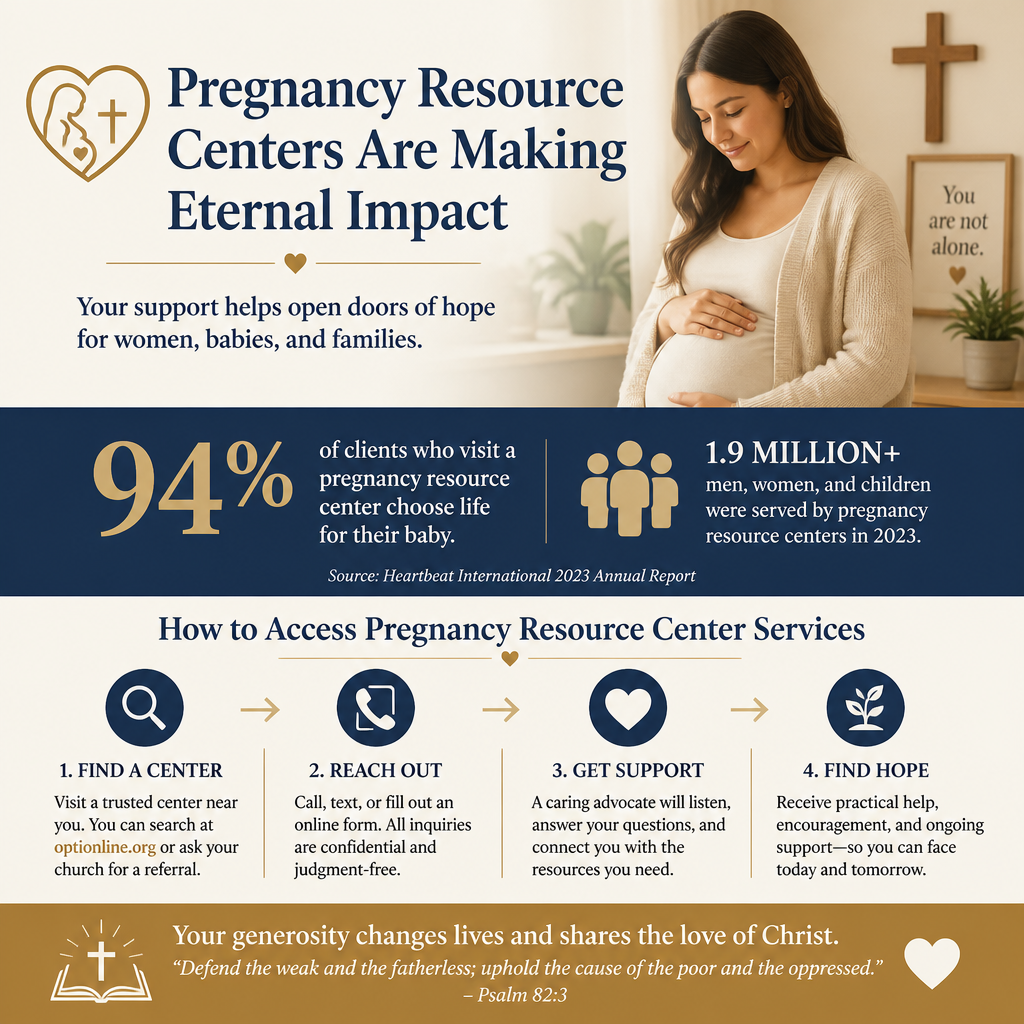
Most centers are designed to be approachable. A first interaction is often a phone call, a web form, or a walk-in conversation. The tone of that first contact is part of access. If a center cannot clearly explain what will happen next, or if it uses pressure rather than clarity, women tend to disengage. Donors should recognize that accessibility is not only operational; it is pastoral.

How women can find a center and make first contact
Women typically search by proximity and privacy. Many locate a center through an online search, referrals from a church, a friend, a social worker, or a local health provider. Others find a center through national directories. While centers should be discoverable, discoverability must be paired with honest representation of services and limitations.
What to look for on a center website before calling
Before a woman shares personal information, a center should help her assess whether it is the right fit. The most trustworthy centers usually make these points easy to find: services offered, appointment availability, confidentiality practices, whether a licensed medical professional is involved, and how referrals work. Clear statements reduce fear and prevent misunderstandings that can feel like betrayal in a vulnerable moment.
What to say when making the appointment
A woman does not need to have polished words. Centers should be prepared to receive fragmented, anxious requests. A simple script is often enough: her first name, how far along she thinks she might be, whether she wants a pregnancy test or ultrasound information, and whether she has safety concerns. If safety is an issue, a center should be able to discuss discreet contact methods and local resources.
For donors who want to understand the broader field, we maintain coverage of Pregnancy Resource Centers that treats both strengths and weaknesses with candor, because access depends on public trust as much as on office hours.
Access is shaped by trust, privacy, and legal boundaries
Pregnancy decisions are often made under conditions of fear: fear of parents, a partner, an employer, immigration consequences, or a church community that may respond poorly. Access is not merely the ability to schedule a visit; it is whether a woman believes she will be treated with dignity and discretion.
Confidentiality is a pastoral obligation and an operational discipline
Non-medical centers are not automatically covered by HIPAA, while medical clinics that bill electronically or transmit health information in certain ways may be. Even when HIPAA does not apply, confidentiality remains a moral and reputational necessity. A strong center will explain what it collects, how it stores information, and when it must disclose information under mandatory reporting laws. Mandatory reporting obligations differ by state and typically involve suspected abuse, threats of harm, or exploitation. A woman deserves to hear this before she is asked to disclose sensitive details.
Truthfulness about what is offered is central to Christian credibility
The field has had to reckon with public allegations that some centers misrepresent themselves as abortion providers or medical clinics. Christians genuinely disagree about the best regulatory approach, but there should be no disagreement about truthfulness. Scripture’s concern for honest speech is not a public relations strategy; it is part of Christian discipleship. Centers that are explicit about their identity and services remove a major barrier to access: fear of being deceived or trapped in a conversation.
We also recommend that donors pay attention to how a center communicates online. Many people now begin healthcare-related searches on a phone, and Pew Research has documented that smartphones are a primary way Americans access the internet, especially among younger adults and lower-income households (Pew Research Center). If a center’s site is confusing, slow, or unclear on basic information, access suffers in the real world.
Practical steps that reduce barriers to care
When access breaks down, it is often for reasons that are unglamorous: transportation, childcare, work schedules, language barriers, and the inability to predict how long an appointment will take. Mature centers treat these friction points as part of their ministry, not as inconveniences. Donors who want their giving to translate into actual care should look for operational decisions that reduce drop-off after the first contact.
Ask about referrals and continuity of care
Pregnancy resource centers do not replace prenatal providers, mental health clinicians, domestic violence shelters, or legal services. Access improves when centers have vetted referral relationships and can make a warm handoff rather than a generic suggestion. In the best cases, a woman leaves the first appointment not merely with information, but with next steps and names, and with support to follow through.
What accessible centers tend to do consistently
- Offer multiple contact options, including phone, text, and online scheduling when feasible
- Provide clear information about cost, confidentiality, and appointment length before intake
- Maintain updated referral lists for prenatal care, Medicaid enrollment, housing, and counseling
- Accommodate work schedules through some evening or weekend availability when staffing permits
- Reduce transportation barriers through bus information, ride partnerships, or location planning
One reason these practices matter is that many women in crisis pregnancies are already navigating economic instability. The U.S. Department of Agriculture reports that food insecurity persists for a meaningful share of American households (USDA Economic Research Service). When a refrigerator is empty or rent is late, a missed appointment is rarely about apathy; it is often about triage.
Donors should also recognize that material assistance can either strengthen agency or create dependency. The When Helping Hurts framework, articulated by Steve Corbett and Brian Fikkert, has reshaped Christian thinking about poverty alleviation by emphasizing dignity, reciprocal relationship, and the risk of reinforcing shame (Moody Publishers). In pregnancy resource settings, this means material support is most faithful when it is paired with coaching, community connection, and realistic planning.
What donors should look for when supporting centers that serve well
Access is not only a service question; it is a governance and accountability question. A center can have sincere theology and compassionate staff, and still fail women through poor boundaries, weak financial controls, or inflated claims. For donors, the issue is whether a ministry is structured to keep its promises over time.
Transparency that protects women and honors donors
In our verification work at Most Trusted, we see that ministries that meet The Most Trusted Standard tend to publish clear information about leadership, finances, program outcomes, and policies that govern client care. This does not mean the work is reducible to metrics. It means the organization can be examined. Mature Christian donors should expect that kind of visibility before making a significant commitment.
Effectiveness without reductionism
Pregnancy resource work is often measured poorly in public debate. Some critics reduce the question to political outcomes; some supporters reduce it to heartfelt stories. Neither approach is adequate for serious stewardship. We recommend asking whether a center can articulate what it means by “serving well” and how it tests that claim: client feedback processes, safeguarding policies, training standards, referral follow-through, and a theology of care that refuses both coercion and abandonment.
Donors who want to go deeper into program models and the practical realities of service delivery can review Pregnancy Resource Center Programs for Mothers and Families, where we address common offerings and the operational choices that make them credible.
FAQs for How to access pregnancy resource center services
Do pregnancy resource centers charge for services?
Many pregnancy resource centers provide core services at no cost, particularly pregnancy tests, options counseling, and certain material support. Some centers operate medical clinics that may provide limited clinical services free of charge as well, though the exact offerings vary by state, licensing, and funding model. The simplest way to confirm is to ask directly what is free, what requires eligibility steps, and whether any referral partner may bill insurance or public programs.
What should someone do if they need immediate medical care or emergency help?
Pregnancy resource centers are not emergency departments. If someone has severe pain, heavy bleeding, fainting, or any urgent concern, the appropriate next step is emergency medical care. If someone is in immediate danger from a partner or family member, emergency services and local domestic violence resources are the proper first contact. A responsible center will say this clearly and help a person connect to appropriate care rather than attempting to handle a crisis beyond its scope.
Access is the first moral test of our mercy
Pregnancy resource centers exist because Christians confess that both mother and child bear the image of God and deserve more than slogans. Access is where that confession becomes tangible: whether a frightened woman can reach real help quickly, understand what she is being offered, and receive care that is both compassionate and truthful. For donors, supporting access means supporting the unglamorous disciplines of integrity, clarity, and accountability that make mercy reliable.



