
How pregnancy resource centers provide free ultrasounds is not merely a question of medical equipment and operating budgets. It is a question of Christian mercy ordered toward truth: offering tangible care to a woman who may feel alone, while honoring both her dignity and the dignity of the child she carries.
For Christian donors, the ultrasound sits at a morally weighty intersection. It is a clinical service, often regulated and always sensitive. It is also, in many centers, a moment of clarity that slows down a rushed decision and makes room for informed consent, relational support, and long-term help. The strongest centers understand that an ultrasound is not the ministry’s finish line; it is often the first step into a wider ministry of accompaniment.
What a free ultrasound is and what it is not
Ultrasound as medical imaging and as a pastoral threshold
An ultrasound is diagnostic imaging. In pregnancy care it can confirm pregnancy location, estimate gestational age, and in some cases identify concerns that need referral. For many women, especially those with irregular cycles or limited healthcare access, that information is not academic. It bears directly on safety, on timelines, and on the ability to make a decision with clear facts rather than fear.
Pregnancy resource centers that provide ultrasounds typically position the scan within a broader set of services: pregnancy testing, options counseling, prenatal and parenting education, material assistance, and referral networks. The ultrasound does not replace a physician’s care, and responsible centers are careful about that boundary.
Why “free” still carries obligations
Offering a medical-adjacent service at no cost does not remove accountability; it increases it. Centers must attend to clinical competence, privacy, appropriate disclaimers, and respectful communication. Christians genuinely disagree about some questions at the edges: how assertively a center should speak about abortion in an appointment, what constitutes undue pressure, and how to communicate fetal development without manipulating emotions. A center’s credibility is strengthened when it names these tensions and demonstrates practices designed to protect the client’s agency.

The operational models that make free ultrasounds possible
Licensed medical clinic model
Some pregnancy resource centers operate as licensed medical clinics. In this model, the center maintains clinical oversight through a physician medical director and employs or contracts credentialed staff, such as registered nurses and diagnostic medical sonographers, depending on state requirements and the scope of services offered. Policies, charting, infection control, and quality assurance are approached with the discipline expected in healthcare settings.
This approach can be costly, but it also clarifies standards. It tends to support stronger partnerships with local healthcare providers and clearer referral pathways when an ultrasound reveals concerns.
Limited medical services model with strict boundaries
Other centers provide limited ultrasound services under medical oversight while remaining distinct from a full medical clinic, again depending on state law and the kind of ultrasound offered. The defining feature of this model is boundary clarity: what the center can and cannot diagnose, what it documents, what it refers out, and how it communicates results.
Donors should not assume one model is always superior. The more relevant question is whether the center’s model fits its competence, community needs, and legal context. Our review work at Most Trusted repeatedly shows that mismatched ambition is a common failure point: centers attempt to offer services they cannot sustain with appropriate oversight, which creates preventable risk for clients and for the ministry’s witness.

Where the funding comes from and why sustainability matters
Donor funding, grants, and in-kind giving
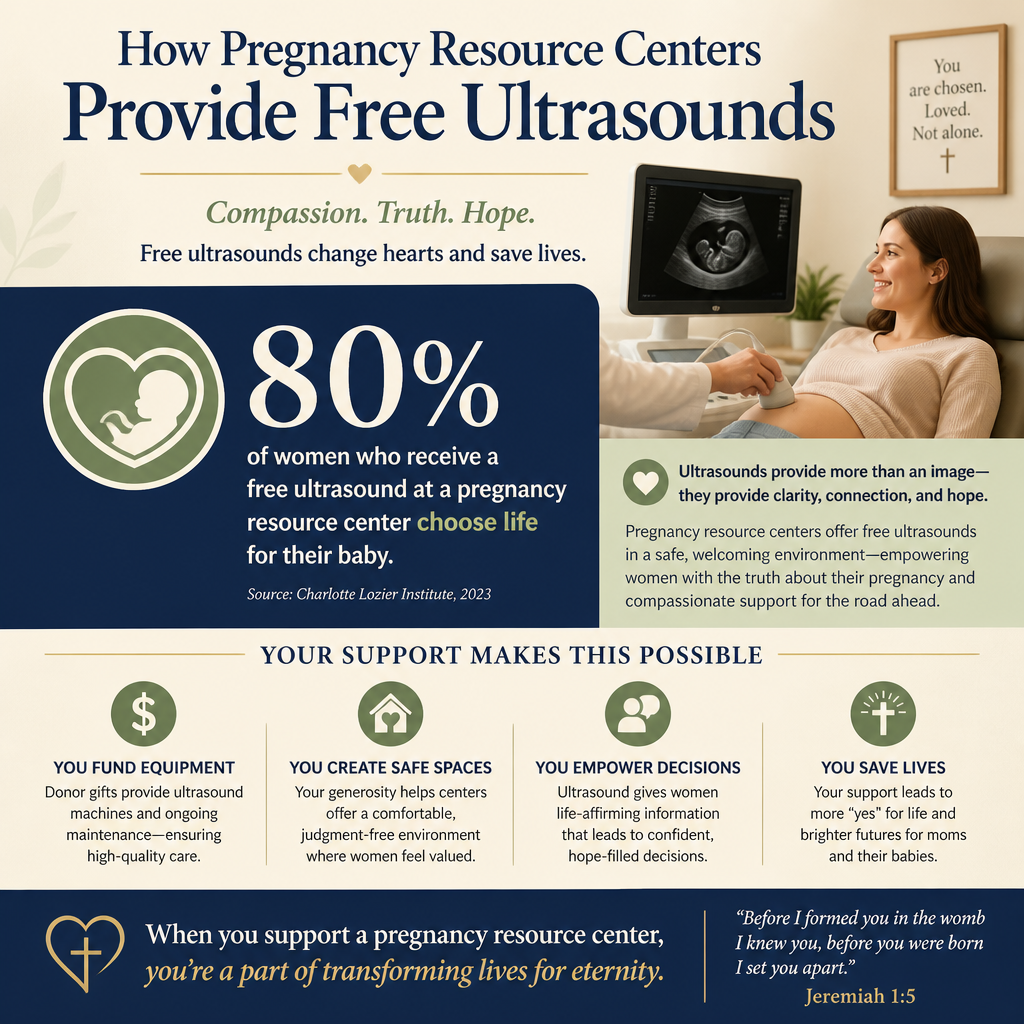
Free ultrasounds are usually funded through a mix of individual donors, church partnerships, and, in some cases, private foundation grants. Equipment is sometimes purchased outright, sometimes financed, and sometimes donated. Consumables, maintenance, training, software, and compliance costs are often less visible but just as real.
Many centers also rely on in-kind support: volunteer medical professionals, pro bono legal counsel, and donated baby supplies. In-kind generosity can be a profound blessing, but it can also create fragility if a program depends on a small number of individuals whose availability changes.
The hidden costs donors should ask about
Ultrasound provision involves ongoing costs that do not show up in a one-time fundraising appeal for a machine. Responsible donors ask whether the center has planned for the full life cycle of the service, including:
- Medical oversight and credentialed staffing appropriate to the state and service scope
- Equipment maintenance, calibration, and software updates
- Client privacy protections and secure recordkeeping
- Training, continuing education, and quality assurance reviews
- Clear referral protocols for medical concerns and emergencies
Sustainability is not a merely financial category. It is a moral category. If a center offers an ultrasound, it assumes a duty to do so competently, consistently, and with safeguards that protect women in vulnerable moments.
Ethical and clinical guardrails that protect both clients and the ministry
Informed consent, privacy, and appropriate claims
High-quality pregnancy resource centers treat informed consent as a matter of Christian integrity, not just legal compliance. Clients should understand what the ultrasound can and cannot tell them, who will perform it, what information will be recorded, and how privacy is protected. In the United States, federal health privacy rules are often discussed as a default standard in healthcare; HIPAA is administered by the U.S. Department of Health and Human Services, which outlines core privacy expectations even as applicability can vary by entity type and circumstance.U.S. Department of Health and Human Services
Centers should also be careful with public-facing language. Donors should be alert to exaggerated promises, vague medical claims, or unclear assertions about “medical care” when the center is not operating as a clinic. Precision in language is part of truthfulness.
Trauma-informed care and the limits of persuasion
Many clients carry prior trauma: sexual coercion, domestic abuse, past abortion, poverty, family instability, or immigration stress. Trauma-informed practice does not require a center to abandon moral conviction. It requires the center to avoid coercion, respect the client’s pace, and communicate in a way that does not weaponize vulnerability.
This is one place where donor expectations can unintentionally pressure ministries. If a center feels compelled to report impact only as immediate “decisions,” it may tilt staff incentives away from patient-centered care. A more mature Christian approach measures faithfulness through truthful processes and long-term accompaniment, not only single-visit outcomes.
Those who want a broader view of how these ministries function in communities can also explore Pregnancy Resource Centers as a category of Christian service and public witness.
What discerning donors should verify before funding ultrasound programs
Verification beyond good intentions
Pregnancy resource centers often attract generous Christians because the cause is morally urgent and personally compelling. Yet urgency is not a substitute for due diligence. The credibility of a center depends on governance, financial stewardship, clinical boundaries, and transparent reporting. The New Testament does not treat stewardship as an administrative afterthought; it treats it as a public matter of integrity. Paul insisted on careful handling of funds not only before the Lord but also “before men” (2 Corinthians 8:20–21), because scandal harms both the vulnerable and the gospel.
Most Trusted exists to help donors give with confidence by evaluating ministries against The Most Trusted Standard, a 15-criteria framework across Faith Foundation, Financial Integrity, Governance and Leadership, and Transparency and Effectiveness. In ultrasound programs, those criteria show up in practical questions: Who provides oversight? How are outcomes reported? Is client dignity protected? Are finances and policies accessible enough to warrant trust?
Concrete signs of strength and signs of concern
Across our verification work, the ministries that meet The Most Trusted Standard tend to demonstrate a stable board, clear written policies, and reporting that is candid about both fruit and limits. They can explain, in plain terms, how ultrasound fits into their mission without turning a medical service into a fundraising spectacle.
Signs that warrant deeper questioning include unclear medical oversight, high staff turnover around clinical services, opaque financial reporting, or communications that imply medical authority without appropriate licensure. Donors should also watch for impact reporting that is overly simplistic. Human crises rarely conform to neat metrics, and pregnancy decisions unfold in complex social realities: housing insecurity, partner pressure, and family systems. The ministry’s seriousness is often revealed by whether it has built partnerships to address those realities rather than treating ultrasound as a stand-alone solution.
For donors focusing specifically on programs that serve mothers and families, Pregnancy Resource Center Programs for Mothers and Families provides helpful context on the wider set of services that often surround ultrasound care.
FAQs for How pregnancy resource centers provide free ultrasounds
Are free ultrasounds at pregnancy resource centers medically reliable?
They can be, but reliability depends on the center’s model and safeguards: appropriate medical oversight, trained personnel, equipment maintenance, and clear service scope. Donors should confirm whether the center operates as a licensed clinic or provides limited services under defined protocols, and whether it has written policies for quality assurance and referral when concerns are identified.
Do pregnancy resource centers use ultrasounds to pressure women?
Centers vary, and public criticism often focuses on whether clients experience manipulation. Responsible centers practice informed consent, communicate fetal development without coercion, and offer support regardless of the client’s eventual decision. Donors should look for evidence of trauma-informed care, transparent client communication, and reporting that does not reduce complex human situations to a single statistic.
A faithful aim for donors who fund free ultrasounds
When pregnancy resource centers provide free ultrasounds with clinical competence and moral seriousness, they offer a rare combination: tangible help, truthful information, and relational presence at a moment when many women feel abandoned. Donor support is most faithful when it funds not only the scan itself, but the accountable systems around it—governance, oversight, privacy, and long-term care—so that compassion is expressed in ways that are worthy of trust.



