
How pregnancy resource centers help after birth is the question that separates momentary crisis response from enduring Christian mercy. The field’s credibility with mothers, churches, and donors is increasingly tied to whether care continues once the baby is home and the cameras are gone.
For Christian donors, this is not only a programmatic issue. It is a discipleship and stewardship question. Scripture consistently pairs the protection of life with the provision of tangible care: “Let us not love in word or talk but in deed and in truth” (1 John 3:18). When support ends at delivery, the church’s witness is narrowed to a single moment rather than the long obedience of love.
After birth is often where the crisis becomes chronic
The pressure points are predictable and measurable
Many mothers describe pregnancy as the season when help is most visible and postpartum as the season when needs become more isolating. Sleep deprivation, anxiety, medical recovery, housing instability, and fractured relationships converge. For donors who have walked with families through crisis, this rings familiar: the most dangerous moment is often not the emergency itself, but the months after when support thins and bills arrive.
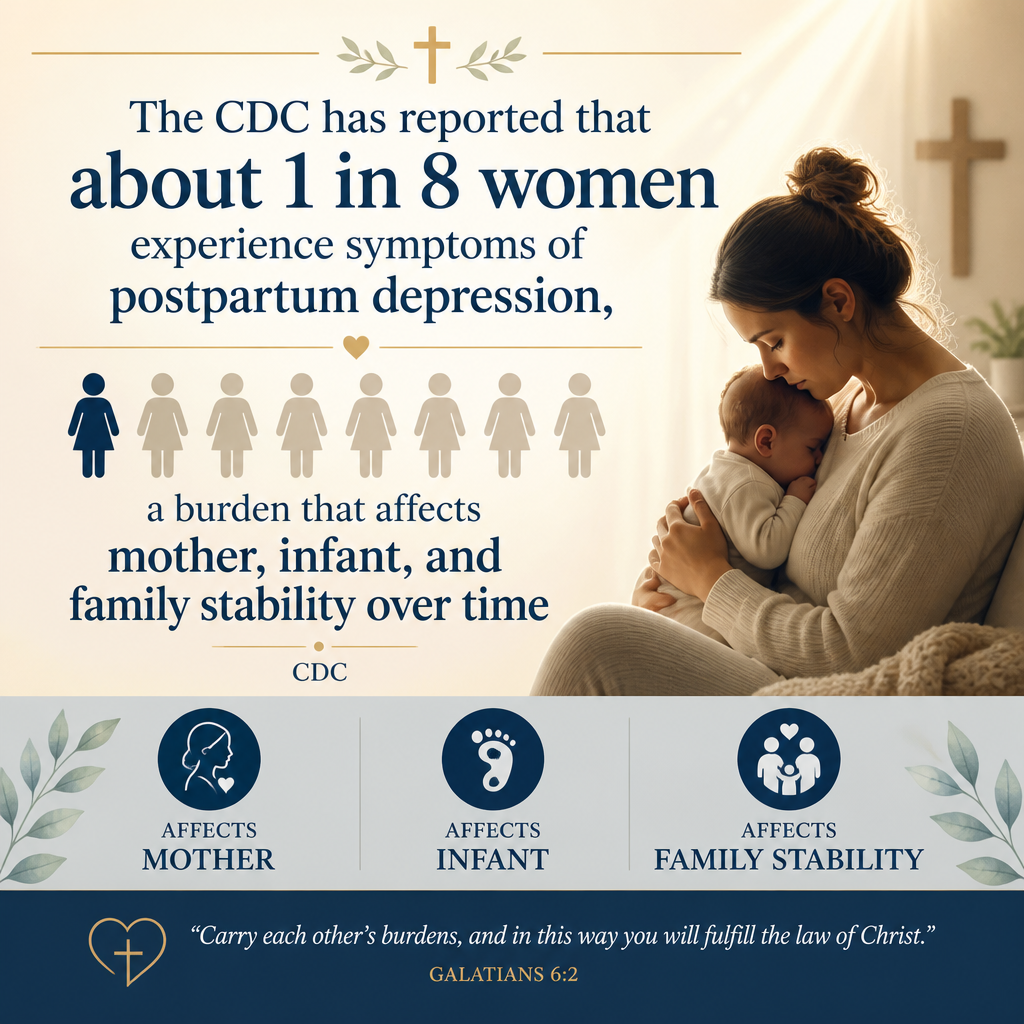
Postpartum mental health is one of the clearest examples. The CDC has reported that about 1 in 8 women experience symptoms of postpartum depression, a burden that affects mother, infant, and family stability over time CDC. Ministries that treat “after birth” as an afterthought will predictably miss one of the most common drivers of relational breakdown, impaired bonding, and spiraling material need.
Poverty, birth, and care systems collide
Donors also need to see the structural reality: postpartum needs are not evenly distributed. Economic fragility, lack of paid leave, and limited access to primary care compound quickly. Pregnancy resource centers rarely have the capacity to replace public systems, and they should not pretend otherwise. But they can be effective at bridging mothers to competent care, stabilizing the first months, and keeping a woman from disappearing into the gaps between institutions.

What faithful, effective postpartum care actually looks like
Material support as dignifying provision
For many centers, postpartum care begins with concrete goods: diapers, wipes, infant clothing, car seats, and safe-sleep supplies. Mature ministries avoid two errors. The first is treating material aid as marketing. The second is treating it as a substitute for deeper support. Material help is often the first rung on the ladder: a tangible expression of compassion that opens trust for ongoing care.
Done well, material support is dignifying rather than transactional. It respects the mother’s agency, acknowledges her constraints, and avoids the humiliating posture of rationing compassion. Christian donors should look for ministries that are clear about eligibility, consistent in distribution, and careful about safety standards for items like car seats and cribs.
Education that is practical, relational, and accountable
Most centers offer some form of parenting education. The more serious question is what kind. Evidence-informed curricula can help mothers learn feeding, safe sleep, infant development, and coping skills, but the real differentiator is relationship: who is walking with her when the baby will not stop crying at 2 a.m., when breastfeeding fails, or when the father’s presence is inconsistent.
Many centers use mentoring models because they fit a Christian anthropology: people are not problems to be managed but image-bearers to be known. Mentoring can also go wrong if volunteers are undertrained or boundaries are unclear. Donors should expect to see screening, training, supervision, and referral protocols for issues beyond volunteer competence.
The most credible centers build a continuum, not a handoff
From pregnancy decision to postpartum stability
Pregnancy resource center work is often discussed as if it ends with a pregnancy test, an ultrasound, or a birth. In reality, the healthiest ministries operate with a continuum in mind: pregnancy support, birth preparation, postpartum coaching, and longer-term stabilization through referrals and partnerships. This is where the category of Pregnancy Resource Center Programs for Mothers and Families matters for donors. Postpartum care is not a niche add-on; it is the necessary continuation of the center’s stated purpose.
What this means in practice is that postpartum services are planned, staffed, and funded rather than improvised. A center that treats after-birth care as optional will tend to fund it with leftover dollars and volunteer gaps. A center that treats it as integral will be able to name outcomes, partnership pathways, and the limits of what it can responsibly promise.
Relationships that account for fathers and families
After birth, mothers rarely experience needs in isolation. Some are navigating co-parenting, conflict, or abandonment. Others are supported by extended family but lack stable income. Still others are recovering from abuse and need safety planning. The field has had to reckon with the reality that “supporting mothers” is often inseparable from addressing the broader family system.
Many pregnancy resource centers provide fatherhood classes, co-parenting coaching, or referrals to counseling. Not every center will be equipped for this work. But donors can reasonably expect a thoughtful posture: neither ignoring fathers nor placing responsibility for a mother’s wellbeing on her ability to secure a stable relationship.
Common tensions donors should name rather than avoid
Measuring outcomes without reducing people to metrics
Christians genuinely disagree about how much quantification is appropriate in relational ministry. Some fear that metrics commodify compassion. Others recognize that without evidence, ministries can drift into activity without impact. Wisdom requires both: a refusal to treat people as data points and a refusal to treat good intentions as proof.
One baseline for donors is clarity about what the ministry is claiming. Is it claiming to reduce repeat unintended pregnancies, improve parenting competence, increase stable housing, or simply provide short-term support? Each claim implies different evidence. For those who want a deeper view of the sector’s scope and variation, we track patterns across Pregnancy Resource Centers as part of our wider research and verification work at Most Trusted.
Partnership with medical and public systems
Another tension is how centers relate to healthcare and social services. A pregnancy resource center is not a hospital, and it should not perform as one. Yet postpartum care often requires medical screening, lactation support, or mental health intervention beyond a center’s staff capacity. The most credible ministries cultivate partnerships with local clinics, WIC offices, churches, and licensed counselors, and they are candid about when referral is the responsible choice.
Donors should pay attention to whether a center’s messaging implies it can meet every need internally. That posture is rarely sustainable and can be unsafe. The goal is not institutional self-sufficiency. The goal is a functioning local ecosystem that makes abandonment less likely for mother and child.
How donors can evaluate postpartum impact with confidence
What to look for under The Most Trusted Standard
At Most Trusted, we evaluate ministries against The Most Trusted Standard, a 15-criteria framework that examines faith foundation, financial integrity, governance and leadership, and transparency and effectiveness. Postpartum care is one of the places where these areas converge: the theology of human dignity meets the administrative reality of budgets, staff, risk, and accountability.
In practical terms, donors can ask for a small number of concrete signals that a center is serious about after-birth care:
- Clear postpartum offerings with defined timelines (for example, first 12 months) and eligibility that avoids arbitrary gatekeeping.
- Volunteer screening and training appropriate to the level of contact with mothers and infants.
- Referral protocols for postpartum depression, domestic violence, substance use, and medical complications.
- Financial clarity showing how material aid, education, and mentoring are funded and tracked.
- Outcome reporting that is modest in claims but specific in evidence, paired with stories that respect privacy and consent.
Why overhead ratios are the wrong question
Some donors still evaluate pregnancy resource centers primarily by how “low overhead” appears. The nonprofit sector has worked to correct this assumption for more than a decade. In 2013, Charity Navigator, GuideStar, and the BBB Wise Giving Alliance jointly warned donors against using overhead as the primary measure of a charity’s worth, urging attention to results, transparency, and governance Charity Navigator. Postpartum care is a clear example: competent mentoring programs, secure client data practices, and appropriate staff oversight cost money. Underfunding administration can produce preventable harm.
Christian stewardship is not a hunt for the cheapest compassion. It is a pursuit of faithful, competent care with integrity. Donors can be rightly cautious about bloated spending, but caution should be tethered to mission delivery rather than simplistic ratios.
FAQs for How pregnancy resource centers help after birth
Do pregnancy resource centers usually provide help after the baby is born?
Many do, but the scope varies significantly. Some centers focus primarily on pregnancy confirmation and options counseling, while others maintain structured postpartum programs that include material aid, parenting education, mentoring, and referrals. Donors should verify what a specific center offers, how long support typically continues, and whether staff and volunteer capacity match the stated commitments.
What kind of postpartum support is most urgent for donors to fund?
Urgency depends on local gaps, but donors often see high impact in four areas: consistent diaper and safe-sleep support, trained mentoring relationships, referral pathways for postpartum depression and trauma, and the operational capacity required to deliver care safely. Funding that strengthens supervision, training, and partnerships often multiplies the effectiveness of direct aid rather than competing with it.
A pro-life witness that remains present
Pregnancy resource centers help after birth when they remain present for the slow work of stabilization, not only the decisive moment of birth. Christian donors are right to care about both compassion and credibility. The public disputes around this ministry category will not be resolved by slogans, but they can be answered by verifiable care that is sustained, accountable, and rooted in the conviction that mother and child bear God’s image.
The work is demanding, sometimes costly, and never reducible to a single metric. Yet it is also one of the clearest opportunities for the church’s generosity to take institutional form: love expressed in truth, shaped by wisdom, and stewarded with integrity.



