

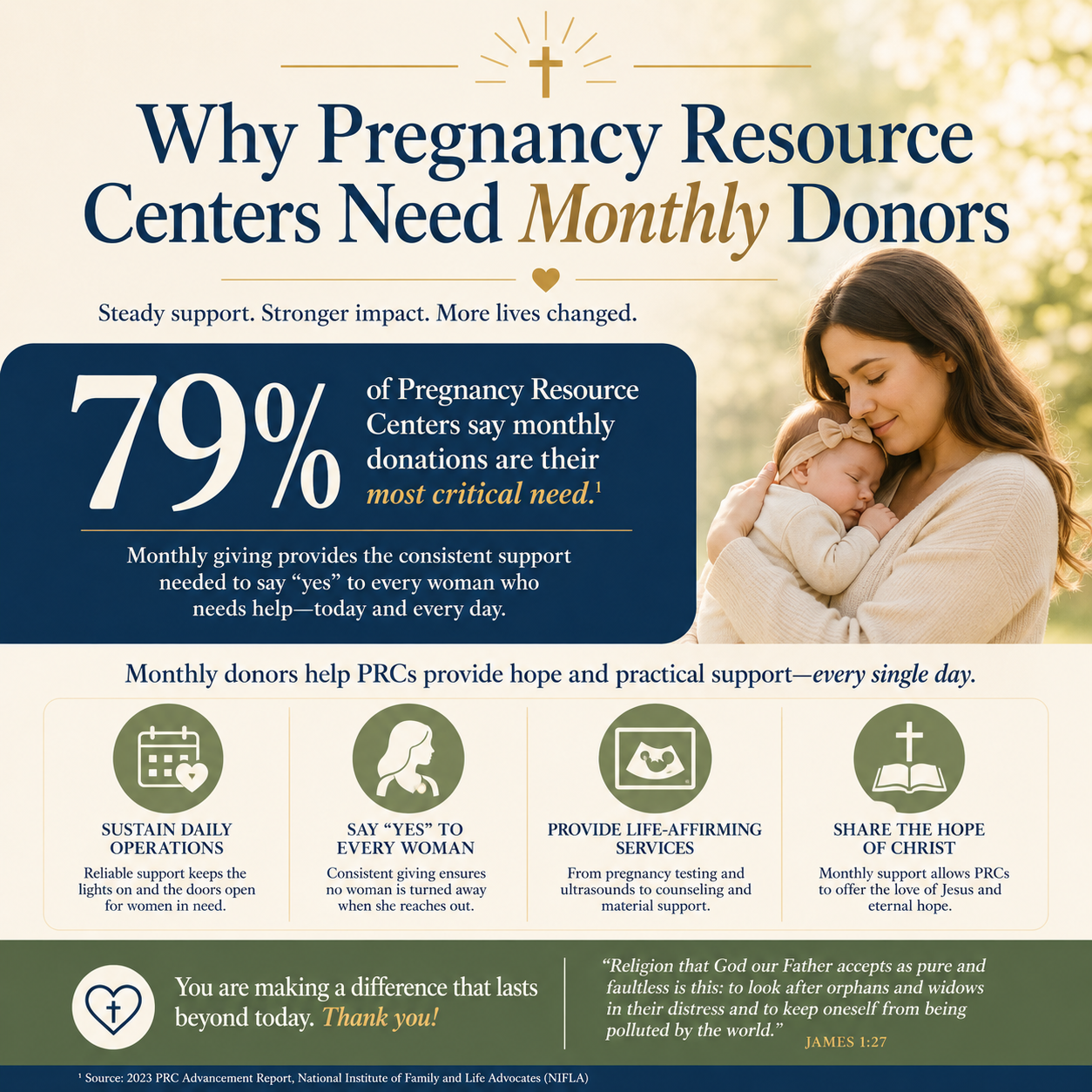
Pregnancy resource centers need monthly donors because the work is not episodic. A single ultrasound appointment, a bag of diapers, or a one-time gift does not carry a woman through the medical, relational, economic, and spiritual pressures that often surround an unexpected pregnancy. Most centers are trying to provide steady presence, competent care, and ethical advocacy over months and sometimes years.
Christian donors often ask whether monthly giving is merely a fundraising preference. It is not. Monthly support is a form of shared endurance: it stabilizes staffing, safeguards client care from financial whiplash, and reduces the temptation to chase short-term revenue at the expense of wise ministry. Scripture’s vision of steadfast love is not sentiment; it is covenantal constancy. Ministries built on that pattern require a funding base that can sustain it.
Monthly giving aligns with the actual timeline of care
Client needs rarely resolve in a single visit
Many centers serve women who are weighing pregnancy decisions under time pressure, fear, and conflicting counsel. Even where a woman chooses life early, the practical burdens do not evaporate: prenatal care, transportation, housing instability, job insecurity, family conflict, and relationship dynamics often intensify. A responsible center does not treat “choice” as the finish line; it treats it as the beginning of a longer path of support.
Monthly donors make that longer path possible. A center can plan for follow-up coaching, parenting classes, material assistance tied to participation, and referrals that require consistent staff time. When giving is primarily one-time and seasonal, leadership is forced into triage: serve whoever arrives today with whatever is on hand, rather than building a coherent care plan that respects human dignity.
Steadiness protects against ministry built on urgency
Pregnancy resource center work is emotionally charged by nature. That reality can tempt both ministries and donors toward a crisis-only posture: respond when a story is shocking, a lawsuit emerges, or a public controversy spikes attention. Yet Christian mercy is not meant to run only on adrenaline. Paul’s exhortation not to “grow weary of doing good” assumes that good often feels repetitive and costly (Galatians 6:9).
Monthly giving reduces the need to constantly generate urgency. It does not remove the need for thoughtful appeals, but it changes the emotional economy of the ministry. The healthiest centers tend to communicate with clarity rather than pressure, because their core operating needs are not dependent on the latest viral moment.

Reliable revenue strengthens ethical service and reduces perverse incentives
Program decisions are cleaner when the budget is not fragile
When cash flow is unstable, even well-intentioned leaders can drift into decisions that are shaped more by fundraising than by client care. Centers can feel pressure to over-promise outcomes, to inflate program counts, or to pursue highly visible services that photograph well but do not address deeper needs. Donors may not see these pressures, but front-line staff do.
Monthly donors help prevent those distortions. Predictable support allows a center to fund core services that are less dramatic but more formative: trained client advocates, medical oversight where medical services are offered, and partnerships with churches and social service agencies that require consistent coordination. Ethical ministry is rarely cheap, and it is almost never compatible with volatility.
Respect for clients includes respect for professional standards
Christians genuinely disagree about how pregnancy resource centers should balance evangelism, medical services, and social support. The field has had to reckon with legitimate questions about informed consent, advertising, medical supervision, and data privacy. These are not peripheral matters; they go to truthfulness and neighbor-love.
Stable funding makes it more feasible to invest in staff training, compliance counsel, secure record systems, and appropriate clinical protocols. When donors prefer only restricted gifts for visible items, centers can be left under-resourced in precisely the areas that protect clients and honor the name of Christ. Monthly giving is one of the simplest ways donors can fund the unglamorous but essential work of integrity.
Monthly donors underwrite the less visible costs that keep doors open
Operations are part of ministry, not an embarrassment
Christian donors sometimes assume that “administration” is a necessary evil rather than part of faithful stewardship. Yet Scripture’s concern is not that ministry has overhead; it is that ministry is honest, accountable, and directed toward righteous ends. Modern nonprofit work requires rent, insurance, technology, background checks, governance processes, and financial controls. These costs do not compete with mission; they enable it.
Most centers are not large institutions with extensive reserves. They are local ministries operating in a contested public environment. That combination makes them unusually vulnerable to funding swings. Monthly donors provide a baseline that keeps staffing stable and avoids the recurring cycle of layoffs and rehiring, which damages both care quality and organizational culture.
Public giving patterns are more volatile than many donors realize
American generosity moves with economic confidence and media attention. During the COVID-19 pandemic, U.S. charitable giving increased in 2020 even while volatility rose in many local economies, a reminder that headline numbers can mask uneven impact across organizations and communities (Giving USA). In practice, smaller local ministries can see dramatic month-to-month shifts even when national giving appears steady.
Monthly giving is a countermeasure to volatility. It does not eliminate financial risk, but it reduces dependence on seasonal spikes and year-end surges. For a center deciding whether it can keep a nurse on staff, maintain an office lease, or expand appointment availability, that predictability is often decisive.
- Keeping staff hours consistent so appointment availability does not collapse mid-year
- Funding client follow-up and mentoring, not only intake services
- Maintaining appropriate insurance, security, and facility readiness
- Supporting training and supervision that protect clients and staff
- Reducing pressure to run constant high-intensity fundraising campaigns
Monthly donors make better governance and clearer reporting more realistic
Accountability requires systems, and systems require funding
Donors rightly ask for evidence of faithfulness and effectiveness. Yet meaningful transparency is work. Financial statements must be prepared and reviewed. Boards must meet, document decisions, manage conflicts of interest, and ensure appropriate policies. Client outcomes must be tracked with care, especially when confidentiality is involved.
Across our verification work at Most Trusted, we observe that ministries able to maintain stable unrestricted support are more likely to invest in the kind of disciplined governance that withstands scrutiny. This is one reason we evaluate organizations against The Most Trusted Standard, a 15-criteria framework spanning Faith Foundation, Financial Integrity, Governance and Leadership, and Transparency and Effectiveness. The point is not perfection; it is verifiable evidence of stewardship.
Donors should ask for clarity, not spectacle
A mature donor does not need a ministry to present itself as flawless. Pregnancy resource centers operate at the intersection of medicine, pastoral care, and public controversy. Some are targets of misinformation; others have made real mistakes and had to rebuild trust. What donors should require is clarity: clear mission, clear services offered, clear boundaries, and clear financial reporting.
Monthly giving strengthens a center’s ability to communicate with that kind of clarity. It reduces dependence on emotional appeals and increases the capacity for honest reporting. If donors want transparent ministries, the funding model must allow ministries to do transparency well.
Many donors begin their evaluation by understanding the broader ecosystem of Pregnancy Resource Centers and how these ministries differ in services, oversight, and theological posture. That context helps monthly giving become more than a reflex; it becomes a deliberate commitment to a specific kind of care.
Monthly donors model a distinctly Christian form of stewardship
Faithful giving is formed over time
Christian stewardship is not primarily a transaction. It is a habit of the heart ordered toward the Kingdom of God. The New Testament pattern of regular provision for ministry and for the poor assumes planning and consistency, not only spontaneity. Paul’s instructions for setting aside funds on the first day of every week reflect a disciplined approach to generosity (1 Corinthians 16:2).
Monthly giving mirrors that discipline. It allows donors to support life-affirming ministry without waiting for a crisis to stir compassion. It also helps donors resist the false spirituality of only giving when it feels dramatic. In an attention economy that monetizes outrage, steady generosity is a quiet form of resistance.
Monthly donors help centers stay local and church-connected
Pregnancy resource centers are often most effective when they remain anchored in local relationships: churches, medical providers, social workers, housing ministries, and employers willing to hire and mentor. Those partnerships are built over time. They depend on credibility and consistency, and they cannot be maintained if the center is constantly contracting and expanding with funding swings.
Donors who want their giving to strengthen local Christian witness should consider whether their pattern of giving helps or hinders that stability. Many centers describe their most reliable support as a broad base of modest monthly gifts rather than a handful of large annual checks. Both forms of generosity are honorable, but monthly giving often does more to stabilize the work.
For donors who want to understand the practical realities of funding models, restrictions, and reporting, our coverage of How Pregnancy Resource Centers Use Donations addresses common questions that arise when donors move from sympathy to serious stewardship.
FAQs for Why pregnancy resource centers need monthly donors
Is monthly giving better than a large one-time gift?
Not inherently. One-time gifts can fund capital needs, technology upgrades, facility repairs, or a time-limited expansion. The concern is not the size of the gift but the stability of the funding base. Monthly giving tends to underwrite staffing and ongoing care, which are difficult to fund through episodic generosity. Many donors find a wise pattern is both: a sustainable monthly commitment paired with occasional additional gifts for specific needs.
How can we evaluate whether a pregnancy resource center is worthy of monthly support?
We recommend looking for clear disclosure of services, appropriate oversight for any medical services offered, documented governance practices, accessible financial reporting, and truthful communication that avoids manipulation. Donors should also assess theological clarity and whether the ministry’s approach to clients reflects dignity, informed consent, and neighbor-love. Independent verification can help donors move from trust-by-association to trust grounded in evidence, which is part of why Most Trusted assesses ministries against The Most Trusted Standard.
A steadier form of partnership
Pregnancy resource centers need monthly donors because faithful care is sustained care. The ministry is most credible when it is not forced into constant financial urgency, and the client is best served when support remains consistent after the appointment ends. Monthly giving is not merely a convenience; it is a way of sharing responsibility for a work that requires patience, integrity, and endurance.



