

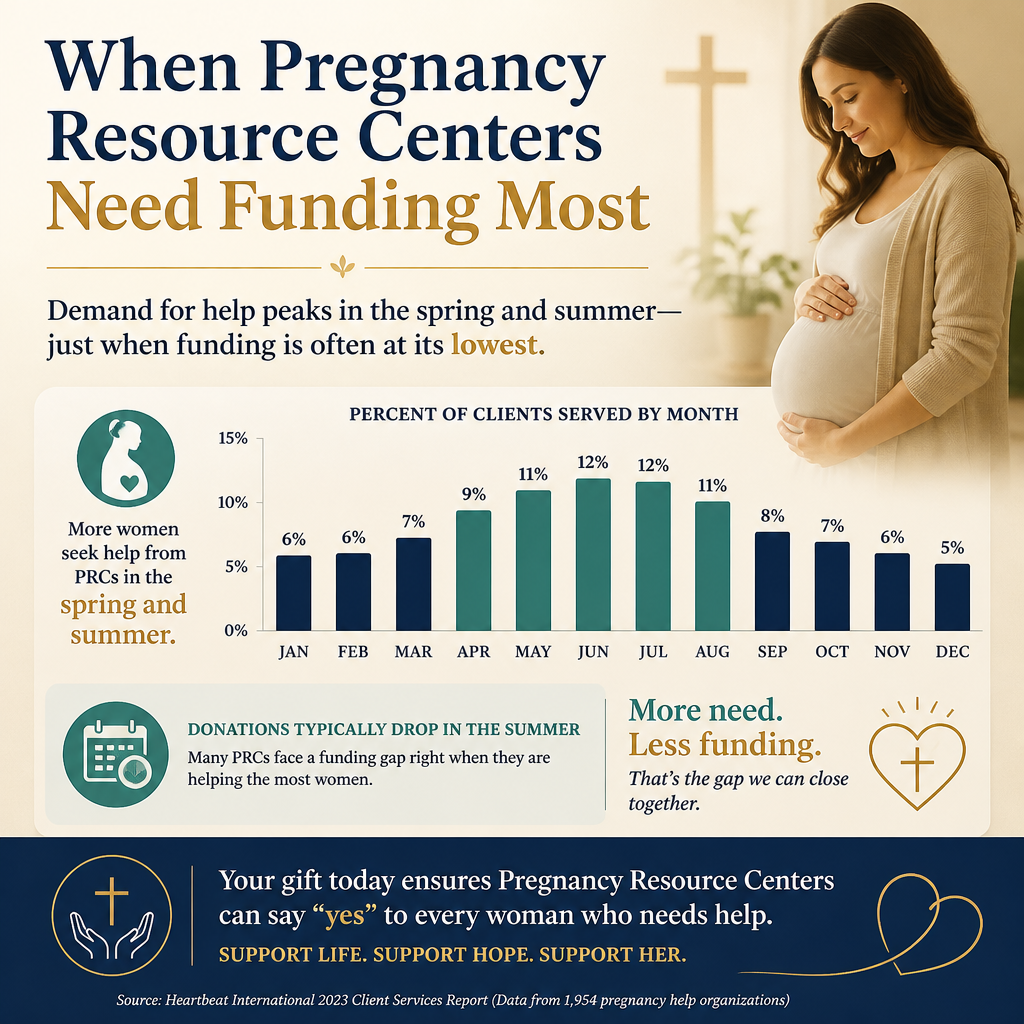
When pregnancy resource centers need funding most is rarely when the public spotlight is brightest. It is when a center is quietly carrying an ordinary caseload of women and families who need time, consistent care, and practical stability rather than a single dramatic intervention.
For Christian donors, the question is not whether these ministries matter. The question is how to give in a way that strengthens faithful presence over time, resists reactive giving patterns, and supports work that is both compassionate and accountable. Across Pregnancy Resource Centers, we see that the strongest ministries plan for predictable pressures and build financial resilience that protects clients from disruption.
Funding pressure follows a calendar, not a headline cycle
Most pregnancy resource centers operate with rhythms that are as practical as they are spiritual: rent and payroll are due every month; material aid is replenished continually; ultrasounds, parenting education, and follow-up care require trained staff and reliable hours. The need is steady, even when donor attention is not.
Year end generosity can create a first quarter gap
Many ministries receive a meaningful share of contributions in November and December, then face a quieter first quarter when budgets still require full staffing. This is a common dynamic in charitable giving broadly. The National Philanthropic Trust notes that charitable giving in the United States often concentrates at year end, creating cash-flow challenges for organizations that serve people year-round National Philanthropic Trust.
What this means in practice is that a center can appear “healthy” in December and constrained in February, even if demand for services has not changed. Mature donors treat year-end gifts as a beginning, not an ending, by pairing a significant gift with sustained support that stabilizes the ministry across the full year.
Summer and back to school seasons test material aid
Centers that provide diapers, wipes, car seats, formula support, and baby clothing often see increased strain at predictable moments: summer when family schedules and expenses shift, and late summer into early fall when school-related costs rise. Many centers are also resourcing mothers with older children, not only infants, which can expand the scope of need.
We should name a tension clearly: donors sometimes assume material aid is the center’s primary work and therefore the easiest to fund through in-kind drives. In practice, in-kind giving can be highly valuable, but it also carries sorting, storage, and distribution costs that are real operational burdens. When donors pair in-kind drives with unrestricted support, they are funding the full ministry rather than only its most visible outputs.

Staffing and compliance are the hidden budget lines that keep doors open
Pregnancy resource centers are often evaluated by what happens in a single appointment. Yet the capacity to offer that appointment depends on staffing, training, and compliance responsibilities that do not feel “programmatic” but are essential to faithful service and risk management.
Clinical services require credentialed oversight and consistent training
Centers offering medical services such as limited ultrasounds typically require qualified medical direction and ongoing training, along with clear policies. Those costs do not rise and fall neatly with appointment volume; they exist to protect client safety and maintain appropriate standards of care.
Donors sometimes prefer funding “direct services” and hesitate to support professional development or supervision. But Christian charity has never been indifferent to prudence. Wisdom literature assumes that good intentions must be disciplined by sound practice. When a center budgets for training and clinical oversight, it is usually demonstrating seriousness about serving women well.
Security and facilities costs have become unavoidable for many centers
Some pregnancy resource centers have faced protests, vandalism, or threats, and have needed to budget for security measures, repairs, or legal counsel. We should avoid overstating uniform risk across all communities; many centers operate with minimal security concerns. But the trend toward needing some level of security planning is real enough that donors should not treat it as optional overhead.
When donors insist that every dollar must be visibly “client facing,” ministries can be pushed into underinvesting in basic protections. A secure, well-managed facility is part of hospitality, not a distraction from it.
Demand spikes are often local and sudden
Unlike large national organizations, many pregnancy resource centers are deeply local. Their demand can shift quickly based on changes in nearby healthcare availability, housing instability, employer layoffs, or the closure of another service provider. These spikes are rarely visible outside the community.
Local service disruptions can redirect clients overnight
When a neighboring clinic closes, when a county agency changes eligibility rules, or when another nonprofit reduces hours, pregnancy resource centers may see an immediate increase in calls and walk-ins. A donor scanning national news may miss the local reality that has changed staffing needs, scheduling capacity, and material aid demand within a week.
This is one reason we recommend that serious donors prioritize ministries that can show clear operational readiness: documented policies, a realistic budget, and reserves appropriate to their scale. At Most Trusted, our verification work evaluates these kinds of signals through The Most Trusted Standard, because love of neighbor should not require financial fragility.
Economic stress amplifies vulnerability in pregnancy and parenting
Inflation and housing costs affect everyone, but they press especially hard on mothers already making decisions under pressure. The U.S. Bureau of Labor Statistics tracks price levels through the Consumer Price Index, which has documented significant inflation over recent years U.S. Bureau of Labor Statistics. For a center, this can translate into higher operating expenses at the same time that clients need more practical support.
Christians genuinely disagree about the best policy solutions to economic strain. But there is little disagreement that the Church is called to tangible mercy. When a center’s grocery-gift program, diaper pantry, or parenting class fills more quickly than usual, it is often a local indicator of broader economic pressure.
Restricted gifts can unintentionally create fragile ministries
Most donors want their giving to matter in measurable ways, and restrictions can be an appropriate tool. The risk is that heavy restriction can leave a center with well-funded program lines but underfunded capacity to deliver them consistently. The result can be staff burnout, inconsistent hours, and reduced follow-up care precisely when continuity matters most.
Unrestricted support often protects follow-up care
Centers often describe the most meaningful work as what happens after the first appointment: parenting education over months, mentorship relationships, referrals to housing or healthcare, and continued material support as a mother stabilizes. These are relational commitments, not one-time transactions.
When donors fund only the initial visit or a single material purchase, they can unintentionally reinforce a short-term model. Unrestricted gifts, or flexible program gifts with broad allowable use, are often what enable a center to keep promises to clients.
A practical way to strengthen a center without guessing at needs
We have found that many mature donors want to help a center meet its greatest needs without becoming de facto managers. A small set of giving practices tends to be both respectful and effective:
- Provide a monthly gift that covers a predictable operational cost, such as a portion of rent or a staff hour block.
- Pair any restricted gift with a smaller unrestricted gift to support delivery and administration.
- Ask whether the center has a board-approved reserve policy and whether it is following it.
- Fund staff training and volunteer management when a center can name specific goals and safeguards.
- Support security and facilities improvements when they are tied to a documented risk assessment.
These practices are not about distrust. They are about the stewardship realism Scripture requires. Jesus commends wisdom that counts the cost, because discipleship includes responsibility for outcomes as well as intentions.
Verification helps donors fund the moments that are hardest to see
The hardest funding moments to identify are often the most important: the month a key staff member leaves and must be replaced; the quarter when donor receipts dip but client appointments do not; the season when compliance requirements increase; the year when leadership transitions demand careful governance.
What stronger ministries tend to have in common
Across our evaluations, the ministries that meet The Most Trusted Standard tend to show a consistent pattern: clear faith commitments, disciplined financial practices, credible governance, and transparent reporting. Those qualities do not eliminate hardship, but they reduce the likelihood that a short-term funding gap becomes a service interruption for a woman who has already experienced instability.
Donors also benefit from acknowledging a second tension: in this field, public controversy can make it difficult to assess claims. Verification does not ask donors to ignore controversy; it helps donors distinguish between ministries that can substantiate their work and those that cannot.
Giving that matches how centers actually operate
If donors want to fund a center when it needs funding most, they will often need to give against the emotional grain: not only when a campaign is compelling, but when operational resilience is being built. That kind of giving aligns with the Christian conviction that faithfulness is measured over time. The parable of the talents is not a celebration of impulsive generosity; it is a call to careful stewardship and accountable fruitfulness.
For donors seeking a clearer view of how gifts become services, staffing, and long-term care, our reporting across How Pregnancy Resource Centers Use Donations is designed to make those realities more legible and more verifiable.
FAQs for When pregnancy resource centers need funding most
Is it better to give monthly or as a one-time gift?
Monthly giving is often the most stabilizing form of support because it aligns with recurring expenses like payroll, rent, utilities, and ongoing client care. One-time gifts still matter, especially for equipment, facility improvements, or building an appropriate reserve, but many centers experience their sharpest strain when predictable costs meet unpredictable giving.
Should donors restrict gifts to ultrasounds or material aid?
Restricted gifts can be appropriate when the center has clear budgets, documented policies, and the capacity to deliver the funded service responsibly. However, a heavily restricted giving profile can weaken a ministry by leaving essential capacity underfunded. Many sophisticated donors pair a restricted gift with flexible support so the center can sustain staffing, training, follow-up care, and basic operations.
Funding the faithful work between the crises
Pregnancy resource centers most need funding in the ordinary stretches of the year when the work is steady, private, and relational. This is the funding that keeps doors open, staff trained, follow-up care consistent, and women served with dignity rather than interruption. Christian donors who give with that long view are not only responding to need; they are strengthening a ministry’s capacity to keep faith with the people it serves.



