
What financial reports pregnancy resource centers should share is not a public-relations question. It is a stewardship question, because Christian donors are not merely purchasing outcomes; we are entrusting resources that belong to the Lord. Scripture treats the handling of money as a spiritual matter with public consequences, and ministries that ask for support should expect to be known by the light (Luke 8:17).
Pregnancy resource centers operate under unusual pressures. They serve women in crisis, hold deeply contested moral convictions in public, and often depend on a donor base that expects both compassion and credibility. The right financial reporting does not eliminate controversy, but it does make faithful support possible. Transparency is one of the few gifts a ministry can offer to friends and critics alike: verifiable evidence that its work is orderly, lawful, and accountable.
Financial reporting is discipleship in stewardship
Christian giving is not sentimental. It is a concrete act of obedience that assumes ministries will handle funds with integrity and prudence. When Paul organized the collection for Jerusalem, he took visible precautions “so that no one should blame us about this generous gift” (2 Corinthians 8:20–21). The impulse is not distrust; it is love for the gospel’s reputation and protection for the church.
Financial reporting is also about moral clarity. Centers routinely promise donors that they will offer practical support without coercion, provide medically accurate information, and treat clients with dignity. Those promises carry costs—trained staff, compliant facilities, secure data systems, and careful oversight. Good reports show whether a center’s financial choices align with its stated mission.
What donors are actually trying to discern
Most donors are not looking for perfection; we are looking for patterns. Is the ministry solvent? Is it candid about constraints? Does its leadership submit to meaningful oversight? Does it avoid the temptation to hide behind spiritual language when basic accounting questions arise? The ministries that meet The Most Trusted Standard tend to treat financial reporting as an extension of pastoral care: an honest accounting offered to the community that sustains the work.
A note on overhead and faithfulness
Christians genuinely disagree about what “good stewardship” looks like in a budget line by line. Some donors distrust administrative spending. Others have seen how underinvesting in finance, HR, and compliance creates hidden risks that eventually harm clients and staff. The sector has had to reckon with the “overhead” fixation, and major charity evaluators have argued that overhead ratios alone are a poor measure of effectiveness, as reflected in the Overhead Myth letter endorsed by Charity Navigator, Candid, and BBB Wise Giving Alliance (Charity Navigator).

The baseline reports every center should publish
Donors should not have to request basic documents that clarify where money came from, how it was used, and whether the organization can sustain its commitments. For many pregnancy resource centers, the simplest and most credible practice is to post these reports directly on their website, updated annually and easy to locate.
Form 990 or a functional equivalent
If the center is a U.S. 501(c)(3) required to file an IRS Form 990, it should make the most recent 990 available and easy to find. The 990 provides standardized visibility into revenue sources, expenses, compensation, governance practices, and related-party transactions. It is also a document donors can compare across organizations.
Churches and some church-affiliated entities are exempt from filing a 990. That exemption is legal, but it does not eliminate the donor’s need for clarity. In those cases, we recommend a “990-equivalent” package: audited or reviewed financial statements (as feasible), a detailed annual report, and a clear governance disclosure. The IRS describes the Form 990’s role in exempt-organization transparency and compliance (Internal Revenue Service).
Annual financial statements with functional expense detail
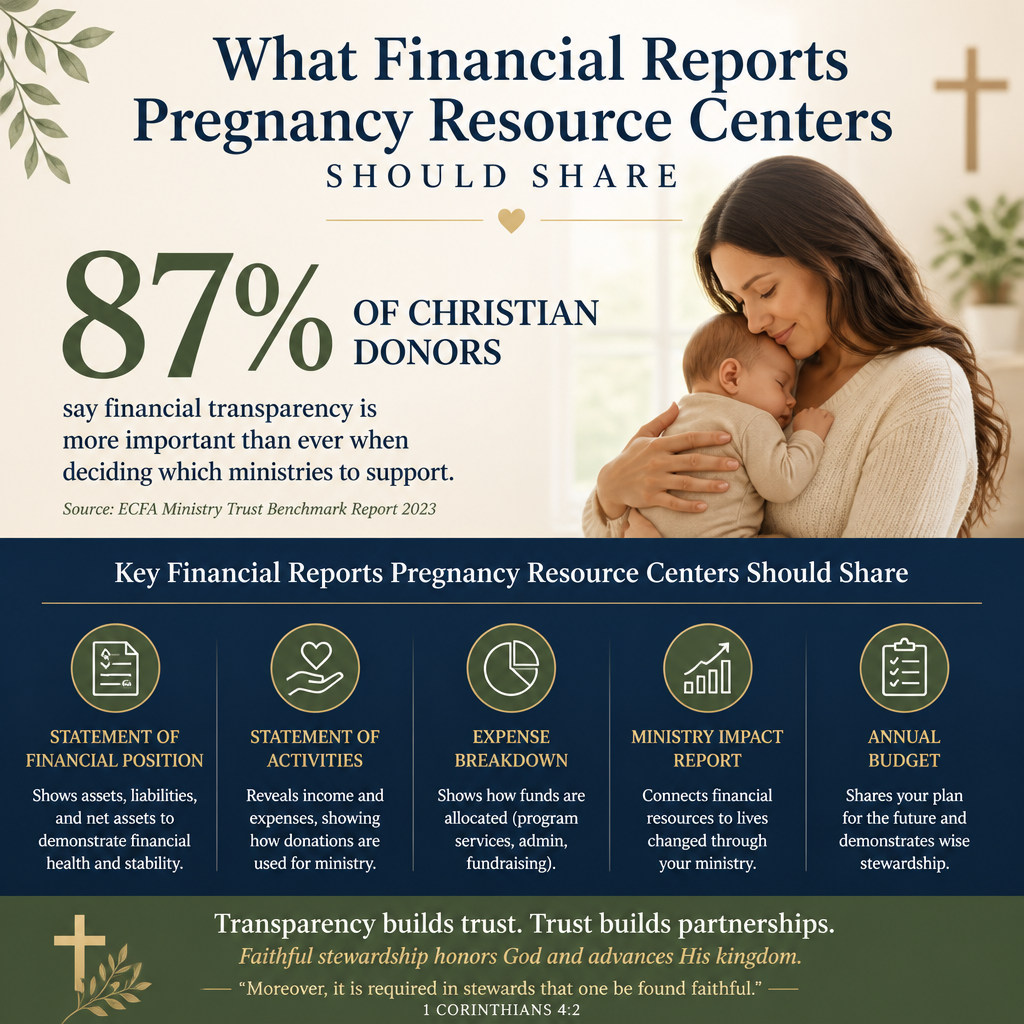
At minimum, a center should share annual financial statements that include:
- Statement of financial position with cash, reserves, and liabilities
- Statement of activities with revenue by major category and expenses by function
- Notes that explain material items, restrictions, and unusual events
- A clear explanation of how the center defines program, administrative, and fundraising expenses
Functional expense reporting is especially important for centers whose work spans multiple services—limited ultrasound, parenting education, material assistance, sexual risk avoidance education, or post-abortion support. Donors can support a center even when they differ on strategy, but only if the center is clear about what it actually funds.
Assurance and oversight donors should look for
Transparency is not merely the presence of documents. It is the presence of credible checks on the organization’s own self-reporting. The question is whether a center has built structures that make it difficult for anyone—no matter how sincere—to misuse funds without detection.
Audit, review, or compilation and why the difference matters
Not every center can afford a full independent audit, and donors should not demand a standard that forces smaller ministries to choose between financial assurance and client services. But the center should be candid about what level of external assurance it has obtained. In general terms:
Audit provides the highest level of assurance and includes testing and an auditor’s opinion. Review provides limited assurance based on inquiry and analytical procedures. Compilation assembles financial statements without providing assurance.
Where budgets allow, we recommend an independent audit conducted by a qualified CPA firm, with the audit report posted publicly. Where budgets do not allow, a review is often a meaningful step above internal statements alone, especially when paired with strong board oversight.
Board-level financial governance disclosures
Pregnancy resource centers are often relationally funded, which can tempt boards to treat donors as friends who should not ask hard questions. Mature governance welcomes those questions. We recommend that centers disclose, in plain language:
Who approves the budget, how often the board receives financial reports, whether there is a finance committee, and whether any leaders have related-party transactions. If the center has adopted conflict-of-interest and whistleblower policies, it should say so and describe how they are enforced. These are not bureaucratic niceties; they are protections for clients, staff, donors, and the witness of the church.
For donors who want a broader view of how these practices fit within a credible accountability posture, our coverage of Accountability and Transparency in Pregnancy Resource Centers names the governance and disclosure patterns that consistently correlate with integrity over time.
Reporting revenue sources and restrictions without exposing clients
Centers should be transparent without being reckless. Donors have legitimate questions about dependence on single sources of income, the presence of government funds, and the degree to which gifts are restricted to particular uses. Clients, by contrast, have a right to confidentiality that should not be compromised by reporting.
Revenue concentration and sustainability
A credible financial report should disclose whether the center is heavily dependent on a small number of donors, a single church, or a limited set of fundraising events. This is not a call to shame dependence; it is a call to acknowledge risk. Centers that conceal fragility often end up making hurried program cuts that destabilize staff and interrupt care.
We recommend reporting revenue in major categories (individual giving, church support, foundations, events, in-kind donations, government grants if applicable) and disclosing material concentrations. A donor can respond with constructive support—multi-year commitments, capacity funding, introductions to aligned churches—when the risk is honestly named.
Restricted giving and program integrity
Many donors want gifts to support a specific service, such as ultrasound capacity, parenting classes, or material assistance. Restricted giving can serve mission clarity, but it can also create distortions if restricted funds accumulate while core operations languish. Financial reports should explain how restricted funds are tracked, what portion of net assets are donor-restricted, and how the center ensures restrictions are honored.
For centers that receive in-kind gifts—diapers, formula, baby clothing—transparency should include how in-kind donations are valued and recorded, and how the center avoids overstating impact by counting donations in ways that confuse “value received” with “life change.” The aim is not suspicion; it is truthful speech about money and ministry.
Connecting spending to outcomes without reducing people to metrics
Donors rightly ask whether a center’s spending produces meaningful help. Centers rightly resist measuring human lives as if they were production units. Both concerns are legitimate. The mature practice is to connect finances to outcomes in a way that is honest about limits and careful about the dignity of clients.
What a credible outcomes section can include
We recommend that centers report a small set of outcomes that correspond to their actual services, describe their data collection methods, and acknowledge uncertainty where it exists. For example: number of client appointments, number of parenting education sessions completed, number of material assistance visits, number of ultrasounds performed where permitted and appropriately staffed, and follow-up engagement rates where tracked. If a center uses third-party medical oversight for ultrasound services, it should state the relationship and oversight model.
Centers should avoid implying causal claims they cannot substantiate. Public debates around pregnancy resource centers have included contested claims about medical accuracy and client experience, and those debates will not be resolved by marketing. What strengthens credibility is careful language, documented practices, and a willingness to be examined.
A note on public trust and contested narratives
Pregnancy resource centers serve in a polarized environment. Some critics will assume bad faith regardless of reporting quality. Some supporters will assume faithfulness regardless of warning signs. Financial transparency does not neutralize ideological conflict, but it does give conscientious donors a basis for confidence.
Across our verification work at Most Trusted, we find that ministries that consistently invite external scrutiny—financially and operationally—are better positioned to endure scrutiny when crises come. The Most Trusted Standard treats transparency not as an aesthetic, but as a durable discipline.
For donors evaluating how a particular center fits within the broader landscape, our work on Pregnancy Resource Centers situates financial integrity within the larger questions of governance, faith commitments, and public accountability.
FAQs for What financial reports pregnancy resource centers should share
Should a pregnancy resource center always publish an audit?
Not always. An independent audit is a strong practice, but smaller centers may not have the budget to obtain one without compromising services. What donors should expect, at minimum, is a clear statement of what level of external assurance the center has obtained, recent financial statements with functional expenses, and evidence of active board oversight. Where a center has sufficient revenue and complexity, an audit becomes increasingly appropriate as a matter of prudence.
What if a center is church-affiliated and does not file a Form 990?
Church and certain church-affiliated entities may be exempt from filing a 990. That status does not remove the center’s responsibility to practice transparency with donors. We recommend a “990-equivalent” disclosure: annual financial statements, clear governance policies, disclosure of executive compensation oversight, and a plain explanation of revenue sources and restrictions. Donors can respect legal exemptions while still requesting the clarity needed for faithful stewardship.
What faithful reporting makes possible
Financial transparency is not a substitute for moral conviction, compassionate care, or wise program design. It is the condition that allows donors to participate responsibly in ministry that touches vulnerable lives. When pregnancy resource centers share clear, verifiable financial reports, they honor the church’s trust, protect their own staff and clients, and model the kind of integrity that withstands both praise and accusation.



