
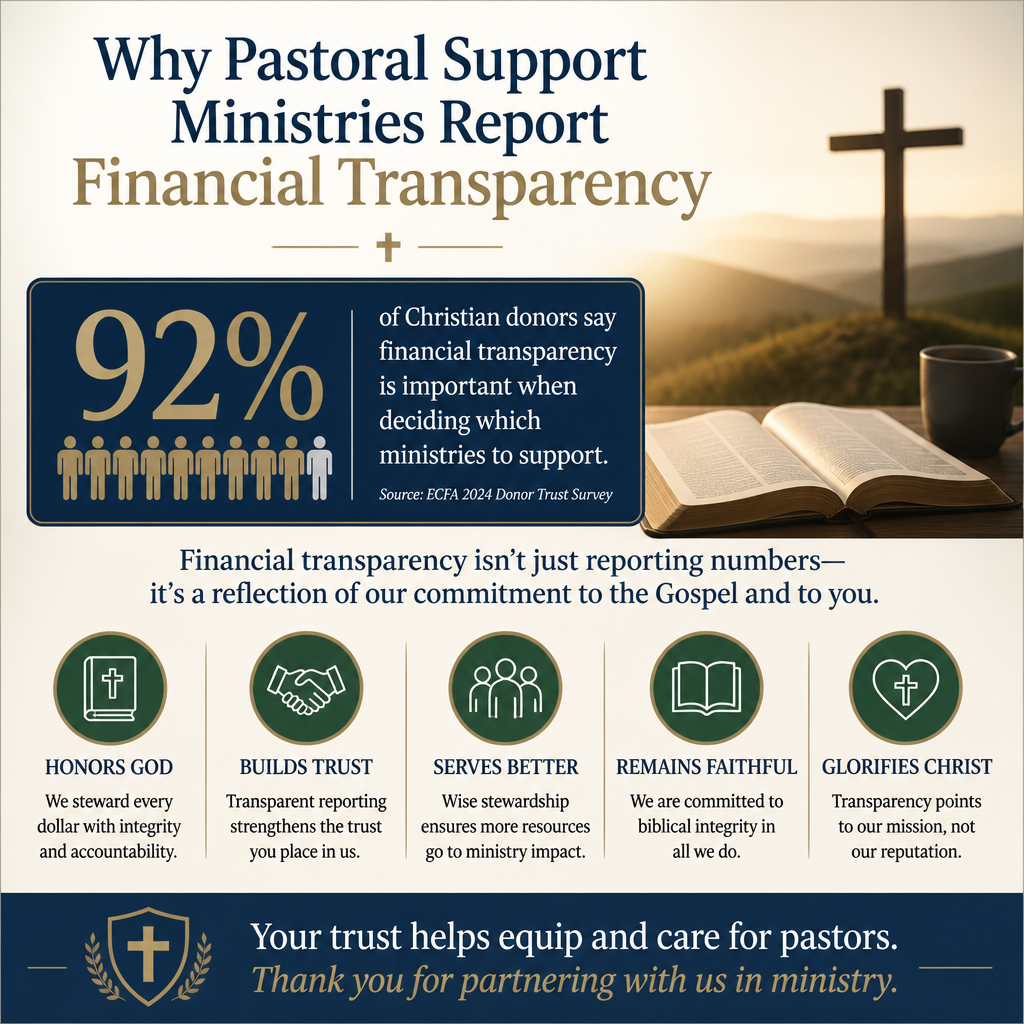
Why pastoral support ministries report financial transparency is not a secondary question for Christian donors; it is a test of whether a ministry understands stewardship as a spiritual trust. Pastoral support ministries often ask the Church to carry a weight that is both intimate and invisible: the ongoing care of shepherds who are weary, underpaid, isolated, or facing crisis. When money moves into that kind of vulnerability, transparency is not public relations. It is moral clarity.
Scripture consistently joins generosity with accountability. Paul’s collection for the saints was administered with deliberate safeguards, “so that no one should blame us about this generous gift” (2 Corinthians 8:20–21). The goal was not suspicion but integrity before God and neighbor. Financial transparency is one practical way a pastoral support ministry can honor that biblical instinct in a modern, audited, regulated environment.
Financial transparency is a form of pastoral care for donors
Christian giving is worship, not merely philanthropy
For mature Christians, giving is not mainly transactional; it is an act of worship and a participation in God’s work. That is precisely why donors feel a particular grief when a ministry’s finances are unclear or evasive. The issue is not simply “Did our money help?” but “Were we invited into stewardship that fears God?” A pastoral support ministry that reports transparently respects donors as disciples, not as revenue sources.
Transparency also protects the consciences of those who give sacrificially. Many households do not have unlimited charitable capacity. When a donor supports a pastor’s counseling, emergency assistance, sabbatical care, or continuing education, they are often forgoing other good works. Reporting is one way the ministry acknowledges the gravity of that trade-off and refuses to treat it lightly.
Trust is fragile when the beneficiaries are leaders
Pastoral support ministries serve those who hold spiritual authority. That reality is beautiful and necessary, but it also creates unique reputational risk. Christians genuinely disagree about pastor compensation norms, retirement benefits, and the boundary between legitimate care and lifestyle subsidy. Clear financial reporting does not eliminate disagreement, but it keeps the conversation tethered to verifiable facts rather than impressions and rumors.
In our work at Most Trusted, we see that ministries serving pastors face an additional trust hurdle: donors instinctively ask whether leaders are “taking care of their own.” The ministries that answer that concern best are not the ones with the most polished messaging; they are the ones that publish coherent financials, explain decisions plainly, and invite appropriate scrutiny.

What donors should expect a pastoral support ministry to disclose
The baseline documents that establish credibility
Financial transparency is not a vague posture. It is a set of concrete disclosures that allow an informed outsider to understand where funds come from, where they go, and what controls exist. At minimum, donors should be able to find current governing documents, leadership names, and financial statements without friction. When ministries treat basic disclosure as optional, they are training donors to accept ambiguity in stewardship.
For U.S. nonprofits, one practical marker is the organization’s IRS Form 990, which many donors can access through established nonprofit databases. The IRS describes Form 990 as a disclosure tool intended to provide the public with financial information about tax-exempt organizations and to promote compliance.IRS Form 990 resources A ministry does not need to reduce its story to a tax form, but it also should not treat the tax form as irrelevant to Christian integrity.
Clarity around restricted gifts and designated funds
Pastoral support ministries often raise money for specific purposes: emergency grants for pastors, counseling subsidies, a sabbatical fund, a benevolence reserve, or a training cohort. Donors should expect the ministry to explain how restricted gifts are handled, whether designated donations are legally restricted, and how the organization reports on those funds. This is not only best practice; it is protection against the quiet drift where “designated” becomes “general” without clear donor consent.
We recommend donors look for narrative reporting that matches the accounting reality. If a ministry claims “most gifts go directly to pastors,” donors should be able to see what counts as direct aid, what is program administration, and what is fundraising. When definitions are unclear, slogans are doing work that audited statements should be doing.
- Current year operating budget and the most recent year-end financial statements
- Form 990 and a plain-language explanation of major revenue and expense categories
- Executive compensation-setting process and whether independent board members approve it
- Policies on restricted gifts, designated gifts, and benevolence distributions
- Conflict-of-interest policy and disclosures for related-party transactions
Transparency helps donors resist the overhead debate and ask better questions
Why simplistic ratios fail pastoral support work
Pastoral support is relational, confidential, and often crisis-driven. Some costs that donors might instinctively label as “overhead” are, in fact, part of careful care: licensed counseling networks, secure case management systems, trauma-informed training, compliance support, background checks, and pastoral care coordinators who handle sensitive situations with discretion. A ministry can be lean and still be unsafe; it can also be responsibly staffed and still be faithful.
The sector has had to reckon with how donors sometimes weaponize overhead ratios. Charity Navigator, Candid (formerly GuideStar), and the BBB Wise Giving Alliance jointly warned against judging nonprofits solely by overhead percentages, noting that “overhead is a critical component of effective charities.”Charity Navigator on overhead Pastoral support ministries, in particular, should not be pressured into under-investing in governance, accountability, and caregiver competence.
What this means in practice for Christian donors
Financial transparency does not mean demanding that ministries be bare-bones. It means demanding that ministries be intelligible. Donors can hold two convictions at once: (1) administrative capacity can be mission-critical, and (2) money still must be traceable, policies still must exist, and leaders still must submit to oversight.
Across our verification work, we observe that the healthiest ministries speak candidly about the true costs of doing this work well. They do not shame donors for asking questions, and they do not hide behind complexity. They treat donors as partners in stewardship.
Pastoral support requires discretion, and transparency must respect it
Confidential care and public accountability can coexist
Some pastoral support ministries hesitate to report because they fear harming pastors through exposure. That concern is legitimate. A pastor receiving emergency assistance or counseling support should not be turned into a case study for fundraising. Yet discretion is not the same as secrecy. A ministry can protect identities while still reporting totals, policies, controls, and outcomes at an appropriate level of aggregation.
Well-governed ministries often publish anonymized reporting that includes: number of pastors served, types of assistance provided, average grant size, counseling sessions subsidized, and the criteria used for eligibility. They also explain who can approve disbursements and how conflicts of interest are managed when pastors and donors share networks. These details matter because pastoral ecosystems can be tightly connected, and informal influence can quietly distort benevolence decisions.
The harder question is governance when ministry leaders are the beneficiaries
When a ministry exists to support pastors, it can inadvertently become a closed loop: pastors lead, pastors refer, pastors receive. Transparency helps interrupt that loop by making the governance architecture visible. Donors should look for independent board oversight, clear recusal procedures, and documented compensation and benevolence policies. Where leaders benefit directly, even indirectly, the case for public accountability is stronger, not weaker.
For donors who want a wider frame of how this ministry category functions, Pastoral Support Ministries is a helpful place to compare common models of care and the disclosure practices that tend to accompany them.
How The Most Trusted Standard evaluates financial transparency for pastoral support
Transparency is inseparable from faithfulness
Most Trusted exists because Christian donors often face an uncomfortable asymmetry: ministries know far more about their operations than donors ever will. That gap is not inherently sinful, but it is spiritually risky. The Most Trusted Standard evaluates ministries across 15 criteria to narrow that gap with verifiable evidence—so donors can give with confidence rather than with mere hope.
In the pastoral support space, transparency and financial integrity are not abstract categories. They touch questions like: Are pastor-care grants distributed according to policy or relationships? Are counseling subsidies paid to vetted providers? Is emergency assistance paired with wise boundaries? Are reserves maintained responsibly so that a ministry does not create dependence and then collapse? Financial reporting is one of the few ways an outsider can assess whether the ministry’s care is stable and governed.
What donors can reasonably ask without becoming cynical
Christian donors sometimes hesitate to ask questions because they fear becoming suspicious or uncharitable. Scripture does not commend naiveté. Paul’s model in 2 Corinthians 8 is not distrust; it is deliberate honesty that avoids even the appearance of mishandling funds. Asking for financial clarity is not a lack of faith. It is a commitment to love truthfully.
We recommend donors look for ministries that welcome careful questions and provide plain documentation, including how they assess impact without violating confidentiality. For a closer view of how ministries communicate the path of a donation from gift to pastoral care, How Pastoral Support Ministries Use Donations provides important context for evaluating what “support” actually entails.
FAQs for Why pastoral support ministries report financial transparency
Does financial transparency mean a pastoral support ministry must publish every detail of every case?
No. Pastoral support often involves sensitive matters—marriage crisis, depression, burnout, moral failure, or financial distress. A ministry can protect confidentiality while still being transparent about policies, totals, governance controls, and aggregated outcomes. The appropriate standard is intelligibility and accountability without exposure of individuals.
What are the most common red flags when a pastoral support ministry is not financially transparent?
Patterns that warrant caution include: missing or outdated financial statements; unwillingness to provide Form 990 or audited financials when they exist; vague claims about “most funds go to pastors” without definitions; unclear governance where beneficiaries and decision-makers overlap without recusal; and fundraising appeals that emphasize urgency but provide little follow-through reporting. None of these prove wrongdoing by themselves, but together they signal heightened risk for donors seeking faithful stewardship.
Why transparency strengthens pastoral care
A pastoral support ministry exists to sustain those who sustain others. That calling requires compassion, discretion, and spiritual maturity. It also requires financial practices that can bear daylight. When ministries report financial transparency, they are not yielding to a secular demand for metrics; they are honoring a biblical pattern of integrity that protects pastors, donors, and the credibility of the Church’s witness.



