
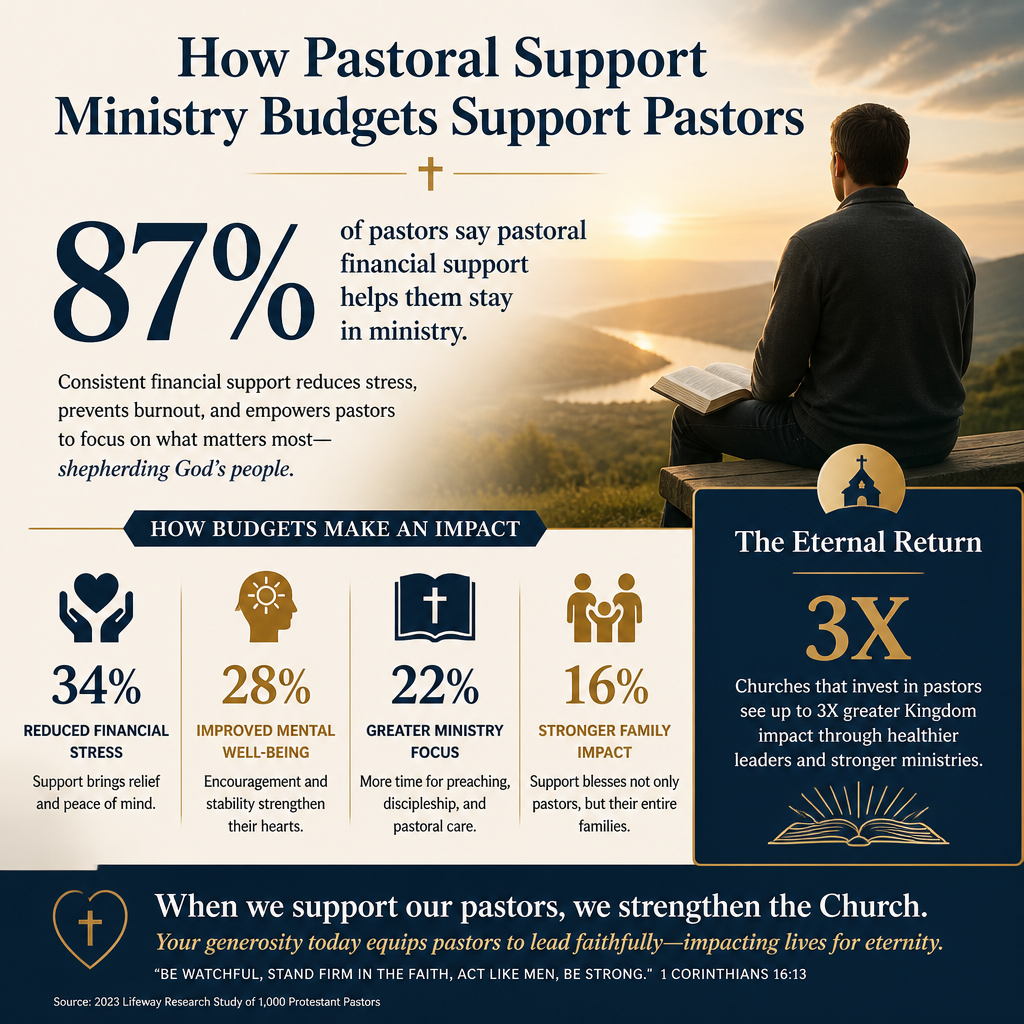
Pastoral support ministry budgets support pastors by turning donor generosity into credible care: rest when exhaustion sets in, counseling when wounds deepen, training when the work changes, and accountability when isolation becomes dangerous. For Christian donors, the question is not whether pastors deserve support, but whether a ministry’s spending actually strengthens pastoral faithfulness over time rather than offering a temporary relief that leaves deeper risks untouched.
Scripture takes the weight pastors carry seriously. Paul describes the work as watchfulness “as those who will have to give an account” (Heb. 13:17), and he also insists that those who preach the gospel should be able to receive material support (1 Cor. 9:14). Mature giving holds both truths together: pastoral ministry is not a career with benefits, and it is not a calling that requires families to absorb preventable harm in silence.
Budget lines are moral decisions not merely administrative ones
A budget is theology applied. Every expense category implies a ministry’s answer to basic questions: What harms pastors most? What protects them? What restores them? What temptations accompany spiritual authority? Pastoral support organizations differ in their answers, and Christians genuinely disagree about where scarce dollars should go first: counseling, sabbaticals, conferences, emergency benevolence, or leadership coaching.
Across our verification work at Most Trusted, we observe that the ministries that meet The Most Trusted Standard tend to articulate their budgeting logic in plain terms. They do not treat spending patterns as a marketing tool. They show donors how inputs connect to specific pastoral outcomes, and they name what they will not fund because it would confuse mission or weaken safeguards.
Why donors should resist simplistic ratios
Many donors have been trained to judge ministries by overhead ratios, as if lower administrative spending automatically means higher faithfulness. The nonprofit field has pushed back on that assumption for years. In the “Overhead Myth” letter signed by GuideStar, Charity Navigator, and BBB Wise Giving Alliance, the authors argue that overhead ratios can punish healthy investment in governance, evaluation, and internal controls—exactly the systems that reduce misuse and improve outcomes GuideStar.
Pastoral support work makes this tension sharper. Counseling networks require coordination. Retreats require logistics and risk management. Financial assistance programs require verification and case management so that help is real and not easily exploited. A budget that starves these functions can look virtuous while increasing the likelihood of pastoral harm and donor deception.
The category that often hides in plain sight
The most consequential line items are often the least glamorous: screening, follow-up, documentation, and independent oversight. These costs can feel “administrative,” but in pastoral care they are frequently the difference between benevolent intentions and trustworthy ministry.

Core budget categories that tangibly strengthen pastoral endurance
Pastors are not supported by sentiment. They are supported by systems that make sustained faithfulness more likely: rhythms of rest, relationships that tell the truth, and access to competent care when spiritual leadership intersects with trauma, depression, anxiety, or marriage strain. A sound pastoral support budget typically invests in several distinct forms of care rather than treating one program as a cure-all.
Clinical and pastoral counseling that is accountable
Some ministries fund direct counseling sessions for pastors and spouses. Others subsidize vetted providers or create referral networks with agreed standards. For donors, the key question is not whether counseling is listed, but whether it is governed: How are counselors credentialed? How is confidentiality protected while still guarding against enabling patterns? How is crisis escalation handled when safety is at risk?
When the budget supports careful provider vetting, clear care pathways, and follow-through, donor dollars can reduce the “quiet collapse” dynamic that often precedes moral failure or vocational exit. When budgets merely reimburse loosely defined “care,” ministries can unintentionally finance avoidance.
Sabbath and sabbatical funding that is not performative
Many organizations pay for retreats, sabbaticals, or respite weekends. That spending can be deeply faithful when it is tied to clear pastoral rhythms and realistic re-entry planning. It becomes thin when it functions as a one-time escape from an unhealthy system the pastor must return to unchanged.
Well-designed budgets often include coaching before and after rest periods, spouse inclusion, and practical support that makes rest possible for small-church pastors who cannot simply “take time off” without congregational disruption.
- Direct care such as counseling subsidies and crisis intervention
- Rest and renewal including retreats, sabbaticals, and spiritual direction
- Training in pastoral resilience, conflict leadership, and ethical boundaries
- Peer community that reduces isolation through cohorts or mentoring
- Safeguards such as screening, case management, and independent review
Emergency aid can be faithful and still require careful controls
Some pastoral support ministries carry benevolence funds for housing crises, medical bills, counseling costs, or short-term income disruption. Donors often resonate with these needs because they are immediate and concrete, and because many pastors live closer to financial fragility than congregations assume. Yet emergency aid is one of the easiest programs to run poorly, not because pastors are untrustworthy, but because emergencies invite urgency, and urgency can erode process.
What responsible benevolence looks like in a budget
Responsible benevolence budgets fund assessment, documentation, and follow-up. They also define eligibility rules that prevent favoritism and reduce conflicts of interest, especially when a referring church leader has a personal relationship with the pastor in need. In some cases, the most pastor-honoring decision is a smaller grant accompanied by a longer care plan rather than a large check that delays necessary changes.
Christians have long debated how aid should relate to responsibility, agency, and long-term formation. The When Helping Hurts framework, articulated by Steve Corbett and Brian Fikkert, has shaped much of this conversation by warning that assistance can create dependency or undermine dignity when it replaces rather than supports local responsibility When Helping Hurts. Pastoral support budgets that incorporate this wisdom typically fund coaching, budgeting help, or mediated church conversations alongside emergency grants.
Why this matters for donor confidence
Donors are not merely underwriting a moment of relief. They are funding a ministry’s judgment under pressure. A budget that invests in careful processes is not evidence of coldness. It is often evidence of love that is disciplined enough to tell the truth.
Training and formation spending should be evaluated by outcomes not events
Conferences and training programs are common budget items, and they can either deepen pastoral competence or merely offer inspirational content that fades by Tuesday. The hardest question is whether a ministry funds formation that changes pastoral practice: healthier boundaries, better conflict leadership, clearer ethical guardrails, and more durable spiritual habits.
The difference between content and formation
Content can be delivered at scale. Formation is slower and more expensive. It often requires cohorts, coaching, assignments, and follow-up. A pastoral support budget that prioritizes formation will usually spend more per participant and serve fewer participants at a time, which can frustrate donors who equate faithfulness with volume. Yet the goal is not attendance; it is endurance.
For donors who want a wider view of how these organizations commonly allocate resources, the category page How Pastoral Support Ministries Use Donations provides a broader map of where funding tends to go and what questions to ask when reviewing those choices.
Measuring what is measurable without shrinking the mission
Not every pastoral outcome can be reduced to a metric. Some of the most important fruit is qualitative: a marriage stabilized, a call renewed, a temptation confessed before it becomes scandal. Still, ministries can track meaningful indicators without becoming reductionist: participation completion rates, re-referral patterns, counselor utilization, and follow-up engagement. A budget that funds evaluation is often a budget that takes pastoral integrity seriously.
What we look for when budgets claim to support pastors
Pastoral support is a high-trust space. That is precisely why it requires high-verification practices. Donors should expect ministries to protect pastors from unnecessary exposure while still providing enough transparency to justify financial confidence. The tension is real: too much disclosure can violate confidentiality; too little can become a shield for poor stewardship.
Signals of credibility under The Most Trusted Standard
The Most Trusted Standard examines ministries across faith foundation, financial integrity, governance and leadership, and transparency and effectiveness. Applied to budgets that claim to support pastors, that framework tends to surface several practical questions:
Does the ministry show audited or independently reviewed financials when appropriate, and does it explain major program categories in terms a donor can understand? Are restricted gifts handled carefully, with clear policies for designation and release? Is there meaningful board oversight, including conflict-of-interest discipline, especially when leaders have personal or professional ties to providers? Does the ministry communicate impact with theological seriousness, avoiding both triumphalism and vague claims?
These are not abstract concerns. Pastoral support ministries often work with vulnerable families, sensitive moral failures, and complex power dynamics. A budget that funds governance and controls is frequently a budget that prevents harm.
Where donors can get oriented
Many donors begin with a simple question: “Is this organization trustworthy?” Most Trusted exists to serve that question with independent verification, so that generosity can be confident rather than anxious. For readers looking for the wider landscape of organizations serving this work, Pastoral Support Ministries is the natural starting point.
FAQs for How pastoral support ministry budgets support pastors
Should we avoid pastoral support ministries with higher administrative costs?
Not automatically. Pastoral support requires screening, case management, provider vetting, confidentiality safeguards, and oversight—functions often categorized as administration. The better question is whether those costs are explained, governed, and proportionate to the ministry’s programs. The nonprofit field has cautioned donors against using overhead ratios as a primary measure of effectiveness, including in the “Overhead Myth” letter signed by GuideStar, Charity Navigator, and BBB Wise Giving Alliance GuideStar.
What budget items most directly protect pastors from moral failure?
No line item guarantees integrity, and the church has learned painful lessons about assuming otherwise. Still, budgets that fund accountable relationships and timely care tend to address common risk factors: isolation, unmanaged stress, untreated mental health concerns, and secrecy. Practically, this often includes subsidized counseling with vetted providers, peer cohorts with clear expectations, coaching around boundaries, and follow-up structures that continue after a retreat or conference ends.
Giving that strengthens pastors over the long haul
Pastoral support ministry budgets support pastors best when they honor the full reality of pastoral life: spiritual leadership, ordinary human limits, and the heightened risks that come with authority. Christian donors can give with clarity when budgets show not only compassion but also disciplined stewardship—care that is structured, accountable, and consistent with the Church’s calling to shepherd its shepherds.



