
How donors can fund pastor family care ministries is not a sentimental question. It is a stewardship question about the health of the church and the credibility of its witness. Pastors are called to shepherd others, but Scripture is equally clear that shepherds are not disposable. “Pay careful attention to yourselves and to all the flock” was Paul’s charge to elders, and that order matters: the care of souls includes the caregiver’s soul (Acts 20:28).
Many donors already fund preaching, church planting, and missions. Fewer fund the mundane, sustained support that keeps a pastor’s marriage resilient, a child’s anxiety addressed, a sabbatical protected, and a family’s financial stress from becoming a spiritual crisis. When those needs go unmet, the costs are rarely private. Congregations absorb them in leadership churn, conflict, and disillusionment.
Pastor family care is church care by another name
A biblical frame for sustaining those who labor in the Word
Christian giving tends to prioritize visible outputs: sermons preached, baptisms counted, buildings built. Pastor family care ministries work upstream, addressing the conditions that make faithful ministry sustainable over decades. The New Testament assumes that ministers are materially and relationally supported by the people of God. “Let the elders who rule well be considered worthy of double honor… for the laborer deserves his wages” (1 Timothy 5:17–18). That principle is broader than payroll. Honor includes the practical provisions that prevent a pastor’s home from becoming a chronic casualty of public ministry.
Theologically, this is not a concession to modern therapeutic culture. It is a recognition that pastors are embodied creatures with limits, families with formative needs, and marriages that require time, attention, and protection. A church that benefits from a pastor’s availability must also take responsibility for the boundaries that make availability humane.
Why donors often hesitate
Christians genuinely disagree about what counts as faithful pastoral sacrifice. Some view exhaustion as a badge of calling; others see it as a sign of disordered expectations. Donors also worry about funding what sounds like “benefits” rather than “ministry.” Those concerns deserve respect. The harder question is whether we have unconsciously built ministry models that presume an unlimited pastor and a family that absorbs the overflow.
Across our verification work at Most Trusted, we observe that strong pastor care efforts tend to make their theology explicit: care is not indulgence, it is stewardship; rest is not entitlement, it is obedience; accountability is not suspicion, it is protection.

What effective pastor family care ministries actually do
Interventions that address both crisis and prevention
Pastor family care is not a single program. It is a set of services that range from emergency response to long-term formation. The most credible ministries avoid a false choice between “rescue” and “resilience.” They plan for both.
In practice, effective models commonly include:
- Confidential counseling pathways with clinicians trained to work with ministry families
- Marriage intensives and coaching that address ministry-specific stressors
- Sabbatical planning support that protects time away and reintegration back into ministry
- Peer cohorts for spouses and children, reducing isolation and normalizing wise help-seeking
- Emergency grants for acute financial shocks, especially when a church lacks capacity
The emphasis on confidentiality is not cosmetic. Pastors and spouses often avoid help because they do not trust that their church can hold it wisely. A donor-funded intermediary can create the necessary distance, without severing accountability.
What donors should not fund without careful scrutiny
Some offerings are marketed as care while functioning as reputation management: minimal counseling, maximum storytelling; or generic retreats with little follow-up. The field has also had to reckon with approaches that treat spiritual struggle as merely clinical, or treat clinical realities as merely spiritual. The ministries worth funding are clear about their scope, use qualified professionals where appropriate, and honor the integrated nature of body and soul.
Donors who want to understand the broader ecosystem can begin with How Pastoral Support Ministries Serve Pastor Families, which maps common models and the questions they raise.
How to fund pastor family care without distorting it
Pay for capacity, not just moments
Most donors prefer restricted gifts tied to a specific outcome. Pastor family care does not always cooperate with that instinct. A ministry may need a licensed counselor on retainer to ensure timely access, or a care coordinator to triage requests, maintain referral networks, and follow up with families over months. These are not overhead in the pejorative sense; they are the ministry.
The broader nonprofit sector has argued for years against simplistic overhead ratios, notably in “The Overhead Myth” letter from Charity Navigator, Candid, and the BBB Wise Giving Alliance, which warns donors that minimizing administration can undermine effectiveness Charity Navigator. The same logic applies here: underfunded care systems become shallow care systems, and shallow care systems disappoint the families they promise to serve.
Use matching and challenge gifts to change church behavior
One of the best uses of donor capital is to move churches from admiration to responsibility. Matching structures can require a local church to share the cost of counseling, coaching, or a sabbatical plan. This protects dignity and prevents donor funding from quietly replacing congregational duty.
In our assessment work, we see healthier outcomes when the care ministry requires some combination of pastoral consent, spouse involvement when appropriate, and church leadership alignment on expectations for time off and workload. Donors should view those requirements not as barriers but as safeguards.
Due diligence that fits the spiritual stakes
Ask questions that reveal theology, governance, and safeguards
Pastor family care ministries often operate in sensitive territory: trauma, marital distress, addiction, financial collapse, and sometimes misconduct. Donors should expect a level of operational seriousness that matches the moral weight of the work.
What this means in practice is that a credible ministry can answer, clearly and without evasiveness:
- How do you protect confidentiality while ensuring appropriate reporting and safeguarding?
- Who provides clinical services, and what credentials and supervision structures are in place?
- What is your policy when care reveals disqualifying behavior for ministry leadership?
- How do you avoid conflicts of interest when donors, churches, and families have competing priorities?
- How do you measure whether care is helping without turning families into data points?
How Most Trusted evaluates pastor care ministries
At Most Trusted, we exist to help donors give with confidence by evaluating Christian nonprofits against The Most Trusted Standard. The framework assesses ministries across faith foundation, financial integrity, governance and leadership, and transparency and effectiveness. For pastor family care, governance and safeguarding practices matter as much as compassion. A ministry can be warm and still be unsafe; it can be doctrinally sound and still be financially opaque.
Donors should treat verification as a form of neighbor-love. When we fund care, we are also funding the systems that handle crisis disclosures, manage restricted gifts, and protect vulnerable spouses and children from being pressured into silence.
Funding priorities that strengthen the church over time
Support that reaches spouses and children directly
Pastor family care can inadvertently focus on the pastor as the sole client, as if the family exists merely to stabilize the leader. More mature approaches serve the whole household. Spouses often bear unspoken congregational expectations, and children may carry a unique form of social exposure: their family’s hardship becomes public information in a way most families never experience.
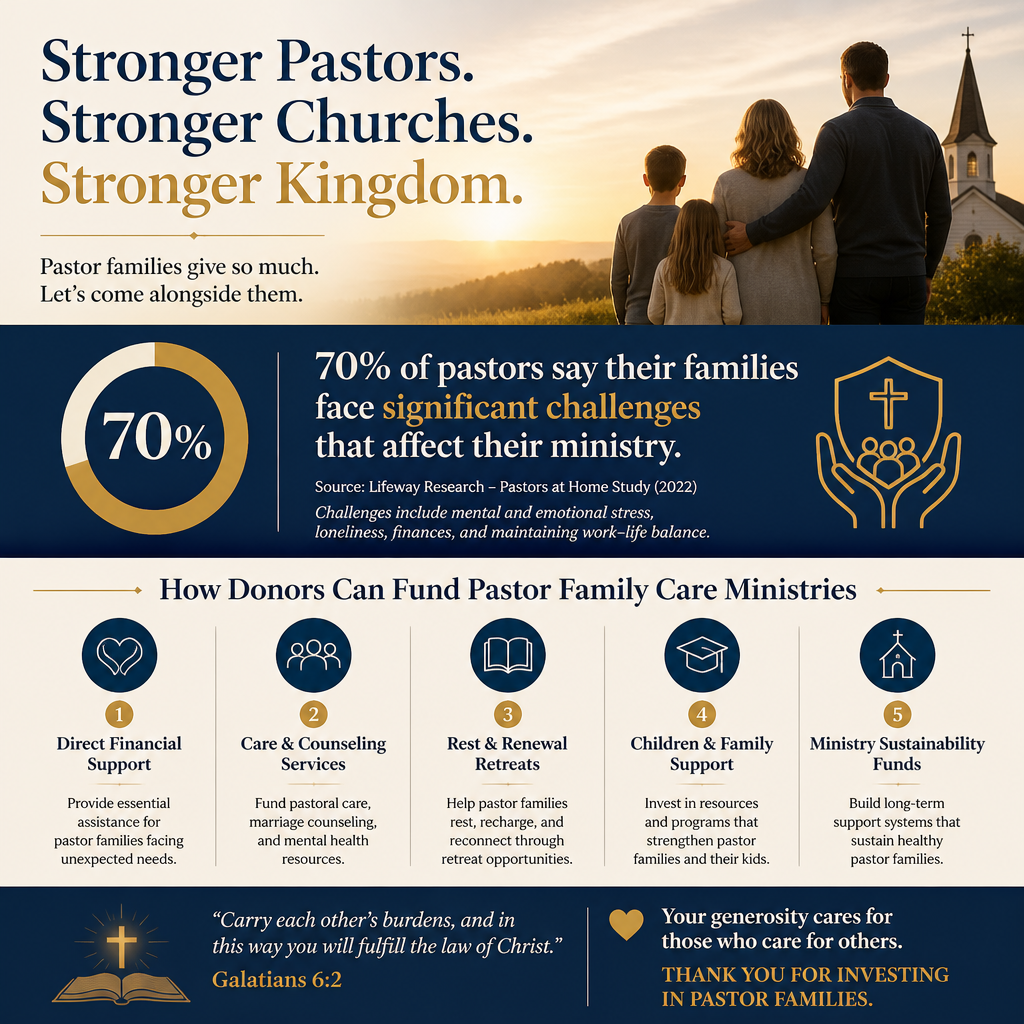
Donors can fund programs that give spouses access to confidential counseling not mediated by church leadership, and that provide age-appropriate support for children navigating transitions, criticism, or chronic instability. This is not a detour from mission. It is part of the church’s obligation to “bear one another’s burdens” (Galatians 6:2), especially when the burden is carried in silence.
Regional networks and referral ecosystems
Many churches, especially smaller ones, cannot build a full care infrastructure. Regional pastor care networks can pool expertise, vet counselors, maintain emergency response capacity, and serve bi-vocational leaders who have little margin. Donor funding is often catalytic here: it can underwrite the network’s backbone until participating churches sustain it.
For donors who want a broader view of ministries that serve leaders across seasons of ministry, Pastoral Support Ministries provides a wider picture of the categories and the verification questions that tend to matter most.
FAQs for How donors can fund pastor family care ministries
Should we give to pastor family care through a church budget or through a specialized nonprofit?
Both can be appropriate, and the best approach is often blended. Church-based care can reinforce congregational responsibility and normalize healthy expectations. Specialized nonprofits can provide confidentiality, clinical referral networks, and consistency when church leadership changes. Donors can prioritize arrangements where the church remains meaningfully invested while an external ministry provides professional capacity and safeguards.
How can donors fund counseling without encouraging secrecy or covering up misconduct?
Donors should insist on clear safeguarding policies: mandated reporting compliance, explicit boundaries on confidentiality, and documented pathways for escalation when care reveals harm to others or disqualifying behavior for leadership. A credible ministry will describe these policies plainly and will not treat “protecting the pastor” as the goal. The goal is truthful care that protects families, congregations, and victims, and that aligns with biblical standards for repentance and qualification.
A donor’s opportunity is to fund faithfulness, not just activity
Funding pastor family care ministries is a decision to underwrite the conditions of endurance. It affirms that God’s work does not require the destruction of God’s servants, and that the church’s leadership culture must be worthy of the gospel it proclaims. When donors fund care that is clinically competent, theologically grounded, and governed with integrity, they are not merely helping a family. They are strengthening a congregation’s capacity to receive long-term shepherding without quietly consuming the shepherd.



