

Why pastoral counseling ministries help pastors stay in ministry is not primarily a question of comfort. It is a question of endurance—whether those called to shepherd the flock can remain present, clear-eyed, and faithful through the long obedience of ordinary weeks and acute crises. Donors who care about gospel work eventually face the same stewardship dilemma: churches can fund programs, staff, and buildings, but if pastoral leaders quietly break under spiritual and emotional strain, the ministry’s public fruit will be brittle.
Scripture does not romanticize shepherding. Paul describes ministry pressures that can feel beyond human capacity, so that “we despaired of life itself” (2 Corinthians 1:8). Yet he also insists that God “comforts us in all our affliction, so that we may be able to comfort those who are in any affliction” (2 Corinthians 1:4). Pastoral counseling ministries exist in that tension: they aim to strengthen pastors in their affliction so that churches are not left with wounded shepherds or unprocessed pain translated into leadership harm.
Pastoral counseling treats pastoral attrition as a spiritual and organizational problem
Pastoral departure is often narrated as a personal failure, but the reality is more complex. A pastor may leave because of moral collapse, but just as often the precipitating forces are chronic: isolation, conflict, secondary trauma, financial insecurity, untreated depression, or a marriage strained under public expectations. When pastoral counseling ministries are healthy, they refuse simplistic stories and deal with the whole set of pressures that accumulate in a pastor’s life.
Leaving ministry is common enough to warrant structural care
Evangelical leaders have tried to quantify pastoral durability for decades, with mixed methods and disputed numbers. Still, the pattern of stress is not debated. In a 2022 Barna study conducted in partnership with the Lilly Endowment, 42% of pastors said they had considered quitting full-time ministry within the previous year, with stress and loneliness among the commonly cited drivers (Barna).
Donors should not treat that figure as a prophecy over every church, but as a signal that the system is under strain. When a pastor quietly imagines leaving, congregational health is already affected: decision-making narrows, preaching becomes thinner, conflict is avoided rather than shepherded, and the pastor’s family becomes an unacknowledged casualty of the congregation’s unmet expectations.
Scripture assumes that shepherds need strengthening, not just scrutiny
Christian communities are right to insist on pastoral character and accountability. Yet the New Testament also shows leaders receiving help. Paul requests prayer for boldness and clarity (Ephesians 6:19–20). Timothy is urged to “fan into flame” his calling (2 Timothy 1:6) and to attend to his health (1 Timothy 5:23). A pastoral counseling ministry functions as a structured form of that strengthening—confidential, discerning, and oriented toward repentance, resilience, and restored joy rather than mere performance.

Good counseling ministries reduce isolation, which is a predictable risk in pastoral life
Many professions carry confidentiality burdens, but pastoral work adds a spiritual burden: the pastor often knows the private griefs and sins of the congregation while bearing the expectation of being consistently available and spiritually composed. Pastors can be surrounded by people and still be alone in the places where they most need care.
Confidentiality creates a relational vacuum that counseling can responsibly fill
Wise pastors do not process the intimate details of congregational crises with church members who are themselves implicated. Even peer friendships can be complicated when the pastor is the employer, the supervisor, or the perceived “strong one” in the room. A mature pastoral counseling ministry offers a protected relationship where the pastor can name fear, anger, exhaustion, temptation, and doubt without turning that disclosure into congregational instability.
This is not merely therapeutic language imported into the church. The Psalms model speech that is both reverent and unguarded. The pastoral calling does not exempt a leader from needing a place to lament truthfully before God and before a trustworthy counselor.
Isolation increases risk, including in the most serious outcomes
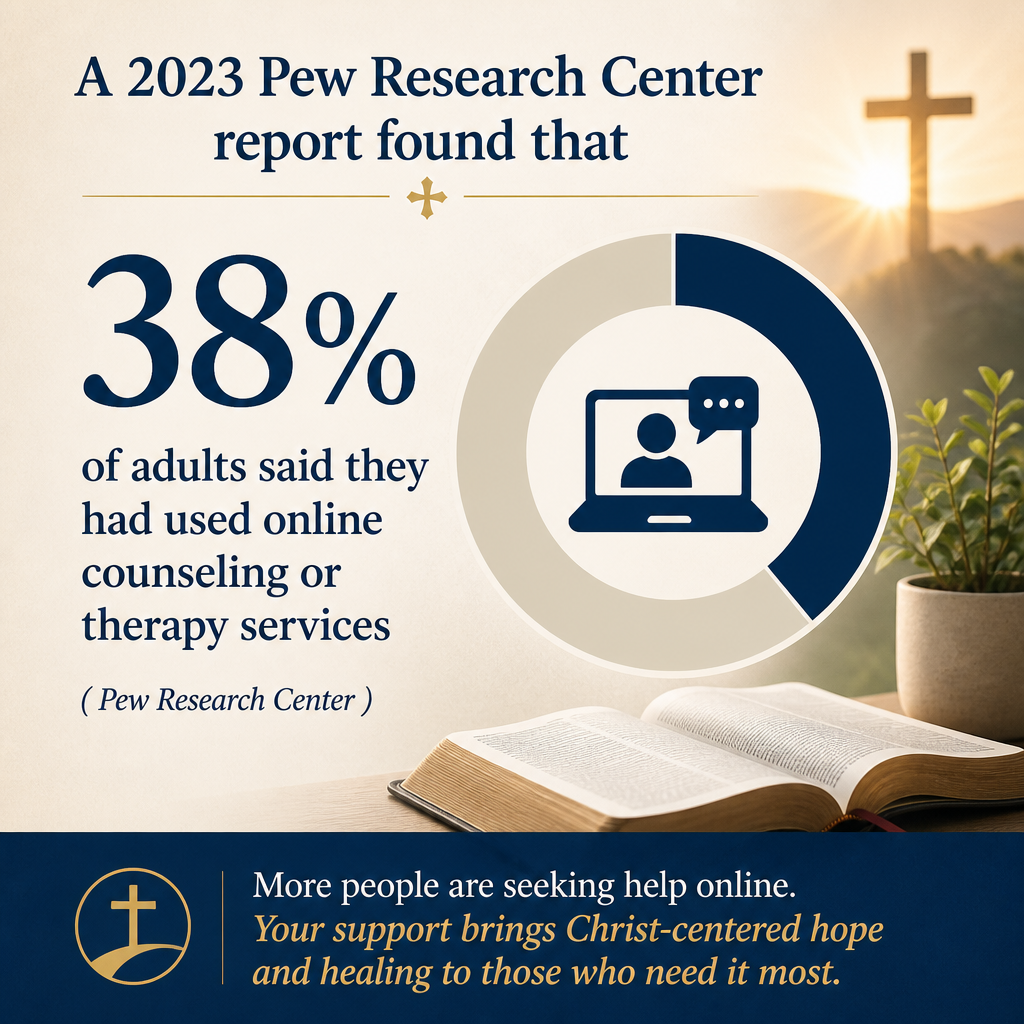
When isolation persists, risks multiply: marital distance, pornography, substance misuse, and despair. A 2023 Pew Research Center report found that 38% of adults said they had used online counseling or therapy services (Pew Research Center). That number is not about pastors specifically, but it highlights a broader reality: in a culture where many people are already seeking mental health support, it is neither surprising nor shameful that pastors also need structured care—provided it is theologically grounded and ethically governed.
For donors, the practical question is not whether pastors “should need counseling,” but whether the church is willing to provide what is actually required to keep shepherds healthy enough to shepherd well.
Pastoral counseling helps prevent ministry harm by addressing wounds before they become patterns
Burnout is not only exhaustion; it is often the precondition for pastoral misjudgment. A depleted leader is more likely to lash out, avoid hard conversations, spiritualize personal preferences, or grasp for control. Pastoral counseling ministries help pastors interpret their inner life before it spills into public leadership in destructive ways.
Unaddressed pain tends to reappear as leadership distortion
Church conflict regularly involves layers: theological disagreement, personality difference, family-of-origin patterns, and grief. Pastors who never have space to examine their own triggers can confuse a congregational disagreement with a personal threat. Counseling that integrates spiritual formation, emotional awareness, and pastoral theology can interrupt that cycle.
Donors who have supported high-profile ministry initiatives have also seen how quickly a ministry can unravel when a leader’s private life collapses. While no program can guarantee integrity, counseling ministries that emphasize accountability, self-knowledge, and repentance can be one of the most concrete risk-mitigation investments a donor makes for the long-term health of a congregation.
What donors should look for in a mature counseling ministry
Because counseling is intimate work, quality varies. Across our verification work at Most Trusted, the pastoral support organizations that tend to meet The Most Trusted Standard are explicit about theological commitments, clear about clinical and pastoral competencies, and disciplined about governance.
- Clear intake and referral pathways, including what happens in crisis situations
- Defined counselor qualifications and supervision, whether licensed clinicians or trained pastoral counselors
- Written confidentiality policies with ethically appropriate exceptions
- Separation of spiritual authority from therapeutic dependency, so care does not become control
- Transparent reporting on outcomes without violating privacy
These markers matter because they protect both the pastor receiving care and the donor funding it. Pastoral counseling done poorly can become a substitute for repentance, or a way of masking abusive leadership. Pastoral counseling done well makes repentance more likely, not less.
Supporting pastors is not a distraction from mission; it is part of mission fidelity
Some donors worry that funding counseling feels indirect compared to evangelism, church planting, or humanitarian work. The tension is understandable. Yet Scripture repeatedly ties fruitfulness to hidden endurance. Jesus appoints the Twelve “that they might be with him” before he sends them out (Mark 3:14). Presence precedes mission, and formation sustains mission.
The church’s public witness depends on private holiness and health
When pastors are emotionally reactive, spiritually dry, or relationally brittle, the congregation absorbs it. The result may not appear in a quarterly report, but it appears in discipleship: anxious churches produce anxious Christians. Pastoral counseling ministries can help pastors maintain the steadiness required to preach the Word, administer sacraments, and shepherd souls without using the congregation to meet the pastor’s unmet needs.
For donors, this is a stewardship question: funding pastoral support can prevent downstream harm that is far more expensive—financially, spiritually, and reputationally—than early care. Preventive support rarely feels heroic, but it is often what keeps ministry faithful over decades.
How this connects to donor due diligence
Donors increasingly expect verifiable integrity in the ministries they support. That expectation is not cynicism; it is a form of love for the church. When evaluating pastoral counseling ministries, we recommend approaching them with the same seriousness given to any other Christian nonprofit: theology, governance, finances, and measurable effectiveness. Our work at Most Trusted is designed for this kind of discernment, helping donors distinguish between organizations that are compelling in language and those that are accountable in practice.
For readers looking to understand the wider ecosystem of care, our analysis of Pastoral Support Ministries situates counseling within a broader set of interventions that keep pastors faithful and effective.
Wise donor support strengthens confidentiality, accessibility, and accountability at once
Pastoral counseling ministries live under competing pressures. If care is too expensive, pastors will not use it. If it is too informal, it can drift into boundary violations. If it is too data-driven, it can betray the confidentiality that makes pastoral counseling possible. Sustainable ministries hold these goods together through thoughtful design and accountable leadership.
Accessibility requires funding models that do not shame pastors
Many pastors, especially in small churches, have limited benefits and little discretionary income. Funding that subsidizes sessions, retreats, or clinician networks can be the difference between a pastor receiving care and simply enduring until something breaks. Donors can underwrite scholarship funds, regional counseling networks, or partnerships that bring qualified care within reach.
Because pastors may fear being perceived as “unfit,” ministries must communicate that seeking help is a normal part of pastoral stewardship. Donors can reinforce that message by funding programs that are framed as preventive care and spiritual formation, not as remediation for scandal.
Accountability requires clear governance and transparent stewardship
Confidential counseling must still be accountable. A credible pastoral counseling ministry should be governed by an active board, use audited or review-level financial statements when feasible, and publish clear policies on conflicts of interest. Donors should not accept spiritual language as a substitute for basic nonprofit discipline.
We also encourage donors to resist simplistic fundraising signals. Christian donors sometimes penalize “overhead,” even when healthy systems require qualified staff, clinical supervision, secure record-keeping, and crisis protocols. The broader nonprofit sector has repeatedly warned against this distortion, including the public letter on the “overhead myth” signed by GuideStar, BBB Wise Giving Alliance, and Charity Navigator (GuideStar). In pastoral counseling, thin infrastructure can become a safety risk.
Those who want to assess how counseling fits into a larger burnout-prevention strategy can also review How Pastoral Support Ministries Prevent Pastor Burnout, where we consider the mix of spiritual, organizational, and relational supports that keep pastors from quietly disappearing.
FAQs for Why pastoral counseling ministries help pastors stay in ministry
Is pastoral counseling just therapy with Bible verses?
It should not be. Mature pastoral counseling is spiritually grounded care that takes Scripture and the human person seriously, often drawing on clinically informed practices without surrendering theological convictions. The counselor’s competence, supervision, and ethical boundaries matter as much as their vocabulary. Donors can ask whether the ministry’s counseling model is clearly defined and whether it respects both spiritual formation and professional standards.
How can donors evaluate a pastoral counseling ministry without violating confidentiality?
Donors should not seek private case details. Instead, ask for verifiable indicators: governance policies, counselor qualifications, crisis procedures, financial transparency, and aggregated outcome reporting that protects identities. The goal is not to audit a pastor’s story but to confirm that the ministry’s structure is safe, faithful, and stewarded with integrity.
Why this form of support keeps pastors at their post
Pastoral counseling ministries help pastors stay in ministry because they address the pressures that quietly erode pastoral faithfulness: isolation, unprocessed grief, chronic conflict, and the spiritual weight of caring for souls. Donors who fund this work are not choosing a lesser mission; they are investing in the durability of the church’s shepherds, so that congregations receive steady, repentant, and resilient leadership over time.



