
How donor support strengthens pastor resilience is not a sentimental question. It is a matter of whether shepherds can sustain long obedience in the same direction without collapsing under chronic spiritual, emotional, and financial strain. Christian donors often understand resilience in leaders as a personal virtue; Scripture also presents endurance as something the body of Christ supplies through shared burdens and orderly care.
Pastors are called to pour themselves out for the flock, yet the New Testament assumes that gospel ministry is not sustained by individual heroism. Paul describes pressures “beyond our strength” and then interprets God’s purpose as learning not to rely on self but on God who raises the dead (2 Corinthians 1:8–9). Donor support cannot replace God’s sustaining grace, but it can remove avoidable weights, fund structures of care, and strengthen accountability that makes endurance more likely.
Resilience is not merely personal grit
Scripture frames endurance as communal
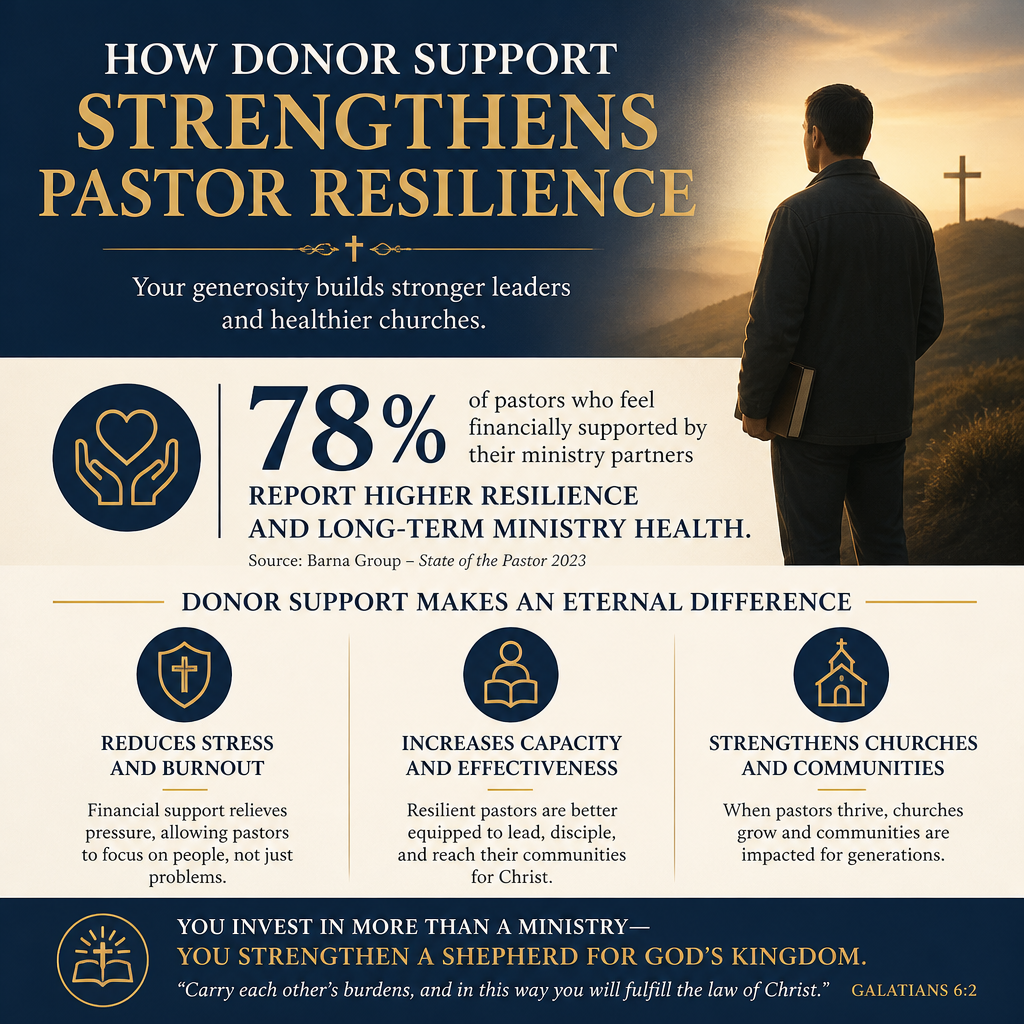
The church is commanded to “bear one another’s burdens” (Galatians 6:2). That instruction is not limited to visible needs in the pews. Pastors carry the burdens of preaching, counsel, crisis response, conflict mediation, and the spiritual formation of a people—often in a culture that treats church leaders as service providers. Donor support strengthens resilience when it takes that shared-burden mandate seriously and builds durable patterns of care rather than episodic relief.
What this means in practice is that donors can fund systems that make healthy pastoral life normal: confidential counseling access, peer cohorts, sabbatical rhythms, and coaching that addresses both ministry craft and interior life. The harder question is whether donors are willing to fund care that produces fewer dramatic stories but more faithful longevity.
The field must name the pressures honestly
Pastoral discouragement is not new, but the intensity of contemporary ministry is widely documented. Barna has reported high levels of pastoral burnout and consideration of quitting, tied to stress and isolation; their broader research on pastors has kept this concern in view for years Barna.
Christians genuinely disagree about how much of this strain is cultural, how much is congregational, and how much is a leadership formation problem within churches. A mature donor posture does not need a single cause to act; it needs clarity about which interventions are verifiably helpful and which are merely sympathetic.

Donor support strengthens resilience by reducing preventable fragility
Financial stability is a spiritual and operational concern
Many pastors live close to the margin. That reality increases vulnerability to anxiety, family stress, and ministry short-termism. Donor support is often most resilience-building when it underwrites necessities that churches cannot reliably provide: emergency funds, health care assistance, continuing education, or relocation support for pastors serving in high-turnover contexts.
Some donors hesitate to fund “personnel” because it feels less like mission. Yet Scripture treats provision for gospel workers as normal: “the laborer deserves his wages” (1 Timothy 5:18). Responsible generosity does not indulge excess; it prevents a predictable cycle where financial pressure drives pastors to overwork, avoid needed help, or leave ministry prematurely.
Care requires more than a one-time gift
Resilience is rarely restored by a single intervention. It is strengthened by sustained inputs over time. Donors can structure support to match that reality through multi-year commitments that fund counseling, coaching, or mentoring relationships. They can also fund policies that institutionalize care: sabbatical plans, family retreat allowances, and mental health coverage that does not depend on the pastor’s willingness to ask publicly.
For donors seeking vetted pathways to support this work, ministries in How Pastoral Support Ministries Prevent Pastor Burnout often describe their care models with enough specificity to evaluate whether the approach is durable, appropriately confidential, and accountable.
The most effective support is structured, not improvised
Programs that strengthen interior life and leadership practice
Pastoral resilience fails in multiple domains at once: spiritual vitality, emotional regulation, marriage and family stability, and leadership judgment under conflict. The most credible pastor-care programs address multiple domains without collapsing them into therapy alone or discipleship alone. A spiritual retreat that ignores family systems can be shallow; counseling that never engages vocation and calling can be incomplete.
Strong models commonly include spiritual direction, peer cohorts, professional counseling, and coaching in a coordinated plan. They also set expectations for boundaries and rest rather than merely offering encouragement. Donors strengthen resilience when they fund these integrated approaches and resist the temptation to demand constant visible outputs as proof the money is “working.”
Healthy accountability protects the pastor and the church
Support that is purely protective can become enabling. Pastors are not only caregivers; they are also leaders with authority. Donor-funded care should not create a private world where harmful patterns remain hidden. The most trustworthy models build confidentiality alongside appropriate reporting structures, clear safeguarding policies, and crisis protocols that protect congregants.
This is one reason verification matters. At Most Trusted, our evaluation work emphasizes whether a ministry’s governance, leadership oversight, and safeguarding practices are coherently documented, not merely asserted. Donor care for pastors is strongest when it is paired with institutional integrity.
Wise giving asks what kind of resilience is being formed
Resilience is not the ability to endure anything
Christian endurance is not stoicism. Pastors sometimes remain in patterns that are spiritually corrosive: chronic overwork, hidden addiction, domineering leadership, or unresolved conflict. Donor support should not canonize dysfunction by making it sustainable. Instead, it should strengthen the kind of resilience Scripture commends: endurance that is shaped by truth, humility, repentance, and love for Christ’s people.
In donor terms, this means funding care that includes honest assessment. The best programs are willing to say that a pastor needs clinical help, a season away, mediation with elders, or in some cases a supervised exit from ministry. That is not failure; it is fidelity to the church’s long-term health.
What donors should look for in pastor-care ministries
The ministries that meet The Most Trusted Standard tend to make their care model and financial practices legible to outsiders. They can explain how referrals work, how confidentiality is protected, how counselors and coaches are vetted, and how outcomes are assessed without turning pastors into data points.
- Clear care pathways from first contact through follow-up, including crisis escalation when needed
- Qualified providers, with transparent standards for licensure, supervision, and theological fit
- Safeguarding and reporting policies that protect congregants and staff
- Governance oversight that prevents charismatic founders from operating without accountability
- Financial clarity on how donor funds support care, administration, and reserves
These criteria are not bureaucratic hurdles. They are the practical expressions of truthfulness and neighbor-love in organizational form.
Donor support strengthens resilience when it is paired with trust and transparency
Resilience grows in the presence of faithful partners
Many pastors are reluctant to seek help because they fear exposure, stigma, or professional consequences. Donors can unintentionally deepen that fear by funding only what is publicly celebratable. Resilience grows when donors signal that seeking care is consistent with faithful ministry, not a mark against it.
That posture is not naïve. It still asks hard questions about integrity, doctrine, and outcomes. But it does not force pastors into performance to maintain support.
Verification protects generosity from wishful thinking
Donors have learned, sometimes painfully, that not every ministry labeled “pastor care” is safe or effective. Some are built around a compelling personality but lack governance. Others confuse confidentiality with opacity. Still others offer spiritual counsel while being structurally unable to respond well to trauma, abuse, or severe mental illness.
Most Trusted exists to help donors give with confidence by evaluating Christian nonprofits against The Most Trusted Standard, a 15-criteria framework across Faith Foundation, Financial Integrity, Governance and Leadership, and Transparency and Effectiveness. When pastor-support ministries meet these criteria, donors can fund care without requiring pastors to shoulder the additional burden of proving the ministry’s legitimacy.
Donors looking to understand the broader landscape can begin with Pastoral Support Ministries, where the range of approaches becomes clearer and easier to evaluate responsibly.
FAQs for How donor support strengthens pastor resilience
Should donors give directly to a pastor or through a pastor-support ministry?
Direct gifts can be appropriate in specific circumstances, especially for discreet, short-term needs, but they often lack the safeguards that protect both donor intent and the pastor’s long-term well-being. Pastor-support ministries can provide structured care, confidentiality, and accountability, including vetted counseling networks and clear policies. The wisest approach depends on the situation, but donors should not underestimate the value of a well-governed intermediary when needs involve mental health care, family crisis, or extended recovery.
How can donors assess whether a pastor-care program is healthy without violating confidentiality?
Donors should not seek personal details about pastors receiving care. Instead, donors can ask ministries to document their model: provider qualifications, referral and intake process, safeguarding policies, governance oversight, and financial reporting. Healthy ministries can explain how they protect confidentiality while still practicing transparency about operations and stewardship. Verification against a framework such as The Most Trusted Standard can further reduce the need for intrusive donor scrutiny.
Faithful resilience is cultivated through responsible provision
Pastoral resilience is strengthened when donors fund more than encouragement. The church’s shepherds need structures that make repentance possible, rest normal, counseling accessible, and accountability non-negotiable. When donors give with theological seriousness and organizational discernment, they participate in a form of care that serves not only individual pastors, but congregations that depend on steady, trustworthy leadership for years rather than seasons.



