
How pastoral support ministries provide sabbaticals is not a secondary question for donors who care about the long-term health of the church. A sabbatical, handled with theological seriousness and operational clarity, can function as an act of stewardship: guarding a pastor’s soul, protecting a congregation from preventable crisis, and honoring the dignity of families who have carried hidden burdens for years.
Christian donors often face a real tension here. We want pastors to persevere in costly faithfulness, not to treat ministry like a professionalized career with perks. Yet Scripture does not romanticize exhaustion. Jesus called his disciples to withdraw and rest (Mark 6:31), and the biblical pattern of Sabbath signals that limits are not a failure of faith but a feature of creaturely obedience. The harder work is discerning which sabbatical programs are spiritually wise, financially responsible, and governed with integrity.
Why sabbaticals belong to pastoral faithfulness, not indulgence
Rest is a theological category before it is a policy
Many churches only consider sabbaticals after an emergency: a resignation, a moral failure, a medical collapse, or a bitter congregational split. Pastoral support ministries at their best reverse that posture. They treat sabbaticals as a structured interruption that helps a pastor return to primary callings with clearer loves: prayer, Scripture, family, and the ordinary work of shepherding.
The biblical logic is not complicated, but it is easily resisted. The fourth commandment is not a suggestion for the leisurely; it is a command embedded in creation and redemption. In pastoral ministry, the temptation is to treat constant availability as love. Over time, that can become a subtle denial that God shepherds the flock when the pastor is absent.
The field is learning to name burnout without excusing sin
Christians genuinely disagree about how much burnout language clarifies the problem and how much it can obscure deeper issues of character, boundaries, or church culture. Mature pastoral support ministries acknowledge that disagreement and still insist on a basic moral reality: chronic overwork corrodes judgment. It does not create sin from nothing, but it can weaken the ordinary restraints that wisdom and patience require.
For donors, this matters because sabbatical support should not be sold as a spiritual shortcut. It is not a replacement for repentance where repentance is needed, nor does it solve structural dysfunction in a church. It is a means of grace when paired with clear expectations, accountability, and a sustainable post-sabbatical plan.

What pastoral support ministries actually fund and coordinate
The strongest models pair money with a disciplined plan
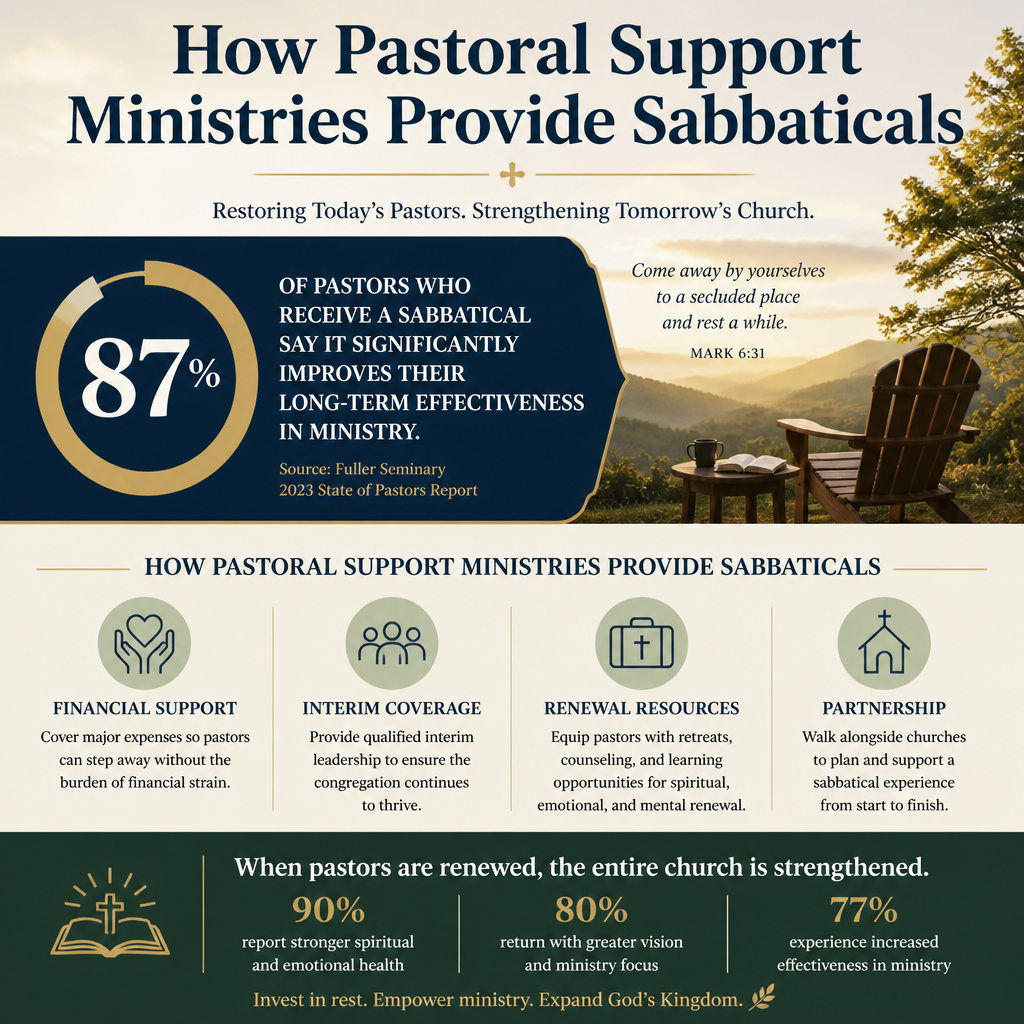
When pastoral support ministries provide sabbaticals well, they do more than write a check. They coordinate a coherent season with a start date, end date, and boundaries that protect the purpose of the time away. This often includes coaching for the pastor and spouse, guidance for the church board, and transitional preaching or pulpit supply so the congregation is not left scrambling.
Financially, the most common costs are straightforward: temporary preaching support, counseling or spiritual direction, retreat expenses, and sometimes a limited travel component oriented toward rest and reflection rather than ministry networking. In some cases, ministries also underwrite childcare support or a short-term household burden that would otherwise make the sabbatical impossible.
Duration and cadence vary, and donors should ask why
Some church traditions normalize periodic sabbaticals, while others view them as exceptional. Pastoral support ministries may fund sabbaticals of four to twelve weeks, and some advocate longer seasons for pastors in unusually complex contexts. Donors should be cautious about one-size-fits-all rules. A sabbatical for a pastor coming out of a season of trauma care in a small community may need a different shape than one for a pastor in a stable multi-staff church.

What this means in practice is that donors should ask not merely, “How long is the sabbatical?” but “What is the ministry’s theory of pastoral recovery and renewal, and how does it avoid sentimental promises?” Strong programs are explicit: rest is real, but it must be integrated into a durable rhythm of life and leadership.
How to evaluate a sabbatical ministry with donor-level diligence
Governance and boundaries protect both the pastor and the donor
Sabbaticals touch money, confidentiality, and pastoral vulnerability. That combination can attract poor governance: blurred lines, informal decision-making, or overly personality-driven leadership. Donors should expect basic protections: clear eligibility criteria, written agreements, and an independent board that can say “no” when needed.
Across our verification work at Most Trusted, we observe that ministries aligned with The Most Trusted Standard tend to document their decision processes and clarify the respective roles of the pastor, the church’s governing body, and the sabbatical provider. That is not bureaucratic fussiness; it is a guardrail against spiritual harm and financial misdirection.
Transparency should extend beyond finances to outcomes and learning
Outcome measurement in soul care is difficult. Not everything that matters can be counted, and donors should not demand pseudo-precision. Still, credible sabbatical ministries can report concrete indicators: completion rates, adherence to stated boundaries, post-sabbatical reintegration plans, and patterns of recurring need that signal whether the ministry is treating symptoms or helping address root causes.
When ministries publish learning—what worked, what did not, what they changed—they communicate seriousness. Donors who care about the church’s long-term health should reward that posture. It is consistent with the biblical ethic of walking in the light (1 John 1:7), applied to organizational life.
- Eligibility clarity: tenure requirements, church endorsement, and disqualifying conflicts of interest
- Written sabbatical plan: goals, boundaries, communication limits, and schedule
- Church readiness: board commitments, interim preaching, and congregational communication
- Financial integrity: restricted funds handled properly and expenses documented
- Post-sabbatical reintegration: coaching, accountability, and workload adjustments
Why sabbaticals can fail and what mature programs do differently
A sabbatical cannot compensate for an unsustainable church system
Some congregations quietly assume a sabbatical will “fix” what is actually a governance problem: unclear authority, unmanaged conflict, or chronic role confusion. If the pastor returns to the same expectations—unbounded availability, unprocessed criticism, and perpetual crisis management—then the sabbatical becomes a temporary relief that intensifies future disappointment.
Pastoral support ministries that take the church seriously, not only the pastor, will require some form of institutional participation. That may include a board coaching process, a leadership handoff plan, or a commitment to adjust workload expectations. Donors should view these requirements as marks of maturity, not obstacles to compassion.
Some programs mistake activity for renewal
A second failure mode is a sabbatical packed with conferences, preaching invitations, and travel that simply relocates the same pace. Pastors can return more tired, not less, and the congregation can feel abandoned without gaining the benefits of a rested shepherd. A credible sabbatical plan is intentionally quieter than ordinary ministry, with the pastor’s spiritual and physical health treated as a legitimate stewardship concern.
Research on clergy well-being underscores that the pressures are real, even if the reasons vary by context. For example, Barna has reported high levels of stress among pastors in the years following the pandemic disruptions, with many describing their role as overwhelming at points during that period. Donors who want to understand the broader context can review Barna’s research hub here: Barna.
How donors can fund sabbaticals without undermining the local church
Give in ways that strengthen, rather than replace, congregational responsibility
Christian donors are rightly cautious about anything that could weaken a congregation’s obligations to its own shepherds. A healthy sabbatical ministry does not remove responsibility from the local church; it helps a church fulfill it. The ideal posture is partnership: the church contributes financially where possible, the ministry provides structure and support, and the donor helps close the gap so that smaller or economically constrained congregations are not excluded.
When donors ask whether a sabbatical ministry is a wise investment, it is appropriate to examine whether it cultivates long-term practices in the churches it serves. The aim is not merely a rested pastor but a more faithful congregation—one that understands limits, honors family life, and structures leadership so that the church is not dependent on one person’s constant availability.
Verification helps donors distinguish seriousness from sentiment
Because sabbatical work is relational and often confidential, it can be difficult for donors to assess quality from public marketing alone. This is one reason verification exists. Most Trusted evaluates ministries against The Most Trusted Standard, examining faith commitments, financial integrity, governance and leadership practices, and transparency and effectiveness in ways that donors can actually use.
Donors who are considering sabbatical support as part of a broader concern for church health will often benefit from surveying the wider landscape of Pastoral Support Ministries. Those who are specifically focused on prevention rather than crisis response can also explore How Pastoral Support Ministries Prevent Pastor Burnout as a category of giving priorities and due diligence questions.
FAQs for How pastoral support ministries provide sabbaticals
Should donors fund sabbaticals directly for a pastor or through a ministry?
Direct gifts can be appropriate in limited cases, but they raise governance and accountability questions. Giving through a qualified pastoral support ministry can add structure: written plans, objective eligibility, and clear financial handling. The best approach is often a partnership in which the local church remains responsible and the ministry provides a disciplined framework that donors can trust.
What evidence should donors expect that a sabbatical was worthwhile?
Donors should not demand simplistic metrics for spiritual renewal, but they can expect verifiable indicators: a completed sabbatical plan, documented boundaries (including communication limits), a post-sabbatical reintegration process, and clear reporting on how funds were used. Mature ministries also share what they learned and what they changed as a result, which is often a stronger signal of integrity than polished success stories.
A prudent act of care for the church’s future
Sabbaticals are not a luxury item for an elite clergy class. Properly structured, they are a prudent act of care that honors God’s design for rest and protects congregations from avoidable harm. For donors, the question is not whether pastors “deserve” a sabbatical, but whether a particular ministry provides sabbaticals with clarity, accountability, and a theologically grounded understanding of what renewal is for.



