

How restricted gifts work in orphan care ministries is not a niche administrative question. It is a stewardship question that touches donor intent, child protection, and a ministry’s ability to act wisely when circumstances change. For Christian donors, restrictions can be an act of love when they align with a ministry’s calling and real needs; they can also become a hidden source of distortion when they push an organization to serve the gift rather than the child.
Scripture does not treat money as morally neutral. Jesus’ teaching assumes that funds are always spiritually freighted, because they reveal what we trust and what we fear. In orphan care, the weight is heavier still: a restricted gift can either strengthen a family-based, trauma-informed approach or inadvertently subsidize models the field has had to reconsider.
Restricted gifts are a promise about purpose, not a preference
What a restriction actually means
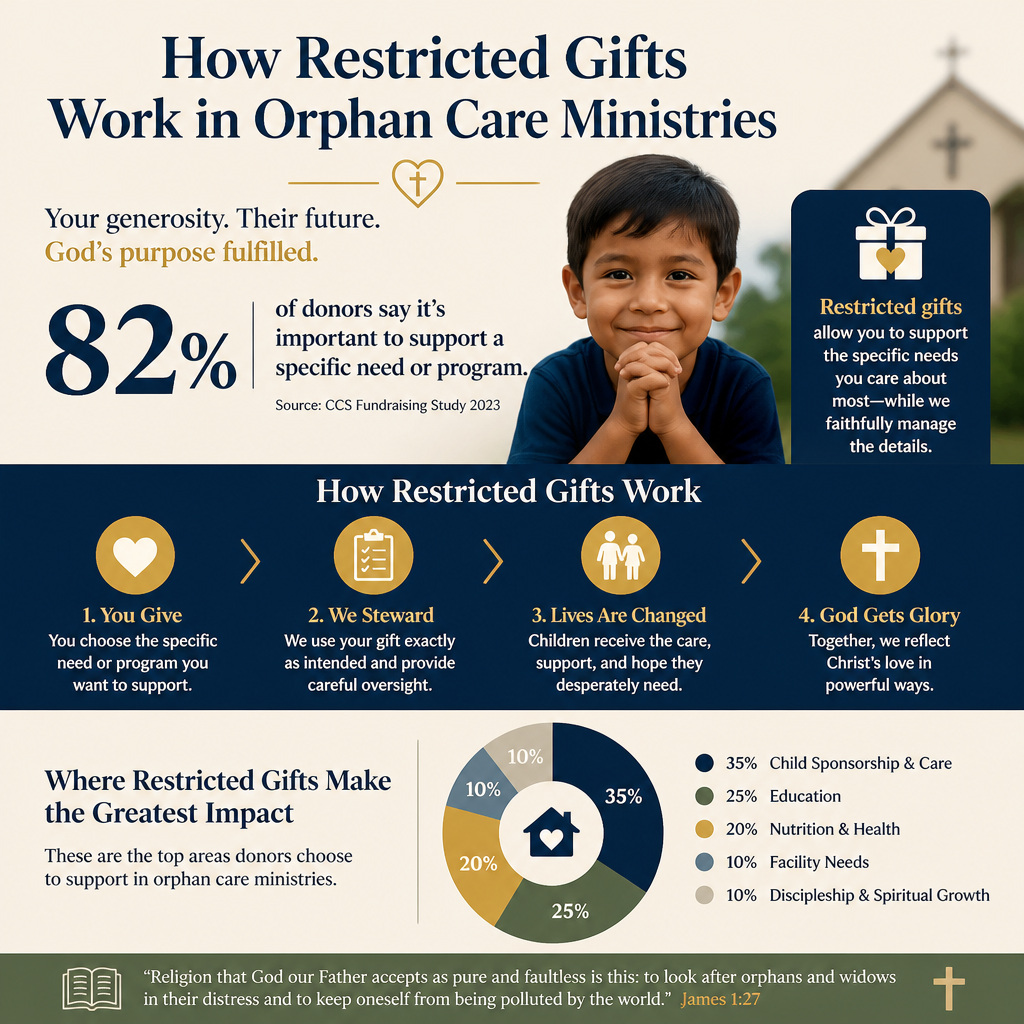
A restricted gift is a donation the donor designates for a specific purpose, program, geography, or time period, and the ministry accepts the gift under those terms. Once accepted, the restriction is not a suggestion. It becomes a binding obligation under nonprofit law and accounting standards, and it should be treated by Christian ministries as a matter of truthfulness.
In practical terms, restricted gifts usually fall into two categories. “Purpose restrictions” limit what the funds can be spent on (for example, “for family reunification services in Uganda”). “Time restrictions” limit when the funds can be used (for example, “to be spent in the 2026 fiscal year”). Donors also sometimes create restrictions that function like a contract: milestones, reporting requirements, or a requirement to return unspent funds.
Restricted does not mean more righteous
Many donors assume restricted giving is automatically more responsible because it feels like control. But Christian stewardship is not synonymous with donor control; it is careful alignment of resources with God-honoring ends. A restricted gift can be wise when it is grounded in credible evidence, a ministry’s stated strategy, and a clear understanding of what outcomes are realistic.
Across our verification work at Most Trusted, the ministries that meet The Most Trusted Standard tend to treat restrictions with an unusual seriousness: they define them clearly, accept them sparingly, and document them carefully. That posture protects donors, but it also protects the children and families whose lives are affected by financial incentives.

Orphan care funding creates incentives that can bless or bend the mission
Why the field has had to grow up
Orphan care has drawn sincere Christian compassion for generations, and Scripture’s charge is unambiguous. At the same time, modern child welfare research has pressed the church to distinguish between caring for children and funding institutionalization. The research consensus is not that every residential program is wrong; it is that large-scale institutional care is associated with significant developmental harm, and that family-based care is generally preferable when it is safe and feasible.
One widely cited synthesis, the Better Care Network’s The Risk of Harm in Institutional Care (led by Mulheir and colleagues), summarizes evidence that institutional care is linked with delayed development and attachment disruptions, particularly for young children; see Better Care Network.
Restrictions can unintentionally subsidize the wrong metric
Restrictions often follow emotionally compelling categories: “for orphanage beds,” “for building a children’s home,” “for Christmas gifts for orphans.” Those categories can create financial pressure to keep beds full, expand institutions, or prioritize visible giving over durable change. Christians genuinely disagree about how to weigh immediate relief against long-term system reform, but the incentive problem is not hypothetical.
This is one reason sophisticated orphan care ministries have shifted toward kinship care support, family reunification, domestic adoption support where appropriate, and prevention services. Donors who care about measurable long-term good often need to ask not only, “Is my gift restricted?” but “Is my restriction consistent with best-practice child welfare and with the ministry’s own theory of change?”
How restrictions are handled in real ministry finance
The accounting and internal controls donors rarely see
When a ministry accepts restricted funds, sound practice requires the organization to track those funds separately in its accounting system and to document releases of restriction when the funds are used for the designated purpose. A ministry should be able to show, with ordinary bookkeeping evidence, that restricted dollars were spent as promised. For larger ministries, audited financial statements and the accompanying notes often describe how restricted net assets are categorized.
Donors sometimes ask whether restricted dollars are kept in a separate bank account. Not necessarily. What matters is not a separate bank account but a reliable ledger, good controls, and leadership integrity. Weak controls can create an appearance of compliance while leaving significant room for misallocation.
Why “general operating” is often the most honest option
Many donors hesitate to give unrestricted support because they fear waste. Yet general operating support is frequently what enables responsible child protection: trained social workers, background checks, case management, safeguarding systems, and supervision. The Overhead Myth letter, signed by leading evaluators, argues that overhead ratios are a poor proxy for impact and can drive unhealthy nonprofit behavior; see Charity Navigator.
In orphan care, the “unseen” costs are often the difference between good intentions and safe practice. When donors restrict too tightly—especially to “direct care” only—they may inadvertently starve the very systems that prevent harm.
How to restrict wisely without distorting the ministry
Start with the ministry’s stated strategy and safeguards
Wise restrictions are usually written in the ministry’s own language, not the donor’s. A donor-imposed category that does not match the organization’s program structure is a warning sign. If the ministry cannot describe how the restricted funds will be used within its existing budget, chart of accounts, and safeguarding approach, the restriction is likely to create confusion or pressure.
Donors also do well to evaluate whether the organization’s approach reflects established principles in Christian development and poverty alleviation. The When Helping Hurts framework, articulated by Steve Corbett and Brian Fikkert, helped many Christian ministries recognize how paternalism and dependency can be reinforced by well-meant giving. In orphan care, similar dynamics appear when donors fund visible institutions rather than durable family systems.
Questions we recommend asking before you restrict
- How does this restriction support family-based care, reunification, or safe permanency where possible?
- What child safeguarding policies govern the program this gift will fund?
- How will the ministry track and report restricted funds in its accounting system?
- What happens if the need changes or the program closes before funds are spent?
- Does the ministry have a policy for declining restrictions that would distort its strategy?
These questions are not a test of friendliness; they are a test of maturity. The ministries best positioned for long-term faithfulness welcome them, because clarity protects their mission and the children they serve.
For donors who want a broader view of the field’s models and the debates that shape them, we maintain editorial context in Orphan Care Ministries.
Where restrictions go wrong and how trustworthy ministries respond
Common failure modes donors should name plainly
Restrictions go wrong in several predictable ways. Some are benign misunderstandings; others reflect serious governance weakness. A donor may restrict funds to a program that does not exist, or to a project the ministry has not approved internally. A ministry may accept an overly specific restriction because it needs cash flow, then quietly repurpose funds when reality changes. Or an organization may rely on restricted gifts to fund core staff, creating chronic instability when designated funding fluctuates.
In orphan care, a particularly concerning failure mode is using restricted giving to maintain institutional capacity—buildings, beds, staffing levels—after the ministry’s stated strategy has shifted toward family-based alternatives. The financial inertia can become a theological and ethical problem: the organization knows what is better, but cannot afford to change.
What strong governance and transparency look like
Trustworthy ministries do not treat restrictions as a fundraising trick. They define them in writing, confirm them in gift acknowledgments, and keep internal approvals aligned. They also build “escape hatches” that are honest rather than convenient: language that allows the ministry to redirect funds to the closest comparable purpose if the original purpose becomes impossible or unwise, with appropriate notice to the donor.
Across our work evaluating organizations against The Most Trusted Standard, we look for evidence that boards and senior leaders understand restricted funds as both a financial and moral obligation. We also look for transparency that is more than marketing: clear program descriptions, accessible financial reporting, and evidence that outcomes drive decisions rather than donor sentiment.
Donors who are also thinking about documentation and tax receipting considerations can find additional context in Tax Receipts and Stewardship for Orphan Care Donors.
FAQs for How restricted gifts work in orphan care ministries
Can a ministry change how it uses a restricted gift if needs change?
Not unilaterally. If a gift is restricted and accepted, the ministry is obligated to use it as designated. If circumstances change, trustworthy ministries seek written donor permission to amend the restriction or apply the funds to a closely related purpose defined in the original gift language. When donor contact is not possible, options can be limited and may require legal counsel or court involvement depending on the jurisdiction and the size of the funds.
Is it better to give restricted or unrestricted support to orphan care ministries?
Either can be faithful stewardship, depending on the ministry and the purpose. Restricted giving can be prudent when it aligns with a well-governed organization’s strategy and safeguards, especially for time-bound projects with clear budgets. Unrestricted giving is often what sustains the systems that keep children safe and programs accountable. The more complex and case-based the work is—reunification, foster care support, trauma counseling—the more valuable flexible funding tends to be.
A faithful restriction is clear, lawful, and ordered toward the child’s good
Restricted giving is best understood as a covenantal clarity: the donor names a purpose, the ministry accepts it, and both commit to integrity in how funds are handled. In orphan care, where financial incentives can quietly shape practice, restrictions should be written with humility and with a clear view of what actually helps children flourish. The strongest ministries do not rely on donor emotion to guide their budgets; they invite donors into mature stewardship grounded in truth, accountability, and the long obedience of wise care.



