
How planned giving works for orphan care ministries is ultimately a question of stewardship: how Christians can align what we will someday leave behind with what Scripture requires of us now. Planned gifts are not merely financial instruments; they are a way of ordering loves, declaring that vulnerable children and families matter not only to our present generosity but also to our long-term estate decisions.
Orphan care is also a field where mature generosity must be disciplined generosity. Christians give because God is “a father to the fatherless” (Psalm 68:5), yet many donors have learned that certain models of care can unintentionally separate children from families, reward institutions for keeping beds filled, or fund well-meaning programs with weak safeguarding. Planned giving can either deepen these dynamics or help correct them, depending on how carefully donors choose both the ministry and the gift structure.
Planned giving is a stewardship decision with spiritual and practical consequences
What planned giving is and what it is not
Planned giving refers to gifts arranged during a donor’s lifetime but typically realized later, often at death. In practice this includes bequests in a will, beneficiary designations on retirement accounts, gifts of appreciated assets, and life-income arrangements such as charitable gift annuities or charitable remainder trusts. The distinguishing feature is not complexity; it is timing and intent. Planned gifts are designed, documented, and coordinated with an overall estate plan.
Planned giving is not a substitute for present generosity or for wise engagement with the realities of orphan care. A bequest does not absolve a donor from asking hard questions now about family preservation, reintegration, trauma-informed care, or safeguarding. The New Testament assumes that faith expresses itself in concrete obedience over time, not in deferred goodwill (James 2:15–17).
Why orphan care donors are drawn to planned gifts
Many Christian donors are drawn to orphan care because the need feels immediate and personal. Planned giving adds a different dimension: it makes it possible to fund work that takes years, such as supporting kinship placements, building local child protection capacity, training social workers, or sustaining post-care discipleship for young adults. These are not one-time interventions; they require patient capital and institutional integrity.
For donors with significant retirement assets, planned giving can also be a way to give more generously than is possible from annual cash flow. The National Center for Charitable Statistics reports that charitable giving in the United States totaled $557.16 billion in 2023, with individuals providing the largest share.National Center for Charitable Statistics Estate gifts are one part of that ecosystem, and for certain households they become the most consequential gifts they ever make.

Common planned gift structures and how they apply to orphan care
Bequests and beneficiary designations
The simplest planned gift is a bequest: naming an orphan care ministry in a will or living trust. Donors can leave a specific amount, a percentage of the estate, or the “residue” after other obligations are met. Many donors prefer percentages because they adjust with the size of the estate and reduce the risk of unintentionally underfunding family needs.
Beneficiary designations often matter even more. Retirement accounts and life insurance policies pass by contract, not by will. A donor can name an orphan care ministry directly as a beneficiary. This can be particularly tax-efficient in some jurisdictions because retirement assets may otherwise be subject to income tax when inherited by individuals. Because rules vary and change, donors should coordinate with a qualified attorney and tax advisor rather than assume a strategy is universally beneficial.
Appreciated assets and complex gifts
Some donors hold highly appreciated stock, real estate, or business interests. Donating appreciated assets can avoid capital gains tax in many cases while providing the ministry with resources for its work. This is where planned giving intersects with ministry capacity: orphan care organizations need competent finance teams, clear gift acceptance policies, and governance oversight to receive and manage non-cash gifts ethically.

More complex arrangements can include charitable gift annuities and charitable remainder trusts, which may provide income to the donor or another beneficiary while ultimately benefiting the ministry. These tools can be appropriate, but they require careful documentation and a sober assessment of the ministry’s administrative maturity. In orphan care, donors should be especially cautious that complex gifts do not inadvertently direct resources away from safeguarding, family tracing, or reintegration work that may not photograph well but protects children.
What responsible orphan care requires from a planned giving relationship
Funding models that protect children and strengthen families
Christian donors genuinely disagree about the best models for orphan care, particularly in contexts where foster care systems are weak or where poverty and conflict have displaced families. But the field has had to reckon with a central principle: children generally thrive best in stable family environments, and institutional care should be a last resort and as temporary as possible. The evidence base for harm associated with institutionalization is substantial, including research synthesized by the Better Care Network and UNICEF initiatives focused on deinstitutionalization and family-based care.Better Care Network
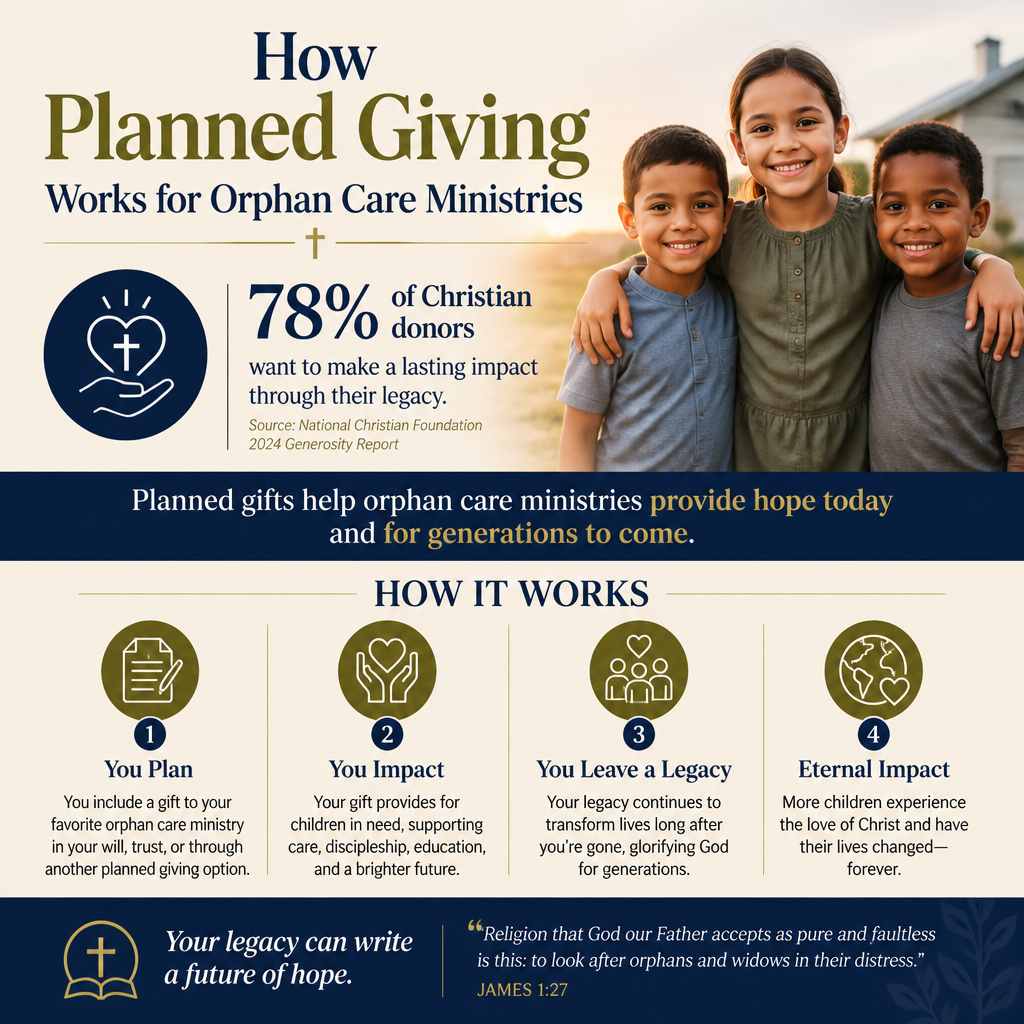
What this means in practice is that a planned gift aligned with biblical compassion should not merely keep an institution open; it should strengthen the pathways that reduce the need for institutionalization. Donors can look for ministries that invest in family preservation, kinship care, domestic adoption where appropriate, reintegration services, and local church-based support that reduces the economic and social pressures that separate families.
Safeguarding, governance, and long-horizon accountability
Planned gifts are “long-horizon” commitments. They may be received years after the donor signs paperwork, and ministries can change dramatically in that time. This makes governance and safeguarding more central, not less. Policies for child protection, background checks, staff training, and incident reporting must be explicit and enforced. Board oversight must be real, not ceremonial. Financial statements should be timely and accessible.
Across our verification work at Most Trusted, we find that the ministries that meet The Most Trusted Standard tend to treat safeguarding as a governance issue, not a program detail. They also tend to communicate clearly about how decisions are made, how conflicts of interest are managed, and what evidence they use to assess outcomes. Those traits matter in annual giving, but they become decisive when a donor’s largest gift may arrive when that donor is no longer present to ask questions.
How to evaluate an orphan care ministry before making a planned gift
Due diligence that matches the moral weight of the gift
Planned giving often begins with a simple question: “We love this ministry—should we include it in our estate plan?” The harder question is whether the ministry’s model of care, governance, and transparency will still deserve trust when the gift is eventually received. A donor cannot control the future, but a donor can insist on present evidence of integrity.
For donors seeking a wider view of the landscape, we encourage engagement with the broader field of Orphan Care Ministries rather than relying on brand familiarity alone. Mature giving requires understanding the range of models—residential care, foster care support, family strengthening, and post-care transition—and the risks and strengths that attend each.
Practical indicators to ask about
A responsible planned gift is easier to make when donors ask a consistent set of questions. The goal is not suspicion; it is clarity. We recommend focusing on indicators that reveal whether a ministry can be trusted with vulnerable children and with long-term donor intent:
- Does the ministry prioritize family preservation and reintegration when safe and possible, with documented processes?
- Are child safeguarding policies public, enforced, and overseen by leadership and the board?
- Is financial reporting clear, current, and independently reviewed or audited when appropriate?
- Does the ministry disclose leadership structure, board composition, and conflict-of-interest policies?
- Can the ministry explain outcomes in concrete terms beyond stories and photography, including hard cases and limits?
When donors want to connect these questions to tax documentation and responsible receipting practices, the category Tax Receipts and Stewardship for Orphan Care Donors is often where the most practical confusion arises. Many planned gifts do not produce an immediate charitable receipt, and donors can be surprised by how different the documentation requirements are across gift types.
Documentation, restrictions, and the stewardship tensions donors should name
How receipts and acknowledgments typically work
Some planned gifts generate an immediate receipt; many do not. A bequest intention in a will generally does not create a deductible charitable contribution at the time it is written. A completed gift of appreciated securities generally does. Life-income arrangements can have partial deductions subject to complex rules. Because donors often cross state lines and use different custodians, the details matter and should be confirmed with qualified counsel.
What ministries should do, however, is consistent: provide timely written acknowledgment for completed gifts, avoid valuing non-cash gifts on the donor’s behalf, and maintain documentation that reflects donor intent. The Internal Revenue Service provides detailed guidance on substantiation for charitable contributions, including rules for non-cash gifts and contemporaneous written acknowledgments.Internal Revenue Service
Restricted gifts and the risk of unintended consequences
Many donors want to restrict a planned gift to a particular program: a home, a campus, a scholarship fund, or a specific country. Sometimes restrictions are appropriate, especially when a donor is supporting a well-defined initiative with clear accountability. But restrictions can also create long-term burdens or distort ministry priorities, particularly in orphan care where best practice has shifted away from large institutions and toward family-based alternatives.
We encourage donors to consider language that supports a mission while preserving prudent flexibility. A donor might designate funds for “family-based care and reintegration” rather than for “building expansion,” or for “child safeguarding and caregiver training” rather than for “increasing bed capacity.” This is not merely strategic. It reflects a theological commitment to protect the vulnerable rather than perpetuate a system because it is familiar.
The When Helping Hurts framework, articulated by Steve Corbett and Brian Fikkert, has helped many Christian donors and ministries name the ways good intentions can reinforce dependency or undermine local agency. Planned gifts can either entrench those patterns or help fund the slower work of capacity, discipleship, and local ownership that honors the image of God in families and communities.
FAQs for How planned giving works for orphan care ministries
Should we restrict a planned gift to an orphanage building or residential program?
Restrictions should follow evidence, not nostalgia. In many contexts, best practice has shifted toward family-based care, reintegration, and prevention, with residential care used sparingly and temporarily. If a donor restricts a gift to a building or bed capacity, the gift may unintentionally incentivize institutionalization. When restrictions are appropriate, we recommend aligning them with child protection, caregiver training, family tracing, reintegration services, and other elements that reduce long-term reliance on institutions.
Can we name an orphan care ministry as a beneficiary of our IRA or life insurance?
Yes. Beneficiary designations are a common planned giving method and can be straightforward to execute through the account custodian. Because retirement assets and life insurance pass by contract, donors should coordinate beneficiary choices with an attorney to ensure the designations align with the broader estate plan. Tax effects vary by jurisdiction and asset type, so donors should also confirm the implications with a qualified tax advisor.
A planned gift should be as carefully chosen as it is generously offered
Planned giving can honor God by extending the horizon of Christian generosity, but it also fixes a decision in place. Orphan care ministries work in a domain where incentives matter and where children bear the cost of institutional weakness. The wise course is to pair generosity with verification, to ask for evidence of safeguarding and governance, and to direct long-term resources toward models that strengthen families and protect children. That combination is not caution for its own sake; it is a concrete form of love.



