
Knowing how to spot red flags in orphan care ministries is not a secondary skill for Christian donors. Scripture binds care for vulnerable children to the character of God himself, and yet the modern orphan care movement has had to reckon with a sobering reality: sincere compassion can still produce harm when it is ungoverned by truth, accountability, and a clear model of what actually helps children flourish.
The harder question is not whether Christians should care for children without parental protection. The harder question is how to discern which ministries are strengthening families and protecting children, and which are quietly incentivizing separation, dependency, or institutionalization. Across our verification work at Most Trusted, patterns repeat. The warning signs are usually visible long before a scandal becomes public, but donors often lack a framework for seeing them.
Begin with the child protection model, not the marketing
Orphan care language can be emotionally powerful because it touches a genuine biblical mandate. But credibility begins where safeguarding begins: in a ministry’s child protection model and its willingness to submit that model to external scrutiny. Ministries that operate with vague assurances rather than documented policies should not receive the church’s money.
Red flag: institutional dependency as the default
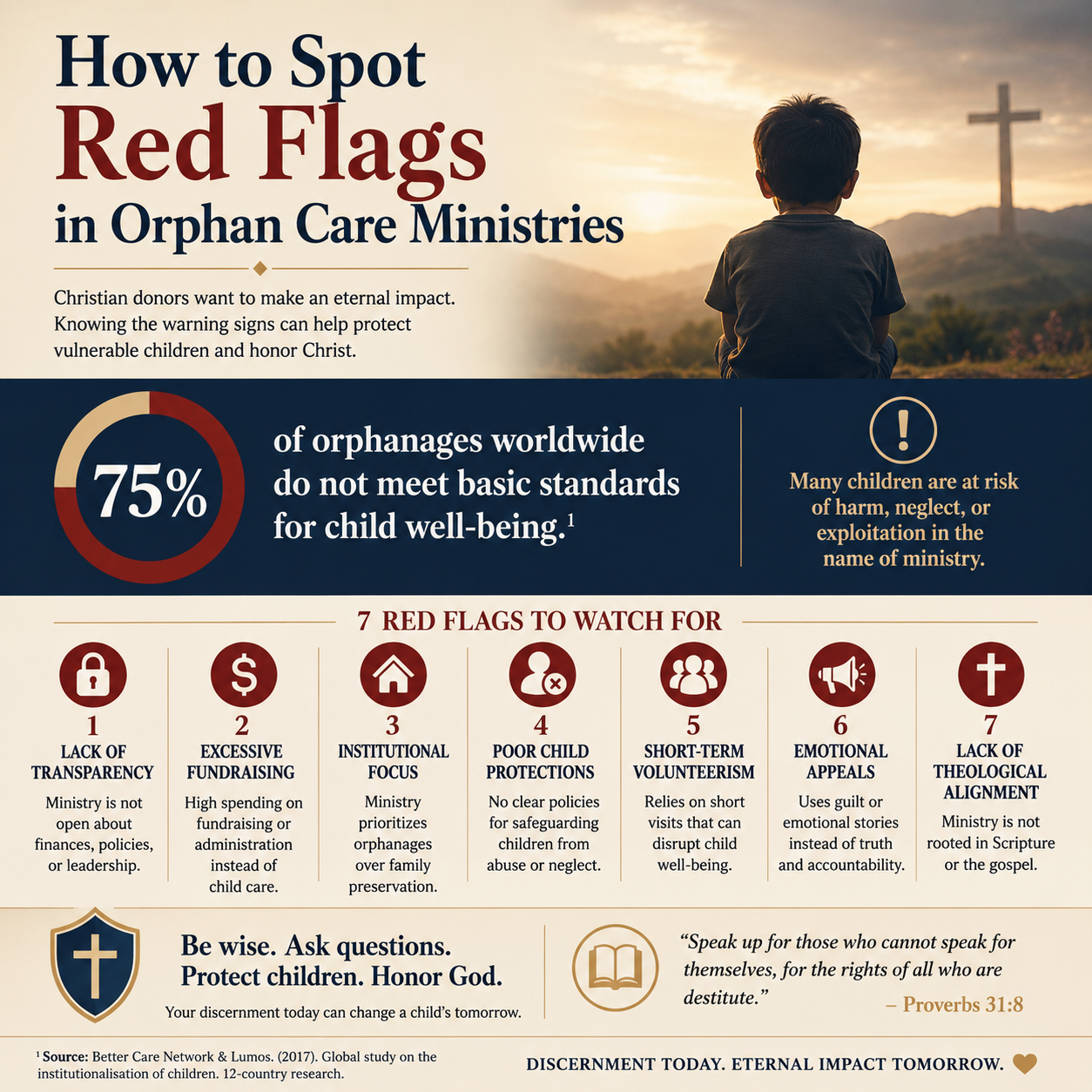
Christians genuinely disagree about how quickly orphanages should be phased out in different contexts. Still, a ministry that treats residential care as the first resort rather than the last resort is moving against the direction of the best available child development evidence and the mainstream consensus of child welfare practice. A helpful reference point is the U.S. government’s own guidance on the harms associated with institutional care and the preference for family-based alternatives when safely possible, reflected in USAID’s guidance on children in adversity and deinstitutionalization USAID.
That does not mean every residential program is automatically illegitimate. It does mean a donor should ask whether residential placement is time-limited, trauma-informed, independently monitored, and explicitly aimed at reunification or family-based placement wherever possible.
Red flag: a ministry cannot explain how children entered care
Responsible orphan care ministries can describe, plainly and consistently, how children arrive, who authorizes placement, what documentation exists, and how guardianship decisions are made. Evasion here is not a communications problem; it is often a systems problem. When a ministry cannot show that intake is legally documented and ethically justified, the risk of family separation for the sake of funding becomes more than theoretical.

Follow the incentives that funding creates
In orphan care, funding can shape outcomes more directly than donors prefer to admit. If money flows most reliably to visible residential programs and compelling child profiles, ministries will feel pressure to keep beds full and stories emotionally high-stakes. The church has seen this dynamic repeatedly across humanitarian work: donors unintentionally fund the presentation of need rather than the reduction of need.
Red flag: child sponsorship that functions as child marketing
Child sponsorship can be structured responsibly, but it carries predictable risks: privacy violations, distorted reporting, and implicit commodification of a child’s story. A ministry that features identifiable children, discloses sensitive details, or uses manipulative narratives is signaling that fundraising priorities have outrun child dignity. Mature organizations show donors aggregated impact where possible, limit identifying details, obtain documented consent where appropriate, and align communications with safeguarding standards.
Red flag: the ministry grows by growing institutional capacity
Some organizations measure success by how many children they house or how many buildings they build. But a theologically serious definition of success asks whether the ministry is strengthening what God designed as the ordinary place of nurture: family, church, and community. Growth that depends on maintaining a pipeline of children into institutions should alarm the donor, even when the buildings are clean and the staff are sincere.
When giving decisions feel difficult, it often helps to step back into the wider ecosystem of this work. Many donors find it clarifying to explore Orphan Care Ministries with an eye toward family preservation, reintegration, and safeguarding as primary categories rather than as program add-ons.
Test governance and financial integrity as spiritual matters
Jesus treated money as a spiritual diagnostic, not because budgets are inherently holy, but because money reveals what leaders fear, trust, and serve. In orphan care, weak governance does not simply risk inefficiency. It can endanger children by removing the controls that prevent exploitation, cover-ups, and retaliatory cultures.
Red flag: a board that appears ornamental
Responsible ministries can name who governs them, how the board is selected, what oversight the board exercises, and how conflicts of interest are handled. When leadership and board are indistinguishable, when a founder is functionally unaccountable, or when board information is absent, donors should assume risk is elevated. The New Testament’s insistence on tested character and accountable leadership in the church is not a formality; it is protection for the vulnerable.
Red flag: financial reporting that is delayed, inconsistent, or selective
Most Christian donors understand that overhead ratios do not tell the whole story. The sector itself has warned against simplistic overhead fixation, as reflected in the joint “Overhead Myth” letter endorsed by Charity Navigator, Candid, and the BBB Wise Giving Alliance Charity Navigator. Still, transparency is not optional. A ministry should provide timely financial statements, clear program descriptions that match spending realities, and credible external review appropriate to its size and risk profile.
Across our work, the ministries that meet The Most Trusted Standard tend to treat financial clarity as part of discipleship: truthful reporting, sober budgeting, and governance practices that do not rely on donor naivety or emergency appeals as a permanent operating model.
Scrutinize claims of impact, especially where measurement is hard
Orphan care outcomes are difficult to measure well. Attachment, trauma recovery, family stability, and long-term flourishing are not easily reduced to a dashboard. But difficulty is not an excuse for vagueness. When ministries claim transforming results without describing methods, limitations, or independent evaluation, donors should slow down.
Red flag: ministry language that bypasses evidence
Phrases such as “rescued,” “saved from the streets,” or “guaranteed a future” can obscure the realities of complex family systems and local child welfare structures. Christians do believe in rescue and redemption, but we also believe truth matters. Responsible communication distinguishes between prevention, temporary care, reintegration, adoption, education support, and economic strengthening. It does not collapse all outcomes into a single heroic narrative.
Red flag: short-term teams placed in relationally intense roles
Short-term missions can serve the church when they are structured humbly and under local authority. In residential child settings, however, repeated cycles of attachment and separation can compound trauma. A ministry that routinely places visiting teams in positions of direct caregiving, physical affection, or emotionally intimate interaction with children should be able to defend that practice under a safeguarding and trauma-informed rationale, not merely a “they need love” appeal.
Donors should also pay attention to whether the ministry’s programs align with the direction of widely recognized child welfare practice: prioritizing family strengthening, kinship care, and reintegration when safe. Where a ministry claims it cannot do this “because the culture is different,” ask for specifics: What partnerships exist with local social services? What reintegration outcomes are tracked? What barriers are being addressed?
Look for a culture of transparency, not a posture of defensiveness
Every orphan care ministry operates under pressure: legal complexity, trauma, local corruption risks, and intense donor expectations. Mature organizations do not pretend those pressures do not exist. They name them and build controls around them. Defensiveness, secrecy, and spiritualized dismissal of scrutiny are not marks of faith; they are often marks of fragility.
Red flag: questions are treated as disloyalty
When donors ask about safeguarding, government licensing, incident reporting, or finances, a trustworthy ministry answers directly. It may explain why some information must be protected for child privacy, but it will not use privacy as a blanket refusal. If the ministry implies that asking hard questions “hurts the mission,” it is asking donors to fund without seeing, which is the opposite of biblical stewardship.
Green flags that often accompany integrity
Discernment is not only about spotting danger. It is also about recognizing the indicators of a ministry worth long-term partnership. As donors evaluate organizations within How to Give Wisely to Orphan Care Ministries, we recommend looking for a small set of verifiable signs that commonly travel together:
- Documented child safeguarding policies, staff screening, and clear incident reporting procedures
- A stated preference for family preservation and reintegration when safe, with defined criteria and tracked outcomes
- Local governance and partnership, not merely foreign control or donor-driven priorities
- Financial transparency that is timely, consistent, and proportionate to the ministry’s size and risk
- Communications that protect child dignity, limit identifying details, and avoid manipulative storytelling
These markers do not guarantee perfection. They do indicate a ministry is building the kind of institutional humility that can bear the weight of caring for children over decades rather than seasons.
FAQs for How to spot red flags in orphan care ministries
Is it always wrong to support an orphanage or children’s home?
No. Some children face immediate danger, and some contexts lack viable foster and kinship systems. The moral question is whether residential care is treated as a last resort with a clear plan toward family-based care when safely possible, governed by strong safeguarding, and accountable to credible oversight. Donors should look for documented intake practices, legal compliance, reintegration pathways, and transparent reporting rather than assuming that clean facilities and sincere leaders equal child welfare excellence.
What questions should a Christian donor ask before giving to an orphan care ministry?
Start with safeguarding and family connection: How do children enter the program, and what documentation supports that decision? What is the ministry’s reunification and reintegration process, and what outcomes are tracked? Then ask about accountability: Who governs the organization, and what external financial review exists? Finally, ask about communications: How is child privacy protected, and how does the ministry avoid fundraising that depends on keeping children institutionalized? Ministries prepared to answer these questions directly are usually prepared to be trusted.
A discerning compassion worthy of the church
Christian donors do not have the option of choosing between compassion and discernment. Scripture calls for both. The aim is not suspicion; it is faithful stewardship that protects children, strengthens families, and refuses to fund incentives that contradict the ministry’s stated mission. When donors learn to spot red flags in orphan care ministries early, giving becomes less reactive and more covenantal: steady support for work that can withstand light, questions, and time.



