
How to vet orphan care ministries before donating is not a secondary question for Christian donors; it is part of obedience. Scripture binds orphan care to the character of God himself: “Father of the fatherless” (Psalm 68:5) and “religion that is pure and undefiled” (James 1:27). Yet the modern orphan care movement has also had to reckon with a hard truth: money that is sincerely given can still incentivize harm when it is poorly directed.
The question is not whether Christians should care for vulnerable children. The question is whether a particular ministry’s model, leadership, and claims stand up to scrutiny—and whether a donor’s gift will strengthen families and churches or unintentionally fund systems that separate children from them. Across our verification work at Most Trusted, ministries that meet The Most Trusted Standard tend to welcome this kind of examination because they see it as part of faithful stewardship rather than donor suspicion.
1. Start by clarifying what the ministry means by orphan care
Orphan care is often family care, not institutional care
Many ministries use “orphan care” as a broad label for any work involving children. Mature organizations define their terms. They distinguish between children who have lost both parents, children who have one living parent, children who are separated due to poverty, and children who are abandoned or trafficked. That clarity matters because the interventions differ: family strengthening, kinship care, foster care, adoption services, education support, or residential care.
Donors should ask for the ministry’s operating definition and its practical implications: What outcomes does the ministry pursue, and what is it willing to fund—or refuse to fund—in order to pursue them? Verifiable evidence suggests that long-term, large-scale institutionalization carries developmental risks for children. The consensus statement from the global childcare community has been that children generally do best in family-based care settings rather than institutions; UNICEF summarizes this evidence and the policy direction toward family-based alternatives on its website (UNICEF).
Residential care may sometimes be necessary, but it should be exceptional
Christians genuinely disagree about how to speak about orphanages because the term covers a wide range of realities. Some residential programs are small, family-like, and transitional; others are large, under-staffed institutions. Some operate in contexts where state foster systems are absent or unsafe. The harder question is whether residential care is a last resort within a child protection system, or a default that grows because donor dollars grow.
When a ministry relies on residential care, we recommend asking for safeguards: family tracing processes, reintegration plans, independent child protection policies, and evidence that the organization does not recruit children to fill beds. If a ministry cannot explain how it prevents perverse incentives, donors should assume those incentives are operating.
2. Examine the ministry’s theology of dignity and its practical model
Theological fidelity shows up in program design
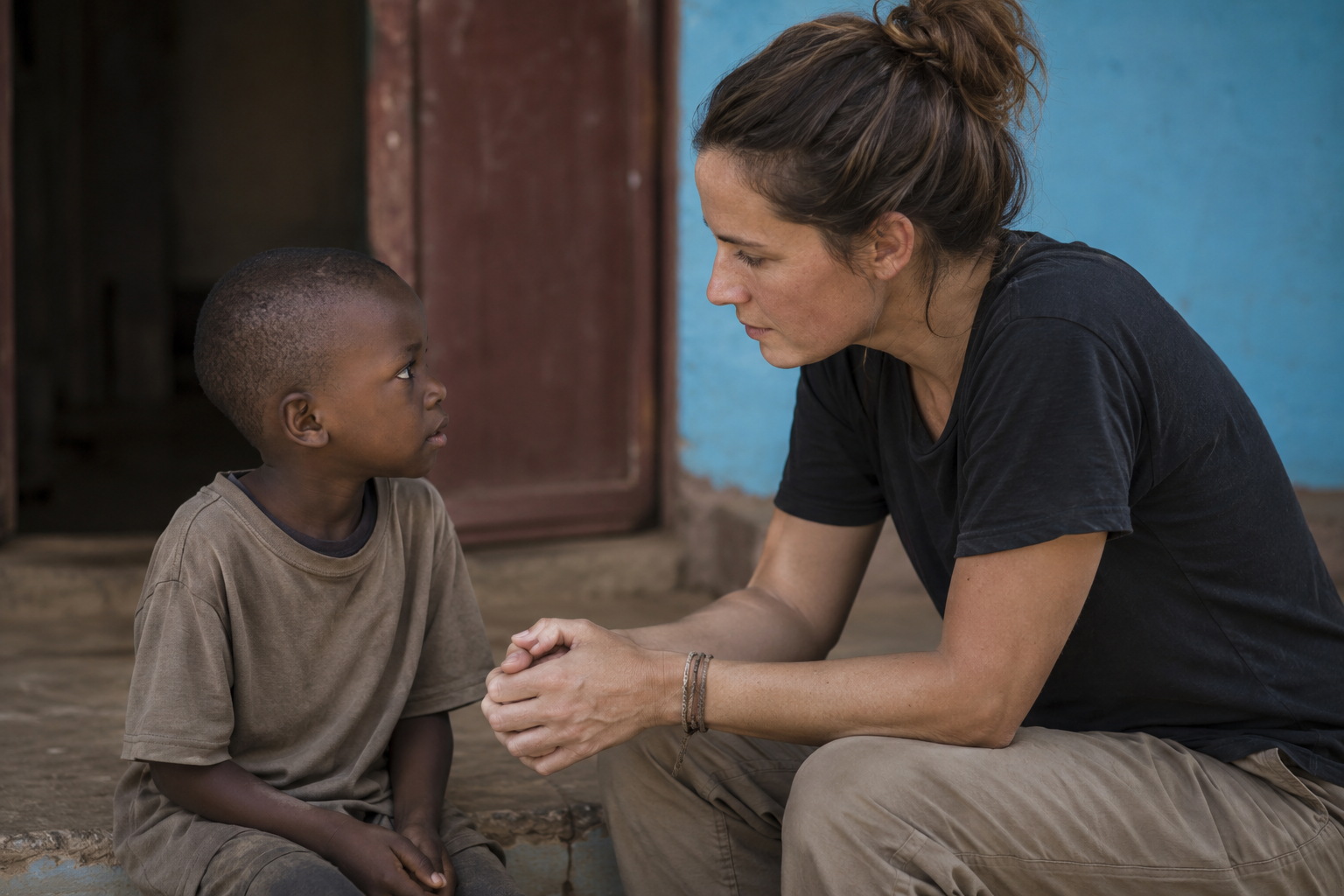
Orphan care is not merely compassion; it is justice and discipleship. A ministry can affirm orthodox doctrine and still operate in ways that unintentionally treat families as obstacles, local churches as optional, or children as fundraising narratives. Theologically serious orphan care begins with imago Dei dignity and moves outward into concrete commitments: keeping siblings together when possible, prioritizing kinship placements, and strengthening families before separation becomes inevitable.
We recommend listening for whether a ministry’s language implies rescue as the primary story, or restoration as the primary aim. The New Testament’s category of “care for the least” is never permission to bypass wise processes. Christian compassion is meant to be ordered by truth. A ministry that has internalized this will describe how it addresses root causes—poverty, disability stigma, family breakdown, violence—rather than treating institutional placement as the solution to poverty.
Look for alignment with established field frameworks
Many responsible ministries have learned from the broader Christian development conversation. The “When Helping Hurts” framework, articulated by Steve Corbett and Brian Fikkert, has reshaped how churches and donors evaluate whether help is relief, rehabilitation, or development—and whether it inadvertently undermines local agency (When Helping Hurts). In orphan care, this translates into disciplined restraint: supporting families and local systems rather than defaulting to externally run solutions.
Ask a direct question: “How does your model avoid creating dependency or displacing local responsibility?” Ministries that are prepared to answer will point to local partnerships, capacity building, and a strategy that would still make sense if foreign funding declined.
3. Demand verifiable evidence, not moving stories
Outcomes matter, but the right outcomes matter
Child-focused ministries are particularly susceptible to emotional fundraising. Stories can be true and still be selectively framed. Donors should insist on outcome claims that can be tested. A credible ministry can tell you, in ordinary language, what success looks like and how it measures it: family preservation rates, reintegration stability after 6–24 months, school attendance, reductions in repeat placements, trauma-informed caregiving practices, and child protection incident reporting.
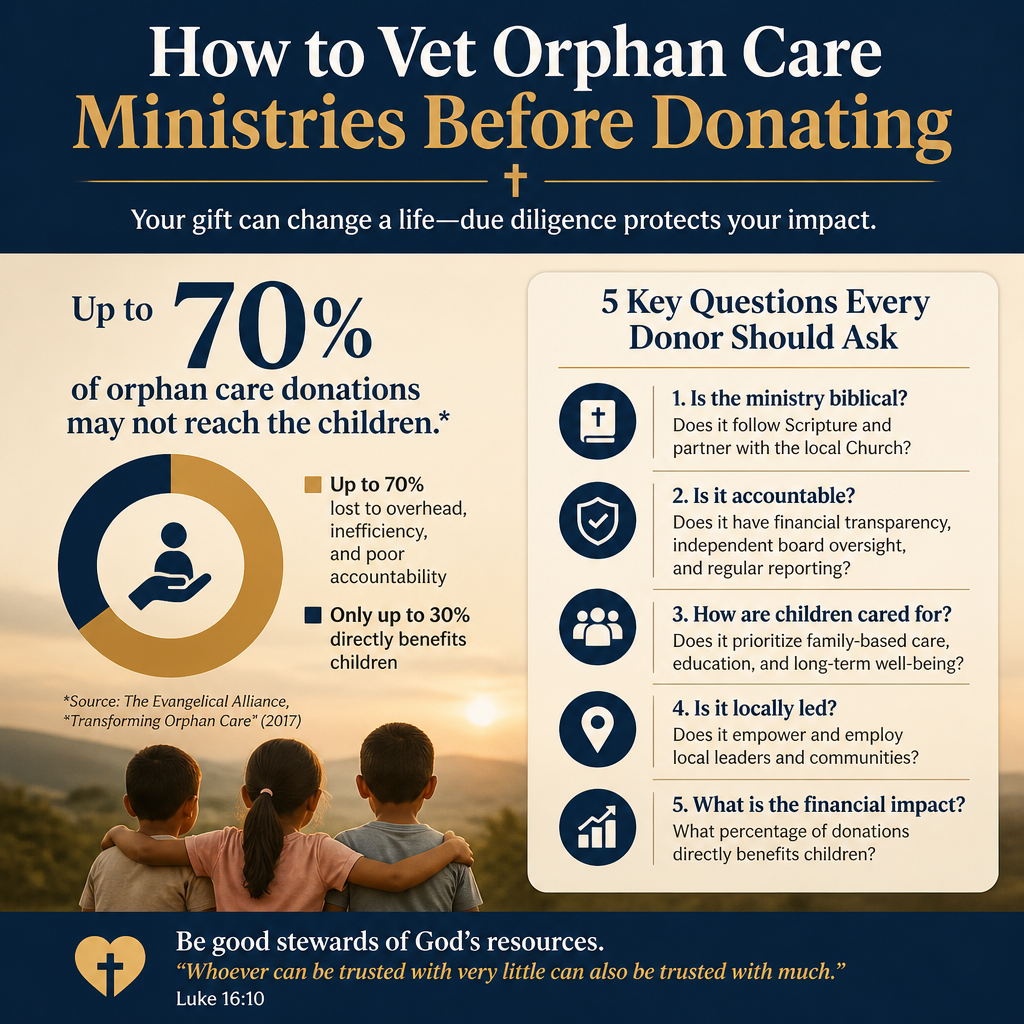
Many donors have been trained to fixate on overhead ratios. The field has largely rejected that as a primary indicator of effectiveness. The “Overhead Myth” letter—signed by GuideStar (now Candid), Charity Navigator, and the BBB Wise Giving Alliance—explains why overhead percentages are a poor proxy and can even pressure nonprofits into under-investing in necessary capacity (Candid).
Ask for the documents that serious ministries already maintain
At minimum, we recommend requesting and reading a ministry’s annual report, audited financials (or reviewed statements for smaller organizations), child safeguarding policy, and a clear description of governance and decision-making. If the ministry operates overseas, ask whether it complies with relevant local registration and child welfare regulations, and whether it uses third-party monitoring in high-risk settings.
Donors should also look for congruence across channels: the website, the annual report, the audited financials, and leadership communications should tell the same story. When the public narrative is simpler than the internal documentation, that may be reasonable. When the narratives conflict, it is not.
- Annual report with program outcomes and candid limitations
- Independent audit or financial review appropriate to size and complexity
- Board list and governance disclosures, including conflict-of-interest policy
- Child safeguarding policy with reporting pathways and training expectations
- Clear program model that prioritizes family-based care when possible
4. Evaluate governance and financial integrity as child protection issues
Weak governance creates predictable risks
In orphan care, governance failures are not abstract. They can become child safety failures. A board that is merely advisory, a founder with unchecked authority, or a culture that discourages internal reporting can expose children to harm and donors to deception. Sound governance includes a functioning, independent board; documented policies for conflicts of interest; and a credible process for handling allegations.
We encourage donors to consult broader context on How to Give Wisely to Orphan Care Ministries because governance questions often surface differently in child-focused work than in other nonprofit categories. The goal is not to demand corporate sophistication from small ministries. The goal is to ensure that basic accountability is real, documented, and practiced.
Financial transparency is not optional for Christian stewardship
Christian donors are not purchasing results; they are practicing stewardship. That stewardship includes insisting that money designated “for children” is traceable to child-serving programs and not primarily to travel, marketing, or unrestricted expansion. The ministry should be able to explain how restricted funds are managed, how it prevents fraud, and what percentage of spending reaches program work—without presenting that percentage as the only measure of trustworthiness.
For U.S.-based nonprofits, Form 990 provides a baseline view of finances and governance. Donors can access filings through the IRS nonprofit search portal (IRS). A mature ministry does not fear those disclosures. It uses them to demonstrate consistency between stated mission and actual spending.
5. Test transparency and effectiveness where it is hardest
Pay attention to what the ministry will not say
In high-integrity ministries, transparency includes limits, setbacks, and hard trade-offs: placements that disrupted, families that could not be stabilized, local corruption risks, and safeguarding incidents handled with appropriate confidentiality. A ministry that never reports challenges may be simplifying reality for fundraising. That pattern is especially dangerous in orphan care, where the public appetite for heroic narratives is strong.
We recommend asking how the ministry handles child images and stories. Does it protect privacy, obtain appropriate consent, and avoid portrayals that reduce a child to a fundraising prop? Ethical communications are a form of discipleship because they train donors to see vulnerable children truthfully rather than sentimentally.
Seek independent verification when the stakes are high
Many donors do not have time to evaluate governance documents, financial controls, safeguarding policies, and on-the-ground models across multiple organizations. That is one reason Most Trusted exists: to provide independent verification against The Most Trusted Standard, a 15-criteria framework that examines faith commitments, finances, governance, and transparency. The value is not merely efficiency; it is consistency. Ministries that are confident in their practices generally welcome consistent standards applied across the field.
For donors who want to go deeper into ministry categories and how different models function, we encourage engagement with Orphan Care Ministries as a way to compare approaches with clear eyes. The aim is not to find a perfect organization. The aim is to direct generosity where it strengthens what God intends: the protection of children and the repair of families.
FAQs for How to vet orphan care ministries before donating
Is donating to orphanages always harmful?
No. The research and field experience indicate that long-term institutionalization carries risks and that family-based care is generally preferable, but contexts vary and not every residential program functions like a traditional orphanage. The responsible question for donors is whether residential care is temporary, carefully governed, safeguarding-forward, and oriented toward family reintegration when possible. A ministry should be able to explain why residential care is necessary in its context and what it is doing to reduce reliance on it over time.
What should we do if a ministry will not share financials or safeguarding policies?
We recommend treating refusal as a material concern, not a minor inconvenience. Christian compassion does not require financial secrecy, and child-serving work should have clear safeguarding standards. If a ministry cannot provide basic documentation—appropriate to its size and legal context—consider redirecting your giving to an organization that can. Donors are not withholding mercy by requiring transparency; they are practicing stewardship that protects children, staff, and the integrity of the church’s witness.
Giving that protects children and honors God
Christian donors give to orphan care because Scripture commands it and because love for vulnerable children is a mark of genuine faith. That same Scripture also calls for truthfulness, wisdom, and accountability. The ministries most worthy of support are not those with the most affecting stories, but those with models that strengthen families, governance that prevents abuse, finances that withstand scrutiny, and transparency that does not fear daylight. When donors vet carefully, generosity becomes not only heartfelt, but safe and durable.



