
How sponsorship works in orphan care ministries is often simpler in its monthly mechanics than in its moral and operational realities. Christian donors deserve clarity about what a sponsorship commitment does and does not guarantee, because Scripture binds us to truthfulness in our speech as surely as it binds us to compassion for vulnerable children.
Sponsorship can be a means of steady provision, dignified relationship, and accountable stewardship. It can also, if poorly designed, pressure ministries toward fundraising narratives that do not reflect how children actually thrive: in families, with stable attachment, and under the protection of competent local authorities. A thoughtful donor should expect ministries to be candid about these tensions and to show verifiable practices that protect children.
What sponsors are actually funding
From a child centered promise to a ministry centered budget
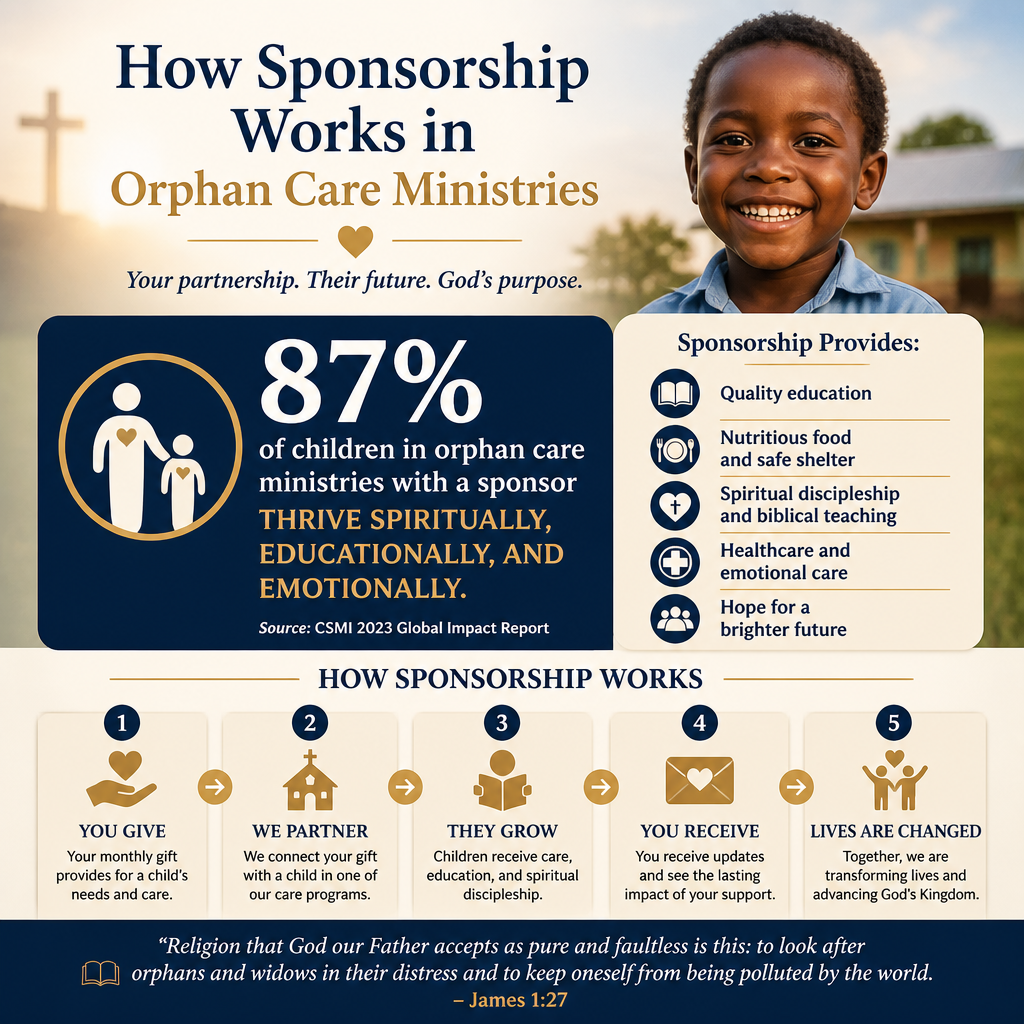
Most sponsorship programs use a child-centered invitation—“sponsor Maria” or “support Daniel”—to create a stable stream of giving. In practice, many ministries place sponsorship gifts into a designated program fund that supports a cohort of children and the services around them: school fees, nutrition, medical care, trauma-informed counseling, case management, and family reintegration efforts. That difference is not a defect; it is often a safeguard. A child’s needs fluctuate, and ethical programs avoid treating a child as a personal fundraising account that rises or falls with a single donor’s circumstances.
The harder question is whether the ministry explains this plainly. If a ministry implies that every dollar goes directly and exclusively to one named child, but actually uses pooled funding, that is a transparency failure. Mature donors should require language that matches practice, and practice that can be audited.
Restricted, designated, and unrestricted funds
Terms matter. “Restricted” has a formal meaning in nonprofit accounting: the donor places legal restrictions on use. Many sponsorship gifts function as “designated” by the donor but internally managed as program support rather than as a legal restriction. Unrestricted gifts allow leadership to direct funds where the need is greatest, including capacity that keeps children safe: background checks, staff training, child protection systems, and independent audits. The contemporary debate over overhead has clarified that low administrative percentages do not automatically indicate faithfulness or effectiveness; Charity Navigator has publicly warned against simplistic overhead judgments in its discussion of the “overhead myth” and nonprofit cost structures Charity Navigator.

How sponsorship dollars move through the ministry
Monthly giving, receipting, and internal controls
At the level donors see, sponsorship is typically a recurring monthly gift processed through an online platform, receipted for tax purposes, and recorded in a donor database. What donors do not see—and should care about—is the internal control environment behind those transactions. Responsible ministries separate duties so that no single employee can receive donations, record them, and approve spending. They reconcile bank deposits to donor records, and they maintain clear documentation for program expenses tied to the sponsorship fund.
Across our verification work at Most Trusted, the ministries that meet The Most Trusted Standard tend to treat sponsorship as both pastoral and fiduciary: they understand that a donor’s promise is a spiritual commitment, and that mishandling that trust harms the witness of the gospel as surely as it harms a budget line.
Field transfer, local partners, and exchange rate realities
Many orphan care ministries operate through local partners—church networks, social workers, schools, and clinics. Sponsorship revenue may pass through grant agreements or sub-awards, and sometimes through in-country bank transfers that involve fees and currency conversion. Donors should expect a ministry to disclose whether local partners are independent legal entities, how they are monitored, and how safeguarding standards are enforced across organizational boundaries.
Currency fluctuations can change what a “$39 sponsorship” provides in local purchasing power. Ethical ministries resist the temptation to promise a fixed package of goods if costs are variable. Instead, they report what services were provided during the year and what standards governed decision-making when funds were constrained.
What sponsors receive and what children deserve
Letters, photos, and the ethics of relational fundraising
Sponsorship often includes correspondence: letters, drawings, photos, and occasional updates on school progress or health milestones. This relationship can be a genuine means of mutual encouragement, but it also creates risk. Children are not content. Their stories are not raw material for donor motivation. Ministries should have clear consent practices, limits on identifiable information, and policies against posting children’s images in ways that expose them to exploitation.
Donors should ask whether letters are screened for inappropriate contact, whether photos are handled securely, and whether children are coached to tell “sponsor-pleasing” narratives. Safeguarding is not a bureaucratic add-on; it is obedience to the biblical obligation to protect the vulnerable from those who would use them.
Family based care and the purpose of sponsorship
Christians genuinely disagree about the best models for care in different contexts, but the field has had to reckon with strong evidence that institutionalization can harm children, particularly in early childhood. A widely cited Lancet review concluded that children exposed to institutional care are at increased risk for impairments in growth, cognition, and mental health The Lancet. That does not mean every residential program is identical, or that every setting has immediate family-based alternatives. It does mean sponsorship should be designed to support the best interest of the child, not the perpetuation of beds that require funding.
For many mature programs, the sponsorship “unit” is less an orphanage resident and more a child in kinship care, foster care, or reunification support, with case management that keeps the family stable. That orientation aligns with the biblical vision of restoration rather than permanent dependency.
Common risks and how to evaluate them responsibly
Perverse incentives and the danger of recruitment
When donors sponsor “orphans,” the incentives can drift. If a ministry’s funding depends on keeping children enrolled in a sponsorship roster, leadership may face pressure to delay reunification or to prioritize children who photograph well. In the worst cases, bad actors recruit children from families to fill institutions or programs that attract foreign donors. The existence of such abuses is one reason donors should not rely on sentiment as a vetting method.
We recommend that donors look for explicit policies that privilege family reintegration when safe, and reporting that shows exits as a sign of success rather than as a loss of “inventory.” A credible orphan care ministry is willing to celebrate the day a child no longer needs sponsorship because a family is stable.
Questions that separate transparency from marketing
Donors do not need to become auditors, but we do need to ask questions that reveal whether a sponsorship program is truthful, child-protective, and financially coherent. The following indicators are not exhaustive, but they are practical and measurable:
- Clear language on whether sponsorship is pooled program support or an individual pass-through.
- Documented child safeguarding policies, including photo and communication protections.
- Evidence of case management and family strengthening, not only residential services.
- Annual financial statements and an independent audit when scale warrants it.
- Outcome reporting that includes reunification, placement stability, and school persistence.
For a broader view of ministry models and the donor questions they raise, many donors consult the wider landscape of Orphan Care Ministries as they discern which approaches align with both compassion and prudence.
How Most Trusted evaluates sponsorship programs
Verification that honors both doctrine and due diligence
Most Trusted exists because Christian donors should not have to choose between theological confidence and operational rigor. We evaluate ministries against The Most Trusted Standard, a 15-criteria framework that examines faith commitments, financial integrity, governance and leadership, and transparency and effectiveness. Sponsorship programs sit at the intersection of these concerns: they involve donor truthfulness, child protection, financial controls, and claims about impact.
What this means in practice is that we look for governing boards that exercise real oversight, financial reporting that can be reconciled, and public communications that do not overpromise. We also look for evidence that leadership understands modern orphan care principles, including the limits of institutional care and the importance of family-based alternatives when feasible.
What credible sponsorship reporting tends to include
Because sponsorship is relational, donors often receive more frequent updates than with other giving vehicles. That can be a gift, but it can also become a substitute for accountability if updates remain sentimental and non-specific. Strong reporting tends to include program-level metrics, safeguarding disclosures, and financial clarity about how sponsorship revenue is used over time.
Donors who want to understand how giving is typically structured and applied across the sector often benefit from comparing approaches within How Orphan Care Ministries Use Donations, especially when deciding whether to prioritize sponsorship, general support, or targeted initiatives such as family preservation.
FAQs for How sponsorship works in orphan care ministries
Does sponsorship money go only to my sponsored child?
Often it does not, at least not in a strict one-to-one pass-through sense. Many ministries pool sponsorship gifts within a designated program fund so that services are delivered consistently across children and through fluctuations in individual donor support. The ethical requirement is not one-to-one accounting; it is truthful communication and verifiable internal controls that ensure the funds are used for the stated child-focused purpose.
Is child sponsorship compatible with best practice in orphan care?
It can be, when sponsorship supports family-based care, case management, and reintegration rather than maintaining unnecessary institutionalization. The key is whether the program’s incentives and safeguards align with a child’s best interests: protection from exploitation, stable caregivers, and durable outcomes such as safe reunification or stable alternative family placement.
A sponsorship commitment worthy of the donor and the child
Sponsorship is most faithful when it is more than a transaction and less than a marketing promise. Christian donors can give with both tenderness and discernment when ministries speak plainly, protect children rigorously, and report outcomes that reflect restoration rather than dependency. The goal is not to perfect a funding mechanism, but to honor God’s concern for the fatherless with integrity that can withstand daylight.



