
What Bible passages ground Christian orphan care is not a sentimental question for donors; it is a question of authority. Scripture does not treat the fatherless as a peripheral concern, and it does not permit Christian compassion to be detached from justice, truth, and faithful stewardship.
Yet the modern orphan care movement has learned that goodwill can produce harm when donors fund the wrong models, accept unverifiable stories, or confuse institutional care with biblical mercy. Mature giving asks both questions at once: What does God command, and what actually protects children in practice.
1. The character of God as Father to the fatherless
Orphan care begins in theology before it becomes strategy
The strongest biblical ground for orphan care is not a single proof text but the revealed character of God. The Psalms name him as “Father of the fatherless and protector of widows” (Psalm 68:5). That language is not metaphorical window dressing; it describes God’s settled posture toward the vulnerable and the obligations of those who bear his name.
Deuteronomy links God’s greatness to his particular attention to those without defenders: “He executes justice for the fatherless and the widow, and loves the sojourner” (Deuteronomy 10:17–18). Christian donors who want a biblical center of gravity for orphan care can begin here: orphan care is participation in God’s own justice, not a discretionary kindness.
Justice and mercy are inseparable in Scripture
The Old Testament does not allow care for orphans to be reduced to private benevolence. It is woven into the public moral order of God’s people. Israel’s agricultural and economic life was structured so that the poor, the sojourner, the widow, and the fatherless had access to provision (for example, Deuteronomy 24:17–22). Scripture frames this as an antidote to exploitation: the vulnerable are those most likely to be cheated because they lack social power.
For donors, this matters because “helping orphans” can unintentionally create incentives that do not serve children. When money flows toward institutions that must keep beds full, the line between mercy and recruitment can blur. A biblical doctrine of God’s justice insists that our giving be ordered toward protection, not merely activity.

2. The Old Testament warns against performative compassion
The prophets measure spiritual health by treatment of the vulnerable
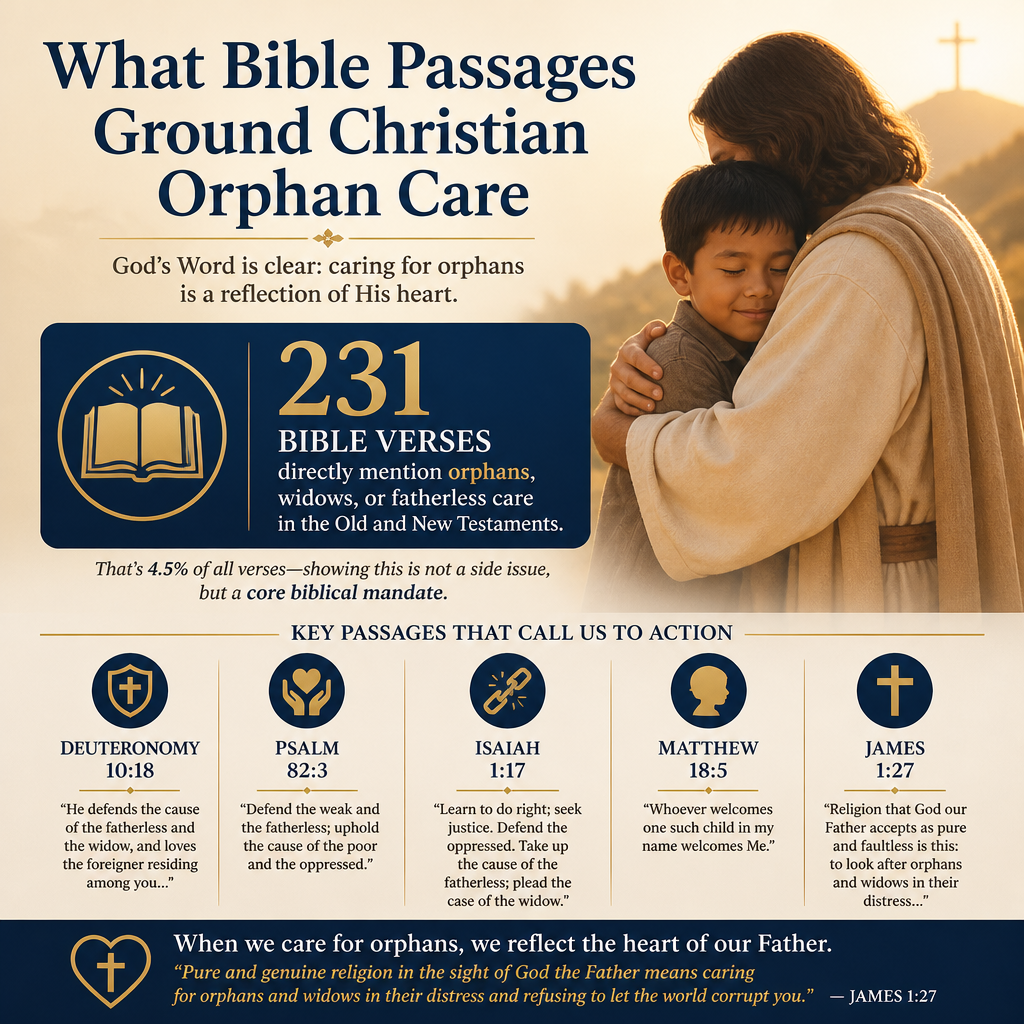
Isaiah’s indictment is direct: “Seek justice, correct oppression; bring justice to the fatherless, plead the widow’s cause” (Isaiah 1:17). The prophetic critique is not that Israel lacked religious energy; it is that worship had become morally hollow. God rejects offerings that coexist with the neglect of the vulnerable (Isaiah 1:11–15).
Jeremiah echoes the same moral test: “Do no wrong or violence to the resident alien, the fatherless, and the widow” (Jeremiah 22:3). This is not simply an exhortation to private charity; it is a warning that societies and institutions can do violence through neglect, corruption, and predation.
Scripture anticipates the donor’s modern dilemma
Christian donors often face a practical question: is funding a residential facility the most faithful response, or does it unintentionally perpetuate separation from family? The field has had to reckon with the reality that many children in institutional “orphanages” globally are not double-orphans but children living in poverty with surviving relatives. That is one reason many development and child-welfare actors now emphasize family strengthening and kinship care over long-term institutionalization.
Where reputable child welfare agencies are involved, the basic direction is clear: family-based care is generally preferred when safe and feasible. UNICEF has repeatedly argued that institutionalization should be a measure of last resort and that strengthening families is central to child protection; donors can reference UNICEF’s child protection work at unicef.org.
What this means in practice is that biblical orphan care often looks less like building buildings and more like funding casework, economic stabilization, trauma-informed counseling, and legal protection—work that rarely produces dramatic photos but frequently prevents family separation.
3. Jesus and the Kingdom logic of receiving children
Children are not ministry objects but image-bearers
Jesus’ words about children are often quoted, but their moral force is easy to domesticate. “Whoever receives one such child in my name receives me” (Matthew 18:5). Receiving is an act of honor and protection, not a transaction that turns a child into a symbol for adult virtue.
Jesus also warns that causing “one of these little ones who believe in me to sin” is a grave offense (Matthew 18:6). In context, the passage carries the weight of safeguarding: power must not be used to harm, manipulate, or exploit children. For donors, that places the burden of proof on programs that place children in repeated contact with short-term visitors, unvetted caregivers, or emotionally intense but transient relationships.
Mercy without wisdom is not the Kingdom ethic
Christian donors sometimes assume that urgency alone sanctifies action. Scripture does not support that assumption. Jesus consistently unites compassion with truth-telling and discernment. The Good Samaritan parable (Luke 10:25–37) commends costly mercy, but it also depicts careful, concrete aid: the Samaritan addresses immediate medical needs, provides safe lodging, and takes responsibility for ongoing expenses.
Applied to orphan care, the Kingdom pattern is not merely “do something.” It is to provide what is needed in ways that do not deepen dependency, fracture families unnecessarily, or conceal abuse. Donors should expect ministries to demonstrate child protection policies, staff training, and clear pathways to family reunification or stable long-term family placement where possible.
4. The New Testament makes care for the fatherless a mark of true religion
James ties orthodoxy to embodied care
James’s definition is deliberately concrete: “Religion that is pure and undefiled before God, the Father, is this: to visit orphans and widows in their affliction, and to keep oneself unstained from the world” (James 1:27). “Visit” is not a token gesture. In biblical usage, it implies attentive concern expressed through action, presence, and provision.
The second half of the verse matters for donors. James joins care for the vulnerable to moral integrity. A ministry’s compassion and its ethical practices cannot be separated. This is one reason our team at Most Trusted treats governance, transparency, and demonstrated outcomes as theological concerns, not merely administrative ones. A ministry that speaks often about justice but refuses external accountability is not aligned with James’s integrated vision.
Adoption is the gospel metaphor that shapes Christian posture
Paul frames salvation itself as adoption: believers “received the Spirit of adoption as sons” (Romans 8:15) and God “predestined us for adoption” (Ephesians 1:5). Scripture does not use adoption language to romanticize childhood vulnerability. It uses adoption to magnify grace: we were received, given status, and brought into a family we did not earn.
For donors, adoption theology does not automatically mandate international adoption, foster care, or any single program model. Christians genuinely disagree about how adoption language should shape policy and practice in different cultural settings. But the moral trajectory is consistent: the goal is belonging, protection, and permanence. The more a ministry’s model moves children toward stable family life—and does so ethically—the more it resonates with the New Testament’s adoption-shaped imagination.
Readers looking for a broader frame for wise giving in this space may also find clarity in Orphan Care Ministries, where we track the major models donors encounter and the questions that separate child-centered practice from donor-centered storytelling.
5. Giving for orphan care requires discernment, not only conviction
Common donor risks in orphan care funding
The biblical passages are clear enough to produce conviction; the harder question is how conviction becomes faithful funding. Orphan care is a field where emotional appeals are strong, oversight varies widely by country, and children’s privacy and safety can be compromised by fundraising practices. Donors should assume that good intentions are common and that rigorous safeguards are not.
Across our verification work, we observe that ministries that meet The Most Trusted Standard tend to treat child protection and truthful communication as central spiritual obligations. They can explain how children enter care, how family tracing is conducted, what reunification rates look like, and what happens when reunification is not safe. They also show restraint in imagery and storytelling, recognizing that children are not marketing assets.
Questions that align donor diligence with biblical care
A donor cannot manage a ministry, but a donor can insist on moral clarity. When evaluating orphan care organizations, these questions often distinguish responsible work from compelling narratives:
- How does the ministry determine whether a child can remain safely with family, including extended kin?
- What child safeguarding policies exist, and are staff and volunteers trained and screened?
- Does the ministry prioritize family-based care, kinship care, foster care, or reintegration when appropriate?
- How does the organization report outcomes without violating a child’s dignity or privacy?
- Are finances independently audited, and is leadership accountable through an active board?
These are not bureaucratic hurdles. They are practical expressions of the biblical insistence that justice must be done, not merely intended.
For donors who want the scriptural case for giving to be matched with due diligence, Biblical Foundations for Orphan Care Giving addresses the recurring tensions: compassion versus incentive structures, short-term trips versus long-term attachment needs, and institutional care versus family strengthening.
FAQs for What Bible passages ground Christian orphan care
Is the Bible specifically commanding support for orphanages?
Scripture commands care for the fatherless, protection from exploitation, and the pursuit of justice. It does not prescribe orphanages as the default model. In many settings, the most biblically faithful approach may be family preservation, kinship care, foster care, or reintegration support—provided it is safe and accountable. Donors serve children best when they evaluate whether a ministry’s model moves toward stable family life rather than institutional dependency.
Which passages should guide a donor’s evaluation of orphan care ministries?
Several passages provide durable donor criteria: Psalm 68:5 and Deuteronomy 10:17–18 ground orphan care in God’s character and justice; Isaiah 1:17 warns against worship divorced from protection of the vulnerable; Matthew 18:5–6 places weight on receiving children with honor and safeguarding them from harm; James 1:27 binds care to moral integrity; Romans 8:15 and Ephesians 1:5 shape Christian posture toward belonging and permanence. Together, these texts push donors toward compassion that is truthful, accountable, and child-centered.
Giving that is worthy of the biblical mandate
The Bible grounds Christian orphan care in the character of God, the justice demanded by the prophets, the child-honoring ethic of Jesus, and the New Testament’s insistence that true religion is visible in how the vulnerable are treated. That mandate should increase, not reduce, a donor’s seriousness about what they fund. The faithful question is not whether a ministry can tell an affecting story, but whether its work measurably protects children, strengthens families where possible, and conducts itself with the integrity Scripture requires.



