
Sacrificial giving for orphan care ministries is not primarily a question of how much we feel, but of how faithfully our giving reflects the self-giving love of Christ in a field where good intentions can produce mixed results. The widow’s offering in Mark 12 was not praised because it was sentimental; it was praised because it was costly and wholehearted, given unto God rather than from surplus.
Yet orphan care is also one of the most emotionally charged categories of Christian giving. Images of vulnerable children can move donors toward urgency that is spiritually sincere but strategically unformed. Mature generosity in this space holds both truths: Scripture calls us to costly mercy, and wisdom requires that our mercy be disciplined toward what actually protects children and strengthens families.
Sacrificial giving begins with worship and costly love
The New Testament frames sacrifice as participation in Christ
Christian sacrifice is not a technique for funding need; it is a response to the gospel. Paul grounds financial generosity in Christ’s own self-emptying: “Though he was rich, yet for your sake he became poor” (2 Corinthians 8:9). Sacrificial giving, then, is not defined by a number on a pledge card. It is defined by a posture: we loosen our grip on comfort because Christ loosened his grip on rightful glory for our salvation.
That posture matters in orphan care because the work is long, complex, and often hidden. Funding a child’s education over ten years, paying for trauma-informed counseling, underwriting competent local social work, or supporting legal family reunification rarely produces the immediate emotional payoff donors receive from dramatic rescue narratives. The Christian donor’s question becomes not “What moves us most?” but “What best honors Christ’s love for this child and this family over time?”
The widow’s mite is not a fundraising slogan
Jesus’ commendation of the widow (Mark 12:41–44) is frequently invoked to encourage greater giving, but its moral center is deeper. The widow is not portrayed as a model because her gift was efficient or because the temple’s governance was above critique. She is commended because she entrusted herself to God. The passage does not flatten moral responsibility in leaders; it highlights the holiness of genuine trust.
For donors, this yields a sober implication: sacrificial giving does not excuse ministries from accountability, and accountability does not excuse donors from sacrifice. The two belong together. Scripture calls leaders to integrity and donors to costly love, not to a trade-off where one cancels the other.

Orphan care is a moral urgency and a contested practice
Scripture’s mandate is clear, but implementation is not simple
The Bible’s concern for the fatherless is unambiguous. God identifies himself as “Father of the fatherless” (Psalm 68:5), and James names care for orphans and widows as “pure and undefiled religion” (James 1:27). Christian donors are right to treat orphan care as central, not optional.
What is contested is not whether Christians should care, but how care should be structured. Over the last two decades, research and field practice have increasingly emphasized family-based care over institutionalization. The reasons are not ideological. They are developmental and measurable. The adverse impacts of institutionalization on children have been documented across contexts, including in the meta-analysis often cited from the Bucharest Early Intervention Project and related scholarship (for an accessible overview, see the Harvard University Center on the Developing Child).
Modern orphan care must address family separation, not only child survival
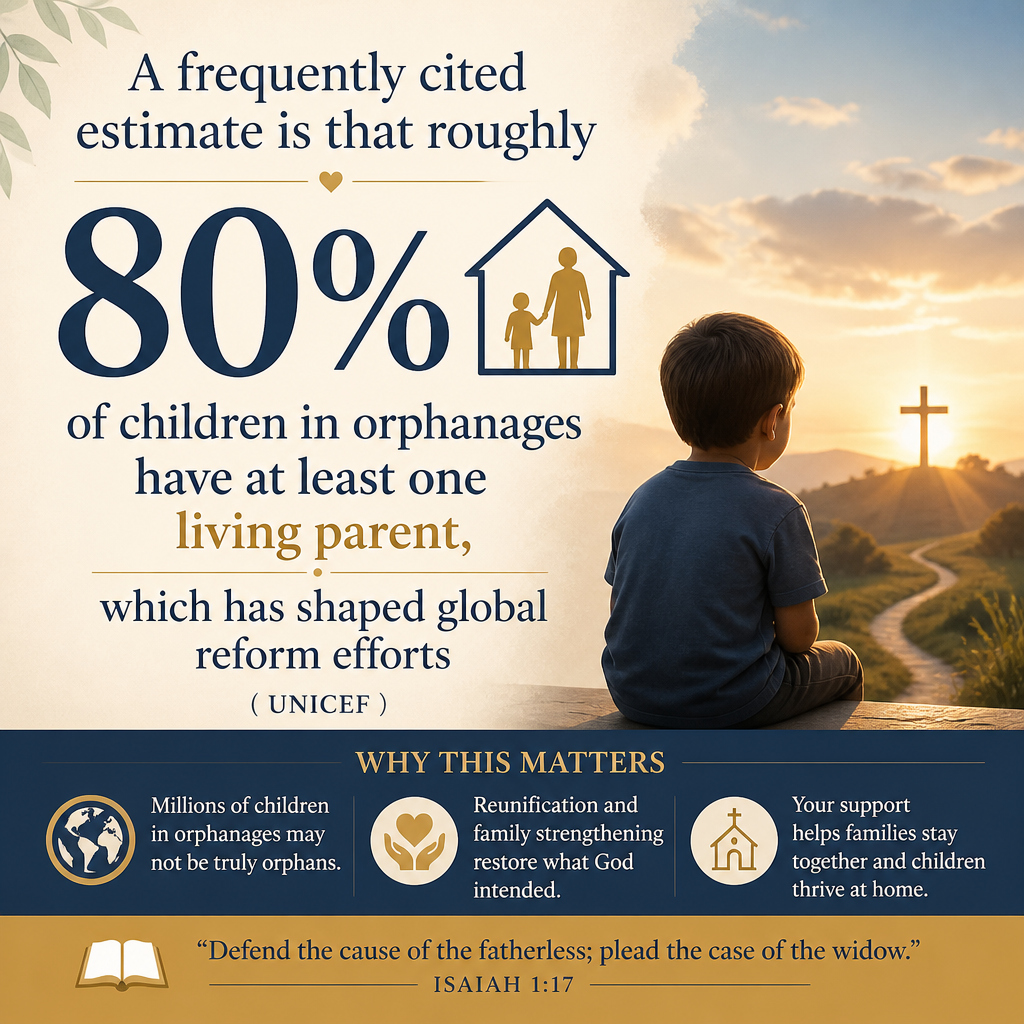
Christian donors also need to contend with a difficult reality: many children living in institutions globally are not “orphans” in the strict sense. A frequently cited estimate is that roughly 80% of children in orphanages have at least one living parent, which has shaped global reform efforts (UNICEF). The underlying drivers are often poverty, disability stigma, lack of access to education, or crisis displacement—conditions that call for family strengthening as much as for substitute care.
This does not negate the need for residential programs in some settings. It does mean sacrificial giving should be oriented toward reducing unnecessary family separation and improving the quality of care where separation is truly required. Donors can fund reforms that are less visible but more protective: kinship care support, foster care development, family tracing, reintegration services, and prevention programming.
Sacrificial giving is disciplined generosity, not impulsive generosity
Costly does not mean indiscriminate
Christian donors sometimes assume that sacrificial giving means saying yes quickly. In orphan care, that instinct can backfire. The When Helping Hurts framework, articulated by Steve Corbett and Brian Fikkert, has helped many Christian ministries recognize how giving that bypasses local agency and long-term accountability can unintentionally deepen dependency or undermine local capacity (When Helping Hurts).
Discipline is not a retreat from compassion. It is compassion refusing to be governed by sentiment alone. Sacrifice guided by wisdom will often feel slower than donors prefer, because child protection work is rightly cautious: background checks, case management, professional standards, and legal compliance are time-intensive for good reason.
What sacrificial donors often fund first
Across our verification work at Most Trusted, we observe that the ministries most worthy of sacrificial support tend to spend donor dollars in ways that do not photograph well but substantially improve safety and outcomes. These are costs many organizations are tempted to underfund because they do not “sell.” Mature donors often choose to fund them anyway.
- Child safeguarding systems, including reporting pathways and staff training
- Qualified local social workers and case management capacity
- Family reunification and kinship placement support where appropriate
- Trauma-informed mental health care and caregiver coaching
- Independent financial audits and transparent reporting practices
This is also where donors benefit from a verification lens. Sacrificial giving becomes more faithful—not less—when it is paired with clear expectations for governance, financial integrity, and evidence of effectiveness.
Sacrificial giving requires discernment about the ministry model
Not every “orphan care” label signals the same approach
Orphan care ministries range from adoption support and pregnancy care to residential homes, transitional programs for older youth, and community-based family strengthening. Each model can be carried out well or poorly. The donor’s task is to understand what the ministry is actually doing in-country and how it relates to the broader child welfare ecosystem: local churches, government social services, courts, schools, and community health systems.
One of the simplest donor disciplines is refusing to fund only the visible moment—rescue, intake, or a short-term visit—and instead funding the full continuum of care: prevention, protection, permanency, and long-term support. That shift often costs more, but it aligns better with a biblical understanding of steadfast love.
Verification protects sacrificial generosity from avoidable risk
Christian donors are not merely buying services; we are entrusting resources to leaders who will speak and act in Christ’s name. That is a spiritual decision with moral weight. It is also a governance decision. When ministries collapse under financial misconduct, abusive leadership cultures, or weak safeguarding, the damage is not only monetary. It is borne by children and by the church’s public witness.
Most Trusted exists to help donors give with confidence by evaluating ministries against The Most Trusted Standard—a 15-criteria framework covering faith foundation, financial integrity, governance and leadership, and transparency and effectiveness. When a ministry is willing to meet high verification expectations, donors can give more freely and more sacrificially because trust is supported by evidence rather than by branding.
For donors assessing specific models and organizations, it can be helpful to compare ministries working in this space across Orphan Care Ministries, especially when the same language is used to describe materially different practices.
Sacrificial giving is sustained giving with truthful expectations
The work is long, and so is the donor’s responsibility
Children harmed by neglect, abuse, trafficking, or family separation rarely “recover” on a donor timetable. The Church’s calling is not to fund a moment, but to love through time. That means sacrificial giving often takes the form of multi-year commitments, patient capital for capacity-building, and steady support that allows ministries to retain qualified staff and maintain safeguards.
It also means we should not demand simplistic outcome claims. Orphan care outcomes are real, but they are also complex: a safe reunification can still include setbacks; a foster placement can still require multiple transitions; an older youth’s progress can be non-linear. The best ministries tell the truth about this complexity without surrendering to cynicism.
Faithful sacrifice refuses both cynicism and naïveté
Some Christian donors become skeptical after hearing about scandals or ineffective programs. Others remain overly trusting because the need feels too urgent to question. Sacrificial giving rejects both extremes. It insists that children deserve more than our emotions, and ministries deserve more than unexamined loyalty. The Christian alternative is costly love with clear-eyed accountability.
For donors who want the theological grounding for that posture in this field, we encourage engagement with Biblical Foundations for Orphan Care Giving, where Scripture’s commands are held together with the practical responsibilities that follow from them.
FAQs for What sacrificial giving means for orphan care ministries
Does sacrificial giving mean we should give even if a ministry lacks strong transparency?
No. Scripture commends generous sacrifice, and it also condemns dishonest weights and measures and the misuse of entrusted resources. Christian giving is not meant to be blind. When a ministry cannot or will not provide basic financial reporting, clear governance information, and safeguarding standards, the appropriate response is not to suspend generosity, but to redirect it toward ministries that can demonstrate integrity.
What if we feel called to support residential care even though family-based care is preferred?
Residential care can be necessary for certain children and in certain contexts, particularly as a time-limited step within a plan toward permanency. The critical questions are whether the ministry actively prevents unnecessary separation, works toward family reunification or family-based placement when possible, meets rigorous child protection standards, and is transparent about outcomes and incidents. Sacrificial giving in this scenario often means funding the safeguards, staffing, and casework required to make residential care genuinely protective rather than merely custodial.
A mature vision of sacrifice in orphan care
Sacrificial giving for orphan care ministries is not measured only by the dollar amount that makes us feel the loss. It is measured by whether our giving participates in Christ’s costly love in a way that protects children, strengthens families where possible, and refuses to trade urgency for truth. Donors who pair sacrifice with verification, accountability, and long-term commitment honor both the biblical mandate and the vulnerable lives that mandate is meant to serve.



