
How to pray before giving to orphan care ministries is not a sentimental question. It is a spiritual discipline that asks God to govern our compassion, so that our generosity strengthens families and protects children rather than rewarding systems that unintentionally separate them.
Scripture places the fatherless near the center of God’s self-description and God’s judgment of his people (Deuteronomy 10:18; Isaiah 1:17). Yet the modern orphan care landscape is morally complex: not every child in residential care is an orphan, not every institution is predatory, and not every “family-based” program is well-run. Prayer before giving is where Christian donors can bring both tenderness and seriousness into the same act.
Begin with God’s heart for the fatherless and for faithful stewardship
Let Scripture set the aim before emotions set the method
Christian donors often come to orphan care with sincere urgency. A photo, a video, or a personal encounter can press immediate need onto the conscience. Scripture affirms that urgency is not in itself a problem. The problem is when urgency becomes the decision-maker.
In prayer, we begin by naming what God has already named. God “executes justice for the fatherless and the widow” (Deuteronomy 10:18). James calls care for orphans and widows “pure and undefiled religion” (James 1:27). At the same time, Scripture treats money as a moral instrument that must be governed, not merely released. “It is required of stewards that they be found faithful” (1 Corinthians 4:2). A prayer that begins with God’s heart must also ask for God’s discipline.
Pray for love that is guided by truth
Christian love is not opposed to discernment; it requires discernment. Paul’s prayer for the Philippians is instructive: “that your love may abound more and more, with knowledge and all discernment” (Philippians 1:9). Before giving, donors can ask for love that does not merely feel strongly, but sees clearly—love that can distinguish between a compelling story and a sound strategy.
What this means in practice is that prayer should not be treated as a spiritual substitute for diligence. Prayer is where diligence becomes worship. We do not research because we distrust God; we research because we want our giving to participate in what God is actually doing.

Ask God to protect children from harm done in the name of help
Pray with sobriety about institutions and incentives
The global church has had to reckon with the fact that some models of care, however well-funded, can deepen trauma. One of the most cited findings in the field is that children raised in institutional settings are at higher risk of harm to development than children raised in families. The strength and nuances of the evidence vary by context, but the broad concern is not speculative. The American Academy of Pediatrics has cautioned against institutional care for young children because of associated developmental risks (American Academy of Pediatrics).
In prayer, donors can bring this tension directly to God: “Lord, do not let our giving purchase outcomes you grieve.” That includes praying about incentives. Wherever beds, buildings, and payroll depend on headcount, the system is tempted to keep children in care longer than necessary, or to recruit children who could remain with family. Not every institution does this; some provide necessary temporary protection when no safe alternative exists. But incentives are real, and prayer should make us honest about them.
Pray for the child’s whole life, not the donor’s reassurance
Many orphan care appeals are structured to reassure donors: a sponsored child, a named dormitory, a concrete project with visible completion. Those can be legitimate tools. The harder question is whether they align with what the child needs most: stable attachment, safe caregiving, legal identity, education that connects to livelihoods, and long-term belonging.
In prayer, we recommend asking God to reorder our sense of “impact” away from what photographs well and toward what endures. The aim is not to remove affection from giving, but to refuse to let affection become the measure of faithfulness.
Pray toward family preservation, reunification, and local church partnership
Ask what kind of care Scripture implicitly commends
Scripture does not give a modern program manual, but it does give moral contours. Care for vulnerable children is woven into household and community responsibilities, not outsourced to distant institutions. The pattern of the early church’s mercy ministries points toward local, accountable care expressed through real relationships (Acts 6:1–7). When donors pray before giving, a wise question is: “Are we strengthening the most proximate, biblically fitting caregivers, or replacing them?”
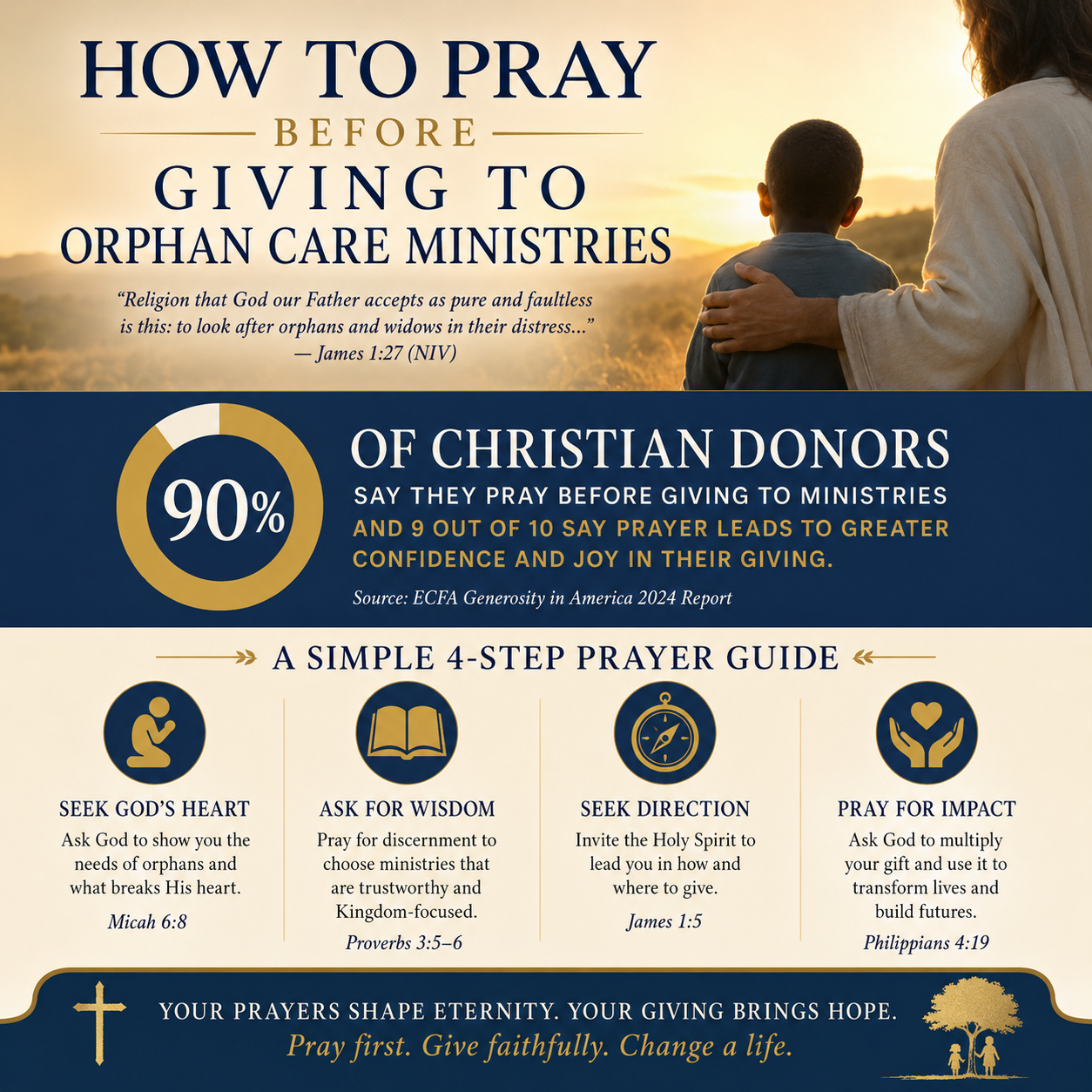
This is where donors should learn the vocabulary of the field: family preservation, kinship care, reunification, domestic adoption, foster care, and community-based child protection. Christians genuinely disagree about the relative emphasis among these approaches across countries and legal systems, and prudence is required. Still, prayer can clarify our bias: we should prefer solutions that move children toward safe family life whenever possible.
Pray for the local church to be more than a supporting actor
Effective orphan care rarely succeeds as an imported project. It depends on local legitimacy, long-term presence, and culturally competent casework. Donors can pray for partnerships in which local churches are not merely distribution points for outside funds, but moral and relational stewards of vulnerable families. In prayer, we can ask God to raise up elders, deacons, and community leaders who will carry the burdens donors cannot carry from a distance.
Those seeking a broader view of ministry models and verification considerations across contexts will find helpful background in Orphan Care Ministries, where we track common approaches, recurring risks, and marks of credibility that serious donors should expect.
Pray for discernment that shows up as due diligence
Make space in prayer for hard questions and clear answers
Prayer before giving should include repentance for the ways Christian donors sometimes confuse generosity with unaccountable trust. Love “rejoices with the truth” (1 Corinthians 13:6). That posture legitimizes questions that are not cynical but protective.
Across our verification work at Most Trusted, we observe that the ministries that meet The Most Trusted Standard tend to treat scrutiny as a form of neighbor-love. They welcome questions about governance, financial integrity, child safeguarding, and outcome measurement because they believe children are worth the burden of proof.
We recommend praying explicitly for the courage to ask, and for the humility to walk away when answers are evasive.
A simple prayerful checklist for donors
Before committing a significant gift, donors can pray through a short set of concrete questions and then pursue the answers with patience:
- Child safeguarding: Are there written safeguarding policies, reporting mechanisms, and background checks for staff and volunteers?
- Casework and permanency: Does the ministry have a documented pathway toward reunification or stable family placement when safe?
- Local legal compliance: Are licensing, child placement, and data practices aligned with local law and international standards?
- Financial clarity: Are audited financials or equivalent independent reviews available, with intelligible explanations of major expense categories?
- Governance: Is the board active, independent where appropriate, and capable of holding leadership accountable?
These questions are not a substitute for spiritual discernment. They are one way discernment becomes concrete. They also reflect why Most Trusted evaluates ministries against The Most Trusted Standard: donors deserve more than assurances; they deserve verifiable confidence that a ministry’s practices align with Christian ethics and credible child welfare practice.
Pray as a member of Christ’s body, not as an isolated benefactor
Bring your church into the act of discernment
Modern philanthropy can train donors to think of giving as an individual moral accomplishment. The New Testament’s picture is more communal. Christians give as members of one body, under shepherding, with shared wisdom and shared responsibility (1 Corinthians 12; Hebrews 13:17).
Before giving significantly to orphan care, we recommend asking pastors, missions committees, and trusted mature believers to pray with you. That practice does not outsource responsibility. It places responsibility inside the ordinary structures God uses to guard his people from self-deception.
Pray for faithfulness across time, not only in the moment of donation
Some needs are acute and require rapid response. Yet most orphan care work is long-duration work: legal processes, family restoration, trauma-informed care, education, and discipleship. Donors should pray not only “Where should we give?” but “How will we remain responsibly connected to what we fund?” Responsible giving often includes follow-up questions, periodic reporting, and the willingness to change course if a ministry’s model or leadership integrity shifts.
For donors who want their giving to be grounded in Scripture and disciplined by Christian moral reasoning—not merely in compelling outcomes language—our ongoing work in Biblical Foundations for Orphan Care Giving addresses the theological logic that should govern compassion in this field.
FAQs for How to pray before giving to orphan care ministries
Should we stop supporting orphanages altogether?
Some Christians conclude that residential institutions should not receive donor funding because of the developmental and incentive risks involved. Others argue that, in certain contexts, short-term residential care is a necessary protection when no safe family alternative exists. A faithful approach begins with prayer for the child’s long-term good and then asks for evidence: Does the ministry prioritize reunification or family-based placement, practice rigorous safeguarding, and limit residential care to what is truly necessary? The moral question is not only whether a child is fed and housed today, but whether the model increases the likelihood of safe, stable family life tomorrow.
What should we do if a ministry’s stories move us but its reporting is unclear?
Prayer should not quiet responsible hesitation. We recommend asking God for clarity, then requesting clear documentation: safeguarding policies, financial statements, governance information, and an explanation of how children enter and exit care. If a ministry cannot provide basic transparency, donors should consider directing gifts to organizations that can. Compassion that refuses accountability often becomes an unintentional subsidy for poor practice.
Prayer that makes giving faithful
Christian donors pray before giving to orphan care ministries because children are not a cause; they are image-bearers whose lives can be shaped for good or harmed by the systems adults fund. Prayer brings our compassion under God’s authority, and it places our money under the demands of truth. When prayer leads us into careful diligence, patient partnership, and a clear preference for safe family life, our giving begins to look less like impulse and more like stewardship worthy of the name.



