
Biblical foundations for orphan care giving are not a sentimental add-on to Christian generosity. They are part of Scripture’s moral architecture: God identifies himself with the vulnerable, commands his people to protect them, and judges societies that exploit them. For Christian donors, the question is rarely whether to care; it is how to care in ways that honor the child, strengthen families, and withstand the distortions that money can introduce into any ministry ecosystem.
Orphan care is also one of the places where good intentions can misfire. The modern movement has had to reckon with the documented harms of institutionalization, the incentives that donations can create, and the real complexity of cross-cultural intervention. That is not a reason to disengage. It is a reason to give with theological seriousness and verifiable discernment.
God’s character is the first argument for orphan care
Scripture does not begin with techniques; it begins with God. The Old Testament repeatedly links the Lord’s righteousness to his defense of those without protection. When donors speak about “biblical orphan care,” we are not simply looking for a few proof texts. We are asking whether a ministry’s practice reflects what God is like and what he requires of his people.
Father of the fatherless is not metaphor only
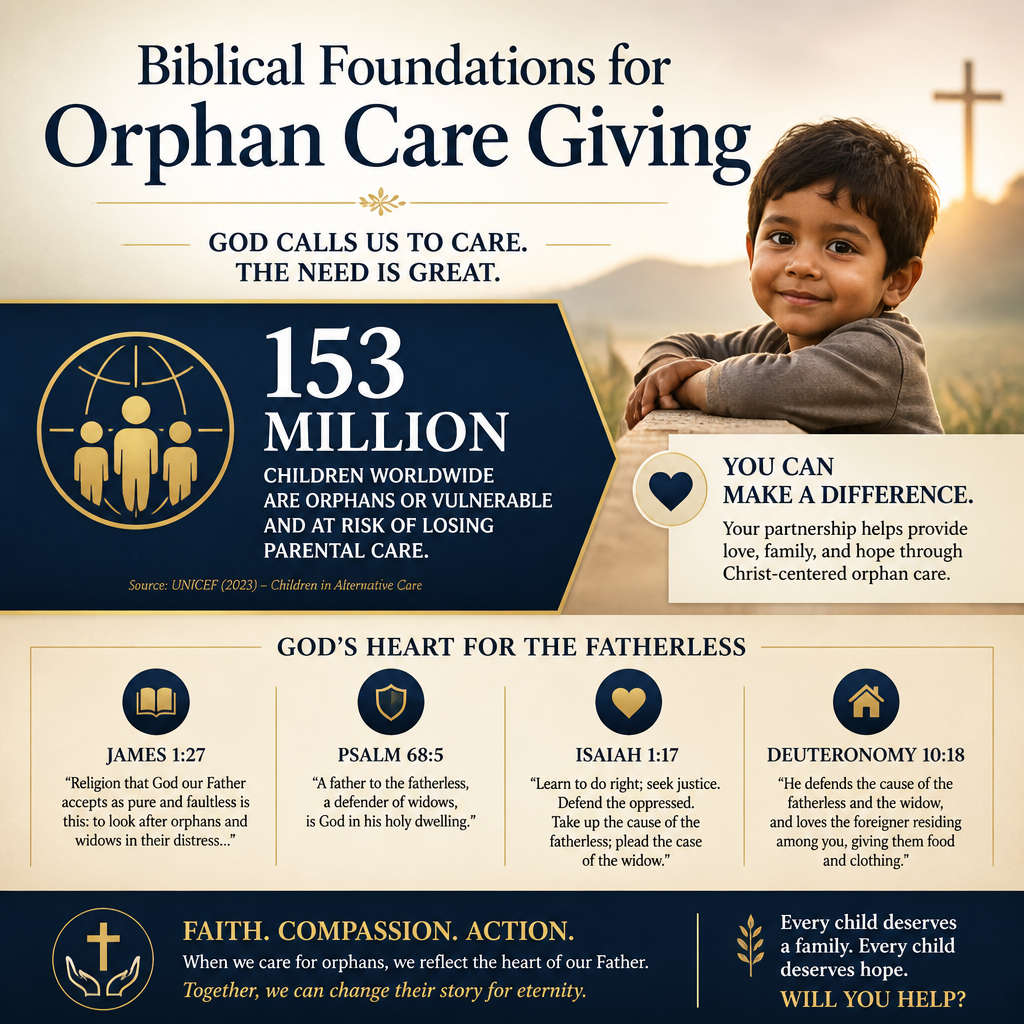
Psalm 68 describes God as “father of the fatherless,” placing the orphan alongside the widow as a test case for whether power is used for protection or predation. James makes the same move in the New Testament: “Religion that God our Father accepts as pure and faultless is this: to look after orphans and widows in their distress” (James 1:27). The aim is not performative compassion; it is concrete care under pressure.
That theological center matters for donors because it clarifies why orphan care is not merely one cause among many. It is a form of neighbor-love with a particular biblical intensity: God defends those who cannot repay, cannot advocate effectively, and are easily turned into projects. A donor’s first responsibility, therefore, is to resist any model that treats children as fundraising instruments rather than image-bearers.
The Bible’s concern is both personal and systemic
The law and the prophets address orphan care in ways that reach beyond individual charity. Deuteronomy and Isaiah condemn societies that “deprive the poor of their rights” and exploit the fatherless. The biblical mandate includes direct care and the just ordering of communal life. What this means in practice is that effective orphan care ministries often work in layered ways: family preservation, foster and kinship care, adoption support, trauma-informed services, and legal advocacy against exploitation.
Christians genuinely disagree about the precise boundaries of that mandate, especially when it intersects with state systems, international law, and questions of subsidiarity. Yet the broad contours are not controversial: God’s people are to protect vulnerable children and to build structures that reduce vulnerability rather than institutionalize it.
Christ’s kingdom ethic reshapes how donors evaluate outcomes
Jesus’ teaching in Matthew 25 does not list orphan care by name, but the logic is unmistakable: the King identifies with the vulnerable, and the authenticity of discipleship is tested by costly mercy. Donors can mistake this for a call to fund whatever feels most compassionate in the moment. The better reading is that mercy must be joined to truth. In a fallen world, love takes responsibility for consequences.
Scripture also warns that power can corrupt care
The Bible’s clarity about caring for orphans is matched by its realism about human motives. Money and power can distort judgment, and religious language can sanctify harmful systems. Mature Christian giving therefore includes both compassion and suspicion: compassion for children and families in distress, suspicion toward any model that benefits adults at a child’s expense.
When institutionalization becomes an incentive
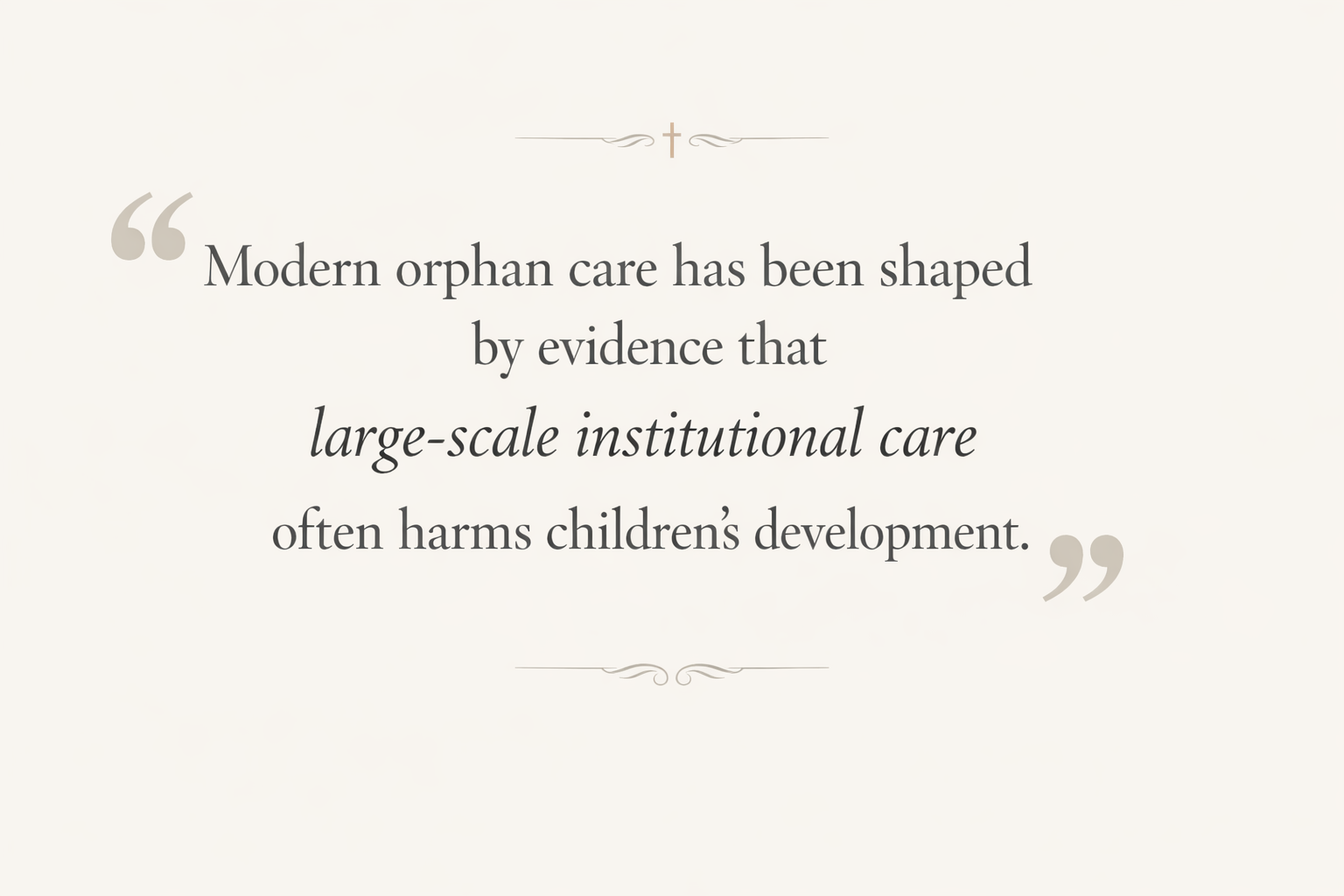
Modern orphan care has been shaped by evidence that large-scale institutional care often harms children’s development. A major review commissioned by the World Health Organization and UNICEF summarized risks associated with institutional settings, including poorer developmental outcomes compared to family-based care, especially for young children (UNICEF). Donors do not need to become specialists in child development to take this seriously; they simply need to treat family-based care as the default presumption unless a ministry can justify an exception.
This is where biblical discernment meets practical accountability. If donations are tied to bed counts, photographs, or “rescues” that require children to be separated from extended family, funding can unintentionally reward separation rather than restoration. The biblical concern for justice includes guarding against perverse incentives, even when the actors involved use sincere spiritual language.
Short-term engagement can deepen attachment wounds
Christian donors often love the idea of personal involvement: visiting, volunteering, bringing teams. The harder question is whether certain forms of short-term engagement actually serve children who have already experienced abandonment and trauma. When Helping Hurts, articulated by Steve Corbett and Brian Fikkert, has helped many churches recognize that good intentions can reinforce dependency and harm dignity when the helping relationship is not rightly ordered (When Helping Hurts).
That framework is not the final word on orphan care, and it has critics, but it names a biblical tension: assistance can become self-justifying if it is designed around the giver’s spiritual experience rather than the recipient’s long-term good. Donors should expect ministries to have clear child-safeguarding policies, thoughtful volunteer protocols, and partnerships with local professionals who understand trauma and attachment.
Designated giving can be faithful and still misdirected
Many donors prefer designated gifts: “for an orphan,” “for a home,” “for meals.” Sometimes designation is appropriate, especially for time-bound projects with clear deliverables. But Scripture’s concern is not merely that we give, but that we give wisely. A ministry that tells compelling individual stories may still lack the governance, financial discipline, and program logic needed to protect children over time.
The field has also had to reckon with transparency pressures. Donors often ask, “How much goes to overhead?” Yet leading charity evaluators have warned that overhead ratios are an unreliable proxy for effectiveness, and that fixation on low overhead can harm organizations by starving them of capacity for accountability and results reporting (Charity Navigator). For orphan care, capacity is not optional; it is part of safeguarding.
Faithful orphan care is usually family-centered and locally accountable
Scripture’s emphasis on justice and neighbor-love does not dictate a single modern program model. It does, however, give donors a set of moral priorities that map closely to what the best research and field practice have learned: children flourish in families, communities must be strengthened rather than bypassed, and authority must be accountable.
Family preservation aligns with the biblical logic of restoration
In much of the world, “orphan” can be a category of vulnerability rather than a description of having no living relatives. Donors should be cautious about models that assume separation is the first response. When ministries provide economic strengthening, parenting support, addiction recovery services, disability inclusion, or legal assistance, they often prevent unnecessary family breakdown. That can be less dramatic than building an orphanage, but it is frequently closer to the biblical goal: protecting the child without dissolving the family when restoration is possible.
Adoption and foster care also have a place in Christian orphan care, and many donors support them as an outworking of the gospel’s “spirit of adoption.” The tension is that adoption, especially across borders, can be ethically compromised when documentation is weak or incentives are misaligned. A serious ministry will welcome scrutiny, not resent it.
Local churches matter, but local accountability matters more
Donors often ask whether a ministry is “indigenous” or “church-based.” Those can be meaningful signals, but they are not guarantees of integrity. Scripture repeatedly condemns religious leadership that exploits the vulnerable. The question is whether local leaders are accountable to credible boards, transparent finances, child-protection standards, and independent audits where appropriate.
Across our verification work at Most Trusted, we observe that the ministries that meet The Most Trusted Standard tend to treat accountability as a theological commitment, not merely a compliance task. They can explain decision rights, conflict-of-interest policies, safeguarding protocols, and how they respond when allegations arise. In orphan care, that posture is not a bureaucratic preference; it is a protection for children and a safeguard for the donor’s stewardship.
Trauma-informed care is not secular drift
Some donors worry that trauma-informed language imports secular anthropology. The concern deserves respect, because the church should not outsource its doctrine of the person. Yet trauma-informed practice, at its best, simply recognizes what Christians already confess: sin harms bodies and souls, suffering leaves marks, and healing is often gradual. A ministry can affirm Scripture’s authority while using clinically informed approaches that reduce harm and support stability for children.
Donors should ask whether programs address attachment, caregiver consistency, and mental health access, and whether spiritual formation is offered with pastoral wisdom rather than emotional coercion. The aim is not to replace evangelism with therapy, but to refuse false choices between spiritual care and responsible caregiving.
How donors can give with confidence and biblical integrity
Christian donors are stewards, not merely benefactors. Scripture’s teaching on money assumes accountability: resources belong to God, and those who manage them answer to him. Orphan care giving becomes more faithful when donors apply a repeatable set of questions that connect theology to governance and outcomes.
Test for faithfulness before funding for scale
Growth is not always a virtue. Some orphan care models scale by multiplying structures that depend on separated children. Others scale by strengthening families and local systems. The difference is moral as well as operational. We recommend asking: What happens to children five and ten years later? What mechanisms prevent recruitment or unnecessary separation? Who has authority to stop a program if safeguarding concerns emerge?
Prioritize verifiable transparency over compelling storytelling
Stories are not inherently manipulative; Jesus taught through parables. Yet the donor’s obligation is to give based on truth, not on emotional momentum. Responsible ministries publish financial statements, describe program activities with specificity, and report both strengths and limits. They invite questions about board oversight, conflicts of interest, and how funds are handled when designated gifts cannot be used as intended.
Use a disciplined framework for trust
Because orphan care involves children, international relationships, and complex legal realities, “good vibes” are an inadequate due diligence standard. Most Trusted exists to help donors give with confidence by evaluating ministries against The Most Trusted Standard, a 15-criteria framework that examines faith foundation, financial integrity, governance and leadership, and transparency and effectiveness. The point is not to replace prayer or pastoral counsel, but to add disciplined verification where the stakes are high.
Many donors begin by surveying the broader landscape of Orphan Care Ministries, then narrowing to organizations that can demonstrate child-safeguarding policies, credible financial practices, and a family-centered approach where possible. The healthiest donor posture is both tender and exacting: tender toward children and families, exacting toward systems that can hide harm behind religious language.
Giving that reflects God’s heart protects children from our own blind spots
Biblical orphan care giving is not measured only by how much compassion we feel or how quickly we act. Scripture calls for mercy that is truthful, justice that is concrete, and stewardship that can endure scrutiny. When donors support ministries that prioritize family-based care, rigorous safeguarding, and transparent governance, they participate in a form of love that does not merely react to suffering but resists the conditions that multiply it.



