

Why donors fund Bible distribution to the military is ultimately a question about whether Christians believe God still speaks through Scripture in places where fear, moral injury, and loneliness press hard. For many donors, the military is one of the clearest settings where a person’s ordinary supports are stripped away and the need for durable spiritual formation becomes unavoidable.
Christian donors also recognize the particular spiritual pressures of military life: authority structures, mobility, isolation from local church community, exposure to violence, and the moral complexity of lethal force. Bible distribution is not a substitute for discipleship or pastoral care, but donors fund it because it can place the Word of God within reach when other forms of ministry are constrained by time, geography, or operational realities.
Scripture in a vocation marked by danger and moral weight
The Bible as a means of grace under pressure
Donors who support Bible distribution to service members are not merely funding printed materials. They are supporting a theology of means: that God uses his Word to convict, comfort, and reorient the heart. Scripture portrays itself as living and active, able to judge the thoughts and intentions of the heart (Hebrews 4:12). In military contexts, where adrenaline and duty can form a person quickly, donors often want service members to be formed by something deeper than unit culture or personal coping strategies.
This is also why Bible distribution in the military tends to resonate across denominational lines. Christians genuinely disagree about many questions in military ethics and national policy. Yet a broad consensus remains that Scripture is necessary for the Christian life, and that access matters when a person is deployed, relocated, or living in communal settings where privacy is scarce.
Moral injury and the need for a trustworthy moral framework
The language of “moral injury” has entered both clinical and pastoral conversations because many veterans describe wounds that are not only psychological but moral and spiritual: guilt, shame, betrayal, and loss of meaning. The U.S. Department of Veterans Affairs has published clinical discussion of moral injury and its relationship to trauma and spiritual distress, noting that it can involve “guilt, shame, anger, and an inability to forgive oneself” U.S. Department of Veterans Affairs. Donors often fund Bible distribution because they want service members to have a moral and redemptive frame available when conscience awakens and the easy narratives fail.
What this means in practice is that many donors see a Bible not as a talisman but as an anchor: a stable witness to God’s character, human dignity, repentance, forgiveness, and hope. When a service member is far from a consistent church community, Scripture can serve as a first line of pastoral care, and at times the first step toward confession, restoration, and renewed faith.

Why distribution matters in a mobile institution
Access is not automatic
Military life is built around movement. Units relocate, deploy, and train in cycles that disrupt ordinary rhythms of church participation and discipleship. Donors fund Bible distribution because the supply chain of spiritual resources is often weakest where the need is strongest: remote training sites, ships, forward locations, and transitional housing. A printed Bible remains usable without electricity, internet access, or a smartphone battery, and it can be carried in conditions where digital tools are limited or discouraged.
Distribution also matters because many service members are young adults who may not yet own a Bible, may not know where to begin, or may be hesitant to ask for help. Providing a Bible in a normal, low-barrier way can remove a social obstacle. When it is paired with clear reading plans, a chaplain referral, or connection to local Christian community, it becomes more than a one-time handoff.
Chaplains and command realities shape what is feasible
Chaplains occupy a unique role: they serve the spiritual needs of service members while operating within constitutional and command constraints. Donors often support Bible distribution ministries that understand these realities and work with chaplains rather than around them. The more credible efforts are careful about permission, propriety, and pluralism, while still offering clear Christian witness to those who want it.
Christians also debate methods. Some argue that “mass distribution” can become performative, counting Bibles rather than cultivating disciples. Others contend that the Word of God is never wasted, and that distribution creates openings for follow-up. Mature donors typically do not accept either extreme. They ask whether the ministry is integrating distribution into a coherent ministry ecosystem: chaplain partnerships, local church connection, small groups, and care pathways for those in crisis.
What donors are really funding when they fund a Bible
Formation rather than sentiment
Many donors have a family connection to military service. That can add emotional intensity to giving decisions, including a desire to “do something tangible.” A Bible is tangible. Yet serious Christian giving aims beyond sentiment toward formation. The donors most likely to fund Bible distribution are often the same donors who care about discipleship, spiritual resilience, and ethical integrity in leadership.
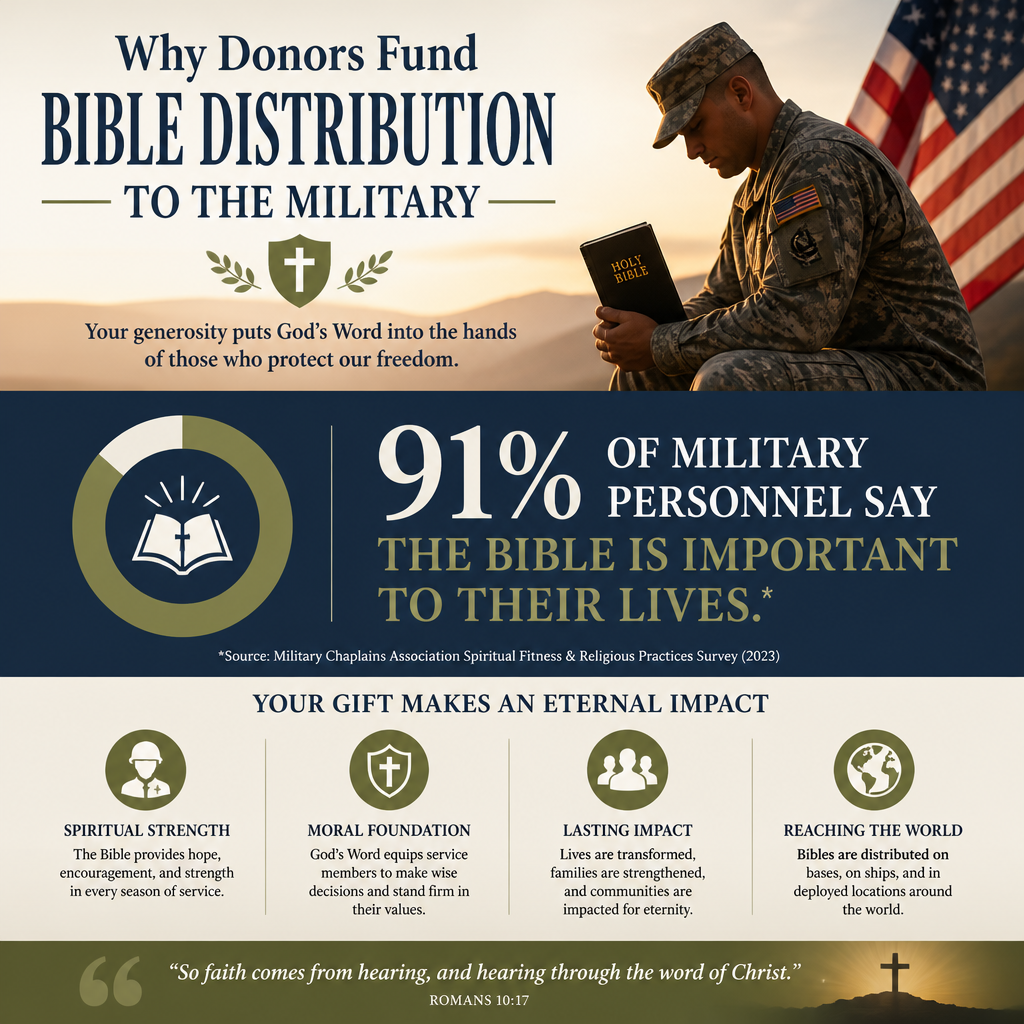
Across our verification work at Most Trusted, we observe that the ministries most worth a donor’s confidence tend to describe Bible distribution as a beginning, not an end. They can articulate how Scripture is introduced, how questions are handled, and how service members are connected to ongoing pastoral care. They also tend to be explicit about what they can and cannot do in military contexts, rather than promising unrealistic outcomes.
Wise giving includes asking harder operational questions
Because Bible distribution can appear simple, it can also attract simplistic reporting. Donors serve the mission best when they ask operational questions that separate serious ministries from publicity-driven efforts. A useful way to think about this is to ask what sits behind the “unit cost” of a Bible: translation choices, durable formats, logistics, chaplain coordination, and follow-up materials designed for spiritual care.
For donors who want a broader view of how ministries serve service members and veterans, the wider field of Military Outreach Ministries provides important context. Bible distribution can be a faithful part of that field, but it should be understood alongside counseling, church connection, trauma-informed pastoral care, and long-term discipleship for military families.
How to evaluate Bible distribution ministries with confidence
The Most Trusted Standard applied to a simple-seeming program
Bible distribution is deceptively easy to market and surprisingly easy to mishandle. That is one reason donors increasingly look for independent verification. Most Trusted evaluates ministries against The Most Trusted Standard, a 15-criteria framework that examines theological clarity, financial integrity, governance, transparency, and evidence of real outcomes. A ministry can distribute many Bibles and still fall short on accountability, theology, or reporting.
Three evaluation questions tend to clarify the difference between ministries that are merely active and ministries that are genuinely trustworthy:
- Is the ministry’s statement of faith clear and operational? It should shape real decisions, not merely exist as a web page formality.
- Does the ministry report finances in a donor-intelligible way? Audited financials, coherent program descriptions, and honest explanation of restricted funds are basic stewardship markers.
- Is distribution tied to pastoral care and local connection? The best ministries build relationships with chaplains and churches and can explain their follow-up pathway.
- Are outcomes described responsibly? “Lives changed” language should not replace measurable indicators such as engagement, requested follow-up, or established partnerships.
- Is there a governance structure that can say no? Healthy boards and conflict-of-interest safeguards matter, especially when a founder’s charisma drives fundraising.
Transparency should match the moral seriousness of the cause
Because this work touches service members’ spiritual and emotional vulnerabilities, transparency is not a bureaucratic preference; it is a moral obligation. Donors should expect clear policies on data privacy, trauma-sensitive communication, and the handling of stories and images. They should also expect honest acknowledgment of what the ministry cannot verify or control, especially in deployed settings.
Donors evaluating this space often benefit from comparing ministries within a coherent giving framework, rather than treating each appeal as unique. The practices that characterize wise stewardship in other categories apply here as well: clarity, accountability, and truthfulness about results. For donors weighing these issues, How to Give Wisely to Military Outreach Ministries names the considerations that tend to matter most when programs are emotionally compelling but operationally complex.
Real tensions donors should name rather than ignore
Proselytism concerns and religious liberty realities
Bible distribution in military contexts can raise public questions about coercion, endorsement, or improper influence. Those questions are not always asked fairly, but they are not always asked in bad faith either. The military is a hierarchical institution, and hierarchy can distort voluntary religious choices if ministries are careless about access or presentation. Donors should prefer ministries that insist on voluntariness, respect command boundaries, and coordinate through appropriate channels.
The harder question is whether donors are funding a program that treats service members as spiritual projects rather than as persons made in the image of God. A ministry committed to Christian witness should also be committed to dignity: offering Scripture, not forcing it; inviting conversation, not manufacturing numbers.
Counting Bibles is not the same as cultivating faith
Another tension is the temptation to equate scale with impact. Distribution numbers are easy to report and fundraise around, but discipleship is slower and more difficult to measure. Christians have long wrestled with the relationship between sowing and fruitfulness. The New Testament itself uses agricultural imagery precisely because growth is real and yet not fully controllable.
Donors can hold both truths without cynicism. We can affirm that placing Scripture in someone’s hands matters, and still ask whether the ministry is positioned to support reading, understanding, and connection to Christian community. That is not an efficiency demand; it is an integrity demand.
FAQs for Why donors fund Bible distribution to the military
Is Bible distribution to the military effective?
It can be, but effectiveness depends on more than distribution volume. The most credible programs combine access with follow-up: chaplain coordination, reading plans, small-group opportunities, and referral pathways for counseling and pastoral care. Donors should look for reporting that describes engagement and partnerships, not only quantities delivered.
What should donors watch for before giving to a Bible distribution ministry?
Donors should watch for weak transparency, exaggerated outcomes, and unclear relationships with chaplains and base leadership. We also recommend reviewing governance practices, audited financial statements when available, and whether the ministry’s theology is clear and consistent. Independent verification against The Most Trusted Standard is one way donors can reduce the risk of funding well-marketed but poorly governed work.
Why this giving endures
Donors fund Bible distribution to the military because they believe Scripture belongs in the lived realities where fear, grief, courage, and temptation converge. The calling is not to romanticize military service, nor to treat the Bible as a token of cultural identity, but to trust that God meets people through his Word in the places they cannot easily leave. When donors pair that conviction with careful evaluation and accountable partnerships, Bible distribution becomes a form of stewardship that honors both the gospel and the service member.



