

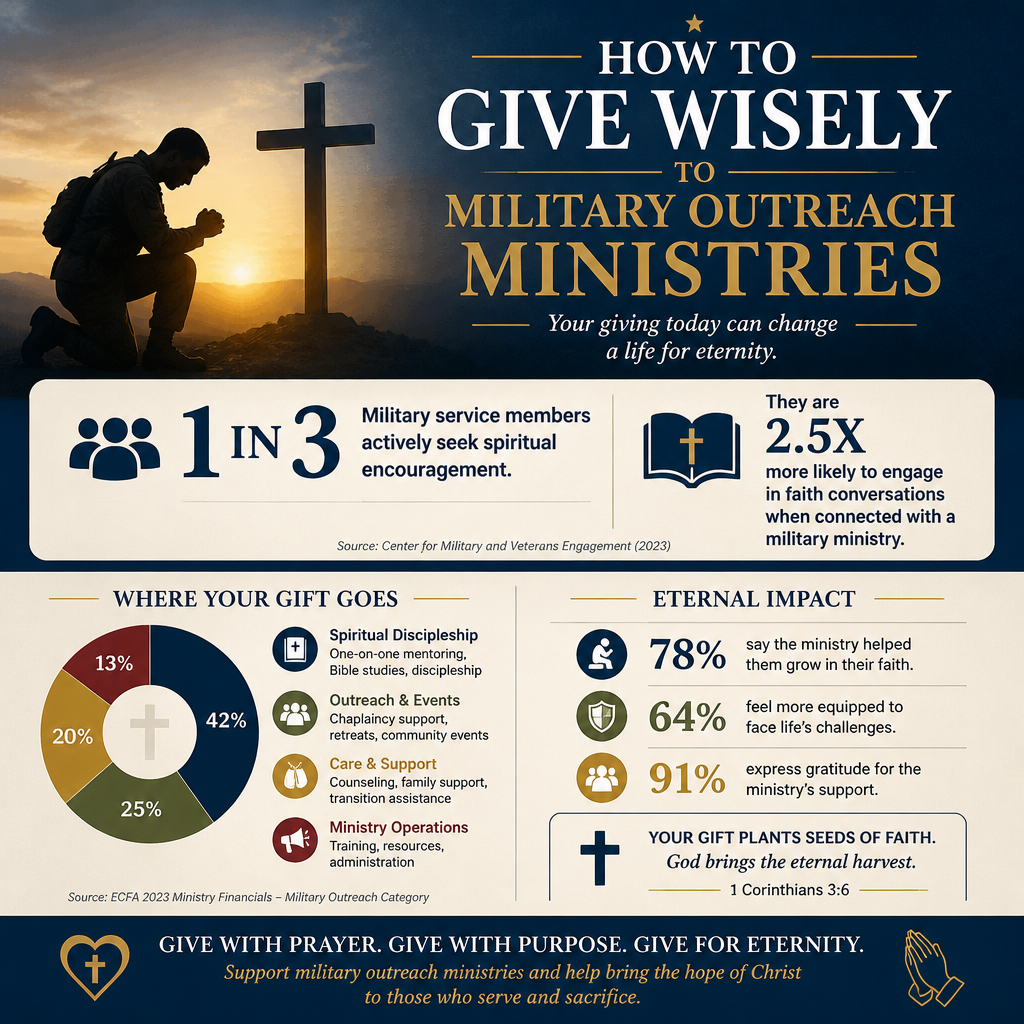
How to give wisely to military outreach ministries is not mainly a question of sentiment; it is a stewardship question with spiritual and fiduciary weight. Many Christian donors feel a legitimate pull to serve those who serve, especially when military life concentrates stress, mobility, moral injury, and isolation in ways civilians rarely see. The harder question is how to help without subsidizing confusion, weak accountability, or a ministry model that cannot credibly demonstrate either faithfulness or fruit.
Scripture commends care for those in harm’s way and those bearing heavy burdens, while also warning that zeal without knowledge can misfire. Paul’s insistence that “all things should be done decently and in order” (1 Corinthians 14:40) and his careful handling of relief funds (2 Corinthians 8) establish a pattern: Christian generosity should be both warm-hearted and well-governed. Wise giving to military outreach requires attention to theology, integrity, leadership, and evidence—because the men and women targeted for ministry are not props in a fundraising story. They are neighbors to be served with truth and honor.
Discern the ministry model and the theological commitments behind it
Military outreach ministries often share similar language—“support our troops,” “spiritual resilience,” “care packages,” “chaplain support,” “Bible distribution,” “PTSD resources.” Under that familiar vocabulary sit very different ministry theories. Some ministries are explicitly evangelistic; others are primarily morale and welfare programs with light spiritual content; others function as advocacy organizations. Christians genuinely disagree about the proper balance of evangelism and social support in this setting, but donors can still ask whether the organization’s stated mission matches its actual programming and communications.
Clarity about the Gospel and the church
Military culture can reward stoicism and can discourage vulnerability, which means a ministry can easily drift into a generic “encouragement” message that avoids the sharper edges of Christian truth. When an outreach ministry is explicitly Christian, donors should expect more than inspirational language. Do leaders articulate a coherent statement of faith? Do they explain how Scripture shapes their approach to counseling, discipleship, and moral formation? If the ministry operates internationally, do they speak carefully about partnership with local churches rather than treating deployed personnel as an audience for a traveling program?
Wise donors also notice what is absent. If the ministry speaks about “spirituality” but never about repentance, grace, and the person of Christ, the ministry may be functioning more as a morale brand than a Christian witness. That does not mean it has no value, but it changes what a Christian donor is funding and how the gift should be weighed.
Programs that fit military realities
The practical constraints of military life—deployments, restricted access, rotating schedules, and strict rules about solicitation—should shape programming. Credible ministries can explain how they gain access (through chaplain channels, base policies, or invited partnerships), how they avoid violating regulations, and how they protect the privacy and careers of service members who seek help. When programming is vague, or when the ministry implies access that seems implausible, donors should slow down and ask for specificity.
Avoiding politicization and identity capture
Military communities often sit near political fault lines, and some ministries discover that culture-war messaging raises funds. That is a temptation donors should name directly. A ministry can honor service members without recruiting them into an ideological brand. The test is not whether the leaders hold strong views; the test is whether the ministry’s public posture consistently serves the spiritual welfare of troops and families, or whether it uses them as symbols in a broader agenda.

Follow the money with precision rather than simplistic overhead rules
Christian donors understandably want to know what share of donations funds military outreach programs. The right question is not “How low is overhead?” but “Is spending aligned with mission, and is the reporting credible?” Modern nonprofit research has repeatedly warned against treating overhead ratios as the primary indicator of effectiveness. The “Overhead Myth” letter—signed by GuideStar (now Candid), BBB Wise Giving Alliance, and Charity Navigator—argues that overhead ratios can mislead donors and can pressure nonprofits into underinvesting in capacity, evaluation, and internal controls (GuideStar/Candid).
What this means in practice is that donors should read financials with a stewardship lens: integrity, transparency, and proportionality. A ministry distributing Bibles on base may legitimately spend heavily on printing and shipping. A ministry providing counseling or resilience training may spend heavily on personnel. A ministry coordinating local volunteer teams may have meaningful administrative costs because coordination is part of the work.
What strong financial reporting looks like
At minimum, donors should expect a current Form 990 for U.S. nonprofits, clear program descriptions that match expense categories, and leadership willing to answer hard questions without defensiveness. If the organization is large enough to warrant it, an independent audit (and a posted audit report or at least a clear statement of audit status) is a meaningful trust marker.
Government data can also help donors interpret claims. For example, the IRS provides the Form 990 framework that nonprofits use to describe program service accomplishments and report expenses (Internal Revenue Service). Donors do not need to become forensic accountants, but they should expect consistent, intelligible reporting that does not treat transparency as optional.
Campaign costs and restricted gifts
Military outreach ministries frequently use seasonal campaigns: holiday care packages, “Bibles for deployed troops,” emergency family support, or chaplain resource drives. These can be legitimate needs, but campaign design creates two common problems.
First, fundraising and fulfillment can swallow attention. A well-run campaign will disclose whether donations are restricted to a specific program, what happens if the goal is exceeded, and how administrative and shipping costs are treated. Second, some campaigns rely on emotionally loaded imagery that can blur the line between honor and exploitation. Mature donors can ask whether the ministry obtains permission for photos, protects identities where needed, and represents military life truthfully rather than theatrically.
Interpreting “percent to programs” in context
A single percentage rarely settles the question. A ministry can report a high program ratio while still doing little that is measurable or distinctively Christian; another can report a lower ratio while building durable chaplain partnerships, training volunteers, and safeguarding participants. Wise donors press for program logic: what is being done, for whom, at what scale, with what evidence of spiritual and human impact.
Examine governance, safeguards, and the ministry’s approach to care
Military outreach sits near sensitive pastoral territory: trauma, marriage strain, addiction, grief, and moral injury. That reality raises the governance stakes. A ministry’s board, policies, and leadership culture are not bureaucratic details; they are the moral architecture that protects service members and families from spiritual abuse, financial misuse, and confidentiality breaches.
Board independence and leadership accountability
Donors should look for a governing board that is meaningfully independent, meets regularly, and documents oversight. When most board members are related to the founder or financially dependent on the organization, accountability tends to weaken. Transparent conflict-of-interest policies, documented compensation practices, and clear lines between board governance and executive operations are signals of seriousness.
Across our verification work at Most Trusted, the ministries that meet The Most Trusted Standard tend to treat governance as part of discipleship—an expression of truthfulness, restraint, and neighbor-love. They do not promise perfection; they demonstrate controls that make misconduct harder and correction more likely.
Trauma-informed care and referral boundaries
Many outreach efforts begin with encouragement and connection, then encounter needs that exceed the training of volunteers. Wise ministries name their limits. They have written policies for mandated reporting where applicable, confidentiality, and referral to licensed clinical care. They also honor chaplains’ roles rather than competing for authority on base. Donors should be cautious of organizations that imply they can handle severe mental health crises through informal mentoring alone.
For donors who want an evidence-based lens, the U.S. Department of Veterans Affairs maintains extensive resources on PTSD and treatment pathways, which can help donors evaluate whether a ministry’s claims align with established clinical understanding (U.S. Department of Veterans Affairs).
Protecting the conscience and dignity of service members
Access to troops is a position of trust. A credible ministry avoids manipulative tactics: pressured altar calls in dependent settings, coerced “decisions,” or public disclosures that could affect a career. Evangelism that honors the person will be patient, truthful, and voluntary. Donors should also ask whether the ministry protects families—especially spouses navigating reintegration stress—rather than focusing only on the service member as the heroic center of the story.
Give with a long horizon and demand verifiable transparency
Monthly giving can be particularly fitting for military outreach because many needs are ongoing rather than episodic: pastoral presence, steady discipleship, consistent resource supply, and sustained care for families through deployment cycles. However, recurring support should be paired with recurring scrutiny. Wise donors revisit a ministry’s reporting annually, not because suspicion is virtuous, but because stewardship is.
What to expect in receipts and donor communication
Tax receipts should be prompt, accurate, and compliant. In the United States, donors generally need a contemporaneous written acknowledgment for gifts of $250 or more, and the acknowledgment must state whether goods or services were provided in exchange for the gift (Internal Revenue Service). Ministries should also provide clear information for non-cash gifts, recurring donation changes, and year-end summaries.
Communication should respect donors without manipulating them. A steady cadence of updates tied to real activity—units served, chaplain partnerships resourced, counseling sessions funded, Scripture distributed, follow-up pathways—signals operational maturity. Ministries that only communicate in crisis tones or perpetual urgency often struggle to build stable systems.
Measuring fruit in a ministry where outcomes are complex
Not everything that matters can be counted. Spiritual formation, reconciliation in marriages, and renewed hope after loss are not reducible to dashboards. Still, transparency and effectiveness are not opposites of faith; they are expressions of honesty. A wise ministry will offer both narrative and evidence: credible case examples with identities protected, clear definitions of what “served” means, and sober acknowledgment of limitations.
Donors can also ask whether a ministry learns. Does it evaluate programs and adjust, or does it repeat the same appeals year after year without showing operational development? In complex fields, humility is often visible as measurement and adaptation, not as vague disclaimers.
For donors seeking an independent lens, Military Outreach Ministries research at Most Trusted is designed to help Christians give with confidence. Our evaluations apply The Most Trusted Standard, a 15-criteria framework spanning faith foundation, financial integrity, governance and leadership, and transparency and effectiveness. The intent is not to replace prayerful discernment, but to support it with verifiable information.
Stewardship worthy of those we aim to serve
Military outreach asks donors to hold two truths at once: the needs are real, and not every organization that invokes those needs is trustworthy. Wise giving is neither cynical nor naive. It is a form of love ordered by truth—seeking ministries that speak clearly about Christ, operate with financial integrity, maintain accountable governance, and report their work with candor. When donors insist on that kind of stewardship, service members and families are more likely to receive care that honors their dignity and strengthens the church’s witness.



