
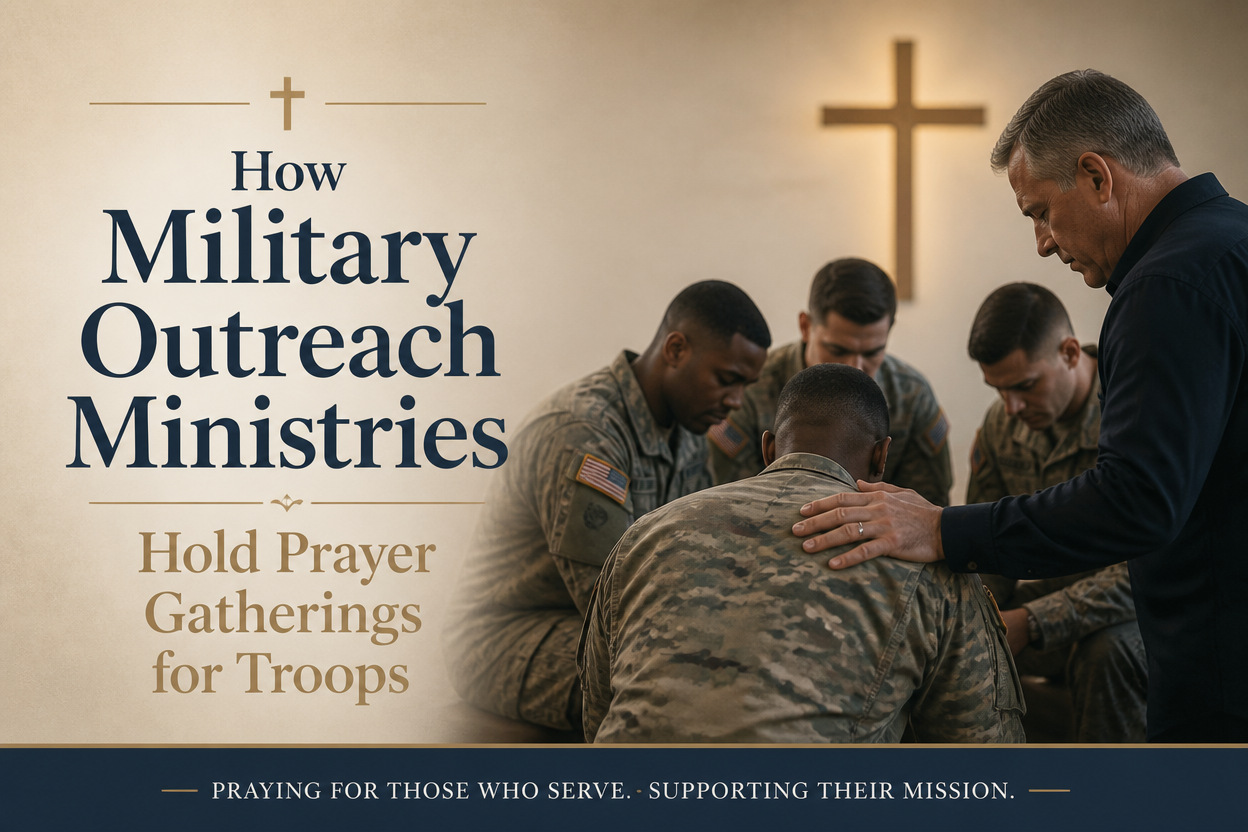
How military outreach ministries hold prayer gatherings for troops is not a question of event planning as much as ecclesiology under pressure. A prayer gathering on a base, in a hangar, or in a field environment asks what the church is when time is short, authority is real, and the people present may be preparing to kill or to die.
For Christian donors, this work can be difficult to evaluate from a distance. The fruit is often quiet: a soldier returning to Scripture, a marriage stabilized after a deployment cycle, a moral injury named before God rather than buried. Yet the risks are also real: prayer that becomes a tool of coercion, chaplaincy-adjacent programs that blur lines of authority, or spiritual care offered without accountability. Serious generosity requires more than affection for the mission; it requires confidence that a ministry’s practices are both faithful and verifiable.
The spiritual realities troops carry into prayer gatherings
Prayer in the presence of fear, grief, and moral weight
Military life concentrates many of the pressures Scripture names without romanticizing: fear, anger, loneliness, temptation, and the steady experience of loss. A well-led prayer gathering does not treat those realities as interruptions. It brings them into the light of God’s character: his nearness to the crushed in spirit, his justice, his mercy, and his authority over death.
Many troops arrive carrying what clinicians call moral injury, a construct that has gained increasing attention in the U.S. Department of Veterans Affairs: the distress that follows perpetrating, failing to prevent, or witnessing acts that violate one’s moral beliefs. The VA has described moral injury as involving guilt, shame, anger, and spiritual conflict, and has noted its relevance to veterans’ care (U.S. Department of Veterans Affairs).
Voluntary faith in a command culture
The armed forces run on lawful authority; the gospel does not. That tension is not a footnote for ministry leaders—it shapes every invitation to prayer. The best ministries treat voluntary participation as a theological and ethical commitment, not merely a legal safeguard. Prayer gatherings must make room for conscience, questions, and the reality that many attendees are spiritually curious but not yet convinced.
In our coverage of Military Outreach Ministries, we consistently see that the healthiest programs are explicit about what is and is not being asked of a service member. They resist the temptation to use institutional proximity as a substitute for pastoral trust.
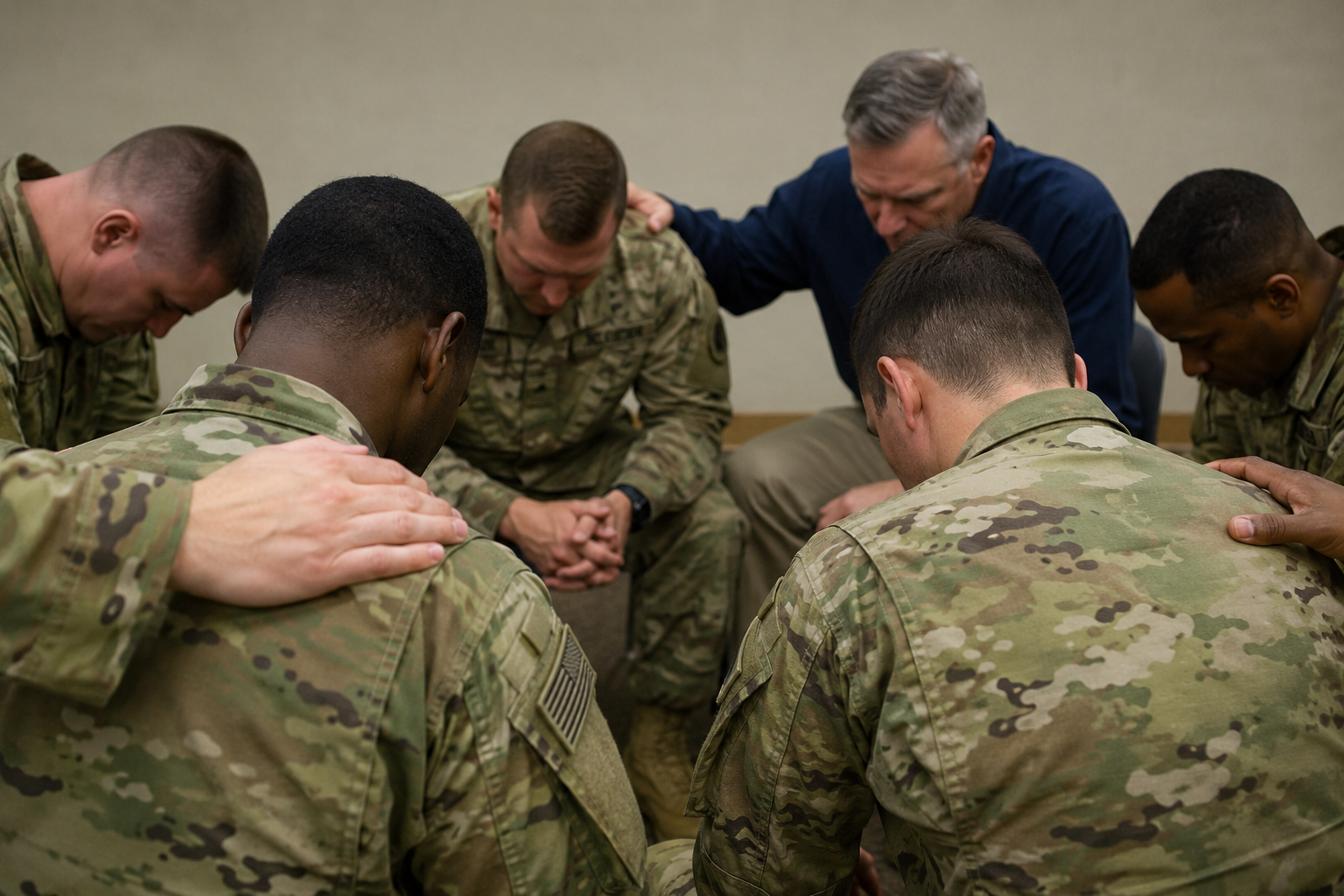
How ministries design prayer gatherings that respect conscience and strengthen faith
Clarity of purpose and an accessible liturgy
Prayer gatherings for troops work best when their purpose is plain: to seek God together in Scripture-shaped prayer, to intercede for those in danger, and to strengthen Christian witness without coercion. A gathering can be liturgical or informal, but it must be intelligible. Military settings include believers formed in different traditions, and also those with little church background. Leaders who read a short passage of Scripture, explain the posture of the gathering, and model brief, sincere prayer usually create the safest on-ramp.
When prayer becomes performative—long, insider language, or prayers that function as speeches—it often signals a leader’s anxiety rather than the Spirit’s power. Troops are trained to assess authenticity quickly. Reverence is not verbosity.
Guardrails for participation and privacy
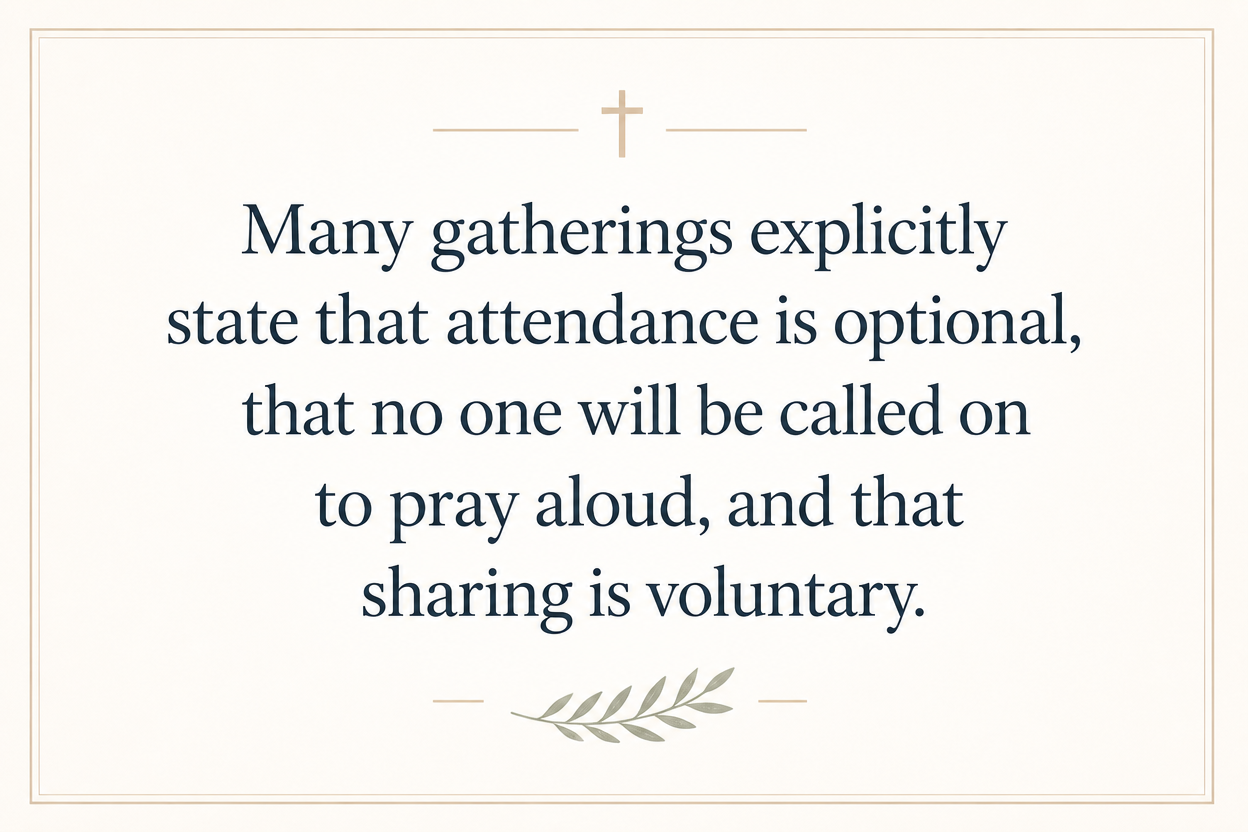
Because the military is a community where careers can be affected by perceived alignment, thoughtful ministries build guardrails that protect participants. Many gatherings explicitly state that attendance is optional, that no one will be called on to pray aloud, and that sharing is voluntary. They also treat privacy as pastoral care, not as secrecy.
In practice, a well-run gathering often includes a few stable elements: prayer for units and families, prayer for leaders in authority in keeping with 1 Timothy 2, and prayer for moral courage and restraint. It also leaves room for lament. The Psalms are not an exception in Scripture; they are a school of prayer for people under pressure.
The operational constraints that shape prayer gatherings in military contexts
Time, security, and transient communities
Ministry leaders cannot assume the rhythms of a local congregation. Schedules change quickly. Units rotate. Access can be restricted without notice. Some gatherings are planned around predictable windows—early mornings, lunch hours, or evenings—while others are improvised in response to events: casualties, deployments, or crisis in a family.
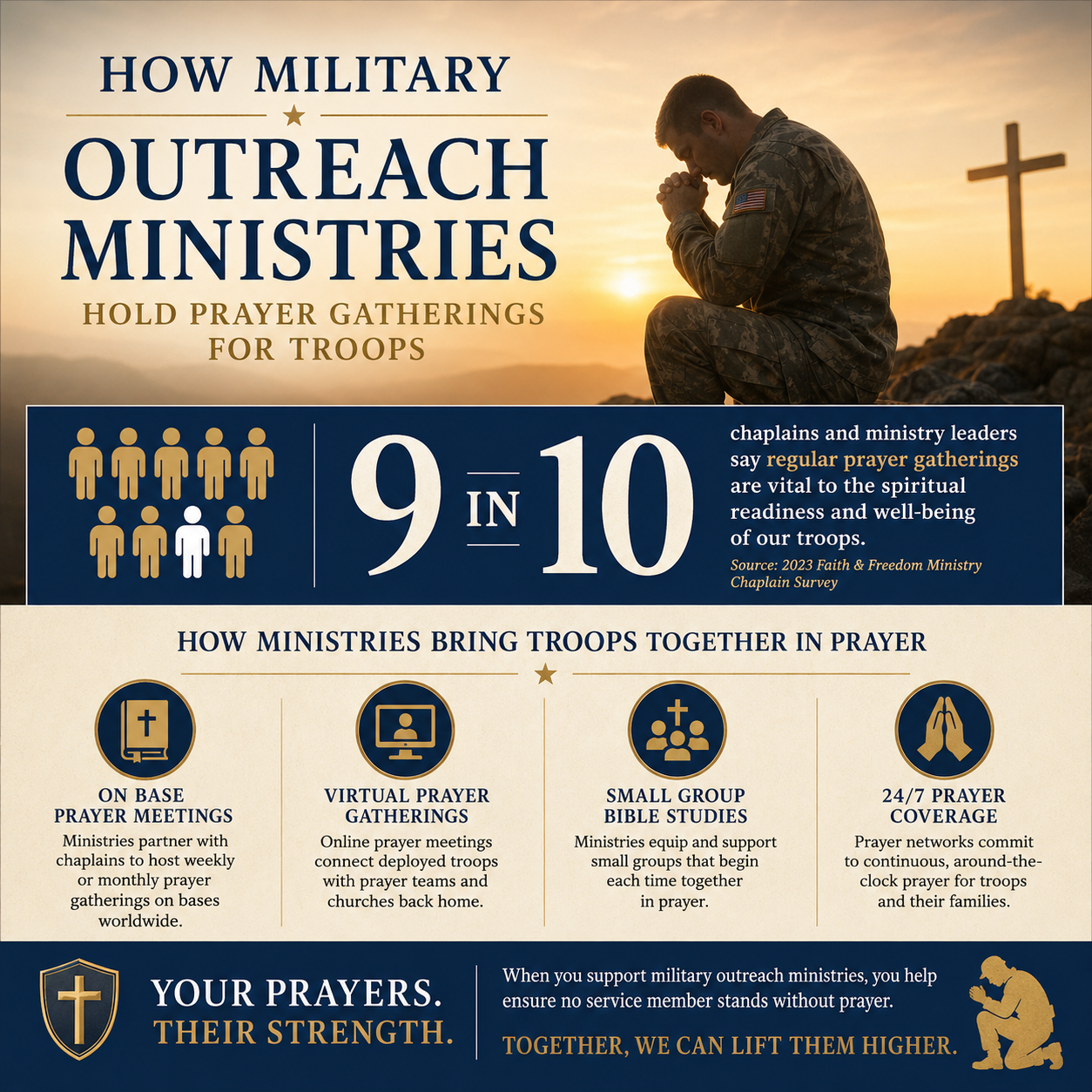
These realities help explain why many military prayer gatherings are simple by design. A short passage, a brief teaching anchored in the character of God, and intercession that names real needs can be more faithful than an elaborate program that collapses under operational demands.
Coordination with chaplains and compliance requirements
Chaplains occupy a unique and legitimate role within the armed forces, tasked to provide for the free exercise of religion while also caring for the whole force. Civilian ministries working near bases must understand and honor those boundaries. Christians genuinely disagree about where the lines should be drawn in specific cases, but the principle is not ambiguous: ministry must not exploit command relationships or create pressure through official channels.
Donors should be attentive to whether a ministry describes its relationship to chaplaincy with precision. Vague language often conceals either overreach or misunderstanding. Responsible ministries can explain how they obtain permission for access, how they protect voluntary participation, and how they respond when a commander’s preferences conflict with conscience protections.
What faithful prayer gatherings tend to include and what they avoid
Practices that serve troops rather than a brand
Across our verification work at Most Trusted, we see that prayer gatherings become spiritually fruitful when they are oriented toward shepherding rather than audience-building. The ministries that meet The Most Trusted Standard tend to describe their prayer work in terms of pastoral aims and measurable practices: who leads, what training is required, how safeguarding is handled, and how follow-up care is offered when prayer surfaces trauma.
In donor terms, this is where mission clarity meets integrity. It is easier to fund a visible event than to fund a disciplined pastoral system that includes supervision, reporting, and the humility to refer a service member to clinical care when needed. Yet that system is often where the true cost of faithful ministry resides.
Signals donors can look for when evaluating a ministry
Some indicators are practical, but they are not merely operational. They reveal theological instincts about power, truth, and neighbor-love.
- Clear statements that attendance is voluntary and non-participation carries no consequences.
- Documented training for prayer leaders on trauma awareness, confidentiality, and referral pathways.
- Coordination protocols with chaplains and installation requirements when operating on or near bases.
- Scripture use that is contextual and pastoral rather than slogan-driven.
- Follow-up care that includes local church connection when feasible, not only recurring events.
There are also patterns that should raise questions. Prayer that is routinely fused with political messaging can displace the gospel with a tribal identity. Publicized prayer moments that show identifiable troops without clear consent can put service members in a vulnerable position. And ministries that promise spiritual outcomes as if they were guaranteed results often reveal an unhealthy view of God and of suffering.
Donors who want deeper context on the broader practice of spiritual support can also review Prayer and Spiritual Care in Military Outreach Ministries. The best giving decisions are made with a view of the whole care continuum, not a single event.
Why verification matters when the work is spiritual and the setting is high stakes
Financial and governance integrity in proximity ministry
Prayer ministry in military contexts often involves travel, access arrangements, and partnerships with churches or base-adjacent communities. Those realities can produce financial complexity: restricted gifts, designated trips, and donor expectations tied to particular units. Mature ministries handle these pressures with clear financial controls, appropriate board oversight, and transparent reporting that does not trade on confidential stories.
Many donors have absorbed the “overhead equals waste” assumption, but philanthropic leaders have challenged that narrative for more than a decade. The “Overhead Myth” open letter—signed by Charity Navigator, GuideStar, and the BBB Wise Giving Alliance—argued that focusing narrowly on overhead ratios can mislead donors and starve nonprofits of necessary capacity (Charity Navigator). In military prayer work, capacity is not cosmetic. Training, supervision, and safeguarding cost money, and underfunding those functions can create spiritual and organizational harm.
Transparency without violating trust
The strongest ministries practice a form of transparency that is both candid and restrained. They can describe outcomes without exploiting individuals. They can report activity without implying that God’s work is reducible to metrics. They can disclose risks and boundaries without sounding defensive.
This is a meaningful theological issue. Scripture treats human beings as image-bearers, not as fundraising assets. If a ministry cannot tell its story without disclosing sensitive details, it may be relying on emotional extraction rather than pastoral care. Donors should not reward that pattern.
FAQs for How military outreach ministries hold prayer gatherings for troops
How do prayer gatherings remain voluntary in a culture defined by rank and authority?
Responsible ministries state explicitly that attendance is optional, avoid routing invitations through command channels in ways that create pressure, and ensure no one is singled out for participation. They also train leaders to resist subtle coercion: calling on junior troops to pray, publicly tallying attendance, or implying spiritual deficiency when someone abstains. When chaplains are involved, the best practice is clear coordination that protects free exercise without creating the appearance of command endorsement.
What should donors ask before funding a ministry that hosts prayer gatherings for troops?
Donors can ask who leads the gatherings, what training is required, how confidentiality is handled, and what referral pathways exist for trauma, suicidal ideation, or family crisis. It is also reasonable to ask how the ministry coordinates with chaplains and base policies, what financial controls govern travel and designated giving, and what reporting is provided without compromising participant privacy. A ministry ready for partnership will answer with specificity rather than slogans.
A donor’s role in sustaining faithful prayer among troops
Prayer gatherings for troops are one of the quieter front lines of Christian care. They ask leaders to honor conscience, to speak truth without triumphalism, and to bear burdens that many civilians never see. Donors sustain that work best when giving is paired with discernment: supporting ministries that combine theological seriousness with operational integrity, and insisting on the kind of accountability that protects both the gospel and the service members being served.



