

Choosing a trustworthy military outreach ministry is a stewardship decision with spiritual consequences. Military communities live under pressures most civilians rarely see, and Christian donors rightly want to support ministries that bring the steady comfort of Christ without exploiting sacrifice, suffering, or patriotism for fundraising.
Scripture commends honor for those who bear heavy burdens for the common good, and it also demands sober discernment about leaders, money, and truthfulness. The New Testament repeatedly warns churches not to be taken in by flattering speech, hidden agendas, or unaccountable authority. Giving to military outreach is a tangible way to “do good to everyone, and especially to those who are of the household of faith” while remembering that sincerity does not automatically equal trustworthiness.
Start with mission clarity and a coherent theology of service
Distinguish pastoral care from political identity
Military outreach ministries often operate close to civic symbols, national narratives, and contested public debates. Christians genuinely disagree about aspects of war, conscience, and national policy, but there is far less disagreement about the church’s calling to shepherd souls, pursue holiness, and love neighbors sacrificially. A trustworthy ministry can articulate how it serves service members, veterans, and families without collapsing discipleship into a partisan script.
In practice, we look for ministries that can answer basic questions with precision: Who is being served, and in what setting? Is the ministry primarily pastoral care for believers, evangelistic witness among the unchurched, or crisis support for families? How does it relate to chaplaincy structures, local churches, and clinical care when trauma, addiction, or suicidality are present? Mission drift is common in emotionally charged fields, and clarity protects both donors and those being served.
Evaluate how the ministry handles suffering and moral injury
Military life brings ordinary human suffering into sharper relief and sometimes adds distinct forms of trauma, grief, and moral injury. Ministries that speak about these realities with theological seriousness tend to avoid two opposite errors: treating spiritual care as a substitute for professional treatment, or treating faith as a decorative add-on to fundamentally secular counseling models. Neither approach serves military families well.
We recommend listening for a ministry’s doctrinal center of gravity. Is the gospel presented as the power of God for salvation and the ground of endurance, repentance, forgiveness, and hope? Or is the message primarily therapeutic reassurance without confession and renewal? A trustworthy ministry does not manipulate pain; it names sin and suffering honestly and points to Christ with patience.
Look for accountable leadership and credible partnerships
Ask who provides spiritual and organizational oversight
Military outreach often elevates strong personalities: decorated veterans, charismatic speakers, or leaders with compelling personal stories. Stories can be true and still be used to bypass oversight. Donors should ask how authority is restrained. Does the organization have an independent board with real governance responsibilities, or a board that functions as an honorific circle around a founder?
Across our verification work at Most Trusted, ministries that meet The Most Trusted Standard typically show evidence of governance that can say “no” to leadership when necessary. That includes clear conflict-of-interest policies, documented board minutes, and meaningful separation between those who approve budgets and those who benefit from them. Military culture rightly values chain of command; nonprofits must also value accountable leadership.
Examine relationship to local churches and chaplains
Healthy military outreach rarely thrives in isolation. The best ministries understand their lane and honor other callings. For some, that means collaborating with endorsed chaplains and respecting installation policies. For others, it means equipping local churches to receive veterans and military families as long-term members, not short-term projects.

When assessing partnerships, donors should be cautious of two extremes. One is a ministry that refuses collaboration because it insists it alone is faithful. The other is a ministry so eager for access that it dilutes its convictions. Trustworthy ministries can name their theological commitments and still work respectfully within complex environments.
Follow the money with disciplined, fair questions
Seek transparent financial reporting and sober fundraising
Military-themed fundraising can produce strong donor response, which makes this category vulnerable to emotional appeals that outrun verified impact. A trustworthy ministry makes it possible to understand where funds go and why. At minimum, donors should expect current financial statements, a clearly articulated budget narrative, and accessible explanations of major expense categories.
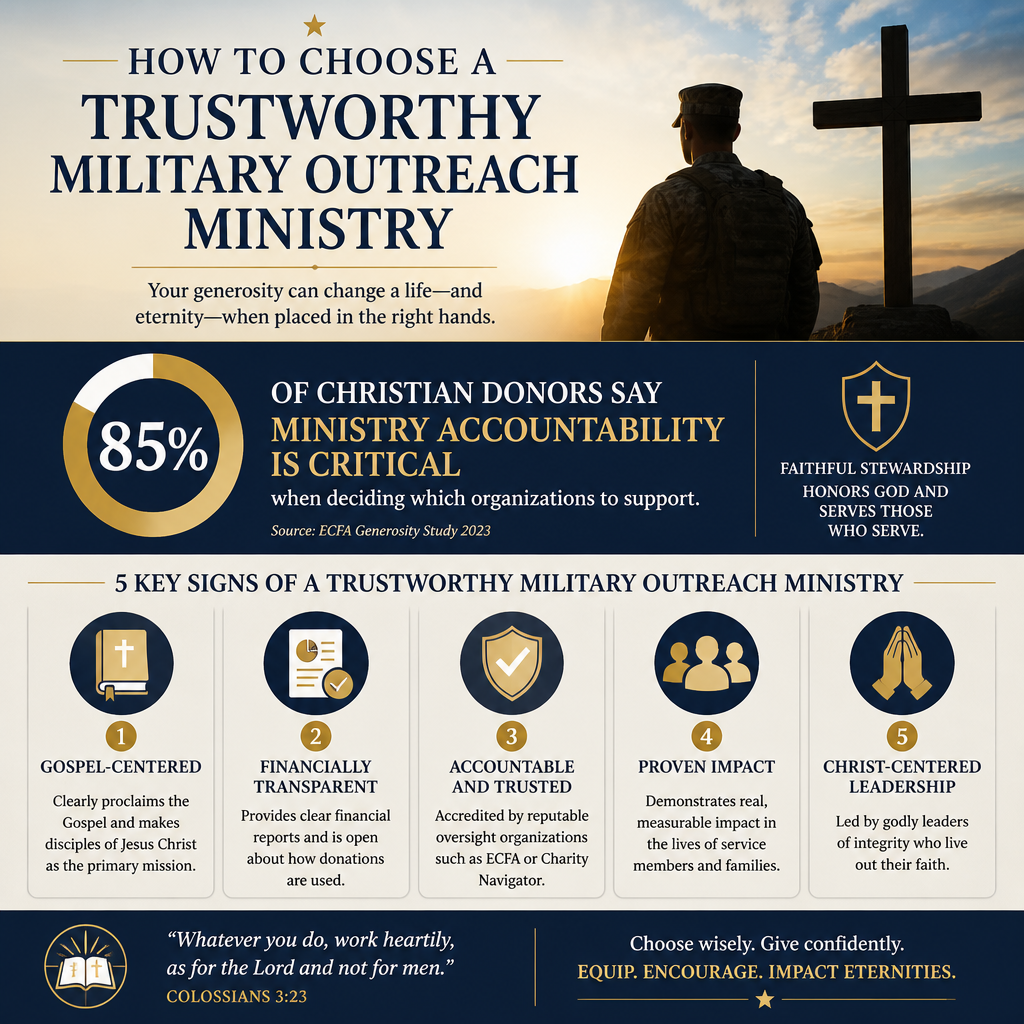
For larger U.S. nonprofits, the IRS Form 990 is a baseline public document. Donors can find it through the IRS Tax Exempt Organization Search, which allows verification of tax-exempt status and access to filings where available through the IRS system itself: IRS Tax Exempt Organization Search. The point is not to punish overhead but to confirm that basic reporting is consistent, comprehensible, and aligned with the mission.
Apply the right lessons about overhead and effectiveness
Christians often want to fund “programs, not administration,” but the nonprofit field has had to reckon with how simplistic that metric can be. The “Overhead Myth” letter, signed by Charity Navigator, GuideStar, and the BBB Wise Giving Alliance, argued that administrative and fundraising ratios alone do not indicate impact or integrity: Charity Navigator. Donors should take that caution seriously while still asking hard questions about executive compensation, related-party transactions, and unusually aggressive fundraising costs.
What this means in practice is that trustworthy ministries can explain their spending decisions in plain language. If fundraising is substantial, they should be able to justify the strategy and show how it serves long-term mission rather than institutional growth for its own sake.
- Financial transparency: Clear access to audited statements when scale warrants it, and consistent reporting year to year.
- Fundraising integrity: Appeals that avoid exaggeration, guilt pressure, or ambiguous use of restricted gifts.
- Compensation reasonableness: A documented process for setting pay, not informal founder discretion.
- Use of designated gifts: Policies showing that restricted donations are honored as promised.
- Reserve and solvency posture: Evidence the organization can sustain commitments without crisis-driven fundraising.
Insist on truthful communication and measurable, appropriate outcomes
Prefer evidence of changed lives over volume metrics
Some military outreach outcomes are straightforward to count: chaplain referrals fulfilled, retreat participants served, Bibles distributed, peer support groups hosted. But volumes can be inflated, and they can distract from whether people are actually being discipled, stabilized, connected to church, or supported through crises.
Donors should ask what the ministry claims to accomplish and how it knows. “We reached thousands” is easy to say and hard to audit. A more trustworthy approach is to report outcomes that fit the work: follow-up rates, church connection pathways, retention in mentoring relationships, or documented referral protocols for mental health emergencies.
Look for safeguards where vulnerability is high
Military families can be uniquely vulnerable during deployment cycles, transition out of service, or after traumatic events. Ministries serving youth in military households or offering counseling-like support should have clear safeguarding policies, training requirements, and escalation procedures. Trustworthy organizations treat privacy and consent as moral obligations, not administrative burdens.
Donors should also watch for the misuse of stories. If an appeal relies on vivid accounts of trauma, the ministry should be able to explain its consent practices and how it protects the dignity of those served. Christians do not need sensationalism to justify mercy.
Use a verification framework that matches the stakes
Why donors benefit from third-party verification
Military outreach attracts generous people who want to honor sacrifice and stand with families under strain. That generosity is commendable, but it can also be targeted. Independent verification is one way to keep compassion joined to discernment.
Most Trusted exists to help donors give with confidence by evaluating Christian nonprofits against The Most Trusted Standard, a 15-criteria framework across Faith Foundation, Financial Integrity, Governance and Leadership, and Transparency and Effectiveness. The practical value for donors is consistency: the same questions asked across ministries, the same documentary expectations, and the same insistence that theology, money, and governance belong together.
Where to place this decision in your broader giving
Some donors will prioritize direct spiritual care for active-duty service members; others will focus on veterans’ reintegration, marriage strengthening, or trauma-informed discipleship. There is room for varied callings. The harder question is whether a ministry’s work is integrated into the life of Christ’s church and conducted with verifiable integrity.
Many donors also want to compare ministries within the same field rather than evaluating one organization in isolation. For a broader view of the landscape, see Military Outreach Ministries, where donors can better understand common models, strengths, and recurring risks in this category.
Donors who are specifically considering how to assess these organizations with spiritual and financial seriousness may also find it useful to consult How to Give Wisely to Military Outreach Ministries as a reference point for the kinds of due diligence questions that tend to surface in responsible giving.
FAQs for How to choose a trustworthy military outreach ministry
Should we prioritize ministries run by veterans or by pastors and counselors?
Veteran leadership can add credibility, cultural fluency, and earned trust, but it is not a substitute for pastoral and organizational qualifications. A trustworthy ministry can show both competence and accountability: leaders with appropriate formation for the work, clear referral boundaries when clinical care is needed, and governance structures that restrain personal authority. The question is not whether a leader has worn the uniform, but whether the ministry’s leadership is qualified, supervised, and faithful to the gospel.
How can we evaluate claims about preventing suicide or healing trauma without becoming cynical?
We recommend neither cynicism nor credulity. Suicide prevention and trauma recovery are complex, multi-factor realities, and ministries should avoid simplistic cause-and-effect claims. Ask what the ministry actually does, what training its staff and volunteers have, what referral relationships exist with licensed professionals, and what outcomes are realistically measurable. Trustworthy organizations speak carefully, report what they can verify, and do not turn crisis into a marketing tool. Donors can also consult the CDC’s guidance on suicide prevention for a sober picture of what effective prevention work entails: Centers for Disease Control and Prevention.
Giving that honors service and insists on integrity
Military outreach deserves donors who combine gratitude with discernment. The ministries most worthy of trust tend to show clear theological commitments, accountable leadership, transparent finances, and communication disciplined by truth. Christian giving is not only an expression of compassion; it is an act of stewardship before God, offered with open hands and clear eyes.



