

How giving campaigns work in military outreach ministries is not primarily a fundraising question. It is a stewardship question: how a ministry invites the Church to participate in gospel work among those who bear a unique set of burdens, responsibilities, and moral injuries. Campaign design shapes what gets funded, how outcomes are defined, and whether the donor’s generosity strengthens long-term presence or merely funds short-term visibility.
Military communities are not a monolith. Active duty, Guard, Reserve, veterans, spouses, and children experience different pressures, and ministry access varies by installation, command climate, and local chaplain relationships. What this means in practice is that campaigns can drift toward what is easiest to communicate rather than what is hardest to sustain: consistent pastoral care, trauma-informed discipleship, and patient trust-building on and around bases.
1. The ministry context that shapes campaign design
Access is relational and often mediated
Most military outreach ministries cannot simply “scale” access the way a digital nonprofit scales ad spend. Installation policies, chaplain endorsements, event approvals, and the practical realities of deployments constrain what can be done and when. Campaigns that promise quick expansion without naming these constraints often end up funding activity that looks like reach but does not build durable ministry presence.
Christians genuinely disagree about the best balance between evangelism events and longer pastoral rhythms. Some ministries prioritize large gatherings that create contact points; others emphasize steady small-group discipleship and counseling. Healthy campaigns do not hide that trade-off. They explain why a particular approach is faithful to the Great Commission and attentive to the people being served.
Needs are often invisible and long-term
Combat stress, moral injury, marital strain, isolation, and the challenges of reintegration are not solved on a campaign calendar. The donor’s desire to see fruit is good; Scripture honors watchful stewardship. Yet the Church also understands sowing and watering before harvest. Campaigns worthy of donor trust explain what fruit looks like at different horizons: immediate engagement, sustained relationships, and long-term formation.
For donors evaluating work among service members and veterans, it can help to keep the broader landscape in view. We maintain ongoing analysis in our coverage of Military Outreach Ministries, because campaign claims make sense only inside the access and care realities of the military world.

2. What a giving campaign is and what it is not
Campaigns are coordinated invitations, not merely revenue spikes
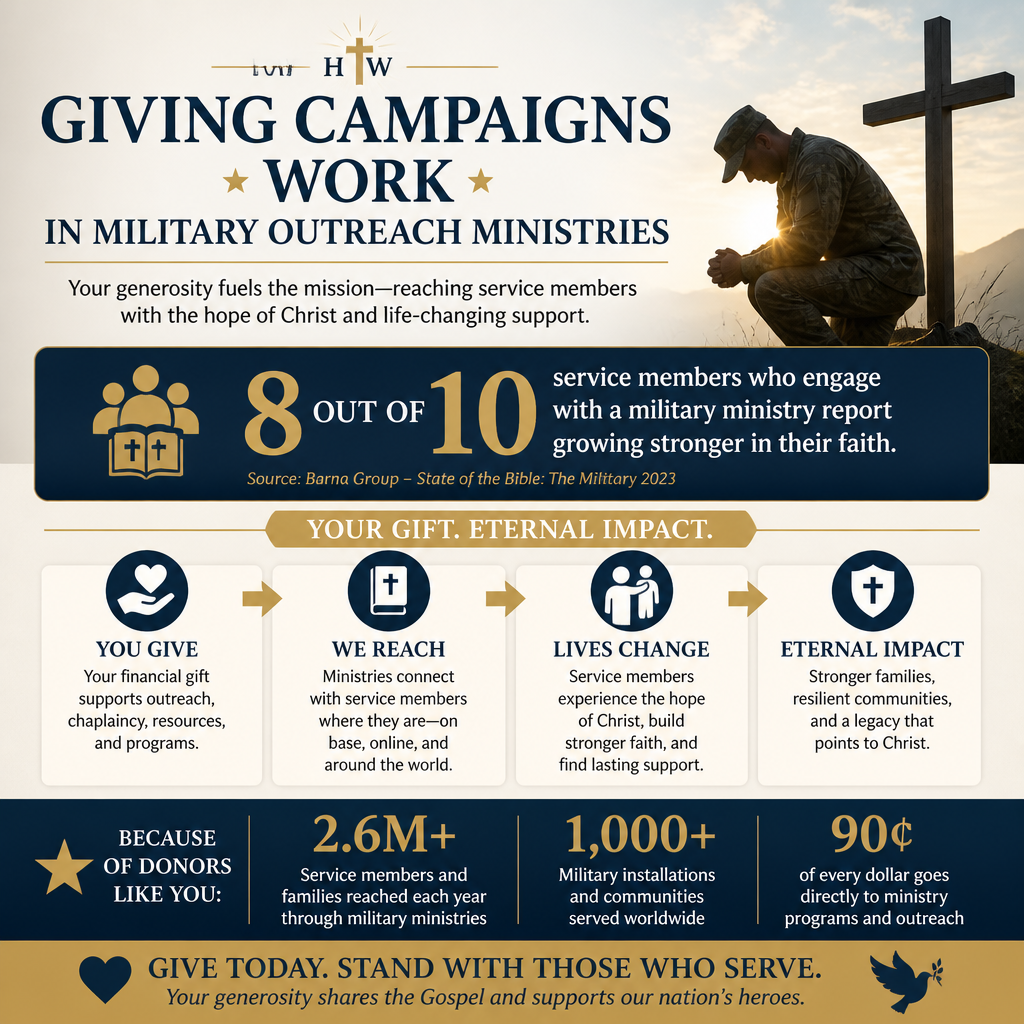
A giving campaign is a defined period of intensified communication and solicitation tied to specific ministry goals. In military outreach, that might be funding chaplain partnerships, underwriting staff who can maintain on-base presence, resourcing retreat ministry for marriages, or supporting follow-up discipleship for service members who first encountered the gospel at an event.
Campaigns become unhealthy when they are treated as a substitute for a coherent funding model. A ministry that relies on repeated urgent appeals to cover ordinary operating costs may be signaling a planning deficit, governance weakness, or a culture that rewards emotional pressure over clarity. Donors should not assume malice; many ministries are under real strain. But patterns matter.
Good campaigns identify the true cost of ministry
Military outreach is often staff-intensive. It requires leaders with credibility, pastoral skill, and the patience to serve in contexts where visible “success” may be slow. A campaign that budgets only for program moments, while underfunding the staff formation and accountability that make those moments safe and fruitful, tends to degrade over time.
Donors are sometimes trained—implicitly or explicitly—to treat overhead as the enemy of faithfulness. The philanthropic sector has had to correct that assumption. The “Overhead Myth” statement, signed by Charity Navigator, Candid, and BBB Wise Giving Alliance, argues that administrative and fundraising costs can be necessary investments in effectiveness and transparency.Charity Navigator
3. The typical mechanics of a military outreach giving campaign
Phases and components donors should expect
Most campaigns in this space follow a similar sequence even when the messaging differs. A disciplined ministry will communicate these elements plainly and provide documentation that matches the story being told.
- Case for support: a coherent theological and practical rationale for the work, including the specific population served and the ministry’s approach.
- Defined funding need: a target amount tied to a budget and timeline, with what will change if the goal is met.
- Segmentation: different asks for major donors, monthly partners, churches, and event-based givers.
- Channels: direct mail, email, events, church presentations, and peer-to-peer efforts, each with appropriate safeguards.
- Receipting and reporting: timely receipts, clear designations, and follow-up reporting that respects donor intent.
Special features in military outreach campaigns
Because military life is mobile, campaigns often emphasize recurring giving. Monthly support stabilizes staffing and allows ministries to plan around deployments and training cycles. It can be a genuine service to the donor as well: a disciplined way to participate in mercy and mission without waiting for emotional peaks.
Campaigns also frequently incorporate storytelling from service members and families. This is where ethical standards become decisive. The people served may have security concerns, trauma histories, or professional consequences if their faith story is mishandled. Strong ministries use informed consent, avoid manipulative detail, and protect identities when necessary. When a campaign’s content feels designed to maximize shock or sentiment, donors should slow down and ask for the underlying policies.
4. Where campaigns go wrong and what integrity looks like
Common failure modes donors should recognize
The fact that military outreach is difficult does not excuse poor practice. Some of the most serious breakdowns arise when a ministry’s fundraising incentives are misaligned with its pastoral responsibilities. Christians are called to truth-telling, especially when money is involved.
Across our verification work at Most Trusted, the ministries that best sustain credibility tend to resist three temptations: overstated access (“we reach every base”), inflated outcome claims (“X conversions from one weekend”), and blurred financial boundaries between restricted gifts and general operations. None of these temptations are unique to this field, but the stakes are heightened when the people served are carrying unseen wounds.
Integrity is measurable in policies, reporting, and governance
Donors often want a single signal that resolves complexity. Mature stewardship looks for a cluster of consistent indicators: audited financials where appropriate, board independence, conflict-of-interest policies, clear program descriptions, and reporting that matches the ministry’s stated theology of discipleship.
Effectiveness is also not identical to “low overhead.” In military outreach, effectiveness frequently depends on staff quality, training, and accountability. The sector’s correction of overhead fixation is helpful here, but it does not remove the need for scrutiny. A ministry can spend heavily and still be ineffective; a ministry can spend frugally and still be irresponsible. The donor’s task is to ask what is being accomplished, at what cost, and with what safeguards.
5. How donors can evaluate a campaign using The Most Trusted Standard
Questions that align with Christian stewardship
The Most Trusted Standard is our 15-criteria framework for evaluating Christian nonprofits across faith commitments, financial integrity, governance practices, and demonstrable clarity about results. When a military outreach ministry launches a campaign, the donor can use that moment to ask questions that are both practical and spiritual: does this invitation reflect truthfulness, neighbor-love, and accountability?
We recommend pressing for verifiable answers in plain language. A ministry worthy of trust will not treat reasonable questions as hostility. It will treat them as part of faithful partnership.
A donor checklist for campaign discernment
The following questions are not cynical. They are the ordinary due diligence Scripture commends when resources are entrusted for kingdom work.
- Clarity of purpose: What exactly will this campaign fund, and what will change if it succeeds?
- Truthful portrayal: Are stories and images used with consent and appropriate privacy protections?
- Budget coherence: Does the ask match an intelligible budget, including staffing and oversight costs?
- Governance: Is there evidence of meaningful board oversight and conflict-of-interest safeguards?
- Reporting: Will donors receive follow-up reporting tied to the stated objectives, not merely more appeals?
For donors wanting a wider framework for discernment, our analysis in How to Give Wisely to Military Outreach Ministries addresses the recurring patterns we see across the field, including how to weigh outcomes that are necessarily hard to quantify.
When donors ask about “results,” it is reasonable to expect ministries to measure what they can measure. It is also wise to resist importing metrics that distort ministry into a marketing funnel. Many effects of pastoral care are real but not easily reduced to counts. The research literature on veteran suicide, for example, underscores the severity and complexity of the problem, but it does not translate neatly into program-attribution claims for any single ministry.U.S. Department of Veterans Affairs
FAQs for How giving campaigns work in military outreach ministries
Should a military outreach campaign emphasize conversions and decisions?
Evangelism is central to Christian mission, and it is appropriate for ministries to speak about people coming to faith. The credibility question is whether conversion language is paired with a discipleship framework and careful reporting. Campaigns that highlight decisions but do not describe follow-up, church connection, and pastoral care can unintentionally train donors to prize momentary response over enduring formation.
Is monthly giving better than one-time gifts for military outreach?
Monthly giving often fits the operational realities of military outreach because it stabilizes staffing and permits planning around unpredictable schedules. One-time gifts can be highly appropriate for discrete needs such as retreat scholarships, resource distribution, or capital purchases. The stronger question is whether the ministry explains why a particular funding mix is needed, and whether it can honor designations without confusing restricted and unrestricted funds.
Conclusion
Giving campaigns in military outreach ministries are most trustworthy when they treat fundraising as a form of truth-telling and pastoral responsibility, not as religious marketing. Donors are right to ask for clarity, governance, and evidence that the ministry understands the people it serves. When a campaign is anchored in transparent budgets, ethical storytelling, and accountable leadership, generosity becomes what it is meant to be: a disciplined participation in Christ’s care for those who serve.



