
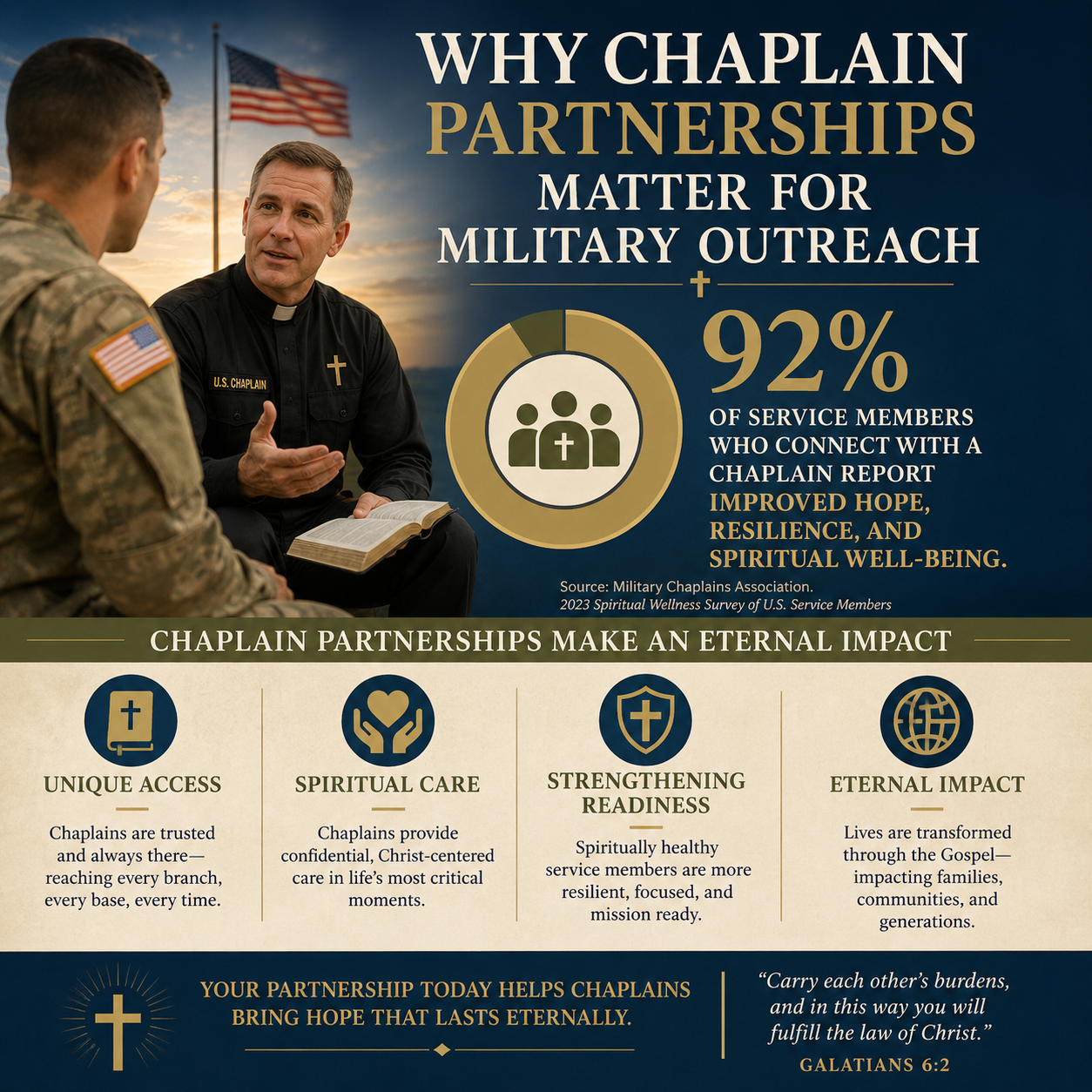
Why chaplain partnerships matter for military outreach is ultimately a question of trust: who has legitimate access to service members, under what authority, and with what pastoral accountability. Donors who care about the Gospel and the common good should want ministries to reach the military, but they should also want that reach to be orderly, lawful, and spiritually wise.
Military communities are not simply another “target audience.” They are governed by command structures, regulated environments, and a moral ecosystem shaped by warfighting realities, repeated relocation, and family strain. Chaplains stand at the intersection of those realities and the Church’s calling to shepherd souls. When ministries work well with chaplains, outreach is more likely to be ethical, effective, and genuinely pastoral rather than opportunistic.
Chaplains provide lawful access and moral legitimacy
Access is a stewardship issue, not a marketing tactic
The modern U.S. military is a closed community in the literal sense: entry, events, and programming are governed by installation rules, commanders’ intent, and security constraints. Chaplains operate within that system as commissioned officers or endorsed religious professionals, accountable both to the chain of command and to their ecclesial endorsers. That dual accountability is precisely why chaplain partnerships matter: they allow Christian outreach to proceed with permission, clarity, and respect for institutional boundaries.
Donors should be cautious about ministries that speak as though “getting on base” is merely a matter of persistence. The military has good reasons to restrict access. Commanders must protect readiness, safety, and good order, and they must ensure that religious support is offered fairly within constitutional limits. Chaplains are trained to navigate that tension so that service members can freely seek spiritual care without coercion.
Pluralism and free exercise are not contradictions
Some Christians worry that chaplaincy pluralism dilutes the Gospel. That concern deserves a serious hearing. Yet the chaplaincy exists in part to safeguard free exercise for service members across traditions, including orthodox Christians. The better question is not whether the military context is complex, but whether a ministry’s approach shows theological conviction alongside institutional respect. Chaplain partnerships often demonstrate that balance because chaplains are obligated to protect religious freedom while also providing ministry consistent with their own faith.
What this means in practice is that a faithful Christian outreach ministry typically does not bypass chaplains. It works through the structures that exist to protect service members from manipulation and to protect the ministry from avoidable conflicts with command policy.
Chaplains see the whole person under conditions civilians rarely witness
War and training environments intensify spiritual questions
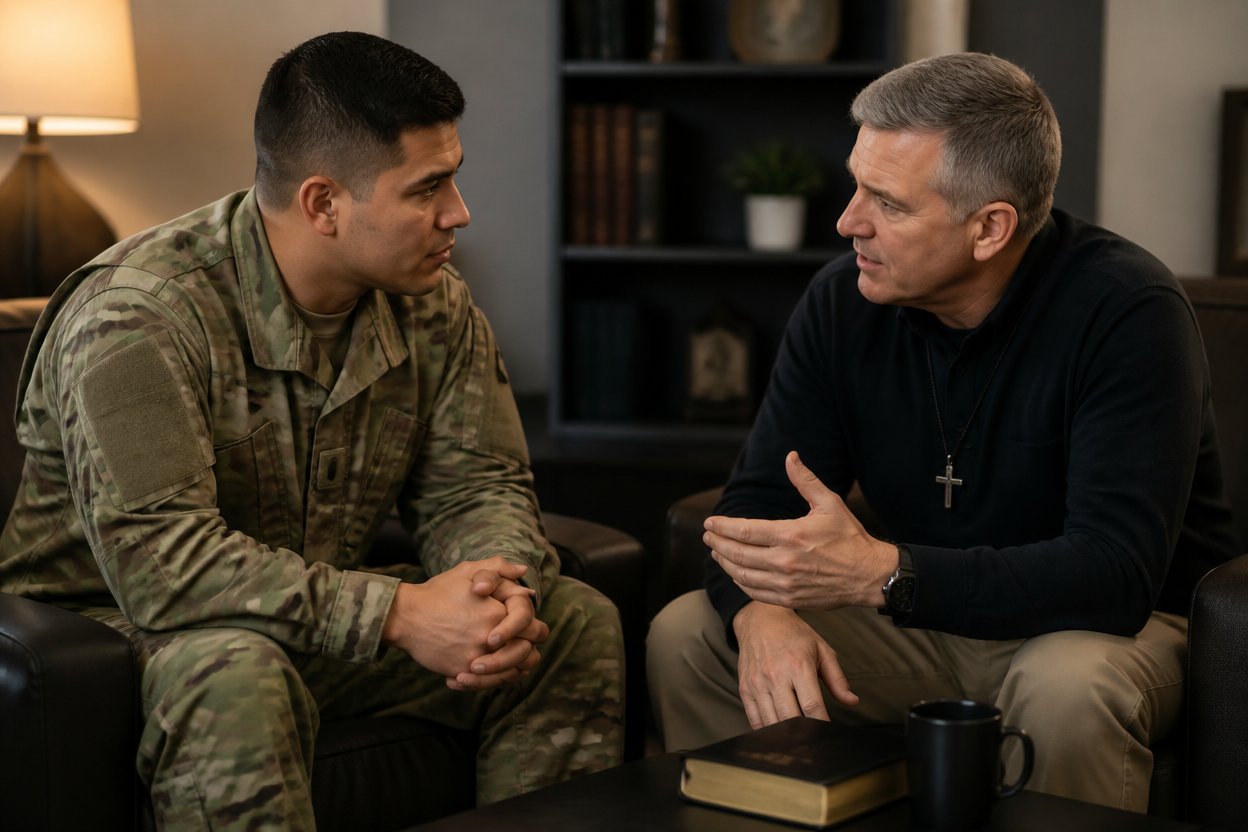
Service members confront moral injury, grief, fear, and isolation in concentrated forms. Many donors understand trauma in civilian settings, but military formation places unique demands on conscience: lethal force, rules of engagement, and the burden of leadership over lives. Chaplains are present in training pipelines, deployments, hospitals, and memorials. They are often the first to notice when spiritual distress is entangling with mental health risk, family breakdown, or disciplinary problems.
Some of the clearest data on military mental health underscores the stakes. The Department of Veterans Affairs reports that, on average, 17 veterans died by suicide per day in 2022, based on its national suicide data report (U.S. Department of Veterans Affairs). That statistic does not reduce ministry to crisis response, but it does remind us that pastoral care in military contexts regularly occurs near the edge of life and death. Chaplains are trained to coordinate within helping systems, including medical and behavioral health, while maintaining pastoral confidentiality within governing rules.
Family strain is part of readiness
Military outreach that ignores spouses and children will miss a central reality of service. Frequent moves, long separations, and reintegration after deployment reshape family life. The Department of Defense’s annual surveys consistently track these pressures and their relationship to retention and well-being (Military OneSource research and statistics). Chaplains, by role, often have visibility into family stressors and can connect ministries to appropriate support channels without turning families into “case studies.”
Donors should expect mature ministries to honor the fact that a service member’s spiritual life is not separable from marriage, parenting, and community stability. Chaplain partnerships help outreach ministries avoid an overly individualized model of discipleship that fails to account for the household.
Partnerships reduce common ministry risks in military settings
Coercion and perceived coercion are real dangers
Military hierarchy changes the ethical landscape. If a commanding officer invites troops to a religious event, even with good intent, subordinates may feel pressure to attend. Chaplains are trained to safeguard voluntariness and to advise commanders on how to support free exercise without coercion. Ministries that treat attendance numbers as the primary success metric can unintentionally contribute to these problems.
Chaplains can also protect ministries from missteps that undermine credibility. A well-meaning speaker who is unfamiliar with military culture can easily communicate contempt for leadership, dismiss the sacrifices of noncombat roles, or mishandle questions about violence and Christian ethics. Chaplains often provide the contextual guardrails that keep outreach faithful and wise.
Proselytism controversies harm the very people donors want to serve
Christians genuinely disagree about how to describe evangelism in government contexts, and not every controversy is evidence of bad faith. Still, the consequences of public missteps are rarely borne by outside ministries; they are borne by service members who must continue living and working in that unit. Chaplain partnership is not a guarantee against controversy, but it is a meaningful discipline: it places outreach under pastoral oversight by leaders who understand both constitutional constraints and the spiritual needs of the community.
For donors, a simple question is revealing: does the ministry have a pattern of working with chaplains and installation leadership, or does it narrate the chaplaincy as an obstacle to be overcome? The latter often signals a theology of ministry that prizes access over shepherding.
What donors should look for in chaplain partnered outreach
Healthy partnerships are structured, not informal
Not every chaplain partnership is substantive. Some are limited to a friendly introduction, while the ministry operates independently. Mature partnerships have clear roles, explicit permissions, and shared expectations about participant care. Across our verification work at Most Trusted, we observe that ministries with disciplined partnership practices tend to show the same discipline elsewhere: financial controls, board oversight, and transparent reporting. Those are not unrelated virtues; they reflect a consistent posture of accountability.
When donors explore Military Outreach Ministries, we recommend looking for evidence that chaplain engagement is normal rather than exceptional. The strongest ministries can describe how chaplains inform program design, how referral pathways work, and how the ministry handles situations involving high risk, confidentiality, or family safety.
A practical checklist donors can use
The following indicators are not exhaustive, but they are concrete signals of seriousness:
- Written memoranda of understanding or documented permissions for on-installation activities where applicable
- Clear policies on voluntariness, especially when commanders or unit leaders are present
- Training for staff and volunteers on military culture, trauma awareness, and boundaries
- Documented pathways for referral to chaplains, behavioral health, and family support services when needed
- Pastoral accountability that includes external ecclesial endorsement or oversight, not only internal enthusiasm
Donors should also ask how the ministry measures fruit. Attendance counts are not meaningless, but they are thin. A more credible approach includes evidence of sustained discipleship, appropriate follow-up, and respect for the service member’s unit obligations and family life.
How verification clarifies partnership claims
Trustworthy ministries can show their work
Military outreach often takes place behind necessary privacy and security constraints. That reality can make donors feel they must choose between secrecy and trust. The better approach is disciplined transparency: a ministry can protect personal identities and operational details while still providing verifiable evidence of governance, financial integrity, and program accountability.
Most Trusted exists to help donors give with confidence by evaluating ministries against The Most Trusted Standard, a 15-criteria framework spanning faith commitments, financial integrity, governance and leadership, and transparency and effectiveness. In military outreach, those categories matter in particular ways. A ministry’s doctrinal clarity affects how it handles pluralistic environments. Its financial controls affect how it manages events, travel, and restricted donations. Its governance affects whether leaders are accountable when something goes wrong. Its transparency affects whether donors can distinguish careful work from confident claims.
Partnership is not a substitute for integrity
It is possible for a ministry to cite chaplain relationships while still operating with weak internal controls or unclear spiritual care practices. Partnership is a positive sign, not a full audit. Donors should resist two equal errors: assuming that a chaplain’s presence guarantees quality, or assuming that any ministry outside the chaplaincy must be reckless. The responsible path is patient evaluation.
Within How Military Outreach Ministries Support Service Members, the more reliable pattern is ministries that can articulate their role with humility: complementing chaplaincy, not competing with it; serving under authority, not around it; and pursuing spiritual fruit that does not treat service members as a platform.
FAQs for Why chaplain partnerships matter for military outreach
Do chaplain partnerships limit evangelism?
They should limit coercion, not witness. Chaplain partnerships typically clarify what kinds of events are appropriate in particular settings and how to ensure that participation is voluntary. In many cases, working with chaplains strengthens evangelistic integrity because it keeps outreach aligned with pastoral care, consent, and the realities of military life.
What if a ministry says chaplains are hostile to the Gospel?
Some chaplains are not evangelical, and some command climates are resistant to overt Christian witness. Still, broad claims of hostility often substitute for careful evidence. Donors should ask for specifics: what policies were cited, what permissions were requested, what accommodations were offered, and whether the ministry sought counsel from endorsing bodies or installation leadership. A ministry that consistently depicts chaplains as adversaries may be signaling an approach to authority that is unwise for military settings.
Why partnerships remain central
Christian donors rightly want the Gospel to reach those who bear the weight of national defense. Chaplain partnerships matter because they locate that desire within pastoral accountability, lawful access, and ethical care for people who cannot easily walk away from spiritual pressure or public controversy. The ministries most worthy of support tend to treat chaplains not as gatekeepers to bypass, but as shepherds to honor—so that military outreach becomes not only possible, but trustworthy.



