
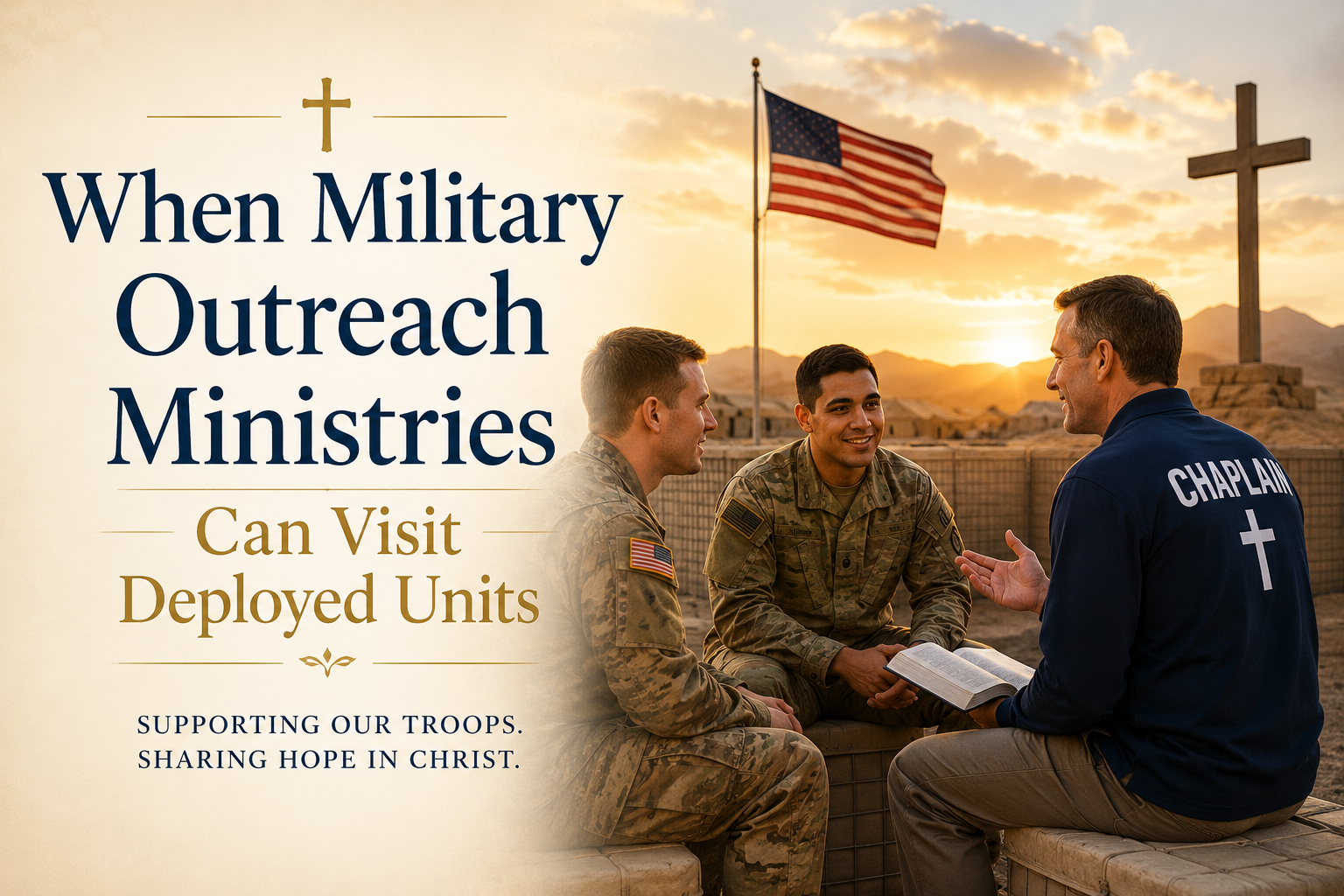
When military outreach ministries can visit deployed units is not primarily a question of convenience or enthusiasm. It is a question of lawful access, command approval, force protection, and pastoral prudence under operational conditions that can shift without warning. For Christian donors, the timing matters because access determines whether a ministry’s presence is a measured act of service—or an unhelpful burden placed on commanders and chaplains responsible for the unit’s welfare.
Deployed settings are not uniform. A training rotation in Europe, a ship at sea, a forward operating base, and a small advisory team in a partner nation all operate under different authorities and risks. The wise donor asks not only whether a visit is possible, but whether the ministry has earned credible permission, understands the chain of command, and can provide ministry that strengthens the unit without compromising security or creating avoidable friction.
Access is governed by command authority and chaplaincy coordination
In most deployments, access begins with the unit commander’s responsibility for mission and safety. Civilian visitors, guest speakers, and outside organizations generally do not “drop in” to deployed environments; they are requested, vetted, and scheduled. The military chaplaincy is typically the rightful point of integration for religious support, both to protect the free exercise of religion and to ensure that religious activities align with operational realities.
The chain of command is not a formality
Christian donors sometimes assume a ministry can visit a deployed unit in the same way a local church schedules a guest preacher. Deployed units operate under orders, not invitations. Even when a commander is personally supportive, the approval process may involve installation access rules, theater-specific policies, host-nation agreements, and background screening that is appropriately more stringent than stateside events.
Chaplains are gatekeepers for a reason
Chaplains carry legal and pastoral responsibilities in a pluralistic force. They also carry situational awareness about tempo, morale concerns, and risks that outsiders do not see. Ministries that respect chaplain coordination tend to provide more appropriate care: they arrive prepared, they avoid creating denominational pressure, and they serve those who ask for spiritual support without turning the deployment into a fundraising platform.
Operational security and force protection determine the feasible windows
The practical answer to when a visit can happen is often “when the operational environment allows it.” Force protection conditions, transportation assets, medical evacuation posture, and intelligence indicators affect travel approvals. Even if a ministry has relationships, a visit can be delayed, shortened, or canceled, and these decisions are not negotiable.
Security realities shape ministry opportunities
Deployed units routinely operate under information constraints. Visitor itineraries can expose patterns; social media posts can reveal locations. A well-meaning guest can become a liability if they do not understand OPSEC expectations. Donors should treat security discipline as a spiritual matter of love of neighbor: recklessness endangers the very people the ministry claims to serve.
Different deployment contexts have different access norms
Some settings allow for controlled access through established channels, such as base access programs, USO-style coordination, or vetted religious support teams. Other settings make in-person visitation effectively impossible. Maritime environments, small teams, and sensitive missions may rely on chaplains already embedded, secure communications, and care packages approved through command channels rather than outside visitors.

Healthy ministries plan with constraints and refuse to market access as entitlement
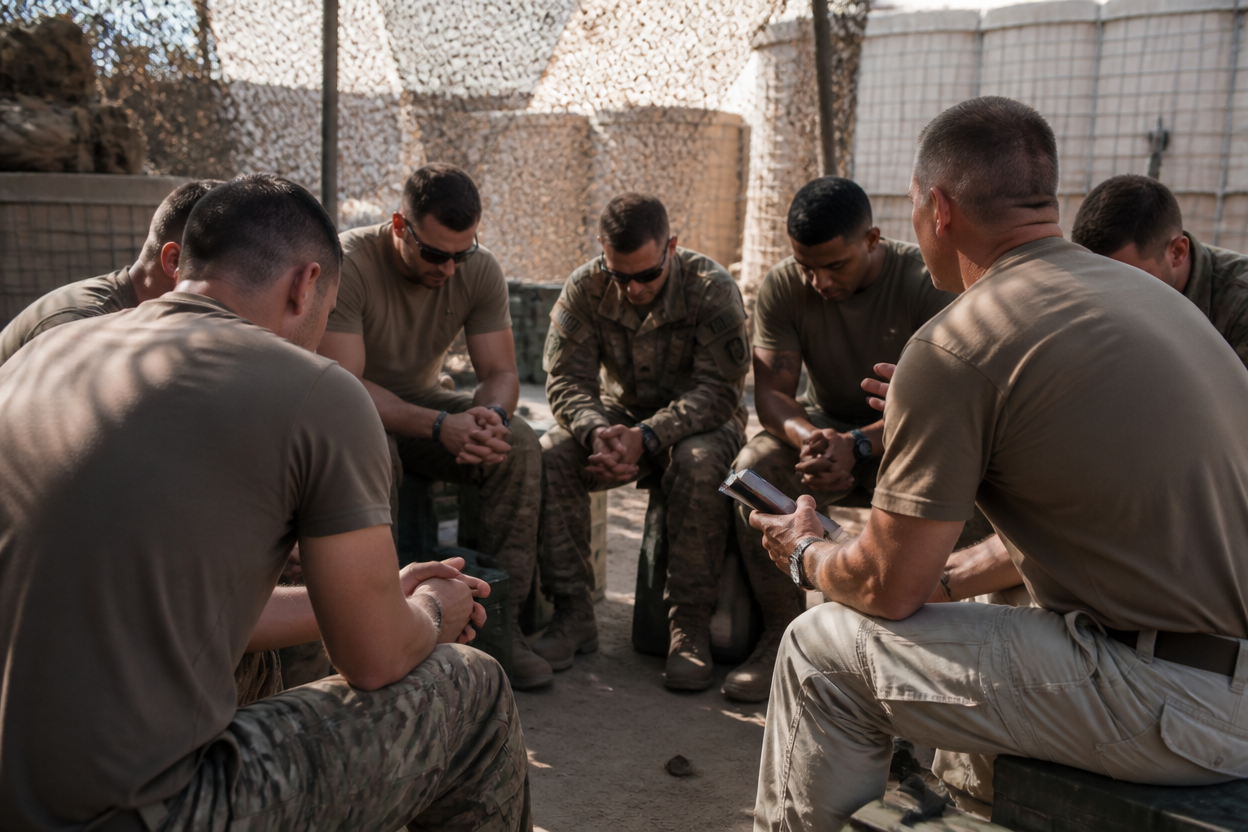
Many donors have read moving stories of Christmas services in desert chapels, worship gatherings on ship decks, or Bible studies in remote outposts. These accounts can be real and honorable. They can also romanticize a context where privacy is limited, trauma exposure is high, and the margin for disruption is thin. Mature military outreach ministries plan their work around constraints rather than pressuring leaders for special treatment.
The ethics of presence matters
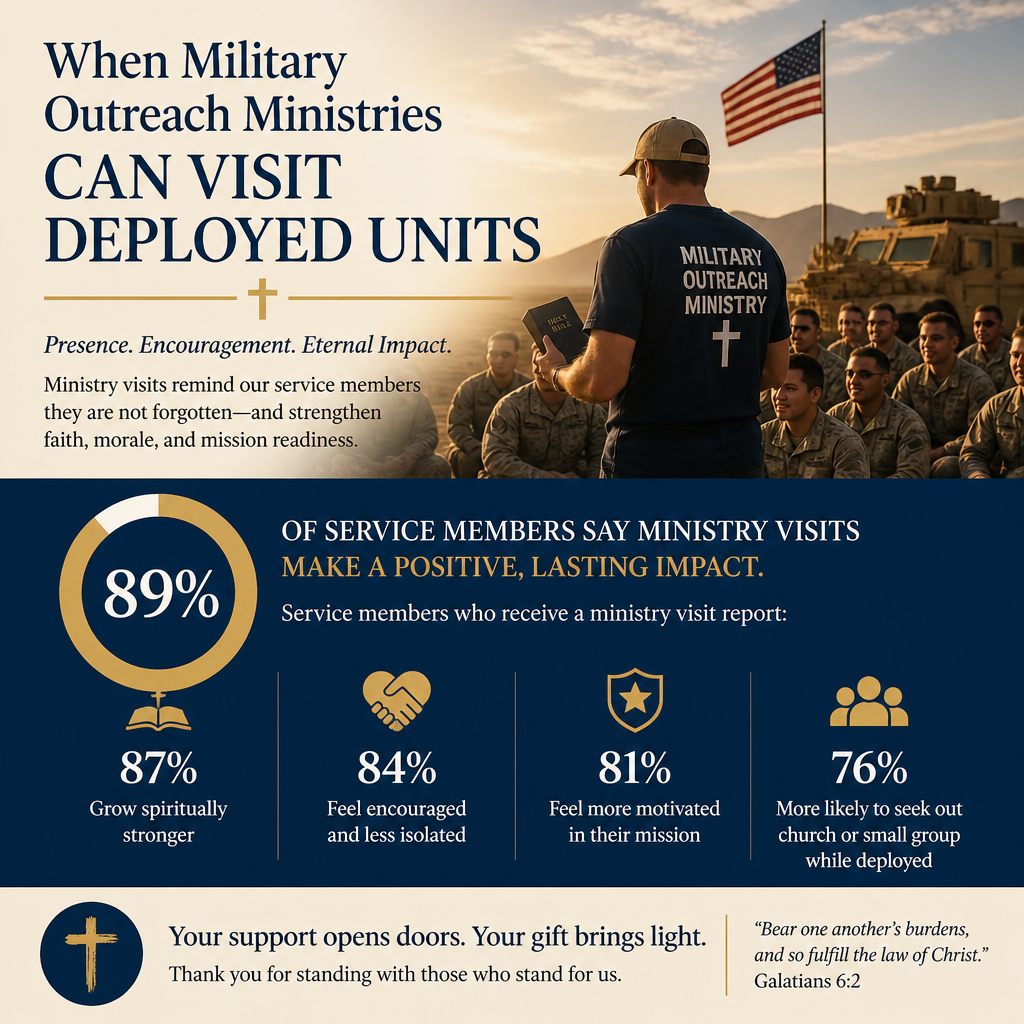
Christians genuinely disagree about how much outside ministry should be invited into deployed settings, especially when the local chaplain is already present. The wiser ministries do not posture as rescuers. They treat their role as supportive to the chaplain’s religious support plan and to the commander’s intent, aiming to strengthen existing care rather than supplant it.
Signals donors should pay attention to
Across our verification work at Most Trusted, the ministries most likely to meet The Most Trusted Standard tend to speak plainly about limitations. They describe their access process, they document permissions, and they show evidence of coordination with chaplains and commands. They also avoid using deployed images, unit insignia, or location details in ways that risk security or imply endorsement.
- Written confirmation of command or chaplain approval for any visit that required access
- Clear OPSEC and social media policies for staff and volunteers
- Training requirements appropriate to the environment, including cultural and pastoral care preparation
- Defined boundaries on proselytizing behavior in pluralistic settings
- Contingency plans for abrupt cancellation without financial or relational pressure on the unit
Donor discernment should integrate theology, stewardship, and measurable accountability
For Christian donors, deployed visitation is not a virtue in itself. The Christian moral question is whether the ministry’s actions embody faithful presence under authority, honoring those entrusted with the unit’s care. Scripture’s call to honor governing authorities (Romans 13:1) does not sanctify every policy choice, but it does require a posture that is not combative or self-authorizing. In military contexts, that posture is tested by the temptation to treat access as a badge of legitimacy.
Stewardship questions that separate seriousness from sentiment
When donors are moved by the needs of service members and their families, it is natural to prefer ministries that can “go there.” Yet an impressive travel footprint can mask weak governance or opaque reporting. The more prudent posture is to ask whether the organization can demonstrate appropriate financial controls, leadership oversight, and honest evaluation of outcomes. The U.S. Government Accountability Office has documented longstanding issues with DOD financial management and accountability challenges, underscoring why donors should not assume complexity equals excellence or that military-adjacent work is automatically well-controlled (U.S. Government Accountability Office).
What this means in practice is that donors should evaluate military outreach ministries the same way they would evaluate any other ministry with heightened risk: clear mission focus, qualified leadership, credible financial reporting, and a disciplined approach to safety. The “Overhead Myth” letter from major nonprofit evaluators has also cautioned donors against simplistic ratios and urged attention to governance, transparency, and results rather than a single expense percentage (Charity Navigator). Deployed visitation adds further complexity: travel costs, security compliance, and specialized training can be appropriate expenses when justified and well-documented.
How Most Trusted approaches military outreach verification
Most Trusted exists to help donors give with confidence by evaluating Christian nonprofits against The Most Trusted Standard, a 15-criteria framework spanning faith commitments, financial integrity, governance, and transparency. In military outreach contexts, we pay particular attention to documented authorization practices, safeguarding, and whether the organization’s communications respect service members’ privacy and security. A ministry can tell a compelling story and still fail basic tests of accountability.
Donors seeking broader context on the field can refer to How Military Outreach Ministries Support Service Members, where the focus is the range of legitimate models beyond deployed visitation. Ministries that serve families at home station, provide counseling, support chaplains, or fund emergency aid may have greater reach and lower risk than travel-heavy approaches, depending on the mission and discipline of the organization.
Practical timing scenarios and what donors should expect
Because deployed visitation depends on external approvals and changing conditions, donors should be cautious about claims that a ministry can visit “whenever needed.” The more credible claim is that the ministry is prepared to serve when invited and permitted, and that it will not override commanders’ decisions. In many cases, the best donor posture is to fund readiness and relationships rather than frequent trips.
Common windows when visits are more plausible
Without pretending uniformity across commands and theaters, several patterns recur. Visits tend to be more feasible when a unit is at a large, established base with structured access procedures; when a chaplain requests specific support for a defined event; or when the visit aligns with scheduled morale and welfare programming that has already been approved. Even then, visits are often restricted to certain areas and times, and visitors may be prohibited from photographing, publicizing, or interacting outside controlled settings.
When a visit is unlikely or unwise
High-tempo operations, small teams, or environments with heightened force protection often preclude civilian visitors. The same is true when the ministry cannot demonstrate the ability to comply with requirements around vetting, training, and communications. For donors, the key discernment is whether the ministry is mature enough to accept “no” without spiritualizing it as opposition, and whether it can redirect effort toward alternative forms of support that the unit can safely receive.
For further perspective on responsible models and the common boundaries ministries must respect, Military Outreach Ministries provides additional context for how these organizations should function within the realities of military life.
FAQs for When Military Outreach Ministries can visit deployed units
Do military outreach ministries need official permission to visit deployed units?
Yes. In deployed settings, access is governed by command authority and implemented through established processes that often involve chaplain coordination, force protection vetting, and theater-specific rules. Donors should expect a credible ministry to describe this plainly and to avoid implying entitlement to access.
Should donors prefer ministries that travel frequently to deployed locations?
Not necessarily. Frequent travel can be appropriate when justified and authorized, but it can also signal misplaced priorities or weak cost discipline. Donors should prioritize ministries that demonstrate lawful access practices, clear safeguarding and OPSEC policies, and transparent financial reporting consistent with The Most Trusted Standard.
A disciplined approach serves both the mission and the service member
When military outreach ministries can visit deployed units will remain contingent, not guaranteed. The faithful posture is not to demand access, but to serve under authority, with humility, and with careful attention to the safety and dignity of those deployed. Donors best honor service members when they fund ministries that can demonstrate permission, preparation, and accountability rather than ministries that trade on proximity to danger as proof of impact.



